
Egypt’s economy, recovering pre-war, now faces energy shocks, tourism fallout, export declines, and $10 billion in hot money outflows due to the Iran conflict. Cairo shows resilience via exchange-rate flexibility, renewable energy targets, and LNG imports. Gulf FDI may tighten.
Egypt Economic Resilience has become a vital topic of discussion following the recent geopolitical shocks in the Middle East. While the nation has faced significant hurdles, the framework of Egypt Economic Resilience allowed for a record-breaking tourism year in 2025. Experts argue that maintaining Egypt Economic Resilience requires a shift away from “hot money” toward sustainable long-term investment. Ultimately, the future of Egypt Economic Resilience depends on private sector expansion and energy diversification.
Macroeconomic Reforms and Egypt Economic Resilience
There is an Egyptian proverb that roughly translates to “he managed to clamber out of a hole, only to trip into a ditch.” It illustrates how overcoming any difficulty can be compounded by additional unforeseen problems.
In February of this year, the Egyptian government had been working on a bevy of macroeconomic reforms aimed at strengthening the economy, increasing resilience, attracting investment, and whittling away at the country’s prodigious debt. Inflation was at a low of 13.4%, down from a record high of 38% in September 2023.
The International Monetary Fund (IMF) had just completed its fifth and sixth reviews of a 2022 $8 billion loan, concluding that the macroeconomic situation had “improved amid sustained stabilization efforts. Tight monetary and fiscal policies together with exchange rate flexibility have helped restore macroeconomic stability, reduce inflation, and strengthen the external position.”
There were other wins, as well. Tourism, a major revenue earner for the country, brought in a record $24 billion in 2025, up from $15.3 billion the year before, and actually leading world recovery in this sector.
The Ministry of Finance managed to score a huge win in what has traditionally been something of an Achilles’ heel: taxation.
Due to innovative media outreach, tax incentives, a digital overhaul with mandatory e-invoicing and e-receipt systems, and a new, customer-friendly outlook, the Tax Authority raked in an additional 35% in revenue compared to the year before — the largest increase since 2005. And the country defied the broader downturn in African foreign direct investment (FDI), topping the continent’s receipts with $11 billion in inflows that year.
Geopolitical Shocks Challenging Egypt Economic Resilience
While Egypt is not in the direct line of fire in the US-Israeli war with Iran, its economy is acutely vulnerable to the conflict. In addition to the rising energy prices and shortages that have affected much of the world, it also struggled with issues that reflected its economy’s own underlying structural vulnerabilities.
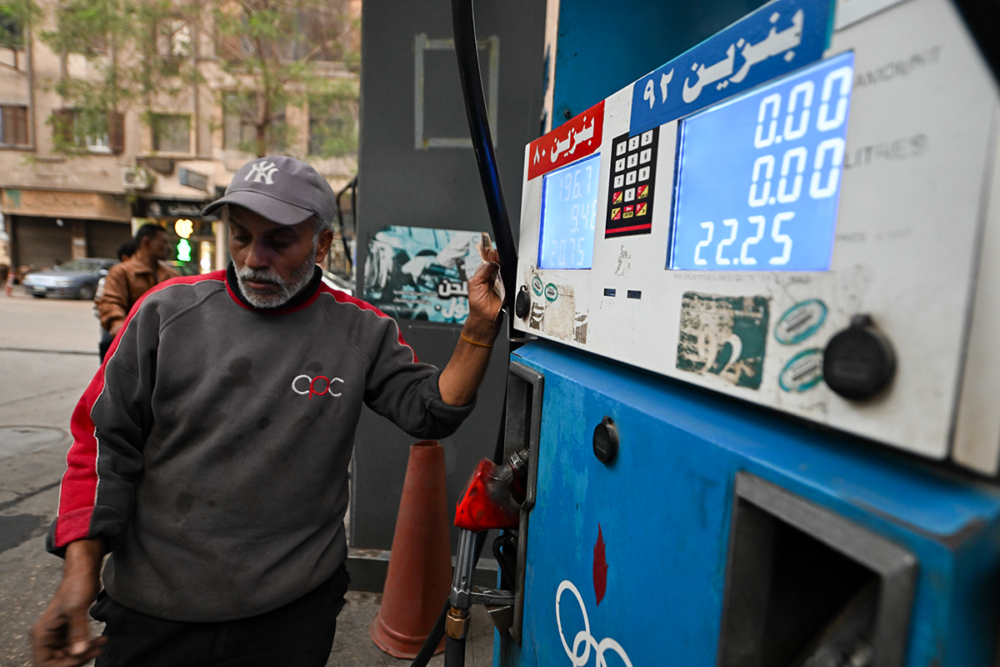
The first immediate blow was energy related. On March 10, Egyptian consumers woke to find that the Ministry of Petroleum’s Automatic Fuel Pricing Committee had raised prices for all fuel categories, between 15% and 22%, at 3 a.m. The increases were apparently announced immediately before they came into effect.
Although the government had promised not to raise fuel prices again for at least a year after the last price hike the previous October, the announcement cited “exceptional circumstances.” Egypt has hedging agreements to guard against force majeure, but those agreements only cover 60% of its import needs.
Iranian targeting of tanker traffic in the Strait of Hormuz disrupted international energy supplies, and Egypt was hardly alone in dealing with the impact.
However, protestations of a global crisis, no matter how reasonable, are largely irrelevant to a population already struggling with a reduced standard of living. The problem was further exacerbated by the fact that Israel, which provides 15-20% of Egypt’s natural gas, had shut down the Leviathan field on February 28 for fear of damage from Iranian attack, but in so doing halted the supply to Egypt.
In a further effort to reduce domestic energy use, and keenly aware of the potential for unrest were it to reinstate the rolling electricity blackouts of previous years during the energy-intensive summer months, the government instituted a mandatory closing time of 9 p.m. for all shops, restaurants and cafes, and malls on March 28. It was lifted on April 28 after serious complaints from commercial retailers.
Sectoral Impacts on Egypt Economic Resilience
The effects on the tourism sector are not yet clear, but the industry is expecting fallout. A March 2 State Department travel advisory for Egypt and more than a dozen other countries in the region, telling US citizens to leave immediately “due to serious safety risks,” did not help. Although it was replaced a few days later, on March 7, by one stating that Egypt was one of the safest countries in the region, industry practitioners said by then the damage had been done.
Exports also took a serious knock. Within days of the conflict, higher insurance and freight costs started slashing into revenue. According to Reuters, an internal briefing from the Ministry of Finance noted that “in the first two to three days of the war, export declarations were down by 77% compared with the same period the previous year. Export declarations for Saudi Arabia and the United Arab Emirates — which together account for more than a third of Egypt’s exports — were down by 83% and 90% respectively.”
The beleaguered Suez Canal is feeling the pain too. Although traffic through the canal had started to rebound at the beginning of this year, with revenues of $449 million in the first month or so of 2026, volumes dropped within the first few days of the conflict. Experts attribute the decline to escalating security risks and higher insurance premiums linked to the possibility of attacks by Yemen’s Houthis.
Hot Money and Vulnerable Egypt Economic Resilience
These losses pale, however, next to those accrued as a direct result of one of Egypt’s most dangerous, and most persistent, vulnerabilities: hot money.
Egypt has consistently sought to shore up its considerable budget deficit with short-term purchases of Egyptian treasury bills by non-resident investors. This type of capital is known as hot money because of the way it behaves — moving quickly into and out of markets to maximize returns.
Emerging markets are attractive to investors because they tend to have significantly higher interest rates than developed markets. Investors seek to strike a balance between acceptable risk and desired profit, and if the risk level rises too high, they pull the investment. Hot money invariably flees emerging economies for developed ones at the first sign of trouble — an issue Egypt has faced with tiresome regularity.
The last seriously disruptive episode was during Russia’s full-scale invasion of Ukraine in early 2022, when approximately $20 billion in hot money was pulled out of Egypt, hollowing out its reserves. In June 2022, then-Minister of Finance Mohamed Maait admitted Egypt had a problem with hot money:
The lesson we have learned (is that) you cannot depend on this type of investment,” he said. “It is coming just to get high yields, and once there is a shock, it leaves the country.” Four years and yet another crisis later, Egypt does not seem to be any wiser. While the lure of ostensibly easy foreign currency inflows can be difficult for any emerging economy to resist, Egypt has been burnt enough times to know that the costs can be prohibitive.
Strategic Energy Shifts for Egypt Economic Resilience
Egypt also appears to be attempting to deal strategically with its other major weakness: energy. While Israel resumed gas delivery as of early April, Egypt’s government is looking to acquire 40 liquified natural gas (LNG) cargoes over the next two months to tide the country over the summer period, when consumption spikes to around 15-20 cargoes per month on average.
Much of this LNG will come from US supplies. At the beginning of April, the Board of Directors of the Export-Import Bank of the United States (EXIM) approved more than $2 billion in export credit insurance to support US LNG shipments to Egypt. While it is great business for US exporters, it is also desirable US support for Egypt — helping to supply a vital commodity rather than a loan that further mires Egypt in debt.
That is quite a selling point for Cairo, considering that 64% of spending is earmarked for debt servicing in its new proposed budget.
Egypt is also pursuing two other tracks. The first is to accelerate its renewable energy targets, aiming to source 42% of its electricity generation from renewables by 2030, driven by massive solar and wind projects, including the 1,800-megawatt (MW) Benban Solar Park and various green hydrogen initiatives. As of 2025, 32 power purchase agreements (PPAs) have been signed with private developers to generate 1,465 MW of renewable energy.
The other track is driven by old-fashioned fossil fuels. Egypt is looking to buy the entire output of Cyprus’ Aphrodite gas field when it comes online in six years, while the Cronos gas field, also in Cyprus and developed by Eni and Total, could be online and supplying Egypt in less than two years.
Closer to home, Eni has discovered 2 trillion cubic feet of gas in Egypt’s own Temsah field. But until these resources come online, Egypt will have to continue to try to insulate itself against geopolitical uncertainty.
The Private Sector Role in Egypt Economic Resilience
It is a delicate situation for Cairo. The economy has always been the safety valve on the pressure keg that is Egypt’s political stability. Of course, one could argue that the stability of most nations is directly proportional to their economic prosperity; but in Egypt’s case, it is easy to draw a direct line.
Economic events led to political unrest in 1977, 2011, and 2013. And considering that Egypt’s economy has been through many crunches over the past few decades, successive governments have always been acutely conscious of avoiding a tipping point that is almost impossible to determine. Scaling back the state’s role in the economy is thus more than just a means of mollifying the IMF.
Egypt, the most populous country in the Middle East, sees a staggering 1.3 million entrants to the labor market annually, but only around 500,000 new jobs created. Considering that the private sector employs around 80% of the workforce, and contributes 75% of GDP to boot, divestiture seems like the safest path toward economic, and political, security. Egypt’s economy and security rises and falls with the ability, and the willingness, of the government to give the private sector the space to become the engine of growth.
The government also needs to be keenly aware that its relations with external donors have changed. The Gulf has for some years now been a source of FDI only, and even that avenue is likely to become more constrained in the face of the financial costs of the Iran war.
Egypt will have to work harder at attracting that FDI. The latest major funding package from the European Union was for 7.4 billion euros in 2024. Of that amount, 5 billion euros was in concessional loans, with 600 million in grants and 1 billion in investments. Egypt needs to aim for more investments rather than add to its debt.
As for the US, helping Egypt help itself is by far the best approach to shoring up stability. Encouraging private-sector development and trade expansion would be a vital aid. A $129 million investment in 2024, aimed at bolstering the private sector, advancing public education, and improving public health services, was an excellent example. Reducing trade barriers would be an even better one.
Egypt will still very much be buffeted by the economic shockwaves of the current conflict, but it is likely to weather them better this time around.