
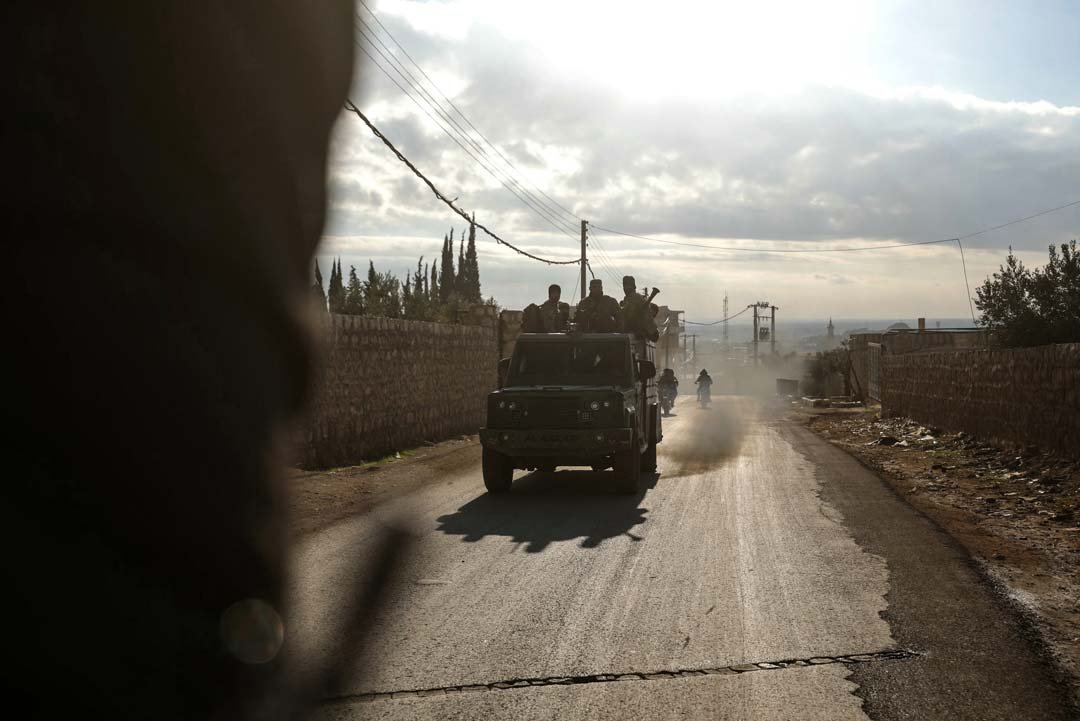
A high-level strategic brief evaluating the integration of 5,000 international militants into Syria’s military infrastructure. The analysis addresses domestic friction, state containment strategies, and foreign counter-terrorism policy dynamics.
The sudden collapse of the Assad regime left an unprecedented security vacuum that Damascus rapidly attempted to stabilize by absorbing thousands of non-Syrian militants directly into its official security apparatus.
This high-stakes consolidation strategy hinges entirely on the containment of Syria’s Foreign Legions, a move that provides the interim government with battle-hardened loyalists while simultaneously stoking deep domestic anxieties and intense international scrutiny. While the integration model has successfully prevented a mass exodus of these elements into transnational jihadist networks, maintaining the status quo threatens Syria’s broader international re-engagement if localized friction escapes state control. Ultimately, the durability of the post-Assad transition depends on the administration’s ability to systematically transition Syria’s Foreign Legions from autonomous, cohesive military blocs into tightly regulated, fully vetted state entities.
Syria’s Foreign Legions Face Integration Dilemmas
Some 5,000 foreign fighters who helped topple former President Bashar al-Assad’s regime are still under arms in Syria, presenting a lurking problem for the interim government led by President Ahmad al-Sharaa. In the heady days following Assad’s ouster in late 2024, Hei’at Tahrir al-Sham (HTS), the rebel group that had led the victorious charge into Damascus, had a matter of weeks to fill the security vacuum left by the regime’s collapse.
Part of its solution was to integrate the foreign fighters into its new armed forces. Most of these foreigners had first been drawn to Syria to join jihadist factions that were fighting the Assad regime alongside other rebels. Roughly two thirds of them are Uighurs from China, while the rest are non-Syrian Arabs, Central Asians or Europeans. The choice made sense at the time.
HTS was, in effect, employing non-Syrian militants to consolidate its rule and bring stability to the country, while placating them with respected positions in the post-Assad order. Yet for many Syrians and outsiders alike, it was unclear whether the foreign fighters were being leashed or unleashed.
The government’s approach has generated a host of anxieties, whether among Syrians who fear a fundamentalist regime in the making or international partners who worry that some within the foreign fighters’ ranks have transnational designs. Many of the government’s detractors view the decision to find useful employment for the fighters as indicating intent to transform Syria into an authoritarian Islamist state.
Events on the ground have deepened those concerns. During the spate of violence against Alawite civilians on the coast and Druze in Suweida in 2025, foreign fighters were implicated in incidents such as killings, looting, destruction of property and other acts intended to humiliate local people, though it should be said that Syrians perpetrated the bulk of the abuses.
Geopolitical Friction Involving Syria’s Foreign Legions
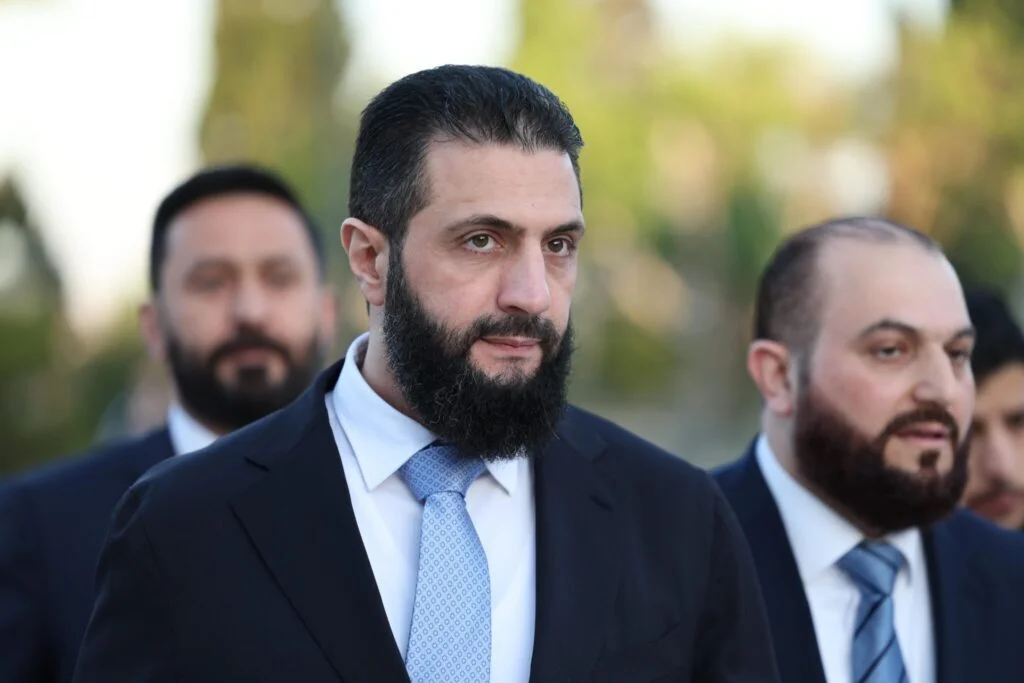
Syria’s foreign partners, for their part, have by and large given the government leeway to manage the fighters as it deems fit, but that is not to say their concerns have entirely dissipated. The U.S., China and other countries have been willing to establish ties with a government in Damascus that is in effect led by HTS, an armed group that split with al-Qaeda in 2016 to adopt a nationalist-Islamist agenda.
But many capitals remain wary of the foreign fighters, on the grounds that some may still have more hardline aspirations and seek to incite violence in their home countries. Officials from a number of Western and non-Western states, especially China, have made clear that government steps to ensure the foreigners pose no danger will be an important factor in their assessments of the new Syrian leadership.
For al-Sharaa’s government, meanwhile, the seventeen months that have passed since Assad’s fall have shifted the calculus considerably. The government has achieved broad international recognition. Damascus has extended its control to almost the entire country, including the formerly autonomous north east, where it has started incorporating the Kurdish-led Syrian Democratic Forces (SDF) into the central state apparatus.
In these circumstances, the foreign fighters’ value as a stabilising force appears to have diminished. But the authorities are in no hurry to dismiss the fighters, much less tell them to leave Syria. State officials fear that moving against these groups could push individual combatants toward ISIS or other jihadist outfits that oppose the post-Assad order. Damascus sees little reason to gamble on disrupting the present arrangements, in part because it sees the cost of keeping them to be low.
As a result, Damascus appears inclined to maintain the status quo for foreign fighters, at least for now. But, since Syria remains prone to unrest, continuing to rely on these battle-hardened combatants carries risks. They could become involved again in intercommunal violence, for instance, or get recruited by ISIS. Some of them run (or have influence over) schools and other educational facilities through which they could disseminate jihadist ideas. Damascus should consider measured reforms that reduce these hazards, while keeping the broader arrangement intact.
Why Military Cohesion Relies on Syria’s Foreign Legions
After it seized power in Damascus, the HTS leadership confronted the question of what to do with the foreign fighters, whose role in the long rebellion against Assad’s rule as members of a variety of insurgent groups had contributed to its success. Roughly two thirds of the foreign fighters belong to the Turkestan Islamic Party (TIP), a Uighur armed group that also maintains a small presence in Afghanistan under the Taliban.
The remainder include hundreds of Uzbeks, Azerbaijanis, Chechens, Arabs and citizens of Western European countries. Several of their now-defunct factions remain designated as terrorist organisations by the UN Security Council and Western governments for alleged association with al-Qaeda. The same is true of some of their commanders, even after the Security Council removed HTS itself from the sanctions list at the end of February.
There was no easy answer to the new rulers’ dilemma. Deporting the fighters was unworkable, because most countries of origin were refusing to take them back or threatening to prosecute them under counter-terrorism laws. No third country had offered them refuge. Nor was forcibly disarming them realistic, as it risked provoking violent resistance or pushing fighters toward the transnational jihadism with which HTS had broken. In addition, parts of the new government’s base might have reacted angrily if it had moved to sacrifice former brothers-in-arms. Yet leaving thousands of combat-ready fighters outside state control raised the spectre of undisciplined militias undermining the effort to rebuild Syria. These fighters’ dim economic prospects made a transition to civilian life unviable.
Contemplating this problem, HTS soon settled on the same strategy it had used in Idlib, the chunk of north-western Syria it controlled for the latter part of the civil war: it would contain the foreign fighters while using them, if need be, in battle. By 2020, HTS had forced all other factions in Idlib to accept the authority of its Military Operations Room.
Under this arrangement, foreign fighters participated in HTS-led combat, but command decisions remained the prerogative of HTS and other large Syrian factions, like Ahrar al-Sham and Faylaq al-Sham, which likewise were part of the Operations Room. HTS wound up benefiting greatly from the foreign fighters’ prowess and zeal, including during the final campaign that brought down Assad.
Syria’s Foreign Legions Structural Incorporation Methods
After December 2024, the new authorities scaled up the model nationwide, offering the foreign fighters (and non-HTS Syrian factions) a choice: join the new Syrian army, submitting to its hierarchy; or face arrest (or worse) if they refused to give up armed struggle independent of the military. The new government said it would punish any militant who defied orders or jeopardised its foreign relationships.
Damascus has kept its word. Most of the non-HTS factions, whether Syrian or foreign, including the TIP, were integrated into the regular army after they dissolved. Dissenters have paid the consequences. In January 2025, authorities swiftly jailed an Egyptian militant who had threatened President Abdel Fattah al-Sisi of Egypt, signalling that Syria would not be a platform to destabilise other states.
A senior Syrian interior ministry official told Crisis Group that the authorities have also moved against foreign fighter contingents that proved difficult to manage, for example placing a French group under tight restrictions, seizing its heavy weapons and bringing its camp under state control. The group Ansar al-Islam, mostly composed of Iraqi Kurds, nominally disbanded in January 2025, but its members rejected integration into the army, thereby becoming targets for the U.S.-led counter-ISIS coalition, whose airstrikes killed several of its leaders that September.
Integrating foreign fighters also served al-Sharaa’s narrower end of consolidating power among the former rebels. Some of the foreigners, like the TIP members, have a decade-long track record of mostly smooth cooperation with HTS and, crucially, limited options outside Syria. Hence, they are a more reliable reserve for the leadership than some of the Syrian ex-rebel factions, whose loyalty remains uncertain or untested.
In sum, bringing the foreign fighters under the new state’s watchful eye seemed safer than any of the alternatives. It also seemed like a step toward achieving stability in post-Assad Syria and shoring up the government’s power.
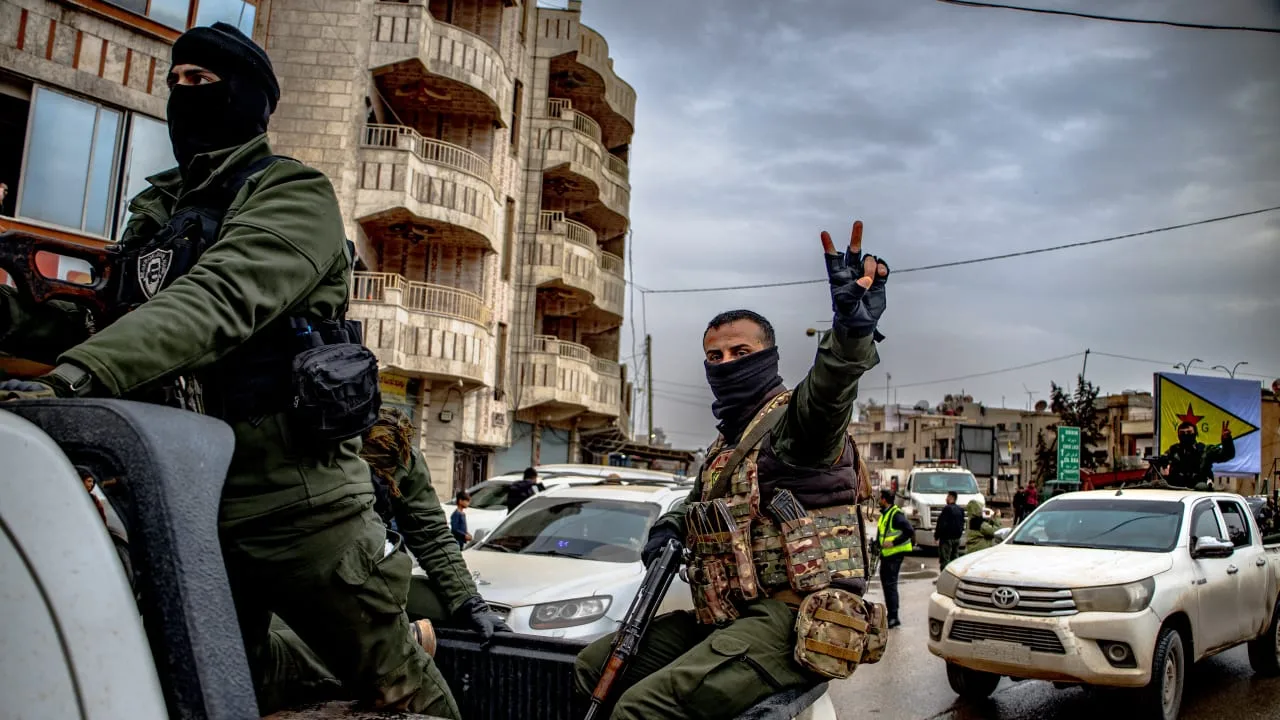
In applying the Idlib model on a national scale, the authorities have shown trust in the foreign fighters, all the more so given that, in many cases, their nominal merger into the army has not yet amounted to full integration. While all the ex-rebel factions, both Syrian and non-Syrian, dropped their own banners and donned army uniforms, many entered the new military as cohesive blocs, preserving their internal command structures.
The TIP, for instance, morphed into three brigades of the newly formed 84th Division under a TIP commander. Smaller groups likewise joined the army as newly created brigades within larger divisions, such as Ansar al-Tawhid, a mixed formation of Syrians and foreigners drawn largely from the former Jund al-Aqsa, which entered the 82nd Division deployed on the coast.
Security Realities Confronting Syria’s Foreign Legions Forces
Al-Sharaa has also awarded sensitive leadership roles to foreign commanders. He apparently has done so for a couple of reasons. In foreign-majority army units, like the 84th Division, keeping familiar commanders has helped preserve internal coherence and discipline. Other appointments reflect long track records of fighting alongside HTS in Idlib. For example, he named a Jordanian, Abdul Rahman Hussein al-Khatib (aka Abu al-Hussein al-Urduni), a central figure in the integration of non-HTS factions into the new army, as head of the Republican Guard, a Syrian formation that functions as a coup-proofing force; and a Turk, Omar Mohammed Jaftashi (aka Mukhtar al-Turki), as head of the Damascus Division, which is tasked with safeguarding the capital.
Meanwhile, foreign fighters seem to have bought into the Idlib model. Virtually all of them had already renounced jihadist goals outside Syria when they were still in Idlib before Assad’s fall. For TIP fighters, Syria seems to have become the priority, overshadowing their conflict with China. They say they accept rule by al-Sharaa’s government and will abide by its laws and instructions. Their children attend Syrian state schools and speak Arabic better than their native language, while also going to community schools and cultural centres that teach Uighur language and religious traditions. Their future looks to be integration into Syrian society, with some accommodation for Uighur culture.
So far, foreign fighters have largely complied with the government’s military directives as well, albeit to varying degrees. A senior Syrian interior ministry official told Crisis Group that most foreign fighter groups are manageable, mentioning the TIP as “more disciplined, structured and reliable” than others. Indeed, the TIP stands out for its strong command and control. For example, within 24 hours of Assad’s fall, TIP fighters had withdrawn from Damascus upon direct orders from al-Sharaa.
When the new government instructed armed groups to return properties they had seized in Idlib to returning families displaced elsewhere in Syria, TIP fighters promptly vacated homes even in areas where they had been living since 2014 (when they first began arriving in Syria). By contrast, some members of non-HTS Syrian factions with Turkish backing defied the same order, staying in Kurdish homes in Afrin that they had occupied in 2018 and charging returning families thousands of dollars to reclaim the dwellings.
A few groups, however, have proven harder to manage. The interior ministry official said in late April that the Uzbek contingents in particular “operate in fragmented, mafia-like ways and are difficult to control”. An episode in Idlib on 6 May underlined his point: when security forces detained a single Uzbek enlisted in the army who had been accused of unauthorised fire within the city limits, armed members of his unit surrounded their headquarters to demand his release. Security forces reasserted their authority only days later, when they arrested sixteen of the Uzbek demonstrators in a sweep of nearby towns.
Foreign states’ responses to Syria’s integration of foreign fighters vary but share a common thread: most view it with a strong dose of pragmatism, even as their concerns persist. The terrorist designations that remain in place have not deterred foreign governments and international bodies from engaging with the new Syrian authorities. In 2025, the U.S., UK, EU and UN all rolled back sanctions on HTS and its leaders, as well as sanctions on Syria itself. Most seem to accept that the government will corral any former rebel group that steps out of line.
Not all their worries have been erased, however. Some of Syria’s international partners fear that foreign fighters who have the new state’s protection could use Syrian territory as a base for attacks abroad or recruitment. Others object on principle to integrating UN-designated terrorist organisations and individuals into a recognised government’s armed forces because of the precedent it sets. A third concern, shared by many Syrians, is the schools, cultural centres and religious establishments tied to the foreign fighters, which in theory could pass down jihadist ideas to a new generation. Idlib is home to roughly 30 Uighur cultural centres with educational programs that run largely outside state oversight. Some reportedly combine religious instruction with military training.
Perhaps reflecting these uncertainties, governments have not always been entirely consistent in how they have dealt with the foreign fighter issue. The U.S. is a case in point. When President Donald Trump met al-Sharaa in Riyadh in May 2025, he made the removal of all “foreign terrorists” from Syria the second of five priorities, albeit without defining that term or laying out a timeline. Only a month later, however, Trump’s envoy Tom Barrack seemingly approved of forming the 84th Division, composed almost entirely of TIP fighters, provided it was done “transparently”. The administration thus seemed to indicate that merging non-Syrian militants into the army was an acceptable interim solution.
The U.S. Congress has taken a more sceptical view. In December 2025, while repealing the 2019 Caesar Act, which imposed secondary sanctions on the Assad regime and entities supporting it, lawmakers introduced a requirement that the White House certify every 180 days for four years that Damascus is “taking steps to remove foreign fighters from the Syrian government”. The law does not have a snapback mechanism – a way for legislators to reimpose sanctions if they find the Syrian government’s efforts wanting – but it does expose Damascus to congressional scrutiny on this issue. It also builds in recurrent opportunities for critics to argue that the Syrian authorities have fallen short.
China was the last holdout on rehabilitating HTS and, until recently, the most vocal critic of the integration of foreign fighters among the major powers. For Beijing, the TIP is an extension of the East Turkestan Islamic Movement, which it views as posing a separatist threat in China’s Xinjiang region.
It was displeased when Damascus gave the TIP a place in its new security apparatus. China signalled its unease by abstaining – a lone abstention it typically seeks to avoid – on UN Security Council Resolution 2799 on 6 November 2025, which lifted UN sanctions on al-Sharaa and Interior Minister Anas Khattab, though not on HTS as an organisation. Syrian Foreign Minister Asaad al-Shaibani visited Beijing that same month, where he pledged that Syrian territory would not be used to threaten Chinese security, and opened negotiations that picked up pace early in 2026.
On 27 February, following a month of talks in which Damascus provided counter-terrorism guarantees, China dropped its objection to delisting HTS, upon which the UN 1267 Sanctions Committee removed HTS from the UN list by consensus, thereby ending the last multilateral terrorist designation on the organisation.
Elsewhere, the weight placed on the issue varies. Among European states, France and others have flagged cooperation on the foreign fighter file as a priority in their engagement with Damascus, while showing little inclination to repatriate their own nationals. Russia, despite its citizens making up a large share of the foreign fighters in Syria, seems to have raised the issue only as a secondary concern in counter-terrorism talks.
Many Syrians tend to have a less sanguine view of foreign fighters and were alarmed to see them retain their arms after the Damascus takeover. For many secular Syrians, and for members of minorities that have borne the brunt of violence following the Assad regime’s demise, the foreign fighters embody an authoritarian Islamist drift they fear under the al-Sharaa government. The new Syrian authorities have been slow to address these concerns, which are not unfounded.
A general concern that goes beyond the narrow issue of foreign fighters is the structure of the reconstituted security sector. The new armed forces draw heavily on personnel with backgrounds in rebel factions, HTS and non-HTS alike, that embraced aspects of jihadist ideology at some point before 2024.
Tens of thousands of former fighters, both Syrians as well as foreigners, have been absorbed into the rapidly expanding security sector, with only limited vetting. Former combatants, including members of hard-line factions, have since been dispersed across a nationwide security apparatus without the level of oversight HTS exercised in Idlib. As a Syrian counter-terrorism officer told Crisis Group, foreign fighters are often more restrained than Syrians because they have nowhere else to go.
Experience has already shown that it is difficult to know if a given person has renounced or still clings to jihadist ideals. In the December 2025 Palmyra attack, three U.S. military personnel working alongside Syrian government forces were killed by a Syrian member of the national security services with suspected ties to ISIS. The incident showed the dangers that can arise when members of a security apparatus built largely out of rebel combatants go rogue. Coming a month after al-Sharaa signed a cooperation agreement at the White House, the attack sharpened the debate in Washington about the risks of patrolling alongside Syrian government troops.
ISIS’s intensified recruitment campaign since Assad’s fall compounds this risk. The group portrays al-Sharaa’s pragmatic governance and Syria’s participation in the anti-ISIS coalition as heretical. Though it is unclear how much this message resonates with new Syrian soldiers, it has sown fears of infiltration of state institutions, defections to ISIS by fighters integrated into the army and lone wolf attacks.
The odds of defections to ISIS may increase if it appears that Damascus is cracking down on foreign fighters or offering them up to governments likely to treat them harshly. Small-scale ISIS attacks pose no threat to al-Sharaa’s rule, but the symbolic dimension matters: while Syrian-on-Syrian strife and violence by foreign fighters are both legacies of the civil war, the latter carries a much heavier political charge. It feeds the politically toxic argument that Syria’s new leadership privileges its wartime jihadist allies over the security of ordinary citizens.
Indeed, foreign fighters have already taken part in violence against Syrian civilians. The participation of foreign fighters in suppressing the Assad loyalist insurrection on the coast in March 2025, as well as the Druze uprising in Suweida that July, has thrown the problem of integration into the armed forces into sharp relief.
While Syrians perpetrated most of the atrocities, the UN’s commission of inquiry documented that foreign fighters were involved in abuses against Alawite civilians on the coast and Druze civilians in Suweida. The takeaway for many Syrians was that the transitional authorities have yet to fully break with their jihadist and sectarian past. Army discipline has since improved, as demonstrated in January when Damascus seized the former SDF-held areas in Aleppo and the north east with significantly less harm to civilians. But perceptions linger of the army as an unruly mass of elements that bear an animus toward religious minorities.
Damascus has limited choices in dealing with foreign fighters and, for now, little incentive to change its approach given the stability it seems to have reinforced. Yet the status quo nevertheless entails risks. Incidents involving foreign fighters, should they recur, would likely come freighted with outsized symbolic weight, fuelling fears of Islamist drift among many Syrians while giving critics abroad reason to question the direction of the post-Assad transition.
Foreign fighters’ participation in violent episodes highlight the flaws of the current model of integration. Other capitals, particularly Washington, Beijing and those in Europe, should continue to urge the Syrian government to adopt measures that reduce the risk of defections or security threats involving these fighters without undoing the framework that has, so far, kept them largely under control. Precisely because security has improved, Damascus now has space to take careful steps. First, it should distinguish between command roles that serve military effectiveness and those based merely on loyalty.
Retaining foreign commanders in foreign-majority units such as the 84th Division can be justified on operational grounds, but in Syrian-majority and particularly sensitive units, such as the Damascus Division or posts within the General Staff, foreigners should eventually be replaced with trusted Syrians. Non-Syrians could instead be reassigned to operational roles within foreign-majority units, where their standing among fighters remains an asset and they do not incur the liabilities that come from commanding Syrian personnel.
Secondly, the authorities should take further measures to ensure that Syrian territory will not be used for planning operations outside the country, for example by expanding communication channels for counter-terrorism inquiries from abroad. It should continue to take firm action against individual fighters, foreign or Syrian, who violate the rules.
Thirdly, to address concerns about jihadist ideology spreading to a new generation, Damascus could bring civilian institutions linked to foreign fighters under direct state oversight. Transferring TIP-run schools and cultural centres to the education ministry and other appropriate state institutions, with requirements for curriculum alignment and removal of military training components, would extend state authority while preserving communal life for Uighur families in Syria. TIP leaders have indicated willingness to accept such an arrangement. The government’s push to unify curricula throughout Syria already provides an institutional framework for such a move.
Fourthly, Damascus could reform the nationality law to allow Syrian women to confer citizenship upon their foreign spouses and children, a right currently reserved for men. This reform would address a longstanding problem of gender discrimination. As a side effect, it would also open a legal pathway for naturalising the considerable number of foreign fighters who have married Syrian women, or at least their children, provided they undergo proper vetting and demobilisation (except for those already integrated into the army, who would still face vetting but for whom continued service substitutes for demobilisation). This approach would pose far less risk of antagonising the public than handing out passports as a reward for wartime service.
Over the longer term, the authorities should gradually dilute foreign military formations and integrate individuals into mixed units as security continues to improve, with broader demobilisation or civilian reintegration as a later objective. With incremental steps by Damascus and calibrated expectations from its partners, the foreign fighter question need not become a major obstacle to Syria’s broader international re-engagement.