
A strategic breakdown of how Yemeni forces closed the Bab al-Mandab strait, disrupting Saudi Arabia’s Red Sea oil trade routes, threatening regional energy security, and driving up global oil prices amid wider Persian Gulf economic instability.
The strategic maritime passageway of Bab al-Mandab has rapidly emerged as the latest regional focal point following new enforcement actions by local forces. As commercial shipping operators re-evaluate maritime routes connecting the Indian Ocean to European markets, the escalating friction along this key transit zone threatens to further strain global supply chains and regional oil distribution networks.
Bab al-Mandab emerges as critical trade chokepoint
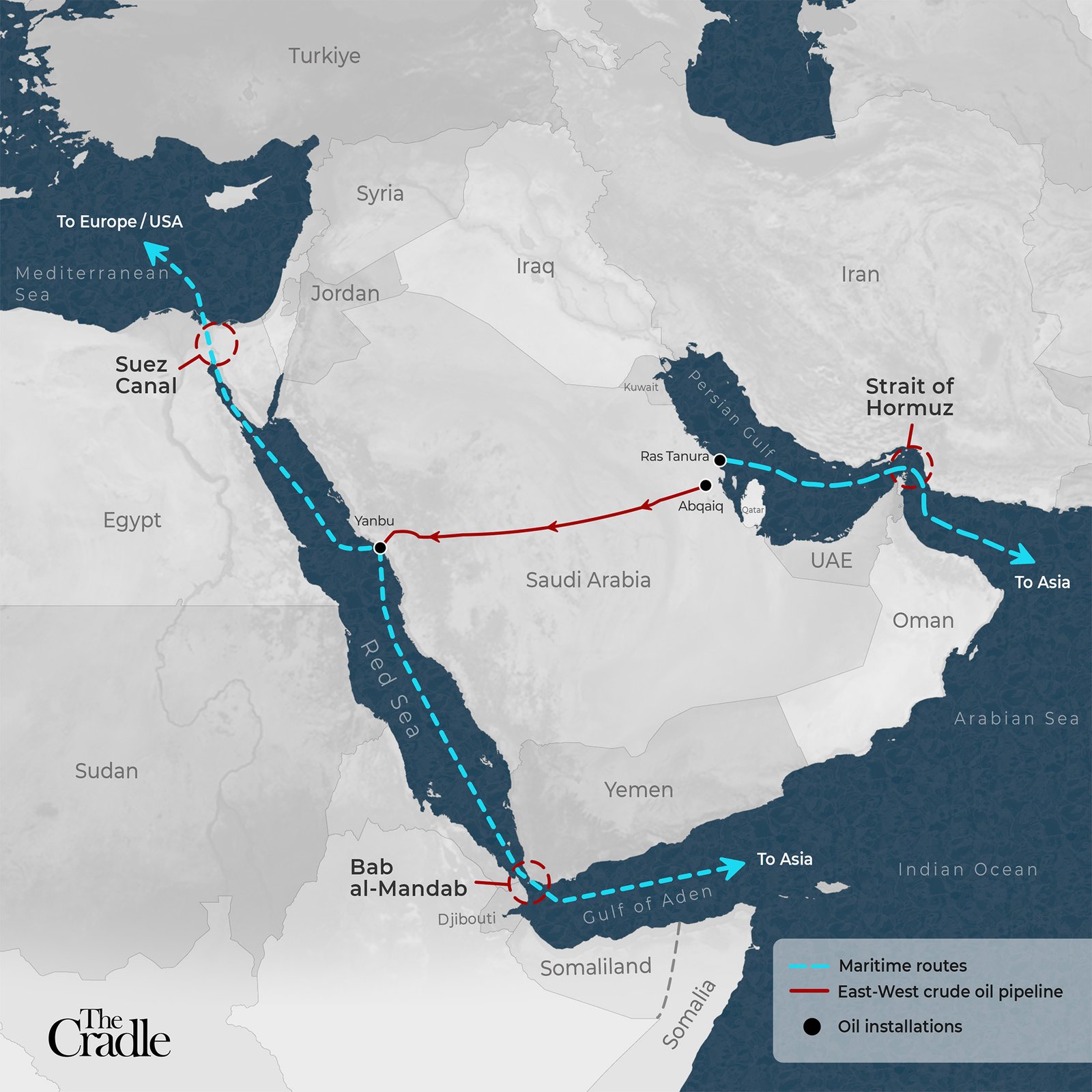
As global attention remains fixed on the Strait of Hormuz, another chokepoint is being disrupted: Bab al-Mandab. Located between the Red Sea and the Gulf of Aden, and squeezed between Djibouti and Yemen, the strait carries 12 percent of global trade and one-quarter of container traffic toward the Suez Canal and the Indian Ocean.
With Saudi Arabia diverting oil from the Persian Gulf to the Red Sea, its closure would be an economic catastrophe for the world. That prospect was only hypothetical until this week, when the Ansarallah-led Yemeni Armed Forces (YAF) announced a naval blockade against Saudi Arabia.
Bab al-Mandab – Arabic for “Gate of Tears” – has earned its reputation as a perilous waterway. Sanaa entered the war in October 2023 with missile and drone attacks on Israel, before imposing a blockade on Israeli-linked shipping the following month in retaliation for the genocide in Gaza.
The blockade only partially ended in 2025 after the US backed down, agreeing to stop attacking Yemen in exchange for safe passage. Last week, Saudi Arabia shattered the de facto ceasefire that had largely held since 2022, striking Sanaa International Airport for the first time in years.
As it demonstrated in 2023, Yemen has the means to enforce such a blockade. Despite being one of the world’s poorest countries, it needs to seize or strike only a few ships to deter vessels from entering the waterway. Even if Riyadh retaliates, Yemen, like Iran, will endure. Saudi Arabia and the global economy may not.
Historical significance of Red Sea shipping routes
Bab al-Mandab’s role in global trade has fluctuated. Until 2023, it was one of the world’s busiest chokepoints. The waterway is so important that tiny Djibouti hosts between eight and 11 foreign military bases, established largely to protect vessels operating in the area.
But in 2023, ships began avoiding the strait after Sanaa launched its Red Sea blockade. Although the blockade targeted Israel, shipping companies across the sector faced higher insurance premiums and opted for the much longer route around South Africa.
Traffic through this crucial corridor did not immediately recover even after the blockade ended. By December 2025, it remained 56 percent below pre-blockade levels.
When Iran seized control of the Strait of Hormuz, Bab al-Mandab grew more active again. With Saudi oil unable to pass through the Persian Gulf, the East–West Pipeline carried it to the Red Sea. Oil shipments through Bab al-Mandab have consequently risen by 60 percent since the war on Iran began, while Saudi exports from the Red Sea reached a record high.
This was not only a relief for Riyadh, but for the global economy. Around 20 percent of the world’s oil has been unable to cross the Strait of Hormuz. By comparison, the 1973 OPEC crisis removed seven percent of global oil supplies from the market. With the East-West Pipeline able to transport 7 million barrels a day (bpd), an equivalent seven percent is still reaching the market through the Red Sea outlet. An energy crisis remains likely, but this route has delayed its full impact.
Escalating tensions around the Gate of Tears
On 3 July, a Mahan Air aircraft landed in Sanaa carrying more than 200 Yemeni passengers, including patients and others stranded abroad – the first Iranian flight to reach the capital in 11 years.
The aircraft later departed for Tehran with an official Yemeni delegation attending the funeral of late Iranian Supreme Leader Ayatollah Ali Khamenei, cutting through an air blockade that had kept Sanaa’s international connections tightly restricted since the 2022 truce.
On 13 July, the aircraft attempted to return the delegation to Sanaa. It was forced to divert to Hodeidah after Saudi Arabia bombed Sanaa International Airport. Yet Saudi Arabia had already blockaded Yemen for a decade, contributing to the deaths by starvation of 85,000 children. The YAF responded on an “eye for an eye” basis, imposing a maritime blockade on Saudi Arabia.
Sanaa is fully capable of enforcing it. Two months after the 2023 blockade began, Israeli shipping in the Red Sea had fallen by 85 percent; by early 2024, it had ceased entirely. Israel’s only Red Sea port, Eilat, entered bankruptcy a year later.
All this was achieved after the YAF seized just two Israeli-linked ships. The threat itself deterred vessels whose operators faced higher insurance premiums and were unwilling to risk valuable cargo or the ships themselves.
The impact extended beyond Israeli shipping. Suez Canal transits fell by 42 percent, while container tonnage dropped by 82 percent. Traffic was redirected around the tip of South Africa – a longer journey, but a far less risky one.
Impact on Bab al-Mandab energy flows
Saudi oil loadings at Red Sea ports have already fallen by 36 percent since Ansarallah’s threat, and ships are turning away from Bab al-Mandab. The disruption may therefore resemble the previous blockade, although important differences remain.
Israel retained access to the Mediterranean, while other countries could reroute around Africa. Saudi Arabia has no comparable alternative, as all its oil must leave through either the Persian Gulf or the Red Sea. With Iran in full control of the Strait of Hormuz, Riyadh has little choice but to keep the Red Sea route operating.
Some vessels may avoid Bab al-Mandab by sailing north through the Suez Canal. Since half of Saudi oil exports travel to Asia, however, this would greatly lengthen their journeys. Very Large Crude Carriers (VLCCs) also cannot transit the canal.
Some oil could be offloaded into Egypt’s Sumed Pipeline, but its capacity of 2.5 million bpd amounts to only one-third of the Saudi oil arriving at the Red Sea and must be shared with other exporters. The YAF’s ability to strike as far north as Israel also means that ships heading toward Suez cannot be guaranteed safe passage. Even so, reducing Saudi Red Sea shipping to zero, as Sanaa did with Israeli traffic, may prove difficult.
The YAF could also expand its blockade to other countries, as it did in the previous campaign. The practical effect is debatable, since higher insurance premiums may already deter non-Saudi vessels. During the earlier blockade, adding US and British ships to the target list did little to accelerate the decline in traffic.

Economic strain on regional energy supply lines
Regardless of which ships are targeted, the energy and economic effects are catastrophic. On top of the massive oil disruption in the Persian Gulf, the closure of the Bab al-Mandab would cause oil supplies to fall a further seven percent, the same amount as the 1973 OPEC crisis. According to John Paisie, president of consultancy group Stratas Advisors, oil could go above $120 a barrel.
Analysts have yet to provide exact figures on the economic impact, but have given dire warnings. “If the Houthis were to simultaneously disrupt shipping in the Bab al-Mandab Strait, the consequences would be disastrous,” stated Chatham House. The Bab al-Mandab closure would be an economic “catastrophe,” according to Clemens Chay, senior fellow for geopolitics at the Observer Research Foundation Middle East.
It is worth noting the global economy was already weak with the closure of the Strait of Hormuz. Back in May, consulting group Wood Mackenzie stated that if the Strait remains closed until September, the world will enter into a recession. The closure of the Bab al-Mandab will only make this worse. The lifeline for oil will be cut. Twelve percent of global trade will be disrupted.
As for Persian Gulf states, the impact will be devastating. Already, things were dire. A Reuters poll of economists, conducted days before Bab al-Mandab’s closure, projected Bahrain’s economy would contract by 5.1 percent, and Kuwait and Qatar down 8.1 percent.
Meanwhile, “Saudi Arabia and Oman are the only GCC economies still expected to expand this year, as Saudi can move oil via its East-West Pipeline to the Red Sea,” the report noted. But now, with Saudi Arabia unable to maximize its use of the Red Sea, it can expect to join the other Gulf states. They also depended on Saudi Arabia’s Red Sea access to move basic necessities overland into their countries. That supply line will now become increasingly difficult to sustain.
Diplomatic choices facing strategic decision makers
Given the scale of the economic damage now confronting the kingdom and its already limited alternatives, Saudi Arabia is likely to respond harshly against Yemen. Its Yemeni proxy, the Presidential Leadership Council (PLC), is stronger than ever after the defeat of the UAE-backed Southern Transitional Council (STC).
But while Saudi Arabia can inflict a heavy toll on Yemen, it cannot defeat the Ansarallah-aligned army. A decade of sustained attacks and punishing blockades has failed to weaken the Yemeni resistance or force it into submission. The US campaign against the country also ended in defeat, with Washington signing a “ceasefire” – in reality, a surrender – in May 2025.
Yemen can impose severe costs in return. A single drone or missile strike on the East–West Pipeline could send Saudi Arabia’s oil-diversion strategy up in smoke. Repeated attacks on port cities such as Yanbu, which handles 75 percent of oil exports, or on a major hub such as King Khalid International Airport could also disrupt commerce.
Saudi Arabia could, of course, lift its blockade, prompting Sanaa to do the same. But Riyadh would view this as surrender and is unlikely to accept it readily. Conflict is therefore increasingly difficult to avoid. Yet Yemen does not stand alone at the edge of the precipice. Saudi Arabia, the Persian Gulf states, and the global economy are there with it.