

The Lebanon-Israel framework trades sovereign agency for vague commitments, embedding normalisation triggers while Lebanon’s state lacks enforcement capacity. This flawed bargain grants Israel perpetual leverage without accountability.
The Lebanon-Israel framework announced Friday evening represents a fundamental concession of sovereign agency disguised as diplomatic progress, with the extracted Lebanon-Israel framework itself functioning less as a technical military disengagement and more as a political on-ramp toward normalisation. This Lebanon-Israel framework transforms a border dispute into a binding political commitment that exceeds the mandate of any Lebanese delegation, embedding obligations that the Lebanese state lacks the institutional capacity to enforce while granting Israel perpetual leverage without reciprocal accountability.
Lebanon-Israel framework binds Lebanese sovereignty
No one expected the Lebanese-Israeli negotiations in Washington, hosted by the US State Department, to produce a good agreement. Those of us considered moderates, without crossing into an endorsement of normalisation, might have accepted a painful bargain if it spared Lebanon, and large numbers of Lebanese civilians, from Israel’s daily violence.
But the agreement announced Friday evening is not merely bad. It is worse than the bad agreement many were prepared to tolerate. It crosses from the realm of the regrettable into the realm of the intolerable.
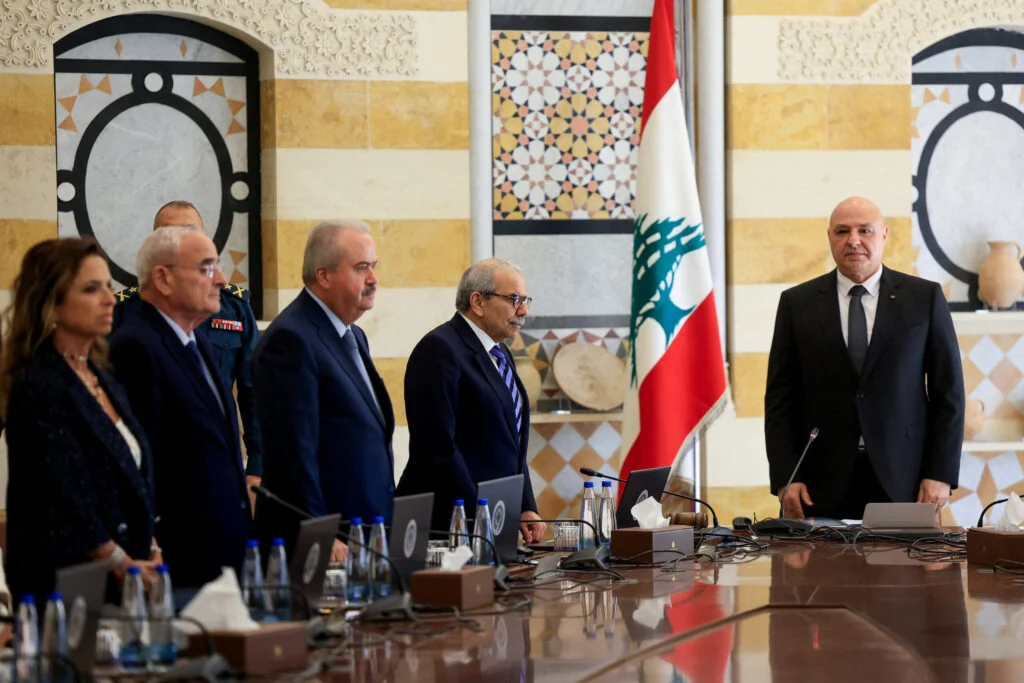
The document, described as a framework agreement, contains language that plainly moves Lebanon toward “ending the conflict” with Israel. It is therefore not alarmist to say that this agreement looks less like a technical arrangement than a political threshold: perhaps to a peace treaty, perhaps to a non-aggression pact, or perhaps to a photograph next month of President Joseph Aoun standing beside Benjamin Netanyahu, the prime minister of the occupying state, under Donald Trump’s patronage at the White House.
Lebanon’s fragile Lebanon-Israel framework paradox
One hopes that this reading proves too pessimistic. But hope is not policy, and unease is not paranoia. The text itself gives ample reason for concern. Its implications could drag Lebanon toward precisely the internal strife that Parliament Speaker Nabih Berri has warned against, and rightly so.
If reports are accurate that the US negotiating team pressured the Lebanese delegation to accept the framework as drafted, while merely noting Lebanese reservations over the so-called pilot areas, Israel’s triumphant reaction to the agreement only deepens the suspicion. So does the gap between the document’s language and the official Lebanese celebration of sovereignty.
In the statements of President Aoun and Prime Minister Nawaf Salam, sovereignty is invoked so frequently that it begins to sound like political poetry: stirring in the moment, but gone almost as soon as it is heard.
A Lebanon-Israel framework that cannot hold
This is not an argument for impugning the patriotism of Mr Aoun, Mr Salam, their aides or the Lebanese government. Criticism of their conduct should not become an accusation of treason. Lebanon’s leaders are operating under immense pressure, with a weakened state, a ravaged economy and an adversary that has repeatedly shown contempt for international law.
But that reality makes the questions more urgent, not less.
Lebanon’s Versailles?
Why has official Lebanon accepted an arrangement that appears to make Israeli withdrawal from Lebanese territory conditional on Hezbollah’s disarmament, without a clear timetable? Why has it agreed, in the name of good faith, to “cease all hostile or harmful acts in international political or legal forums”? And why should Israel, with its long record of violating legal, moral and humanitarian limits in war and in ceasefires alike, be trusted to honour a bargain whose enforcement mechanisms remain so vague?

Lebanon-Israel framework exposes state weakness
Lebanon does not need to be reminded that the Lebanese army should be the sole authority responsible for defending the country, protecting its borders and extending state sovereignty across all its territory. That principle is not in dispute. The question is whether the Lebanese state has the power to enforce it.
Recent experience gives little comfort. In early March, the government banned all of Hezbollah’s military and security activities. It has not been able to enforce that decision. The same state was unable to compel Iran’s ambassador to leave the country after ordering his expulsion and giving him a deadline that Tehran simply ignored.
This is the central weakness in the agreement. It appears to tie a concrete Israeli obligation, withdrawal from Lebanese territory, to a Lebanese undertaking that the state may not be able to deliver. The likely result is not sovereignty where Israeli withdrawal is deferred indefinitely, while Lebanon remains trapped between occupation, internal paralysis and external pressure.
Hezbollah’s rejection of the agreement, and its insistence that it does not exist, only sharpens the point. The Lebanese state’s old predicament has returned with familiar force: it is asked to act as a sovereign authority while lacking the instruments of sovereignty. That weakness may elicit sympathy. It should also provoke alarm.
What the Lebanon-Israel framework ultimately concedes
The Lebanese delegation entered five rounds of negotiations under the auspices of Marco Rubio and his State Department team without meaningful Arab backing. Its lead negotiator, Ambassador Nada Hamadeh, may well have fought hard, as even the Israeli ambassador in Washington suggested when he called her a “lioness”. But courage in the room cannot compensate for exposure outside it.
Lebanon also appears to have been racing against another clock: the emerging Islamabad memorandum between Washington and Tehran. Beirut wanted to show that Lebanon is a sovereign state, that Iran cannot speak on its behalf, and that Israeli withdrawal from Lebanese territory cannot be traded for the opening or closure of the Strait of Hormuz. Those are legitimate goals. But legitimate goals do not redeem a flawed bargain.
A better agreement was possible. Even a bad agreement might have been defensible had it been narrower, clearer and more temporary: a necessary concession to circumstance, tolerated until history allowed something better.