
As major leaders convene in Washington, strategic relations between the United States and China remain defined by intense geopolitical rivalry across arms sales, commercial tariffs, artificial intelligence governance, and global energy access.
Great power competition between Washington and Beijing reflects an enduring structural rivalry that spans military readiness, economic dominance, technological leadership, and global resource networks. High-level diplomatic encounters such as the recent Trump-Xi Talks serve primarily to establish operational guardrails rather than resolve fundamental strategic friction. As both nations navigate multi-regional pressures, including Middle Eastern conflicts, Indo-Pacific security posture, and tariff recalibrations, bilateral engagement aims to stabilize communication channels.
Financial linkages continue to anchor global commerce even as national security priorities drive supply chain decoupling and technology restrictions. Strategic maneuvering across critical domains, ranging from defense sales and artificial intelligence governance to rare earth supply chains, illustrates that neither power seeks systemic concession. Consequently, the Trump-Xi Talks function as an essential stabilizing mechanism designed to manage friction, prevent unintended escalation, and preserve transactional avenues of negotiation. While short-term tactical compromises on tariffs or energy trade remain achievable, the overarching trajectory of Sino-American relations remains firmly anchored in zero-sum geopolitical competition, requiring continuous diplomatic calibration to sustain international economic equilibrium and security stability.
Managing Rivalry Through Trump-Xi Talks
With Chinese President Xi Jinping set to call upon President Trump at the White House on Sept. 24, it is an opportune time to assess U.S.-China relations and their impact on global affairs. The United States and China are not only the world’s largest economies, but also two of its most consequential geopolitical powers.
The last leader-level meeting between the two countries occurred in May 2026, in Beijing, the first such trip by a U.S. president to China since 2017. Afterward, the U.S. readout — or official written summary — of this summit stated that, “President Trump and President Xi agreed that the United States and China should build a constructive relationship of strategic stability on the basis of fairness and reciprocity.”
For more than a decade, the U.S.-China relationship has been marked by robust strategic competition across diplomatic, economic, and military dimensions. The rivalry has intensified in recent years through partnerships in regions well beyond the Indo-Pacific, from Africa and Latin America to Europe and the Middle East. The Trump administration doctrine of “America First” has led to a retreat from multilateralism at a time when China has made economic inroads in key international markets. Based on International Monetary Fund (IMF) data, China is now the largest trading partner for 151 of the world’s 195 countries.
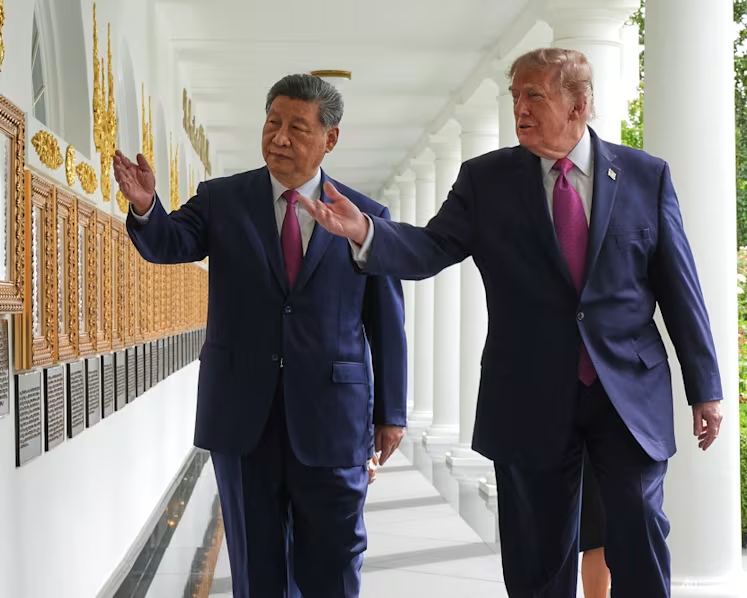
Evaluating Defense Diplomacy and Taiwan Sales
While the bilateral relationship between the U.S. and China is highly complex, analysis of four key dimensions help illuminate the nature of the competition. This policy brief examines trends in U.S.-China defense, trade, artificial intelligence (AI), and energy and environment, concluding with an outlook for the summit between Presidents Trump and Xi.
Complicated Defense Relations Defense dynamics between the U.S. and China ahead of the Trump-Xi summit are marked primarily by prospective U.S. arms sales to Taiwan and reverberations from the conflict with Iran.
Taiwan In December 2025, the U.S. announced $11.1 billion in arms sales to Taiwan, the largest such sale in history. The package would “cover eight items, including HIMARS rocket systems, howitzers, Javelin anti-tank missiles, Altius loitering munition drones and parts for other equipment.” In May 2026, acting U.S. Secretary of the Navy Hung Cao confirmed a pause in $14 billion of arms sales to Taiwan just days after Trump’s meeting with Xi, although Cao attributed the pause to ensuring that the United States had sufficient munitions for its military operations in Iran.
Navigating Middle Eastern Military Contingencies
Subsequent reporting indicated that China was willing to suspend the September 2026 summit between Trump and Xi if arms sales to Taiwan proceeded. The reunification of Taiwan has long been a core interest for China, and the issue remains top of mind for President Xi. It is unlikely that the Trump administration wishes to jeopardize a successful summit and will instead opt to delay future arms sales announcements in the near term.
Other defense diplomacy between China and the U.S. of late has been relatively limited. Admiral Samuel Paparo, who heads the U.S. Pacific Command (PACOM), conducted in-person discussions with General Yang Zhibin, commander of the People’s Liberation Army’s (PLA) Eastern Theater Command, on the sidelines of an August 2026 defense conference in Canada. However, China has thus far been unwilling to host U.S. Under Secretary of Defense Elbridge Colby for an official visit to China despite months-long attempts.
Iran Although China is not directly involved in the conflict in the Middle East, it has had numerous indirect impacts on the U.S.-China relationship. U.S. officials have alleged that China provided Iran with high-resolution satellite imagery of a Jordanian base prior to it being struck by Iran in July 2026, resulting in the death of three U.S. service members.
Following the Beijing Summit in May 2026, the U.S. readout indicated that, “Both leaders agreed Iran cannot have a nuclear weapon, called to reopen the Strait of Hormuz, and agreed that no country or organization can be allowed to charge tolls.” China is currently the leading trade partner for Iran, which elevates the importance of China in the ongoing situation.
The U.S. maintains a broad range of military alliances and partnerships in the Indo-Pacific region. The Iran war has led to the drawdown of several categories of key munitions and the diversion of military assets to the Middle East. Allies and partners are understandably concerned about potential adverse implications for Indo-Pacific military contingencies.
Can Trade Negotiations Reduce Import Tariffs
Trade Talks Could Lead To Lower Tariffs Trade issues are certain to arise in discussions between Trump and Xi. Amid continued trade tensions over tariffs between the U.S. and China, reports indicate that President Xi will be accompanied by a business delegation of executives from multiple industries. Given the tense relationship between Xi and his country’s corporate sector for the last several years, the presence of Chinese business leaders could indicate a desire by China to improve the bilateral commercial relationship.
The May 2026 visit by President Trump resulted in the establishment of a Board of Trade and a Board of Investment, although it is unclear how much progress has been made on these institutions in the intervening months. In July 2026, U.S. Secretary of the Treasury Scott Bessent and U.S. Trade Representative Jamieson Greer reportedly held a video call with Chinese Vice Premier He Lifeng to discuss trade issues ahead of the September summit meeting between leaders.
Tariff levels between the two countries remain high. A reduction in import taxes on $30 billion worth of goods may be announced by both countries after the September summit. If tariff adjustments comes to pass, this could lead to a modest decrease in trade tensions. However, underlying strains in the economic relationship between the U.S. and China may remain.
Escalating Artificial Intelligence Frontier Competition
Artificial Intelligence Tests Prospects for Cooperation Bilateral competition for leadership in artificial intelligence (AI) is escalating. It is widely acknowledged that China and the U.S. are the current global leaders in AI. The September summit could lead to an announcement by Trump and Xi for more in-depth AI dialogues between the U.S. and China in the future. Both countries have an incentive to cooperate to prevent severe AI-related outcomes. However, the race to produce the most advanced frontier models is fueling an intense contest.
It is unclear whether dialogue can produce agreement on governance standards, safety, or crisis management involving AI. A potential middle ground could be for China and the U.S. to “compare broad approaches but withhold tactical details and refrain from granular, riskier discussions of the specific methods they use to elicit unsafe model behavior.”
Trading Energy Resources Amid Climate Friction
Energy Remains Central As Climate Cooperation Recedes The U.S. and China are the largest consumers of hydrocarbons for energy, with the U.S. among the largest producers of oil and gas and China a key producer of materials and technology for many forms of renewable energy. As many diplomats and energy and environmental experts have noted, the potential for cooperation and coordination between these two economies to reduce the risks associated with climate change is substantial.
China refines many of the world’s rare earths and critical minerals while dominating the production of solar panels, wind power blades, batteries, and electric transformers. This gives it the upper hand in talks about trade in renewable energy technology. Unfortunately for Xi, the United States military remains a potential guarantor of the free flow of oil and gas through chokepoints between major waterways, yet it is increasingly disrupting or seizing China’s oil supplies from Iran, Venezuela, and elsewhere. Moreover, Trump is canceling wind farms, banning the imports of electric vehicles from China, and increasing subsidies for domestic thermal power generation.
Rather than collectively leveraging their relative strengths and weaknesses to address the global challenge of climate change, Xi and Trump may instead move environmental issues off of the negotiating table and use energy as a bargaining chip in talks about defense and trade.
For example, China could agree to reopen the exports of rare earths and critical minerals in exchange for looser restrictions of its own imports of advanced microchips as well as the manufacturing technology needed to produce them. Trump might also offer to allow more Iranian oil exports to China, push for the renewal of direct sales of U.S. natural gas to China, or offer a discount on Venezuelan oil that China might argue it has already paid for.
Determining Real Outcomes From Trump-Xi Talks
Smaller economies, particularly in Southeast Asia and Europe, that have been affected by the disruptions to energy and fertilizer supplies related to the Iran war are unlikely to receive joint energy assistance from the Trump-Xi meeting. Beyond these immediate economic concerns, younger generations, who generally rank climate change as an important concern, may find the meeting disappointing if the topic is not a significant focus of the discussions.
Measuring Summit Success The summit meeting in Washington on Sept. 24 is unlikely to produce significant shifts in U.S.-China relations. However, discussions between Presidents Trump and Xi could establish a floor for bilateral relations, helping to prevent further deterioration in this relationship. Regardless, today’s geopolitical landscape is marked by conflict and disruption. From conflicts involving Iran and Ukraine to turbulence in traditional global trade flows, these two major powers are navigating a difficult landscape.
The summit can be considered a success if it lays the foundation for more robust interactions between China and the U.S. on a wide range of issues. Nonetheless, the fundamental dynamics on multiple fronts will remain competitive in the near- to medium-term.