
Global cross-border transaction data indicates Chinese yuan payment momentum has stalled relative to the US dollar. Despite expanding domestic clearing systems and sanction evasion tactics, capital controls continue restricting broader international adoption
Global monetary mechanics reveal a stark divergence between Beijing’s geopolitical ambitions and actual cross-border transaction data. Following initial surges driven by trade realignments and Western sanction regimes, Yuan Internationalization faces structural headwinds that impede broader adoption across international banking networks. Financial clearing mechanisms like CIPS show expanding institutional participation, yet corresponding volume declines in Hong Kong’s CHATS network and SWIFT system reflect diminishing market momentum. Chinese monetary authorities contend with an inherent policy contradiction between maintaining rigid capital controls for domestic stability and achieving reserve currency status abroad. Meanwhile, the American dollar preserves its overwhelming dominance in global foreign exchange settlement, handling nearly ninety percent of transactions.
Persistent reliance on greenback-denominated clearing structures demonstrates that alternative payment channels serve primarily as risk mitigation measures against potential financial isolation rather than immediate operational replacements. Consequently, Yuan Internationalization operates through episodic expansion waves rather than continuous linear progression, leaving Beijing deeply embedded within Western-led financial infrastructure despite concerted efforts toward monetary autonomy.
Tracking Yuan Internationalization Across Global Markets
It is widely known that global use of China’s currency, the yuan, rose substantially in 2023–24 following Russia’s invasion of Ukraine, as sanctions and the related reordering of Russian trade drove geopolitical tailwinds to the yuan, also known as the renminbi (RMB). What is less known—and contrary to headlines that China is “ditching” the dollar and that the Chinese yuan is “taking over the dollar’s role” —is that the yuan’s momentum has faded. By some important measures its international use has even decreased, both in absolute terms and as a share of global payments over the last two years.
The data paint a mixed picture. China’s Cross-Border Interbank Payment System (CIPS) is the main bright spot for the yuan. Many global banks have recently signed on to this system for yuan payments, and the crisis in the Strait of Hormuz seems to have revived its growth.
But yuan-denominated volume in Hong Kong’s Clearing House Automated Transfer System (CHATS), which handles three times as many payments as CIPS, has plunged since mid-2024. The yuan’s share of payments in the Society for Interbank Financial Telecommunications (SWIFT) network has also fallen from its mid-2024 highs. By this measure, the yuan is the world’s sixth most used payments currency, behind even the Canadian dollar. Meanwhile, the US dollar remains unchallenged at historic highs in global foreign exchange payments, and 72 percent of China’s trade is still settled in others’ currencies.
Nevertheless, CIPS’s divergence from these other metrics for the first time suggests that an increasing share of payments using the yuan are bypassing the SWIFT network. It is a sign that China is prioritizing resilience to potential future sanctions and self-sufficiency, even at the risk of diverging from global payment standards.
Policy Ambitions Meet Capital Control Constraints
Fits and starts for the yuan China has long aimed to make the yuan a more important global currency, in part to reduce strategic leverage that ubiquitous dollar payments give the United States. In 2023, China’s president Xi Jinping called for China to become a “strong financial country” (金融强国) with a “strong currency” that has “wide use in international trade, investment, and foreign exchange markets” and even “status as a global reserve currency.”
People’s Bank of China governor Pan Gongsheng warned in 2025 that a “global dominant currency tends to be instrumentalized or weaponized” and hailed efforts to “weaken the excessive reliance on a single sovereign currency.” Beijing has explored many means of boosting the yuan’s international use. But Chinese policymakers have struggled to reconcile the openness that having a major global currency would require with domestic stability reinforced through strict capital controls.
Figure 1 shows the yuan’s share in the SWIFT network, the global standard for payment messages between banks. Starting in 2010, measures to make the yuan more freely usable contributed to a steady rise from less than 1 percent to 2.8 percent of global payments in the SWIFT network by late 2015. But use then fell back and stagnated around 2 percent for five years after a sharp depreciation and tightened capital controls.
In late 2023, use spiked after sanctions imposed by every major reserve currency issuer made Russia and other countries more willing to use the yuan. It peaked at 4.7 percent of global payments by July 2024, passing the Japanese yen and Canadian dollar to become the fourth most used.
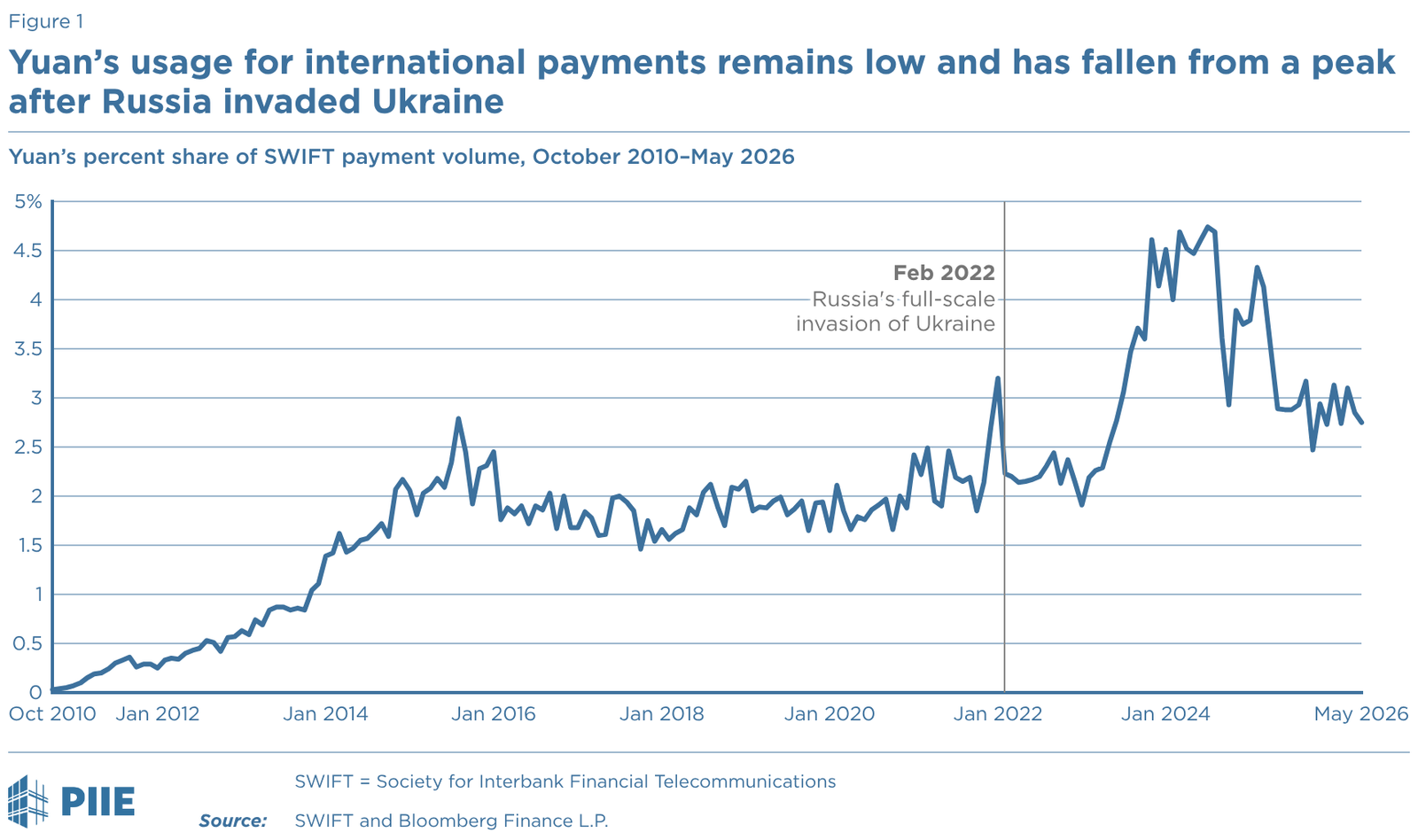
After that peak, the yuan’s share fell back to 2.75 percent. The mystery is why. Chinese economists argue that these data underestimate the yuan’s international role for multiple reasons, but here the most relevant hypothesis is that a growing share of yuan payments are using CIPS in a way that no longer goes through SWIFT.
Is SWIFT Data Hiding Real Usage?
Is the SWIFT yuan decline real? Banks around the world typically send and receive cross-border payment messages with SWIFT. But they also generally need interbank clearing and settlement systems like CIPS and/or CHATS to execute those payments, e.g. to actually move money. Soon after it was founded in 2015, CIPS integrated with SWIFT messaging, which it uses for payments involving CIPS’s 1,619 indirect participants. CHATS, a real-time gross settlement system that supports multiple currencies, including the US dollar and the yuan, also uses it. These systems are interconnected, in that a payment message sent with SWIFT might pass through both CHATS and CIPS on its way through Hong Kong to a mainland Chinese recipient.
Analyzing Divergent Settlement Network Volumes
CIPS, however, also has its own independent messaging system for direct participants. This network of direct participants has grown rapidly from 79 banks since January 2023 to 210 today. If these banks’ yuan payments are the same or growing but they no longer touch SWIFT, this volume could disappear from that data and show a spurious decline in yuan use. Looking at SWIFT and CIPS data together suggest that this volume is in fact disappearing, but adding the CHATS system to the comparison suggests that the SWIFT data showing declining cross-border yuan use are still directionally correct.
Figure 2 shows the payment volume in billions of yuan for CIPS and CHATS. Just like the SWIFT share, both more than doubled from mid-2022 to mid-2024, CIPS from around 350 billion yuan to 770 billion and CHATS from 1.5 trillion to 3.3 trillion yuan.
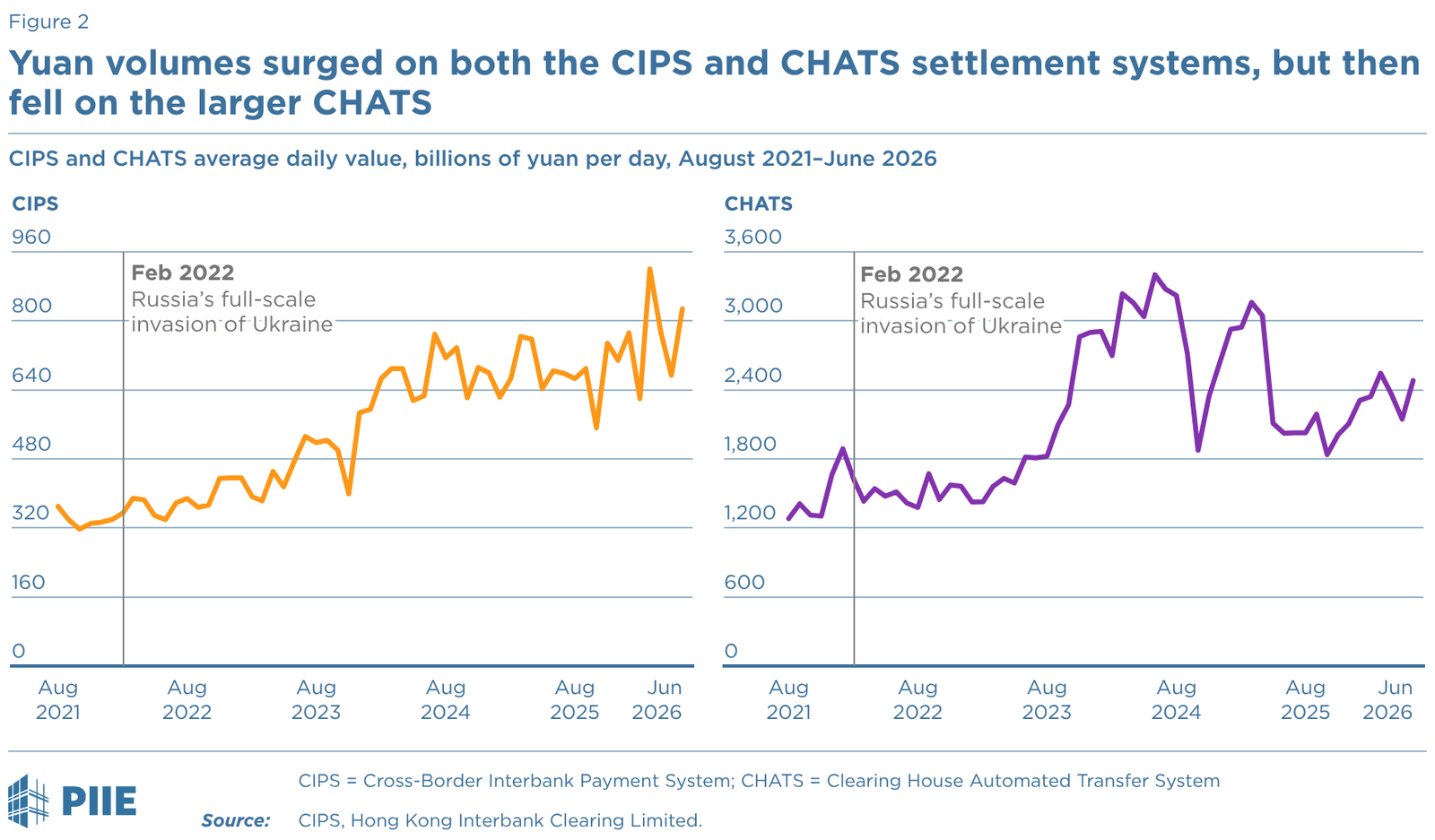
Since the mid-2024 peak, however, the overall trend of yuan volume in CIPS has diverged from that of SWIFT and CHATS. CHATS volumes and SWIFT shares of yuan both fell substantially, while CIPS volume was stagnant. All have come up from late 2025 lows, but CIPS is registering all-time highs while CHATS and SWIFT remain far below the peak. Some of the yuan’s decline n CHATS may be due to migration to CIPS, but CHATS average daily RMB volume has fallen by over 1 trillion yuan from June 2024 to June 2026, while CIPS volume is only up by one-fifth of that, about 200 billion yuan. CIPS alone cannot therefore explain the CHATS decline.
Evaluating Strategic Trade Settlement Shifts
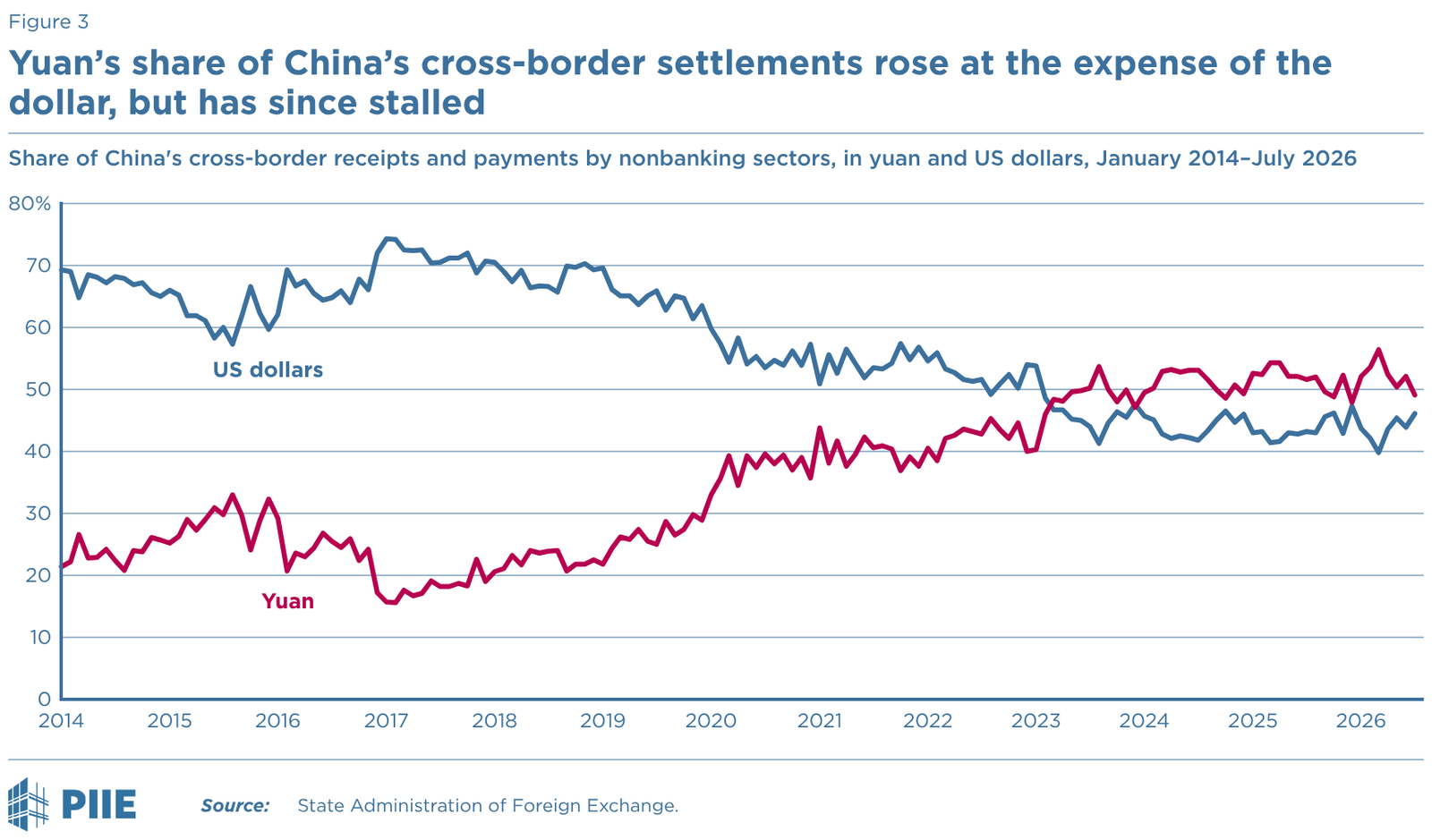
Other data sources Another way to look at yuan payments is through the State Administration of Foreign Exchange’s (SAFE) data on banks’ payments on behalf of clients in and out of China. After a large run-up to around half of China’s overall cross-border settlements until early 2023, largely at the dollar’s expense, the yuan has stagnated at that level and stopped gaining on the dollar. Like in CIPS, yuan payments overall have continued to grow, but adding the context of dollar payments shows that growth is only enough to keep pace with the demand for dollar settlement.
The SAFE data also show the dollar has remained steady with around a 90 percent share of any payments not settled in yuan, suggesting China has not ditched dollar payments to transact in other currencies like the euro.
Other official Chinese data show the share of China’s goods trade that is settled in yuan fell from 23 percent in 2015 to a low of 11 percent in 2017 but then started to rise again, reaching 28 percent in the first half of 2025. The pattern is quite similar to the SWIFT trend for these years, but its latest data end at the first half of 2025, right before the yuan’s SWIFT share dropped.
China has thus convinced trading partners to pay or be paid more often in yuan than any time in the last decade, but the longer series shows that RMB internationalization can proceed in waves and can go in reverse. It is also a useful reminder that 72 percent of China’s goods trade is still settled in other currencies.
Will Digital Currency Accelerate Yuan Internationalization?
Looking globally, the Bank for International Settlements reports the yuan has increased from being on one side of 2 percent of global foreign exchange transactions in 2013 to 8.5 percent in mid-June 2025, but its rise has come entirely at the expense of currencies other than the dollar. Despite all the concerns about sanctions, the dollar’s share increased from 87 to 89 percent.
One other channel that may not be counted in CIPS or SWIFT is the digital yuan, but this is likely not yet material. Many central banks are exploring using central bank digital currencies (CBDC) for cross-border payments, and China’s central bank is part of one of the most promising efforts, the M-CBDC Bridge (mBridge), which includes five central banks. The only public update of the system to date reveals that as of November 2025, the system had handled 4,047 transactions totaling 387.2 billion yuan, of which 95.3 percent were yuan transactions. This transaction count is small compared to CIPS, which handles around 33,000 transactions per day.
Newer figures reported by the Financial Times would imply 83 billion yuan in new transactions from November 2025 to June 2026. If the reporting is accurate, mBridge volume over the past six to seven months would only represent one-tenth of one day’s average CIPS volumes, making mBridge barely a rounding error in the yuan’s international footprint. CBDC payments at scale remain a prospect for years in the future. No major economy has fully launched one that could be connected to China’s, leaving it without a network of other CBDCs to connect to.
Beijing Confronts Deep Dollar Dominance
Conclusion The Chinese yuan’s impressive growth as a payment currency has lost its momentum over the last two years. It is true that some data likely overstate the reversal because of migration into China’s more self-contained payment system, and overall use is still rising particularly in trade. However, the bright spots are not enough for the yuan to continue gaining on the dollar in its share of global payments or even overall Chinese payments. Yuan internationalization may be more of an insurance policy, ready to be activated for larger scale payments if sanctions force China off the dollar.
The yuan overall still punches far below China’s economic weight. Far from ditching the dollar, China is still tightly tied up in dollar-based global financial networks. The lack of gains in a period with rising global concerns about the dollar is particularly surprising, and it suggests Beijing will need to find new growth drivers if it wants to close the gap with the greenback.
Generative AI was used to assist with background research for this blog and to compile replication materials. All AI-generated output has been subjected to careful human review.