
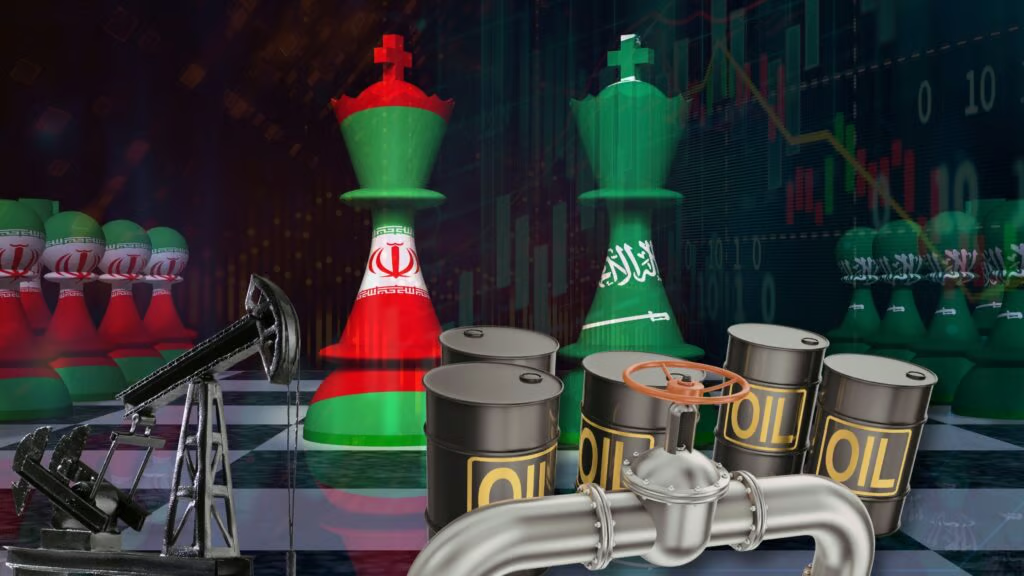
Saudi investment plans falter as the war punctures the myth of Gulf insulation. Oil activity fell 25%, the economy contracted nearly 5%, and Neom added $400 billion in debt, forcing Riyadh to seek ceasefire and rationalize spending.
Saudi Investment Plans Face Wartime Test
Reshma Kapadia here, filling in for Sabrina Escobar. The strange dynamic between the U.S., Russia and Ukraine is getting even stranger. After President Trump blamed Ukraine for the ongoing war, Ukraine began to experience a rollback in satellite services. The U.S. denied interfering, but reports surfaced on Wednesday that Elon Musk himself ordered the Starlink slowdown, which impacted the country’s ability to operate military drones.
Satellite service is up and running, and the U.S. is sharing intelligence with Ukraine once more, but it’s a chaotic backdrop for potential three-way peace talks. Meanwhile, France continues to grapple with its debt problems. If you want to know more about how the European Central Bank could intervene, keep reading. But first I want to start with how the Iran war has affected Saudi Arabia and the UAE—they both entered the conflict on different footing, and the Saudis in particular are going to have to rethink their future investment strategy.
Finally, don’t miss why one portfolio manager thinks agriculture stocks are headed for a bull run. Mentioned in this newsletter: Franklin FTSE Saudi Arabia Fund, MSCI United Arab Emirates ETF, OPEC, Marko Papic, European Central Bank, France, London’s FTSE 100, fertilizer, ethanol, corn, soybeans. You can subscribe to Barron’s Global Signals here.
Saudi Arabia and the UAE are both feeling the pain
When I attended Saudi Arabia’s Future Investment Initiative conference in Miami earlier this year, Middle East executives and investors were cautiously optimistic. They believed the conflict between the U.S. and Iran, which had begun just a few weeks earlier, would be short-lived and possibly leave the region more stable, ultimately increasing foreign capital flows.
Things have changed. This week, Saudi Arabia postponed its October FII conference, nicknamed “Davos in the Desert,” after Iran-backed Houthi attacks on the country’s energy infrastructure, military bases and airports proved too much to bear for a confab aimed at drawing money to the region.
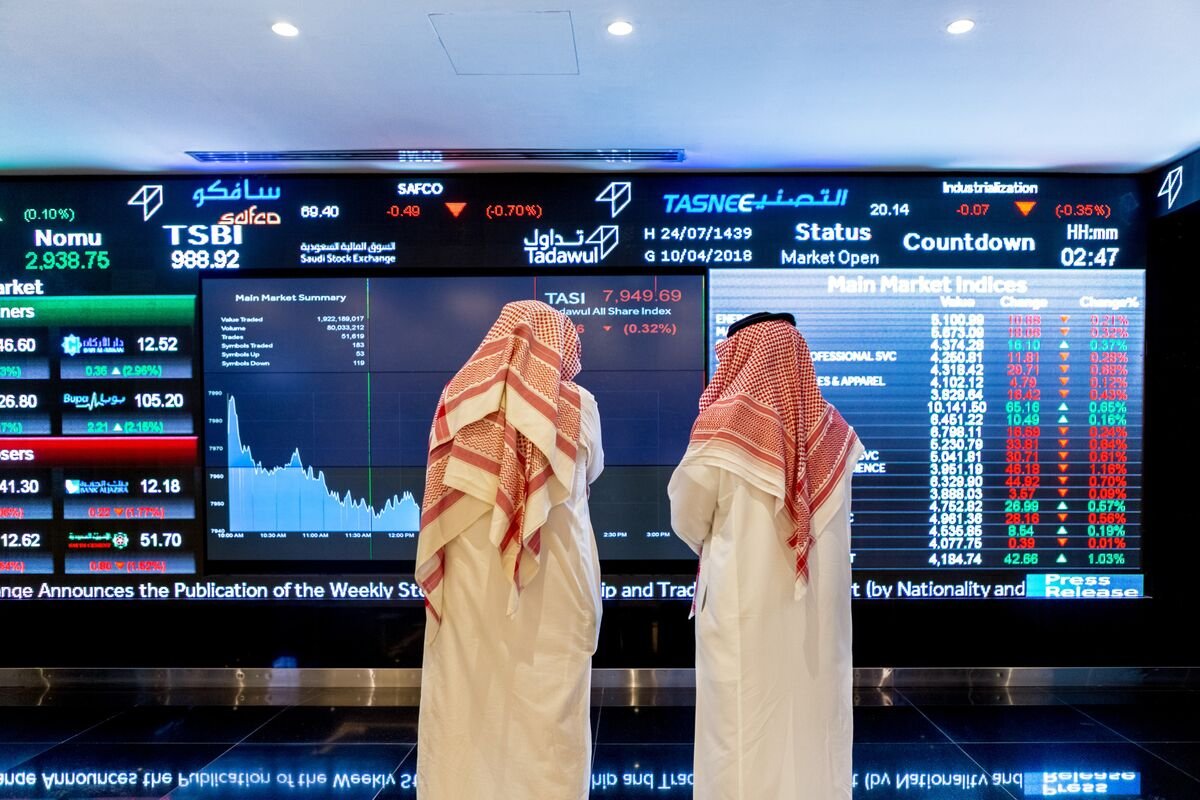
Investors and financial service executives had been flocking to the Arabian Peninsula for years, enthused by the potential in Gulf states like Saudi Arabia and the United Arab Emirates which have gone through great efforts to become tourist, logistics and financial hubs. But as the Iran conflict approaches the eight-month mark, investor enthusiasm has chilled as those countries get pulled into hostilities, throwing their future investment outlooks into doubt.
“The myth that the Gulf states were insulated from the conflict and violence happening around them and able to be these bastions of investment, entrepreneurship, money and wealth, has been punctured,” says Annelle Sheline, a research fellow in the Middle East program at the Quincy Institute for Responsible Statecraft. “If I was an investor, I would feel less bullish on Gulf investments.”
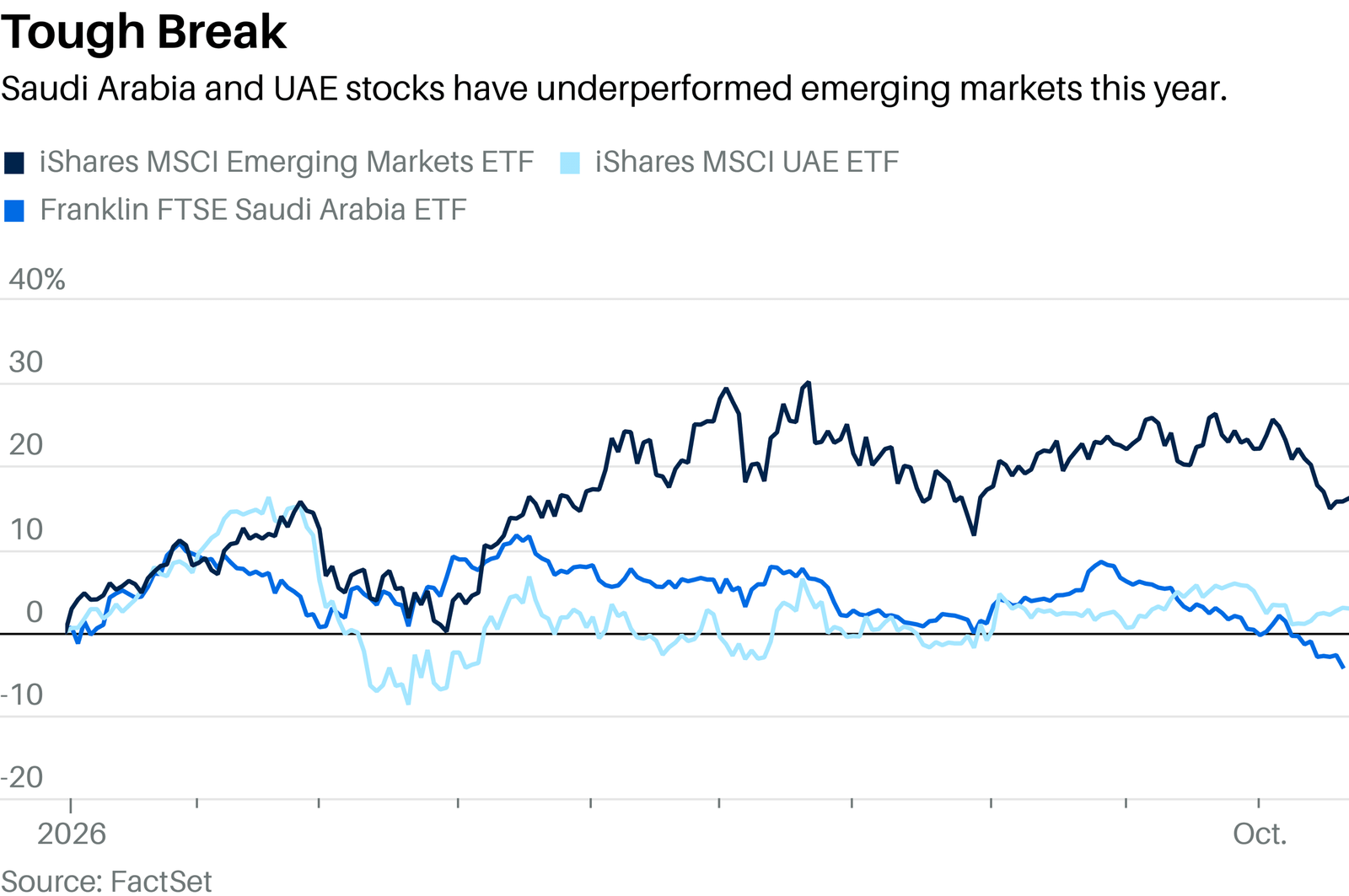
The Franklin FTSE Saudi Arabia Fund is down 2% so far this year while the MSCI United Arab Emirates exchange-traded fund is up 6%. Both have underperformed the 17% gain in the MSCI Emerging Markets index. UAE’s economy contracted 2% in the second quarter and Saudi Arabia’s shrunk nearly 5%, its first decline since 2023. Hotel occupancies in the UAE dropped early on and have remained depressed, while Saudi oil activity fell nearly 25% in the second quarter. Few investors are looking to jumpstart bargain hunting just yet, given the dynamic situation on the ground.
The UAE came to the Iran crisis in a relatively strong fiscal position, and is better equipped to weather the storm over the short term. The country’s previous defense investments have helped it navigate the conflict, says Marwan Haddad, managing director at investment firm Azimut Group, and a manager of the AZ Mena Equity fund. It left OPEC in April, is pumping more oil than before the war began, and has embarked on a huge capital investment supercycle for infrastructure like airports and ports. UAE’s banks saw loan growth in the high teens during the first eight months of 2026 compared with a year ago, one reason investors see opportunity in the country’s banks.
UAE Holds Expat Base and Bank Growth
The UAE’s expat population also hasn’t dwindled much, despite the conflict. Part of the reason is Dubai’s 10-year Golden Visa, which lets foreigners work there without paying income or capital gains. “Most expats aren’t from the West but the East—India, China, Pakistan. Where else are they going to go? They will stay,” says Moneh Salam, manager of the Amana Developing World fund.
To hold onto its relative regional advantage, the UAE needs to double down on its role as the financial capital for the so-called Global South, which includes countries across Asia, Africa, and Latin America, according to Marko Papic, chief investment strategist at BCA Research. That means maintaining its commitment to neutrality, working with geopolitical rivals, and keeping its distance from the U.S. That strategy, he says, would allow it to continue drawing Russian tech executives, Indian billionaires, and Ukrainian entrepreneurs looking for American alternatives.
Saudi Investment Plans Depend on Ceasefire
Saudi Arabia is in a more difficult position, in part because previous efforts to diversify its economy away from oil with megaprojects like Neom, a futuristic megacity in the desert, have added more than $400 billion of debt to its balance sheet. Long seen as a source of wealth to invest elsewhere in the world, the Saudis have more recently focused on wooing foreign investors to bet on their own country’s transformation. That effort has been complicated by the war, and strategists caution that it stands to take a major hit if the conflict drags on and becomes a quagmire that further drains the Kingdom’s coffers.
Papic believes the solution for Saudi Arabia is to find some sort of resolution with Iran and Yemen, such as brokering a formal or even informal ceasefire—something they have managed to do before. He’s currently watching for signals of Saudi Arabia strengthening the Mecca Joint Defense Agreement, which it signed earlier this year with Turkey and Pakistan as it hedges its dependence on the U.S.
Over an extended horizon, the Iran war could force the Saudis to re-prioritize spending on infrastructure and defense, according to Papic. It might also bolster sectors in the country that already work, like industrials, energy and materials, rather than some of its glitzy projects. That, along with steps towards structural reforms to integrate women into the workforce and liberalizing the economy, make him ultimately bullish.
For years, he says, Saudi Arabia has lived off the geopolitical version of quantitative easing thanks to its close alliance with the U.S. “Sometimes you need geopolitical ‘quantitative tightening’ to reveal who is doing the right things and whose foreign policy is a function of American largesse,” Papic says. “In the long-term, it will force countries in the Mideast to live within their own geopolitical means, and that should see a rationalization of both foreign policy goals and ambitions.”
Investors looking for Middle East bargains right now may be skittish, but Papic points to Europe as an example of a region that has taken significant steps to boost its defense and infrastructure spending in a bid to become less reliant on the U.S. That shift has helped European stocks outperform over the past two years. The Middle East is still in the thick of it as alliances and power dynamics continue to shift, but there’s reason to believe it might do the same. That’s enough for investors to keep paying attention.
The European Central Bank has 3 options to stop France from spiraling into a broader crisis
France’s fiscal situation is a blaring alarm bell for the rest of the European Union. And neither the current French government nor the leading candidates for next spring’s presidential elections seem to have a good solution to lower debt levels.
France’s debt as a percentage of GDP rose to 119%, according to the latest data. Frontrunner candidate Marine Le Pen has campaigned on higher public spending and pension reforms that would add to the fiscal burden. Left-wing candidate Jean-Luc Méléchon’s solution—to effectively erase $660 billion in French debt held by the Eurosystem—is a move currently prohibited by EU treaties.
France is still a long way from intervention from the European Central Bank, according to Jack Allen-Reynolds, deputy chief Eurozone economist at Capital Economics. But the possibility can’t be discounted. Further French fiscal deterioration could spark capital flight out of the country—particularly in fixed income—and threaten the stability of the Euro area, according to Oxford Analytica. France’s political inaction could force the ECB to take steps to avoid a metastasizing debt crisis.
Why Debt Crisis Tools Fall Short
The ECB’s statutes rule out bailouts of public sector authorities. But following the sovereign debt crisis that roiled the continent a little over a decade ago, the ECB developed new tools to help members in distress. The Transmission Protection Instrument (TPI), for example, allows the ECB to buy a country’s bonds when its borrowing costs rise sharply due to market panic or contagion, rather than a country’s own financial problems. Given that France’s current situation is tied to untenable fiscal debt levels, it doesn’t likely fit that criteria, writes Oxford Analytica. If, however, the debt crisis were to spread to other countries, those governments could then use an instrument like TPI.
Outright Monetary Transactions (OMT) presents a longer-term solution, but comes with its own limitations. It would allow the ECB to instruct other European central banks to purchase France’s debt and would place France under a support program that Niall Walsh, an analyst at Oxford Analytica, describes as a “lighter version” of IMF austerity measures. For a government trying to quell nation-wide discontent and protests about underfunded education, implementing politically unpopular measures is a hard sell. It would also require buy-in from other European nations, and significant political wrangling from both French politicians and ECB leaders.
There is a third option for the ECB: Wait the situation out, at least until France’s election, Walsh says. “Once they intervene, it’s an admission that it’s a crisis, which creates its own challenges.”
The challenge for the ECB now is deciding which alternative results in the least pain—and convince every interested party to take action. It’s no small feat.
– Sabrina Escobar
How the UK became the cleanest dirty shirt in Europe
Trust the British to bask in the fact that as bad as it is at home, it’s worse in continental Europe.
UK inflation is currently at 3.5% and projected to blow past 4% next year. Unsecured consumer debt is rising at the fastest pace since at least 1993. And runaway government borrowing means that public sector debt is around 95% of GDP.
Yet the British economy grew by 1.2% in the first half of 2026, one of the strongest performances of G7 countries; it’s expected to finish the year with one of Europe’s strongest growth rates, according to the IMF. That’s a much rosier picture than France, where GDP growth is expected to hit just 0.4% this year, and spiralling debt has sent yields on 10-year French government bonds, known as OATs, to the highest level since 2002.
Germany, long Europe’s bulwark, is also struggling. GDP growth is on par with the UK this year, but the economy faces a structural crisis as its prized manufacturing base buckles under rising energy costs and competition from China. The sector has shed almost half a million jobs since 2019. That’s partly why German economic growth is expected to fall behind Britain in 2027.
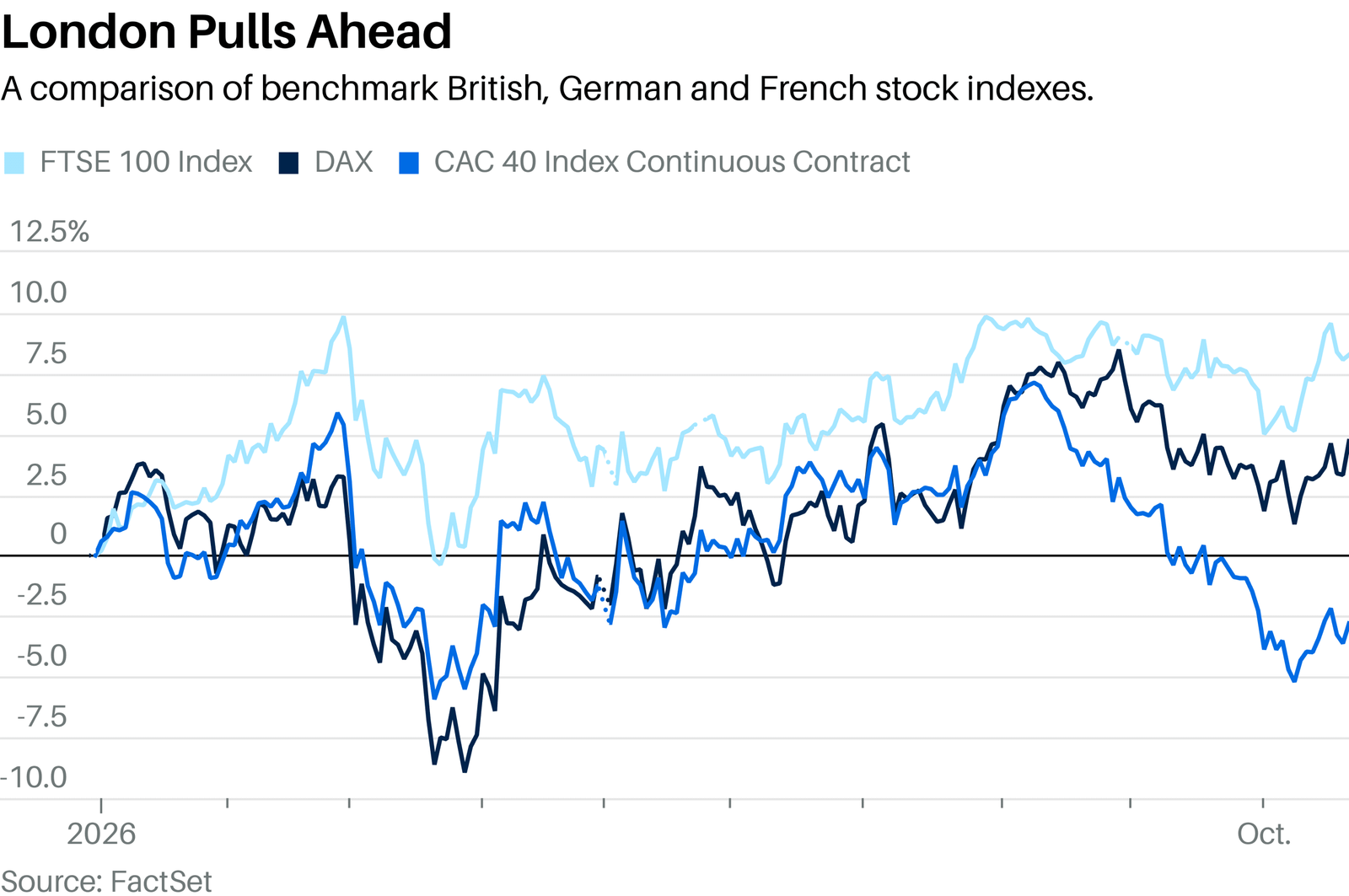
So what does this all mean for investors? UK interest rates are expected to stay high as inflation persists, which will provide more income from British Gilts compared to German Bunds. Gilts also offer significantly less risk than French OATs. The British pound is already handily beating the Euro, a trend that’s likely to continue. And Europe’s fiscal and trade troubles will continue to weigh on its stocks—a promising development for London’s FTSE 100.
This portfolio manager thinks agriculture stocks are headed for a bull market
Between the Iran war disrupting fertilizer supply chains and the super El Niño, it’s no surprise agriculture commodity prices have spiked this year. Dawid Heyl, natural resources portfolio manager at Ninety One, thinks this is just the start of a multi-year bull run for agriculture stocks.
Heyl, who has covered ag commodities and stocks for nearly two decades, believes the market still hasn’t prices in important factors that will keep demand high. For instance, ethanol is poised for a more structural boost in demand; almost all U.S. gasoline is blended with 10% ethanol, but legislative pushes to increase that number have been gaining traction, particularly because newer car engine models can withstand higher ethanol percentages.
I chatted with Heyl about his outlook for agriculture, and how investors should think about a changing world.
You just came back from a two-week tour of the U.S. Corn Belt. What was your takeaway?
It’s a very interesting time in the sector because we’re kind of coming out of a bear market.
We’ve had good growing conditions in the major production regions for nearly a decade. It’s not like we’ve had no supply disruption, but it’s been few and far in between. I’m not saying that we are about to see something major. But what we are seeing at the moment is the combination of enough factors to disrupt supply that actually makes me quite bullish on the underlying commodities like corn and soybeans.
There are different factors contributing to this supply risk: the fertilizer supply disruption from the Strait of Hormuz, and El Niño, which looks quite severe. I don’t think you see that reflected in grain prices, but you do see it reflected in other soft commodities like sugar. We have seen sugar prices react to a deficient monsoon season in India and Thailand. But in the broad-acre crops like corn and soybeans, I think it’s still to come. And in those markets, especially in corn, you have an outsized impact if you’ve got a nitrogen fertilizer supply disruption as well.
Why aren’t those factors reflected in broad-acre crops yet?
On the fertilizer side, the supply chains for the crop that’s currently being harvested in the U.S. was actually full when the conflict started. So there was never really a near-term crisis when the Iran war kicked off. Fertilizers were fully stocked going into that planting season in the spring.
But we were always concerned about what happens with crop cycles that start in the second half of this year. That is where I think the problems will occur. If you look at the Southern Hemisphere, Argentinian corn is quite big. Brazil typically does a bit of corn in the first crop, and then there’s a big safrinha crop—the second-season crop Brazil plants early in the new year.
There’s going to be some concern around nitrogen fertilizer availability there that might impact your planted acreage at the end of the day. Even if your planted acreage is only down a bit, I think the fertilizer availability means there’s probably going to be less application, and then you’ll see quite a [negative] impact on yields.
The Northern Hemisphere is still a much larger producer of these grains. So I’m really concerned when we get to Q1 of next year and those Northern Hemisphere [fertilizer] supply chains need to be filled up again. You’re going to be planting again next spring and there’s going to be some acreage that’s going to be lost because of lack of fertilizer.
On the El Niño side, corn in the U.S. corn belt isn’t really impacted by El Niño. If anything, there’s a positive correlation between precipitation in the Corn Belt and El Niño and it’s been a good grain season. But it’s always that concern around what’s going to happen next year.
How should investors be thinking about these macro forces?
The ways in which we express it in the portfolio are really twofold. One, the input providers that sell into the farm, fertilizer and seeds mainly, and then the primary offtakers who also use those grains to then manufacture ethanol and biofuels. Large holdings for us at the moment include Corteva, but they have gone through a corporate action recently. So it’s actually two separate companies now. So the seed-focused company is called Vylor. Corteva still exists and they are focused on crop protection—pesticides, etc. On the fertilizer side, the key holdings are Nutrien and CF industries. Two names on the primary offtake and biofuel side are Archer-Daniel Midland, and Darling Ingredients.