
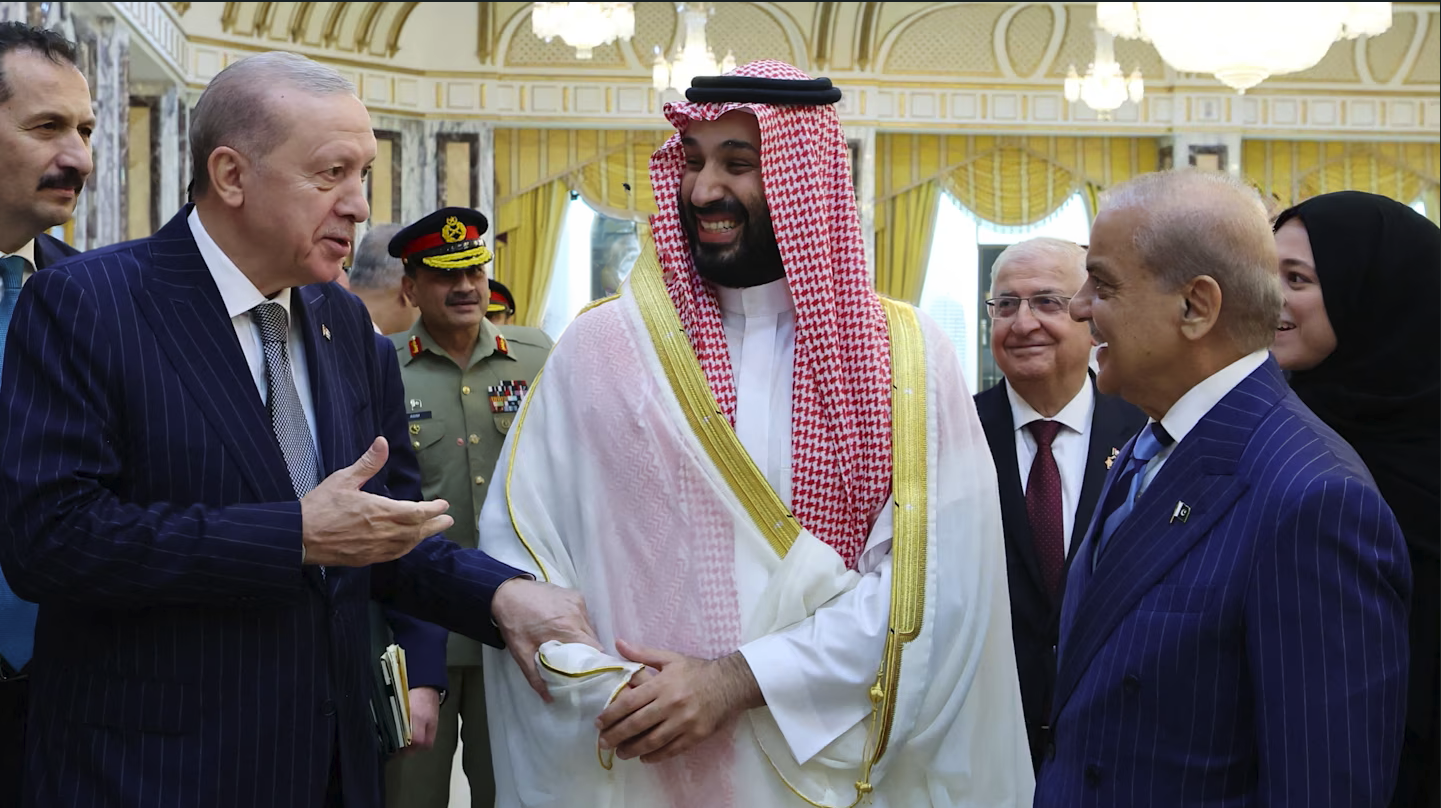
The Saudi Defense Pact with Türkiye and Pakistan diversifies Riyadh’s security ties without replacing Washington. It offers minilateral flexibility, complementary capabilities, and deterrence, though its practical effectiveness remains still untested.
The Saudi Defense Pact signed on August 7 between Riyadh, Türkiye, and Pakistan marks a strategic evolution in the kingdom’s security thinking. Rather than replacing its longstanding relationship with Washington, the agreement adds new partners to an increasingly diversified defense portfolio. The pact stipulates that an armed attack on one signatory will be treated as an attack on all, yet it stops short of guaranteeing automatic military response, leaving the nature of coordination to consultation.
This distinction reveals Riyadh’s pragmatic approach: it seeks overlapping partnerships that bring complementary capabilities without abandoning existing alliances. The timing reflects heightened regional instability, including attacks on Gulf infrastructure, Houthi activity in the Red Sea, and the wider Iran-Israel confrontation. By choosing minilateralism over cumbersome multilateral consensus, Saudi Arabia gains flexibility and speed in defense cooperation. Türkiye offers NATO membership and a growing defense industry; Pakistan brings nuclear status and a large military. Both maintain their own relationships with Iran, underscoring that the pact is not a rigid bloc against Tehran. Instead, it creates space for cooperation where interests overlap. The Saudi Defense Pact therefore represents a calculated hedge, not a rupture.
Saudi Defense Pact Adds Partners
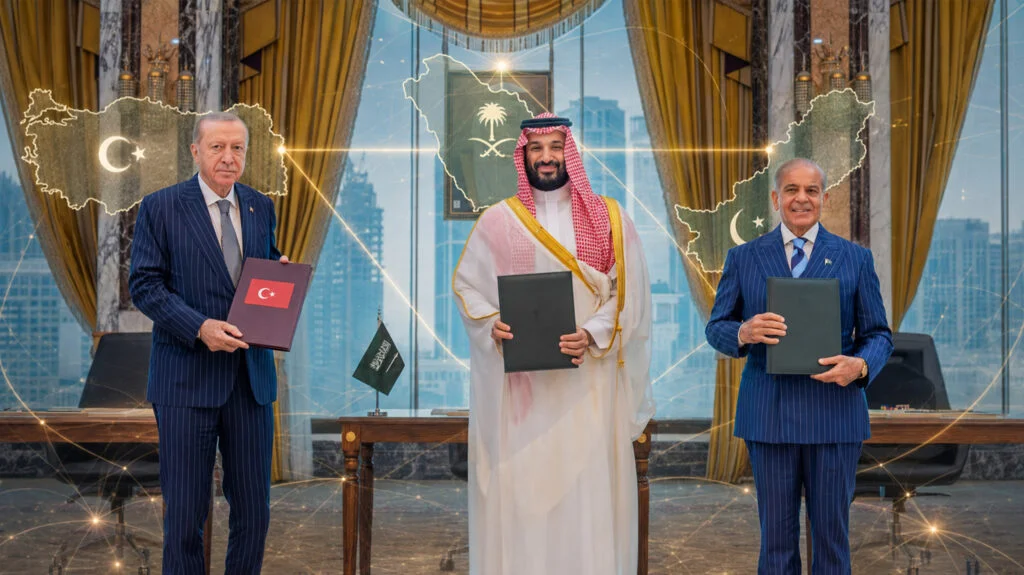
Saudi Arabia’s signing of the Mecca Joint Defense Agreement with Türkiye and Pakistan on August 7 marks a crucial development in the evolution of the kingdom’s security strategy. The agreement stipulates that an armed attack against any one of the three countries will be regarded as an attack against all of them and provides a framework for deeper defense cooperation.
Importantly, the agreement does not guarantee an automatic military response; rather, it provides a framework for consultation and coordination on defense matters, with the nature of the response left to the three parties to determine. More broadly, however, the agreement underscores a shift in Saudi strategic thinking: Riyadh is looking beyond traditional security partnerships toward minilateral arrangements that bring together a small number of partners around specific capabilities and shared strategic interests.
The signing of the agreement comes at a moment of heightened instability in the Middle East and uncertainty over the future of the region’s security architecture. For Saudi Arabia, the ongoing war has reinforced the risks of relying too heavily on a sole security provider. The kingdom’s response has not been to abandon its longstanding security relationship with Washington, but to accelerate the diversification of its regional partnerships.
A Diversified Defense Portfolio
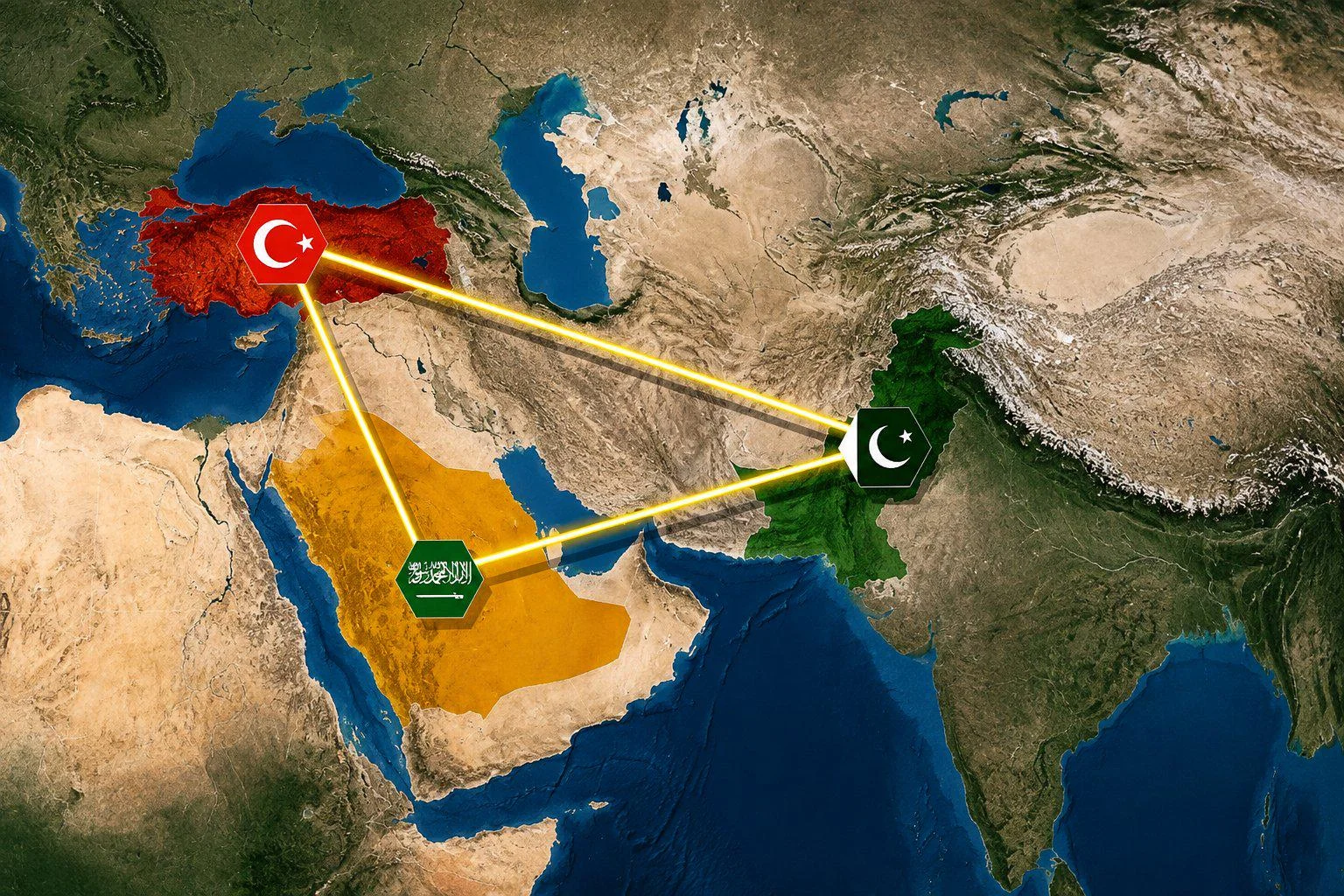
For decades, Saudi Arabia has relied on the United States for external security guarantees. U.S. military deployments, air-defense capabilities, intelligence cooperation, arms sales, and broader security guarantees have been central to the kingdom’s strategic calculations. However, the regional environment has changed dramatically in recent years, demonstrating that Gulf security cannot be reduced to the question of whether Washington will remain present in the region. Widespread attacks on Gulf energy infrastructure and shipping, missile and drone threats, the return of Houthi activity in the Red Sea, and the wider confrontation between Iran and Israel have highlighted the range of threats in the region.
These developments have compelled Riyadh to reconsider the risks associated with excessive dependence on any single external partner. This does not mean Saudi Arabia is abandoning Washington. If one security partner cannot address every threat, Saudi Arabia can construct overlapping relationships in which different partners provide different capabilities. In this light, the trilateral defense agreement should be understood as part of a wider Saudi policy of constructing a diversified security portfolio. This distinction is important. Saudi Arabia is not choosing Türkiye and Pakistan in place of the United States, but rather adding them to an increasingly diversified web of defense ties.
Why Choose Minilateralism?
Minilateralism involves a smaller number of countries cooperating around clearly defined strategic interests. This approach offers several benefits for Riyadh. Multilateral institutions such as the Gulf Cooperation Council are valuable, but reaching a consensus among multiple countries can be difficult, especially when members have different threat perceptions and foreign-policy preferences. A comparatively smaller arrangement, in contrast, allows countries to move more quickly and tailor cooperation to specific strategic requirements. For Saudi Arabia, which is simultaneously developing its own military-industrial capabilities and maintaining extensive defense relationships with the United States and European powers, minilateral arrangements provide another layer of flexibility. The Mecca agreement operates in this manner by bringing Türkiye and Pakistan into a formal trilateral security network.
The inclusion of both Türkiye and Pakistan is particularly significant for the kingdom because each state brings capabilities that can address different aspects of Saudi Arabia’s security needs. Türkiye is a NATO member with a rapidly expanding defense industry, potentially offering Riyadh access to advanced military technologies and capabilities. Over the past decade, Türkiye’s relationship with the Gulf has expanded beyond trade and diplomacy into defense and strategic cooperation, with Turkish defense firms becoming crucial suppliers of unmanned systems and other military technologies.
Meanwhile, Pakistan is a nuclear-armed state with a large military and longstanding defense relationships with both Riyadh and Ankara. It is worth noting that Saudi Arabia and Pakistan had already formalized a mutual defense agreement in September 2025, with the new agreement building upon that existing relationship.
Türkiye and Pakistan Bring Different Strengths
These complementary capabilities do not require the three countries to share identical strategic priorities. Pakistan has its own South Asian calculations, Türkiye maintains its own relations with Iran, and Saudi Arabia has its own interests regarding both regional and global powers. For Riyadh, the value of the arrangement lies in creating space for cooperation where these interests overlap. This makes the Mecca Pact less a rigid ideological bloc than an example of pragmatic minilateralism.
Further, it would be a mistake to view the agreement as evidence that the kingdom has decided to move away from Washington as a security partner. Saudi Arabia continues to have deep military, strategic, and economic relations with the United States, and this will not change. Diversification is not abandonment, and that distinction is crucial. Riyadh can maintain its ties with Washington while strengthening its defense relationships with Türkiye and Pakistan and pursuing additional partnerships with other powers. This is ultimately an expression of strategic hedging rather than a contradiction, whereby Saudi Arabia seeks to diversify its security ties without leaving its existing relationships.
The Iran Question
The timing of the pact inevitably raises questions about Iran. The signatories have stressed its defensive character and have emphasized that it is not directed at any specific country. Both Türkiye and Pakistan maintain relationships with Iran alongside their ties with Saudi Arabia, underscoring that the agreement does not necessarily represent a broader alignment against Tehran. Nevertheless, the pact’s timing gives its deterrent function particular significance amid the current geopolitical climate.
For Saudi Arabia, this matters even if the pact is not aimed explicitly at Iran. The agreement sends a strategic message that Riyadh has additional security partnerships through which it can respond collectively to threats against its territory and critical infrastructure. This is where the deterrent value of the pact may be more important than its immediate military results. Its purpose is not necessarily to influence behavior, but to create uncertainty about the consequences of aggression.
Saudi Defense Pact Faces Its First Test
At the same time, the Mecca Pact does not eliminate the potential challenges of relying on additional security partners. The phrase “an attack on one is an attack on all” is politically powerful, but its practical meaning will depend on what happens after an attack, including whether the partners would deploy forces during a crisis, share intelligence and air defense capabilities, provide logistics or weapons, or coordinate military planning. Equally significant is how these governments would respond if their threat perceptions and strategic interests diverged. These questions have yet to be answered.
For the kingdom, this highlights both the value and potential limitations of minilateralism. Diversification can give Saudi Arabia access to a wider range of capabilities and reduce its dependence on any single security partner, but it cannot guarantee that different partners will respond in the same manner to every threat. The effectiveness of the Mecca Pact will therefore depend on the development of institutional mechanisms, interoperability, intelligence sharing, and clearly defined procedures for responding to crises.
Institutionalizing the Mecca Agreement
The first steps toward that institutionalization are already underway. On August 31, the inaugural meeting of the Strategic Political and Defense Committee, which was established under the Mecca Agreement, was held in Istanbul. During the meeting, the three countries agreed to establish a permanent secretariat in Saudi Arabia and strengthen military cohesion and defense capabilities through joint technology development and production, as well as defense-industry cooperation. The significance of the pact for Riyadh will ultimately be measured by whether this form of minilateralism can develop into a more durable security network capable of addressing evolving regional security threats.