
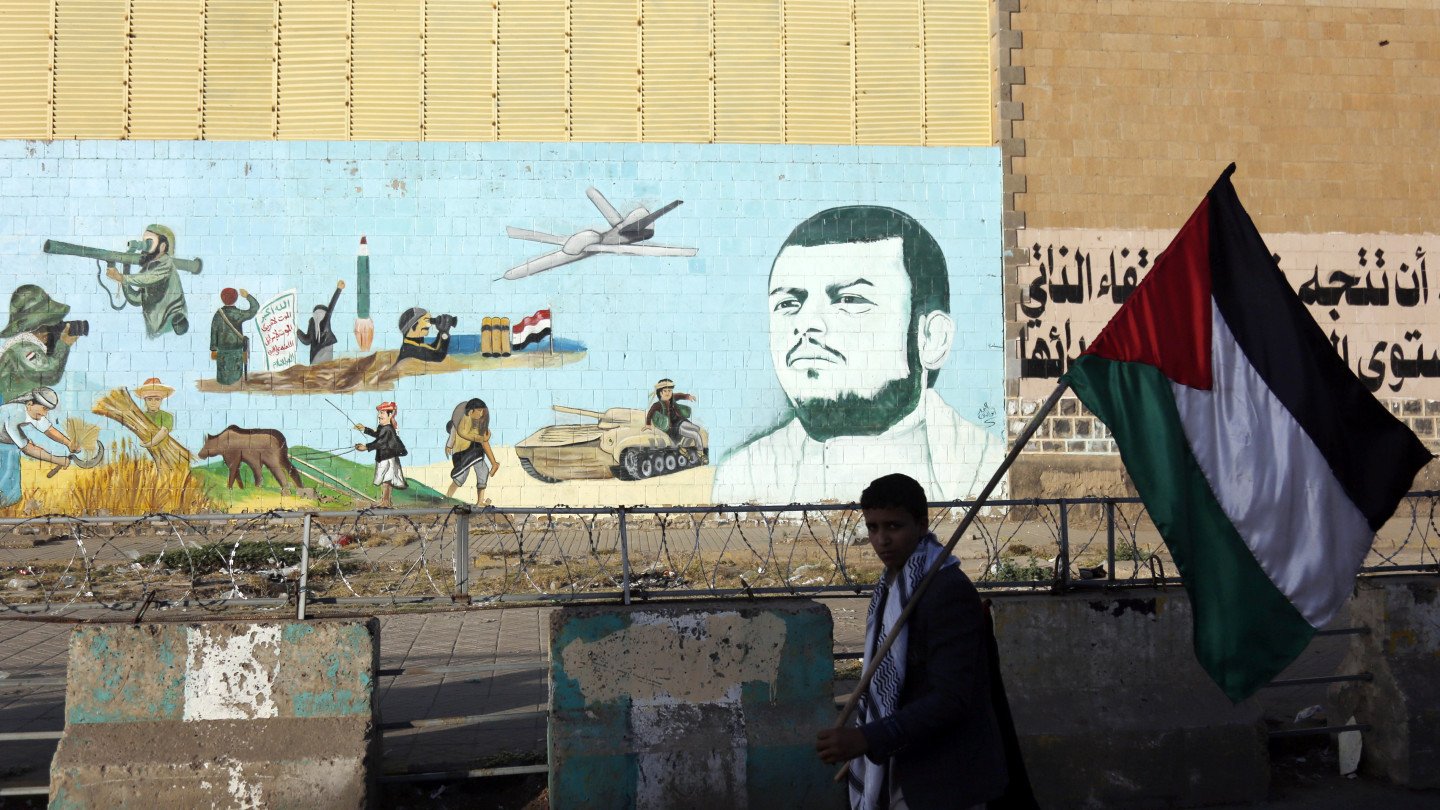
Houthi caution reveals axis fragility. Despite Iran’s war, the group prioritizes survival over solidarity. Devastating previous conflicts, economic collapse, and potential Saudi abandonment make intervention fatal. They may offer calculated Red Sea attacks, but full engagement risks their rule.
On 2 March, the leader of Yemen’s Houthis gave his second speech since the US and Israel launched a war against Iran’s Islamic Republic last week.
Malik al-Houthi condemned the assassination of Iran’s Supreme Leader, Ayatollah Ali Khamenei, and called on the Iranian people to remain “steadfast” on the path of “freedom, dignity and defiance”.
Notably absent from the speech was a promise to come to Iran’s defence as the Islamic Republic struggles to survive a war of aggression engulfing the region.
The Houthis, officially known as Ansar Allah, are part of Iran’s self-styled ‘axis of resistance’. Yet despite their close relationship with the Islamic Republic, the Houthis would prefer not to get dragged into a regional war.
They risk their own survival if they do, analysts told The New Arab.
“Everyone thought the Houthis would jump in [to defend Iran] once the war started. But their two-year war against Israel – and on Red Sea shipments – proved very costly for them,” said Ahmed Nagi, an expert on Yemen with International Crisis Group (ICG), a non-profit dedicated to preventing conflict worldwide.
“The Houthis lost many leaders, and I think they’re now trying to preserve themselves,” he added.
High cost
The Houthis and those living under their rule are under mounting economic pressure.
Since the group seized the capital of Sanaa in 2014, it has struggled to pay government salaries and provide basic services to its beleaguered population.
Unofficial estimates suggest there are about one million people on the state payroll in Sanaa alone, many of whom are living in poverty and drowning in debt to sustain their families.
In addition, the US redesignation of the Houthis as a terrorist organisation last year has pushed many donors to halt funding to relief groups, compounding the suffering.
The group has paid a heavy price – in terms of casualties and infrastructure – for confronting the US and Israel in solidarity with civilians in Gaza.
The Houthis now fear that they will invite another major operation against them if they come to Iran’s defence and that neither they nor civilians will be able to cope with the aftermath.
That could lead to internal unrest while under external attack, compromising their ability to repress dissent.
“They know what the cost would be, and it would be high: it would be fatal for them,” Yazeed al-Jeddawy, an expert on Yemen with the Sanaa Center, told TNA.
He added that if the Houthis are significantly degraded by foreign powers, then rival factions aligned with the internationally recognised government could also make a move to dislodge the group from Sanaa.
Al-Jeddawy noted that government-backed factions require Saudi approval since the kingdom pays many of their salaries.
“The Saudis could allow government forces to move on the Houthis if all its conditions were met,” he told TNA. “This includes uniting all the different factions and dissolving factions from the Southern Transitional Council (STC).”
Answering the call?
While Iran is sustaining strikes on Israel and Gulf states where US bases and personnel are located, it could soon call on the Houthis for help.
Other members of the ‘axis of resistance’ are already involved. On 2 March, Lebanon’s Hezbollah fired a drone and rockets at Israel’s port city of Haifa.
Israel retaliated with airstrikes on southern Lebanon and on the capital of Beirut, killing more than 50 people and uprooting thousands. On Tuesday, it announced the start of ground incursions in the south.
One Iranian-backed militia in Iraq also claimed responsibility for a strike on a US base in Erbil, the capital of the autonomous Kurdish region.
“Iran is using whatever they have to hit back [right now], and one component of that is [the axis] alliance,” said Negar Mortazavi, an expert on Iran with the Center for International Policy, a think-tank in Washington, DC.
“So yes, the more this war escalates across the region, the higher the chance that it calls on allied actors to get more involved,” she told TNA.
Al-Jeddawi predicts that the Houthis will partake in the war if instructed to by Iran.
However, he believes the group will calibrate their attacks to avoid triggering a major retaliation by the US, Israel and perhaps Gulf powers.
“I see the Houthis going for a calculated response, not a major one. That way, they could still leave themselves some room to manoeuvre in order to preserve their assets,” he told TNA.
Other experts believe that the Houthis will likely attack Israel and cargo ships in the Red Sea if it gets involved.
“These sorts of attacks are very much in the Houthi wheelhouse, and any attacks the Houthis carry out will likely be some variation of that,” Nicholas Brumfield, an expert on Yemen who has written for several policy-oriented publications, told TNA.
Attacking the Gulf?
However, it’s unlikely that GCC states will be the target of Houthi attacks. Any assault on Saudi Arabia could particularly backfire for the group, said Brumfield.
He explained that the Houthis have been in an uneasy truce with Saudi Arabia since 2022, with the two sides inching towards a comprehensive peace deal. Part of the deal would likely see the Houthis end their blockade on Yemeni government oil exports in exchange for receiving a share of the proceeds.
Due to significant damage to vital infrastructure and sanctions in recent years, the Houthis view a Saudi deal as a financial lifeline.
“You could really see how attacking Saudi Arabia would cause a lot of problems for the Houthis,” Brumfield told TNA.
For now, the Houthis are behaving cautiously, but they could face an external assault whether they provoke it or not, especially if the Islamic Republic implodes.
That would mean that Hamas, Hezbollah and the Islamic Republic in Iran would all be significantly degraded, leaving militias in Iraq and the Houthis as the only members left from the once sprawling ‘axis of resistance’.
In this scenario, the Houthis would need to make significant concessions during negotiations with Riyadh and the government in Aden in order to avoid a major foreign and domestic offensive against them.
“In the long run, I can’t see the Houthis surviving unless they make concessions to their adversaries and engage positively with Saudi Arabia on peace talks,” said al-Jeddawy.