
This strategic intelligence assessment evaluates structural vulnerabilities within the IMEC framework amid the Iran war, charting essential infrastructure redesigns, diplomatic shifts, and alternative overland networks across Egypt, Syria, and Yemen.
The shifting geometry of global conflict demands a drastic departure from static infrastructure modeling. Securing cross-border supply chains against systemic disruption requires Western policymakers to stop viewing transcontinental trade networks through a peacetime lens. Because vulnerable choke points are becoming highly weaponized zones of economic attrition, prioritizing new methods for bypassing the straits must take immediate precedence over idealistic commercial diplomacy. Only by structurally integrating defensive redundancy and continental alternate routes can the West preserve its economic linkages to Asian markets in an era defined by permanent regional gray-zone conflict.
Bypassing the straits protects global supply links
The war in Iran has handed global business a $25bn bill so far, much of it traceable to a single chokepoint: the Strait of Hormuz. That exposure should reframe how European leaders think about the India-Middle East-Europe Economic Corridor (IMEC)—an aspirational rail-and-port corridor through Israel, Jordan and the Gulf designed to link Europe to the Arabian Peninsula and India. Conceived for peacetime conditions, IMEC now looks ill-suited to an environment in which maritime chokepoints are routinely weaponised. European policymakers should redesign the corridor for the grey zone between war and peace that now dominates the region.
A corridor overtaken by events
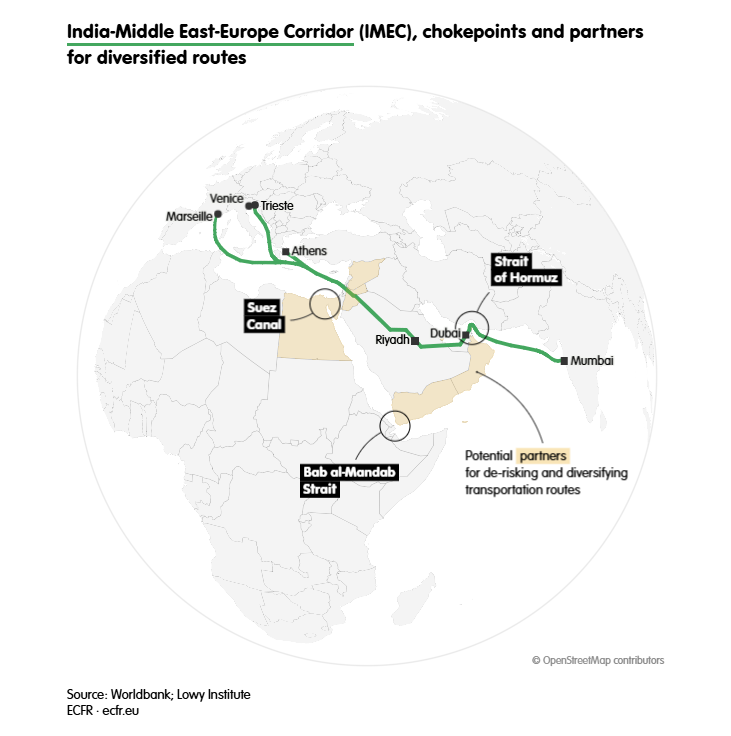
The closure of Hormuz has devastated Gulf exporters: Kuwait’s exports dropped to zero barrels in April, and Qatar’s exports fell by 90%. Only those with alternative export routes sustained flows: the UAE through Fujairah port and Saudi Arabia via its East-West pipeline to Red Sea terminals. Saudi Arabia’s Red Sea terminals also bypass Bab al-Mandab, the other chokepoint off Yemen, which the Houthis effectively closed between 2023 and 2025. Oman alone increased exports, mainly because Iran views it as neutral, but also because its main export terminals—Salalah, Duqm and Sohar—lie far outside Hormuz. The pressure has sent Gulf states hunting for routes that avoid both straits.
Arab countries, India, the EU and various member states had hoped to reduce vulnerability to maritime chokepoints when they unveiled IMEC in 2023. Since its launch, however, geopolitical conditions have changed.
Regional volatility makes bypassing the straits vital
The Abraham Accords—the 2020 normalisation agreements between Israel and the UAE, Bahrain, Morocco and Sudan—had created a framework within which broader Gulf Arab normalisation with Israel seemed achievable, and IMEC along with it. Since the 2023 Hamas-led attack on Israel, however, Israeli armed campaigns in Gaza, Lebanon, Yemen and Iran have made Gulf states, including key IMEC partners like Saudi Arabia, deeply wary of being seen as aligned with Israel.
Netanyahu has compounded this by publicly framing a post-war solution around re-routing Gulf oil and gas through Israel to bypass Hormuz. His seal on the project would recast IMEC as a hostile alignment against Iran—one that would invite sustained attacks on the corridor’s infrastructure from Iran and its proxies.
However, excluding Israel from IMEC outright is not the answer: Israel’s allies like India and the United States, as well as European countries like Germany, would probably stall the whole project if this were the case. At the same time, Saudi Arabia and other regional players will not accept entrenched dependence on Israel for access to the Mediterranean.
In practice, this implies a willingness among Saudi Arabia and other Arab states to sideline initiatives such as IMEC if they entail structural dependence on Israel. Israel’s role in the corridor was always contentious; now that access is an urgent strategic necessity, dependence on Israeli infrastructure is a political and security liability Gulf Arab states will not absorb.
New logistical pathways for bypassing the straits
The routes being built without Europe will, nonetheless, shape the corridor Europe inherits. Saudi Arabia is already seeking alternatives that escape dependency on Israel, and Egypt—absent from the original IMEC blueprint—is its first stop: Riyadh wants to integrate it as a Mediterranean outpost linked to its NEOM logistics hub. A $4bn causeway linking the Saudi coast to Egypt’s Sinai is also underway. Shipping lines such as MSC, meanwhile, are establishing new express land-bridge services between Europe and Gulf markets via Egypt and Jordan—bypassing Hormuz, though still dependent on the Suez Canal.
More ambitiously, officials in Riyadh are courting the new government in Damascus and treating Syria as a key node on the Mediterranean. In effect, Saudi Arabia is ready to spend billions rebuilding war-torn Syria if it means avoiding any reliance on Israel for key transport and trade routes. It has already sought to reroute its fibre‑optic cable projects linked to Greece’s East‑to‑Med Data Corridor through Syria instead of Israel.
It is also promoting a railway that would link it with European markets through Turkey, Syria and Jordan’s al-Haditha crossing, which is already connected to the Saudi rail network. This route, however, is fraught: Syria is still unstable and Jordan needs major infrastructure upgrades. Yet Saudi Arabia is even more reluctant to go through Iraq, which it sees as an Iranian client.
None of these routes will materialise without intricate political coordination—and that is precisely where Europe has a role to play.
Bypassing the straits demands adaptive diplomacy
European leaders should push for a pragmatic solution. The aim in redesigning the corridor should be resilience through deliberate redundancy: multiple routes that can redirect trade flows around single points of failure when tensions flare. This is a European interest in its own right, not simply an accommodation of Gulf preferences. A corridor that cannot secure the political support of its largest Arab partners, or whose key ports lack the capacity to handle required volumes, will not be built.
The economic and logistical case reinforces this. Israeli ports, for example, cannot handle higher volumes. Haifa, Israel’s largest, handled around 1.5m twenty-foot equivalent units (TEUs) in 2024—making it a mid-sized Mediterranean hub compared to Alexandria’s roughly 5.3m. The corridor should include Oman and Qatar as maritime and aerial entry points on the Asian side, drawing on the fact that Oman’s main ports lie outside the Strait of Hormuz and Qatar has unique air cargo capacity.
Infrastructure planning yields bypassing the straits options
Connectivity is also a platform for de-escalation. Europeans should prioritise projects that are politically stabilising, rewarding routes that include rather than exclude regional actors and create shared economic stakes: an attack on one route becomes a cost to all. For example, as Saudi Arabia pivots towards its Red Sea coast, it is deepening diplomatic ties to the Houthis and expanding its influence in southern Yemen. European policymakers should use both to dust off a long-shelved project: a corridor from Saudi Arabia to the Arabian Sea via Yemen’s Hadramawt. With European backing, the corridor could give Yemen’s rival southern factions a shared economic stake in cooperation. It would also be the surest way to bypass Bab al-Mandab, the other chokepoint.
Supporting these routes does not displace the case for defending freedom of navigation in both straits. European leaders should hold that line both as a matter of principle and as a precedent for other strategic chokepoints—and to spare the smaller Gulf monarchies complete dependence on Saudi Arabia.
The uncomfortable reality is that no critical infrastructure is safe without a broader climate of de-escalation. Without stability, every new route becomes a new target. But these projects should reinforce diplomacy, not replace it. European policymakers should press for regional crisis-management mechanisms that draw red lines around civilian and commercial infrastructure before attacks on trade routes become the default tool of pressure.