
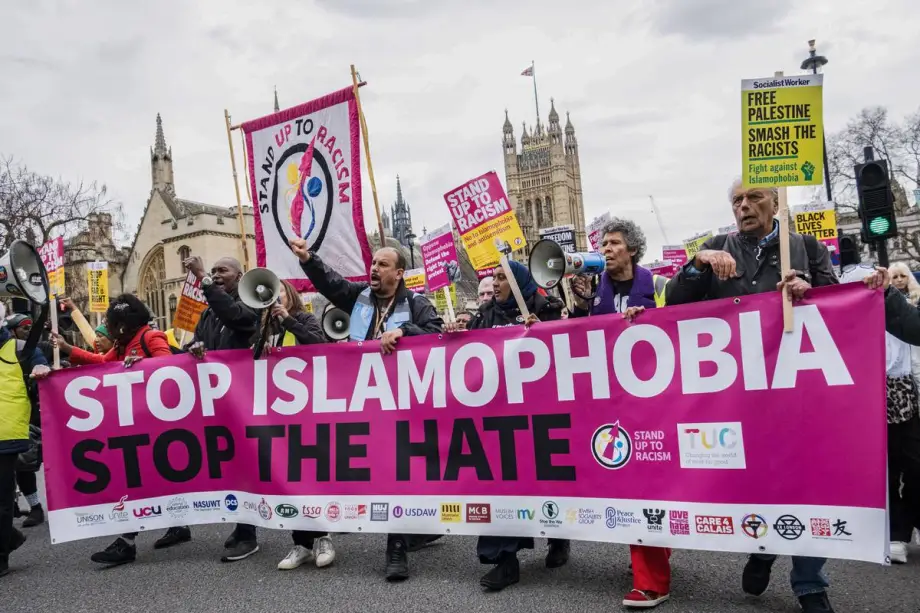
Reform UK’s local election gains risk normalizing anti-Muslim sentiment. Disguised as immigration concern, Islamophobia rising with 5,837 verified cases in 2024 threatens social cohesion. Britain faces choice between policy debate or prejudice-driven politics.
Islamophobia in uk has become a central concern for social cohesion, making the study of Islamophobia in uk vital for understanding contemporary British political shifts. Addressing Islamophobia in uk requires looking closely at how mainstream narratives shift, ensuring that the study of Islamophobia in uk remains rooted in active systemic analysis.
Reform UK’s recent electoral success should not be dismissed as a simple protest vote against the political establishment. It reflects a deeper shift in British politics: the growing ability of right-wing populism to transform public frustration over immigration, economic insecurity and declining trust in mainstream parties into a politics of resentment. The danger lies not only in Reform UK’s electoral gains but also in how its rise may further normalise anti-Muslim sentiment in Britain.
Islamophobia in uk: Political Rhetoric and the Local Election Shift
The party’s performance in the 7 May 2026 local elections was significant. Reform UK won 1,454 council seats and took control of 14 councils in England. It also made gains in devolved politics, securing 34 seats in the Senedd and 17 in the Scottish Parliament. These results show that Reform UK is no longer merely a fringe protest movement. It has become a serious electoral force capable of shaping public debate, influencing local governance and placing pressure on national politics.
The Economic Precursors to Rising Islamophobia in uk
Its appeal has been built on familiar themes: immigration, national identity, border control, economic frustration and distrust of mainstream politicians. These are real political concerns. Many communities in Britain continue to struggle with high living costs, housing shortages, weak public services and stagnant wages. However, the danger begins when these anxieties are redirected toward minorities, especially Muslims who are too often portrayed as outsiders, cultural threats or symbols of national decline.
Statistical Realities and Tracking Islamophobia in uk
This is where Reform UK’s political rise becomes deeply troubling. Public concern about immigration remains high, even though official figures show that long-term net migration has fallen sharply. The Office for National Statistics estimated net migration at 204,000 in the year ending June 2025, down from 649,000 the previous year.
Yet immigration continues to dominate political debate as one of the most emotionally charged issues in Britain. When public perception moves in the opposite direction from statistical reality, scapegoating becomes easier. Muslims have increasingly become targets of this scapegoating. Britain’s Islamophobia problem is no longer anecdotal. Tell MAMA recorded 5,837 verified anti-Muslim cases in 2024, compared with 3,767 in 2023 and 2,201 in 2022. Official police figures also show the seriousness of the problem. These figures point to a disturbing pattern: anti-Muslim hostility is moving from the margins into the mainstream of public life.
How Mainstream Stereotypes Validate Islamophobia in uk
This hostility is often disguised as concern about immigration, integration or national cohesion. In practice, it frequently reduces millions of Muslim citizens to a single stereotype. In some cases, support for Palestinian rights is unfairly associated with extremism, creating a climate in which ordinary Muslim political expression becomes suspect.
Such a climate is not only unjust but socially destructive. Muslims are part of Britain’s national fabric. Census data show that Muslims make up around 6.5 percent of the population in England and Wales or about 3.9 million people. They are not a temporary presence. They are citizens, workers, voters, students, professionals, business owners and public servants. Any politics that treats them as outsiders weakens the national unity it claims to defend.
Digital Media Networks Accelerating Islamophobia in uk
The role of media and social media has made the problem worse. Online platforms allow inflammatory claims, conspiracy theories and anti-Muslim stereotypes to spread rapidly. False or exaggerated stories about immigration, grooming gangs, terrorism or cultural change are often used to portray Muslims as a collective threat. The speed of social media gives these narratives emotional force before facts can correct them. By the time corrections arrive, much of the damage has already been done.
The scrutiny faced by several newly elected Reform UK councillors over alleged racist, anti-Muslim or conspiratorial social media posts illustrates how political rhetoric can create a permissive environment for prejudice. Such cases should not be dismissed as isolated mistakes. At the same time, Britain is not uniformly hostile to Muslims or immigration. Reform UK’s support remains weaker among younger voters, university graduates, urban professionals and people living in diverse cities. Multicultural areas such as London, Manchester, Bristol, Hackney and Tower Hamlets continue to show stronger resistance to anti-immigration populism. This matters because it shows that Britain’s future remains contested. The country has not fully surrendered to the politics of fear.
Policy Responses Necessary to Counter Islamophobia in uk
The rise of Reform UK has exposed real anger in British society. That anger should not be ignored. Economic hardship, public-service failure, housing pressures and political disillusionment are serious problems. But they will not be solved by blaming Muslims. They will only deepen if prejudice is allowed to replace policy.
Britain now faces a choice. It can have a serious debate about immigration, identity and public services without demonising minorities. Or it can allow populist politics to turn frustration into fear and fear into hate. The first path strengthens democracy while the latter corrodes it from within.
Reform UK’s success may be a warning about the failures of mainstream politics. But the rise of Islamophobia along with it points to something even deeper: the danger of a society forgetting that its minorities are not outsiders to be tolerated but citizens whose safety, dignity and belonging are essential to the health of the nation.