
Trita Parsi and Marcus Stanley
This brief is part of a larger project on the Global South, led by the Brzezinski Chair in Global Security and Geostrategy. It includes an edited volume entitled *Fulcrums of Order: Rising States and the Struggle for the Future*.
Introduction
Leading up to the 2023 G20 summit in New Delhi, the Indian government put up billboards of Prime Minister Narendra Modi across the city.
By one count, there were almost 1,000 signs and banners in the 12-kilometer stretch between the airport and U.S. President Joe Biden’s hotel highlighting India’s accomplishments, aspirations, and vision under Modi’s leadership. When asked about the billboards, India’s G20 coordinator responded, “We haven’t done advertising.
We’re doing branding.” But this branding exercise was not merely intended to highlight India’s leadership role in a major international summit; it also sought to assert India’s leadership among the G20 countries that are less wealthy but large and fast growing. Quite purposively, India gathered more than 100 countries for the Voice of the Global South Summit the week before the G20 summit, where Modi declared the importance for India of “voicing the concerns of the Global South on the agenda of a significant platform like G-20.”
As the concept of a coalition of Global South countries has emerged in recent years, India’s efforts to bolster its own brand as the vanguard of the Global South have accelerated.
But India’s response to a new international order reflects an old strategy. In March 1947, on the eve of Indian independence, India hosted the first Asian Relations Conference, bringing together a diverse range of countries, including China, Indonesia, Egypt and the Arab League, Australia, and many of the Soviet republics. India hosted the conference during a period of geopolitical transformation, as countries around the world grappled with the aftermath of World War II and an emerging process of decolonization.
Jawaharlal Nehru, then vice president of the Viceroy’s Executive Council, described the moment of the conference as an “age of transition.” He argued, “One of the notable consequences of the European domination of Asia has been the isolation of the countries of Asia from one another,” but “as that domination goes, the walls that surrounded us fall down and we look at each other again and meet as old friends long parted.”
In 1947, India was still undergoing a postcolonial political consolidation and a reversal of almost two centuries of economic exploitation under British colonialism. The idea that colonizers had purposefully created divisions between the countries they colonized and that India should play a role in restoring the historical ties among the newly liberated states became a powerful foreign policy tool. India argued that similarly situated states should align neither with their former rulers nor with their adversaries and instead should remain nonaligned.
Today, India uses similar instruments of influence. India has a growing repository of hard-power tools—including defense technology and outbound foreign investment—with which to affect the international system. India’s attention has, until now, often focused domestically, with one Indian diplomat arguing, “The foremost task of India’s foreign policy is to enable the domestic transformation of India.”
Yet a changing global order offers new opportunities to strengthen India through expanded Indian influence. An era of U.S.-led unipolarity is yielding to rising great power competition, while demographic and economic growth across the Global South has increased the geopolitical salience of countries that have traditionally lacked influence on the international stage. India has a fast-growing economy, a hard-power tool kit that is poised to significantly expand, and important stakes in the international system.
It is therefore unsurprising that India, once again, finds itself at the center of an emerging discourse among states that were formerly leaders of the nonaligned world, often termed the Global South.
To date, India’s external power and influence are largely confined to its regional neighborhood and to rhetorical power. India’s claims of leadership for the Global South are consolidating its influence in Africa and Asia but still fall far short of China’s investment-led diplomacy.
However, in the coming decades, socioeconomic and geopolitical shifts will dramatically change India’s role in the global system. India’s growing economic power will encourage other countries to seek closer relations, and as India becomes “a friend to all and an enemy to none,” it will gain greater diplomatic power. Still, India’s aspiration for “strategic autonomy” will be tested as states push an increasingly powerful India to pick sides in conflicts ranging from Russia’s war in Ukraine to the Israeli-Palestinian conflict and tensions with Iran.
Additionally, for India to remain undeterred on its economic development trajectory, it will have to carefully balance an increasingly aggressive neighbor, Pakistan. The last few weeks of May 2025 proved the fragile nature of regional peace. The significance of the Global South as a political coalition may ultimately hinge on how India chooses to balance its goal of strategic autonomy with its emerging role as a powerful actor on the global stage.
History, Grievances, and Aspirations
A fundamental contradiction lies at the heart of Indian foreign policy: The state is, in many respects, one of the most significant geopolitical actors on the global stage, yet it does not share in many of the benefits of the international system afforded to other major powers in the Global North.
This contradiction stems from the formation of the post–World War II international system. During the war, India supplied almost 2.5 million troops around the world, a total exceeding that of countries such as France. Yet, in the aftermath of the war, France was rewarded with a permanent seat on the UN Security Council (UNSC), whereas India was not.
The sense of dispossession has remained a through line of Indian foreign policy, with Indian Minister of External Affairs Subrahmanyam Jaishankar lamenting more than 70 years later, “India was not on the high table in 1945 and continues to pay the price of being absent.”
Since independence in 1947, India has sought to play a role in leading fellow countries that had recently emerged from colonialism. In 1955, India co-organized the Bandung Conference, where dozens of nations came together to speak for oppressed nations and outline shared objectives of self-determination and equality.
Six years later, India co-organized the first meeting of the Non-Aligned Movement (NAM) to discuss how postcolonial countries could avoid being drawn into Cold War competition. India played a formative role in the creation of the Group of 77 (G77) in the United Nations in 1964 and served as the inaugural chair from 1970 to 1971. The group, which has been focused on what were formerly known as “developing countries,” now encompasses 134 nations, from impoverished ones like Yemen to wealthy ones like Qatar and from tiny ones like Dominica (population of about 75,000) to huge ones like India (population of more than 1.4 billion).
India has used its capacity to convene and mobilize Global South countries to push for the reform of international institutions. Since the 1990s and 2000s, India has positioned itself as the leading voice of developing nations at the World Trade Organization (WTO).
Indian officials argue that developed nations almost entirely drive the priorities of WTO discussions. Issues such as agricultural market access disproportionately affect poorer countries, and India has often called for a comprehensive set of discussions that offer clear protections for developing nations. India also regularly calls for governance reforms of the World Bank, International Monetary Fund, Nuclear Suppliers Group, and International Telecommunication Union.
Within the United Nations, India has emerged as a champion of the principle of Common but Differentiated Responsibilities and Respective Capabilities within the UN Framework Convention on Climate Change. This principle, which acknowledges different responsibilities for nations like India that have historically had a significantly lower carbon footprint than Western nations, has become a key issue for Global South countries as states ramp up the global response to climate change. Finally, India’s Ministry of External Affairs explicitly linked the Voice of the Global South Summits to its presidency of the G20 at the time.
Following the first summit in January 2023, the ministry wrote that the summit’s deliberations were significant because “India’s ongoing presidency of the G20 provides India a special and strong opportunity to channelize these inputs into the deliberation and discourse of the G20.”
This long-standing grievance about India’s exclusion from the institutions of international governance has naturally aligned its rhetoric at the United Nations with that of other Global South countries. In 2018, then-Minister of External Affairs Sushma Swaraj noted that the combined populations of India and Africa totaled almost 2.5 billion people and called for the inclusion of both Indian and African representation on the UNSC. Similarly, in 2023, Modi pointed to the exclusion of the continents of Africa and Latin America when he advocated for India’s inclusion in the UNSC. India couches calls for its increased inclusion in the international system of governance within the language of a united Global South movement. By doing so, it seeks to legitimize its efforts as part of a broader shift toward more inclusive international governance rather than a self-interested pursuit of increased Indian influence.
Building on its historical role, India hosted three Voice of the Global South Summits between 2023 and 2024, where it convened 125 countries to share their perspectives on and priorities for a range of issues facing developing countries, including the Covid-19 pandemic, Russia’s war in Ukraine, developing country debt, and food and energy security.
But as India seeks to leverage the power of a coalition of Global South countries to restructure the international system, it also seeks to preserve that system. The 1962 Sino-Indian War is a historical example that casts a long shadow. In part, it exposed India’s vulnerability to its eastern neighbor, and the aftermath of the conflict led India to dramatically overhaul and modernize the Indian military. But the war also led India to emphasize the importance of sovereignty and respect for territorial borders in the international system.
As a result, Indian foreign policy today seeks to navigate between the two poles of stasis and change. Modi cautions against an “adversarial relationship” with the Global North and warns that the alternative to an inclusive international order is “a world that is adrift, that becomes more fragmented.
Moreover, China’s ascent in the geopolitical landscape has magnified India’s concerns about sovereignty and the maintenance of international norms. India’s strategy is to balance its competing desires to position itself as a leader of the Global South and to push for fundamental reform of international institutions while also maintaining its strategic autonomy and using the international system of rules and norms to protect its geopolitical interests.
Visions of Global Order
India does not want to be pushed by other nations to reduce critical trade linkages with Russia. While India’s position on the invasion of Ukraine has evolved in helpful ways, India still relies on Russian military equipment for its services, and its decision to ignore restrictions on Russian crude oil sales has been a boon to domestic energy markets. However, there is little strategic overlap between evolving worldviews in Delhi and Moscow. India’s diaspora, trade, and investment partners are largely with the United States, Europe, South Korea, Japan, and other Western or Western-oriented nations. India desires recognized borders, shipping security, and other basic features of a global international order.
India has three interconnected approaches to global order. First, it would like to reform existing international institutions in order to enjoy greater authority within them. At the G20 Foreign Ministers’ Meeting on Global Governance Reform in 2024, then-Indian Minister of State for External Affairs Vellamvelly Muraleedharan argued that an Indian vision of a reformed multilateral system includes four elements: increasing the representativeness and efficacy of international financial institutions, improving the working methods of international organizations, reducing the influence of individual states’ interests in multilateral systems, and initiating comprehensive UN reforms, especially of the UNSC.
Second, India is shifting from its historical policy of nonalignment to a new strategy of “plurilateral omni-alignment.” The fundamental goal of both nonalignment and what India’s ruling Bharatiya Janata Party (BJP) calls “multialignment” remains the same, insofar as India continues to seek strategic autonomy.
However, this new strategy diverges in its increased willingness to enter into simultaneous strategic partnerships with competing major powers alongside coalitions of Global South countries and middle powers. As part of this strategy, India has joined or created a wide range of multilateral or minilateral organizations that allow it to advance its strategic interests while simultaneously providing alternatives to existing structures. In doing so, it has balanced its participation in Western, Global South, nondemocratic, and Indo-Pacific groups with the goal of becoming “a friend to all and an enemy to none.”
Third, while India is engaging with Global South countries across the world, it is also refocusing on expanding relations with immediate neighbors.
It does so as China has expanded its development assistance and economic investments in South Asia, including almost $16 billion in projects in the Maldives and Sri Lanka alone between 2000 and 2018. India has sought to counter growing Chinese economic influence in the Indo-Pacific neighborhood by expanding its regional diplomatic and economic ties. In 2020, for example, India formed the Colombo Security Conclave—a new minilateral group including Bangladesh, the Maldives, Mauritius, Seychelles, and Sri Lanka—focused on security issues, humanitarian assistance, and disaster relief.
At the same time, India has tightened its economic ties with its neighbors through infrastructure investments and debt diplomacy, including by signing a 20-year energy agreement with Sri Lanka and providing loans to the Maldives to prevent a default. Notably, India’s loans to the Maldives were interest free, part of India’s broader strategy of economic engagement with Global South countries that seeks to contrast itself with China’s more exploitative model of debt diplomacy.
National Debate
As India’s leadership seeks to expand the country’s influence on the global stage, domestic public opinion is signaling widespread optimism with the country’s growing geopolitical weight. According to a 2023 Pew Research Center poll, 68 percent of Indians feel that India’s influence in the world has been on the rise in recent years.
This finding holds true across political party affiliation, with 60 percent of respondents who do not support the governing parties under the National Democratic Alliance agreeing that India is growing in global influence. The polls also suggest growing Indian public concern with China, whose impacts on India range from trade to territory. Unfavorable views of China reached record levels at 67 percent of participants, up from 46 percent just five years prior.
Despite growing popular alignment over India’s international trajectory and its principal foreign policy concerns, India’s domestic politics are becoming more challenging. In May 2024, Prime Minister Modi’s BJP formed a third consecutive government—a feat only previously achieved by India’s first prime minister, Jawaharlal Nehru. However, the BJP no longer constitutes a majority in parliament, and it must rely on coalition partners to form a government. While Modi enjoyed an outright majority from 2014 to 2024, the situation was unusual; from 1989 onward, India has typically had coalition governments at the center supported by regional parties—a norm that appears to have returned.
In this context, India’s political opposition parties have begun to craft a foreign policy agenda that more clearly differentiates them from Modi’s ruling party, the BJP. Although foreign policy has historically been a marginalized issue in Indian elections, opposition parties emphasized foreign policy during the 2024 elections. In its 2024 election manifesto, the Indian National Congress party highlighted several areas of divergence, criticizing the Modi government for insufficiently raising defense expenditures and advocating for a harder line on China and greater engagement with India’s immediate neighbors—specifically, Bhutan, the Maldives, Myanmar, Nepal, and Sri Lanka. It also calls for India to return to its more traditional stance on foreign policy, singling out the Modi government’s relative embrace of Israel amid the conflict in Gaza.
But as these critiques demonstrate, the scope of political debate about India’s engagement with the world, and with Global South countries specifically, is mainly relegated to debates over the shape of that engagement. There is widespread support within the political elite, buttressed by strong public opinion, that India should play a more assertive role in global affairs.
Historically, India’s permanent diplomatic corps has contributed to India’s relatively consistent foreign policy agenda. However, turbulent coalition dynamics mean that this consistency and unanimity can change and should not be taken for granted. There are other factors, too. Demographics are changing, and the number of urban voters will increase. Climate risks are increasingly consequential. These changes may combine to make regional political interplays more complex.
Moreover, although foreign policy falls solely under the mandate of the central government, state governments and regional parties are central to India’s development trajectory and, by extension, its narrative as a global player. This is for two reasons.
The first is their role in attracting foreign direct investment. While many outsiders see a “China+1” supply chain diversification strategy as a national issue, states have major economic roles to play, and many develop their own set of foreign policy priorities.
In addition, political parties—such as the one running Bihar and Andhra Pradesh—sometimes have parochial interests that can affect national policy. For instance, the Congress-led coalition government in 2010 could not muster enough regional parties to support legislation to set liability for civilian nuclear accidents, which, in turn, has precluded nuclear trade with the United States.
Ultimately, there is relatively high unity among both foreign policy decisionmakers and grassroots public opinion about the need for India to play an assertive role in global politics and international governance. However, smaller margins for the ruling coalition in parliament have incentivized opposition parties to more clearly differentiate their foreign policy platforms from Modi’s. Combined with demographic changes and substate policy variation, these trends suggest that the specific form of India’s global engagement may be susceptible to change over time in the coming years.
Economics
Promoting economic growth and integration is an integral part of India’s broader strategy of maintaining plurilateral agreements with a wide range of international actors.
The country’s rapid domestic economic growth creates a positive incentive for countries to expand engagement with India, both economically and diplomatically. The country’s GDP has increased dramatically, from approximately $37 billion in 1960 to $3.57 trillion in 2023.
This growth has made India the world’s fifth-largest economy, and it is projected to surpass Germany and Japan in the next six years. In demographic terms, India recently passed China to become the world’s most populous nation—a title India may never cede. India is also the largest source of international migrants, with a diaspora estimated at 17.5 million as of five years ago. India is also the largest recipient of remittances at $125 billion in 2023, almost double that of the second-largest nation, Mexico.
To this end, India’s substantial economic development domestically has put the country in a more powerful position to strike deals internationally.
India was the world’s second-largest exporter of information technology (IT) services in 2021 at $119 billion, behind only Ireland at $204 billion. India also has a meaningful level of trade integration with the world. India’s goods trade is equivalent to 46 percent of its GDP, which is middle of the pack for the world’s five largest economies—behind Germany and Japan but ahead of the United States and China. Military hardware plays a major role in India’s trade figures.
India constituted nearly 10 percent of total global arms imports from 2019 to 2023, and the country’s arms exports are growing. While Russia remains the largest source of foreign-procured arms, France, the United States, and Israel are steadily gaining market share.
India is also a growing provider of development assistance, which has become a tool of foreign policy. Between 2000 and 2024, India provided a total of $48 billion in development assistance to 65 countries. That total includes grants, credit, and capacity building and training assistance but excludes emergency assistance and multilateral funding. The emphasis on international development assistance for Global South countries is also set to expand in the coming years, with India allocating $810 million for external development projects in its FY 2025–26 annual budget, an increase of 20 percent from the previous year and representing a third of the Ministry of External Affairs’ total budget.
Expanded development assistance serves two key functions for India’s foreign policy goals. First, it serves as a vehicle for India to establish itself as a leader among countries of the Global South. At the Third Voice of the Global South Summit, Modi unveiled a Development Compact designed to coordinate efforts by Global South countries to address their debt crisis by boosting capacity building, trade, and concessional finance. Second, Indian development assistance is building long-term partnerships between India and Global South peers. India has provided loans of more than $14 billion to fund 357 projects across 42 countries in Africa.
These projects often focus on building traditional infrastructure, such as highways, railroads, and ports, which could serve as a precursor to more expansive bilateral trade with African countries. Similarly, India is also exporting its own digital infrastructure to Global South countries as a means of fostering greater multilevel engagement. Collectively, this economic engagement has the potential to build up long-term mutual economic dependencies between the Global South and India.
Strategic Competition: The China Threat
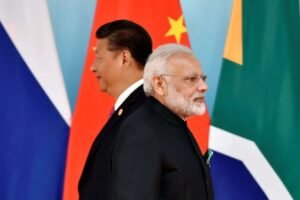
If the goal of India’s increasing engagement with Global South countries is to ensure India’s strategic autonomy in a changing global order, it does not view all threats to its autonomy equally.
As the rhetoric of policymakers and public opinion polling demonstrate, Indians remain particularly concerned about threats within their immediate neighborhood. India faces important territorial disputes with its two largest neighbors, China and Pakistan. Instability in several Middle Eastern countries, where India has large diaspora populations, is a recurring concern for New Delhi. Almost all of India’s immediate neighbors have varying levels of political instability, as well as deepening linkages with China.
India’s most important strategic consideration is its tense relationship with China, which poses a range of escalating threats beyond India’s ability to manage alone. First, the two nations have yet to resolve their border disputes.
This has led to significant clashes, such as a 2020 skirmish where soldiers engaged in brutal hand-to-hand combat resulting in dozens of casualties. Second, China’s People’s Liberation Army Navy has increased its presence in the Indian Ocean, regularly deploying research vessels and conducting deep-water surveys. Third, India holds a significant trade deficit with China.
China (including Hong Kong) is India’s largest goods trade partner by a significant margin, with $147 billion in total trade in FY 2023–24. India’s second-largest goods trade partner is the United States, with $120 billion in total trade last fiscal year. India also has a five-to-one trade deficit with China, which has triggered a range of trade protections by the Modi government.
Fourth, China’s influence extends into the religious domain. In 1959, the spiritual head of Tibetan Buddhism, the Dalai Lama, fled Communist China to take up residence in India. He is now 89 years old, and there are concerns about a leadership schism after his passing. Many expect the Chinese government will seek to select a more pliant religious leader, over the objections of India-based Tibetan Buddhists. Lastly, China is heavily invested in Pakistan, which India views as an often-hostile neighbor to its west. Despite reports that China’s investments are going poorly, projects such as the $62 billion China–Pakistan Economic Corridor (C-PEC) and the deepwater port in Gwadar make some Indians fear China is attempting to encircle them.
India’s response to this set of challenges has been to expand its engagement with Global South countries in the Indo-Pacific. As other sections of this paper note, India in recent years has substantially increased its multilevel engagement with countries in the Indo-Pacific, including by developing minilateral fora, ramping up development assistance, and building physical and digital infrastructure to facilitate mutual dependencies. India’s engagement with Global South countries is thus mediated by extant security concerns and, accordingly, exhibits regional variations.
Recent Actions
While India’s economy has grown significantly, its ability to use economic tools to advance its diplomatic goals remains modest. India provided a total of $667 million in aid to other nations in FY 2022–23, the majority of which went to its tiny neighbor Bhutan. Worldwide, Indian firms invested only around $4 billion in equity into external markets, a tiny sum on a global scale. While India’s trade is growing sharply, the majority of India’s largest goods trade partners are “developed” nations, and all of them have higher per capita income levels than India.
India is expanding efforts at economic integration with partners, particularly through development assistance, loans, and infrastructure construction. Compared to other major powers in the global system, however, its global economic footprint remains modest. The relatively small scale of Indian engagement helps explain why India has sought to use symbolism as a force multiplier, leading through ideals and pushing diplomatically for global changes on behalf of fellow Global South countries.
As discussed, India has taken a strong advocacy role, calling for reform and more inclusive structures within existing international institutions, ranging from the United Nations to the International Monetary Fund, World Bank, and WTO. Officials in New Delhi discuss India’s leadership of the G20 as the reintroduction of India as an emerging leader on global issues and a voice of the Global South. While tangible outcomes resulted, such as gaining support for the African Union joining the G20 and raising awareness of India’s growing digital public infrastructure, these were relatively marginal.
Facing resistance to its efforts to reform the current structures of international governance, India has sought to create competing structures and tools. Among the most notable is the formation of BRIC (Brazil, Russia, India,
China) in September 2006, later rebranded as BRICS with the inclusion of South Africa in 2010. Members’ disagreements about exactly what the group’s goals should be and how it should pursue them, abetted by rivalries between them, have sometimes obstructed progress.
As a result, early ambitions, such as disrupting the Western-led global economic system, have remained unfulfilled. Still, BRICS has been active. It created a multilateral development bank called the New Development Bank in 2015. More recently, it expanded, adding Egypt, Ethiopia, Iran, and the United Arab Emirates in 2024 and Indonesia in 2025. Yet exactly what the organization will seek to do and what it can do remain uncertain.
With internal disagreements limiting the impact of BRICS as an alternative to the Western-led international order, India has recently invested in newer, smaller, and more plurilateral coalitions of Global South countries.
In its own neighborhood, India launched the Forum for India-Pacific Islands Cooperation in 2014 to boost its bilateral and multilateral cooperation with 14 Pacific Island countries. But this policy has extended well beyond the Indo-Pacific. In 1991, El Salvador, Guatemala, Honduras, Nicaragua, and Panama established the Central American Integration System (SICA) to boost regional cooperation and economic integration. In 2004, India hosted a delegation of 14 SICA countries, leading to a formal agreement to establish a mechanism for political cooperation between India and SICA. This agreement led to a framework of biannual high-level meetings between India and SICA countries, as well as annual meetings alongside the UN General Assembly, with a specific focus on cooperation over IT, science and technology, drugs and pharmaceuticals, infrastructure, and tourism.
India has also crafted agreements with Western powers to support its work with Global South countries. In 2015, India cocreated the International Solar Alliance (ISA) with France. The role of the ISA is to facilitate the transfer of capital and technology to developing nations to accelerate steps to combat climate change. India and other nations believe that developed nations’ pledges of support are not being met, and India wants to play a catalytic role in supporting more work. Around 120 nations have signed on to the ISA, including the United States. The ISA claims progress in strengthening solar projects in Bhutan, Madagascar, Uganda, and elsewhere.
However, as much as India seeks to lead the Global South, the chief obstacle is its complex relations with China. The two countries are neighbors, partners, and rivals.
While India has grown strong ties with fellow Indo-Pacific powers that share concerns about China’s destabilizing rise, almost all these countries share China as their principal trading partner. In addition, India’s concern with China has driven U.S.-India security ties, both bilaterally and through the reconstituted Quad—a grouping among Australia, India, Japan, and the United States—of which India is a principal driver. India finds the Global South an inadequate security hedge against China’s power; India requires help from the United States and its closest allies, arguably undermining the strategic autonomy India seeks from traditional great power competition.
Conclusion
India’s future will be even brighter than the present. India contributed around 16 percent of global economic growth last year; this number could rise to 18 percent by the end of the decade. As its economy grows, India will have more resources to channel into outbound foreign investment, development assistance, and production of a wider array of advanced weapons systems.
However, as India continues along this trajectory, it will likely face growing tension between its aspirations to play a more powerful role in the international system and its desire to maintain strategic autonomy and multialignment. India’s engagements with other nations will become more consequential, and India may find it harder to continue its role as a bridge between competing forces. Other nations will want India to choose sides.
India’s strategic and economic footprint has been large enough to be noticeable but small enough to allow flexibility in looking at partnerships and models for global order.
Those days will soon pass. China’s strength and belligerence will compel India to continue deepening a range of strategic partnerships, and India’s growing heft as an economic and technological hub will challenge its ability to retain its position as a balancing power on crucial global issues such as future conflicts in the Middle East. Ultimately, India’s security and domestic prosperity will be most closely linked to its relations with the United States and its partners.
India’s outreach to Global South countries could be a key determinant of its ability to maintain a balance between its strategic autonomy and rising power in an era of dynamic multipolarity and growing geopolitical competition. Like India, many countries in the Global South resent their exclusion from the international system of governance and the legacy of a forced choice between great power competitors during the Cold War.
At that time, however, Global South countries remained fragmented, limiting their ability to resist the pressures of the international system to choose a side. But today, Global South countries have begun to consolidate coalitions of like-minded countries, leveling up their ability to influence international politics. India, as a clear leader of many of these coalitions, could use this scaled-up influence to define for itself what strategic autonomy will look like in a multipolar world featuring a powerful Indian state. In the next decade, a new chapter in the foreign policy strategy of a resurgent India must be written as its tools catch up to its lofty visions for an independent pathway in global affairs.
https://www.csis.org/analysis/indias-future-strategic-choices-complications-mass