
The Strait of Hormuz closure boosts Turkey’s energy hub aspirations via the Kirkuk-Ceyhan pipeline and Iraq Development Road. Gulf states, seeking alternatives to US and Israeli security partnerships, are buying Turkish drones. Meanwhile, Iranian strikes on Gulf cities position Istanbul as a protected financial center, though rule-of-law concerns persist.
The Iran war has posed significant immediate challenges for Turkey. Key among them are rising energy prices, which have complicated President Recep Tayyip Erdoğan’s efforts to stabilize the economy ahead of critical elections in 2028. But Turkish officials think that Ankara could reap benefits from the war in the long term.
Regional Energy Hub Dreams Within Reach?
One key opportunity is in the energy sector. Turkey is one of the world’s leading energy consumers, but it has few domestic resources. Its dependence on Russia and neighbors like Iraq and Iran to meet its energy needs creates vulnerabilities. To overcome those disadvantages and strengthen Ankara’s hand, Erdoğan has long sought to position Turkey as a regional energy hub, connecting natural gas producers to its east and south with markets to the west. Ankara believed Turkey’s geographical position and infrastructure would give it an advantage in this regard, but the country’s complicated relations with regional states have hampered these efforts.
Amid the Iran war, Ankara sees an opportunity to realize its plans. The effective closure of the Strait of Hormuz has disrupted maritime traffic and global energy supplies, prompting regional powers to seek more secure overland alternatives. To mitigate risks and keep oil flowing, Saudi Arabia and the United Arab Emirates are utilizing existing pipelines that bypass the strait. The Saudi East-West pipeline transports up to 7 million barrels per day (bpd) from eastern fields to the Red Sea port of Yanbu while the UAE’s Abu Dhabi Crude Oil Pipeline (ADCOP) moves 1.8 million bpd to the port of Fujairah, located outside the Strait of Hormuz. According to energy analysts, these measures help but are insufficient to fully offset the closure of the strait, through which an average of 20 million bpd of oil and refined products normally flows.
Turkish officials argue that Turkey could play a significant role in transporting the region’s resources to Europe and would like to increase exports through the Kirkuk-Ceyhan Oil Pipeline, which brings Iraqi crude to the Mediterranean. The Turkish energy minister has said that Ankara is working to promote other non-Hormuz projects, pointing out the utility of an alternative way to carry “Qatari gas to Türkiye … and perhaps onward to Europe” in the event existing facilities are damaged or destroyed.
Turkey also plays a role in Russian gas deliveries to Europe through the TurkStream pipeline, which runs from Russia to Turkey beneath the Black Sea. Supplies transiting the pipeline increased 22% from a year earlier to 55 million cubic meters in March, highlighting the collateral effects of the war on Ankara’s efforts to play a bigger role in the energy trade. Although significant hurdles — such as obtaining financing for expensive infrastructure projects — would need to be overcome first, Turkish officials see this moment as an opportunity to push the country’s long-held plans to become an energy hub, and industry experts think that in the medium term, Turkey could indeed offer an alternative.
A Regional Crossroads
Another Turkey-led project that has benefited from the war is the Iraq Development Road, a trade corridor being built from the southern Iraqi city of Basra to Turkey and eventually onto Europe via integrated rail and highway networks. Turkey presented the project as an alternative to the US-backed India-Middle East-Europe Economic Corridor (IMEC), which was announced at the meeting of the Group of 20 (G20) in New Delhi in 2023 and which bypasses Turkey. The Iraq Development Road faced financial hurdles and opposition from Iran, which was worried it would lead to a loss of revenue and influence while boosting Turkey’s regional reach. The war offers Ankara an opportunity to promote the transit route as an alternative, designed to handle 20-25 million tons of cargo annually in its initial phases while decoupling critical energy and trade flows from vulnerable maritime corridors like the Gulf and Red Sea.
The Boon to Turkish Defense Manufacturers
Ankara also wants to capitalize on the current conflict by promoting its interests in the defense sector. The Iran war has demonstrated to the Gulf countries the importance of seeking alternative defense partners as they rebuild their battered economies and navigate a continuing threat from the Iranian regime. Turkey has already cultivated close defense and security ties with these countries centered on arms sales and joint production. During Erdoğan’s 2023 trip to the Gulf, Riyadh signed Turkey’s largest-ever defense export deal for Bayraktar Akıncı unmanned combat aerial vehicles, followed by agreements with Saudi state defense firm Saudi Arabian Military Industries (SAMI) to localize drone manufacturing and expand cooperation with Turkish companies such as Baykar and Aselsan. Talks have since broadened to include warships, tanks, missile systems as well as a partnership in Turkey’s fighter jet program. Defense relations with the UAE and Qatar are strong as well. Turkey’s defense relationship with Qatar is anchored by a Turkish military base, joint exercises, troop deployments, and close strategic coordination that has expanded steadily since 2015. Turkey and the United Arab Emirates have moved into drone sales, industrial cooperation, and joint projects between Turkish firms such as Baykar and Emirati defense giant EDGE.
Both the Turkish government and Turkish defense companies see the Iran war as a major opportunity to build on that momentum. A Turkish defense official told the author, “Our companies such as Aselsan and Otokar are already operating in the Gulf but the current war is pushing other, smaller Turkish defense companies that produce cartridges, explosives, and ammunition to cultivate partnerships in these countries as well.” Turkish officials often talk about the need to “build a new security structure in the region” to counterbalance Israel’s power and reduce dependence on the US, and they consider Turkey’s growing defense capabilities to be the answer.
A Protected Financial Center on the Bosporus
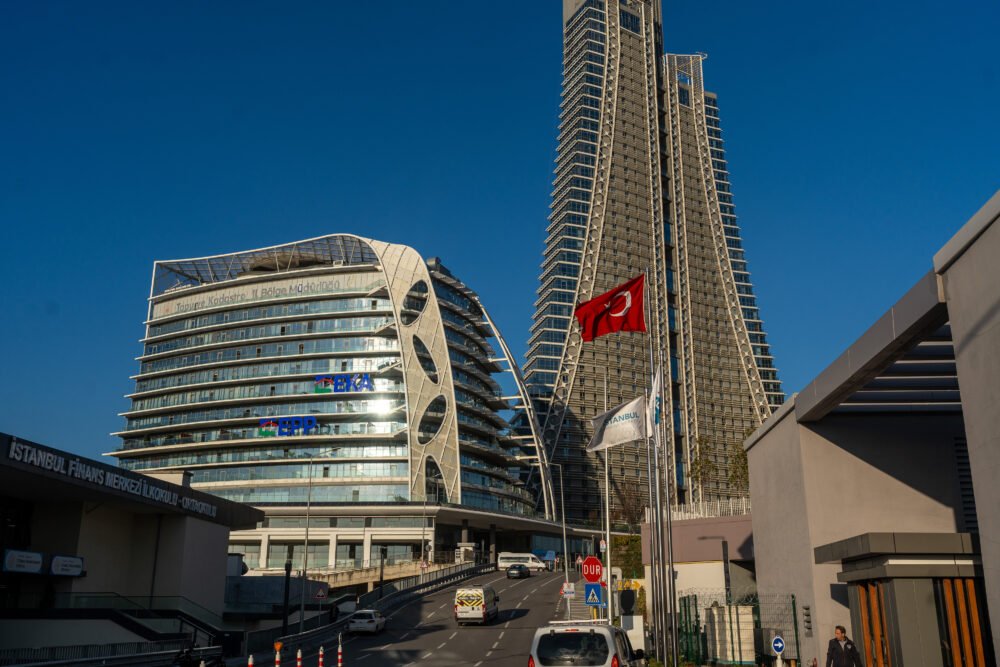
Ankara sees an opportunity in the current regional context to realize another of its long-held plans. Since their early years in power, Turkey’s ruling elite have wanted to make Istanbul, Turkey’s largest city, the region’s financial capital. Instead, Turkey watched as Dubai took on that role. For years, states such as Saudi Arabia, the UAE, and Qatar built diversification strategies around enhancing investor confidence, legal and regulatory predictability, connectivity, tourism, and the promise that they were insulated from the turmoil of the wider Middle East. The Iran war, however, has shaken the Gulf monarchies’ carefully cultivated image as safe havens for global business. Tehran launched missile and drone strikes on Gulf cities, ports, and oil facilities, straining their air-defense systems while NATO shielded Turkish airspace from Iranian attacks. This allows Turkey to make the case that air-defense capacity is key for the protection of critical infrastructure, the continuity of trade flows, and the security of capital movements, promoting Istanbul as a safer alternative for trade and investment. Indeed, the war has prompted dozens of companies spanning the fintech, finance and Islamic finance, and insurance sectors that operate in the Gulf to consider moving their business to Istanbul’s newly emerging, state-backed financial district, although the country’s politicized courts and erosion of the rule of law give investors pause about committing capital there.
Strategic Post-War Positioning
The political elite in Ankara see no easy end to the current war with Iran and are increasingly anxious about President Donald Trump’s recent decision to impose a blockade on the Strait of Hormuz. They are bracing for a prolonged conflict and worry that its immediate impact will further damage the Turkish economy. At the same time, they are eyeing opportunities the war could create for Turkey over the longer term. From defense and infrastructure to energy and business, the openings come with serious hurdles, but Ankara is already positioning itself to capitalize on them.