
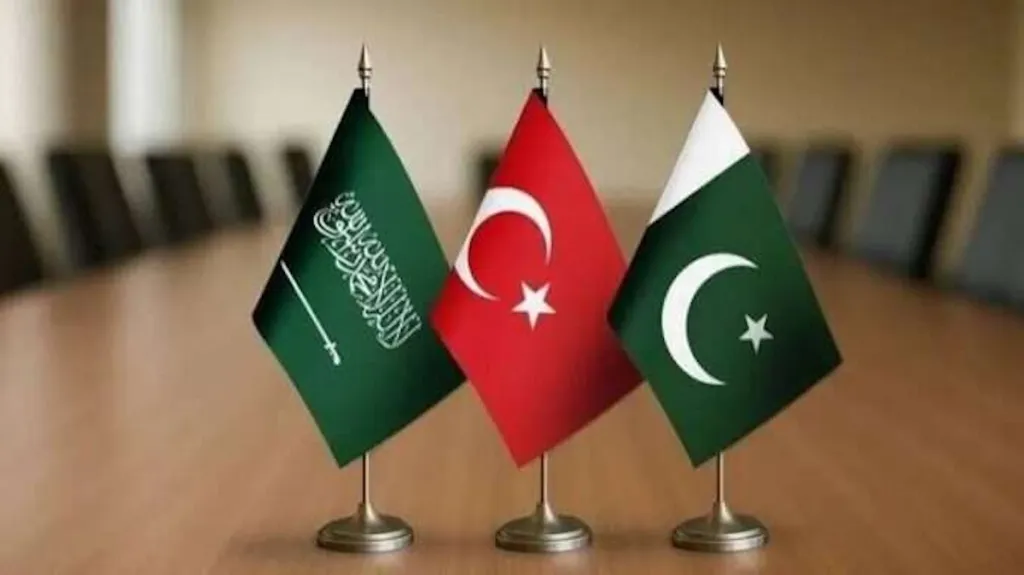
Saudi Arabia, Turkey, and Pakistan signed the Mecca Defense Agreement, a mutual defense pact that rejects US-led Gulf security. The accord follows Iranian retaliation and faltering American deterrence, reshaping Middle Eastern alliances.
The intensifying deadlock in the Middle Eastern war has catalyzed a foundational shift in regional security architecture. The recently inked Mecca Defense Agreement between Saudi Arabia, Turkey, and Pakistan crystallizes a profound disillusionment with American strategic guarantees.
For decades, Gulf monarchies anchored their defense to the United States, hosting its bases and trusting its deterrent umbrella. Heavy American bombing campaigns against Iran and President Trump’s erratic diplomatic maneuvers have shattered that confidence, driving key Muslim-majority powers to erect an independent collective security mechanism. This trilateral pact, signed in Mecca, explicitly invokes an all-for-one mutual defense clause, mimicking NATO’s Article 5 in ambition. Riyadh supplies the economic muscle, Ankara the largest army in NATO after the United States, and Islamabad its nuclear arsenal—a potent combination designed to fill the void left by a perceived American retreat.
The Mecca Defense Agreement thus represents more than a paper accord; it embodies a strategic rejection of external hegemony and a bold, if precarious, bet on regional self-sufficiency. Its emergence signals an accelerating fragmentation of the post-Cold War order, where middle powers no longer wait for Washington’s permission to construct their own security poles. As Iranian counterstrikes paralyze commerce and expose the fragility of US-extended deterrence, this alliance marks a definitive pivot away from a Pax Americana that has governed the Persian Gulf since the 1991 liberation of Kuwait.
Mecca Defense Agreement’s Core Pledge
The deadlocked Middle East war gave birth last week to a defense alliance among Saudi Arabia, Turkiye and Pakistan that represents a vivid backlash to the failures of heavy American bombing of Iran and President Donald Trump’s spasmodic diplomacy to end the conflict.
The agreement was signed Friday in Saudi Arabia, which is among fossil fuel-rich Persian Gulf countries hardest hit by the physical and economic force of Iran’s counterattacks. Tehran justifies its attacks on the basis of the Saudi foreign policy alignment with the US.
Saudi leader Mohammed bin Salman, Turkish President Recep Erdogan and Pakistan’s Prime Minister Shehbaz Sharif signed the agreement. The key phrase echoed the pledge of NATO allies to defend each other: “The agreement is intended to strengthen collective deterrence against any act of aggression, and stipulates that any armed attack against any one of the three states shall be regarded as an attack against them all.”
A Symbolic End to US-Led Security
The locale for the signing ceremony embedded in the document’s name – it’s called the Mecca Joint Defense Agreement – provided a non-subtle sign that this was no Western-adjacent grouping. Rather, it marks a departure from a key feature of Persian Gulf security for decades: United States leadership.
A prime example was the 1990 Americans led libration of Kuwait from the invading army of Iraq’s Saddam Hussein. Ever since, Saudi Arabia and other Gulf States have hosted US ground, naval and air force personnel on their territory.
A Breaking Point for Gulf Security
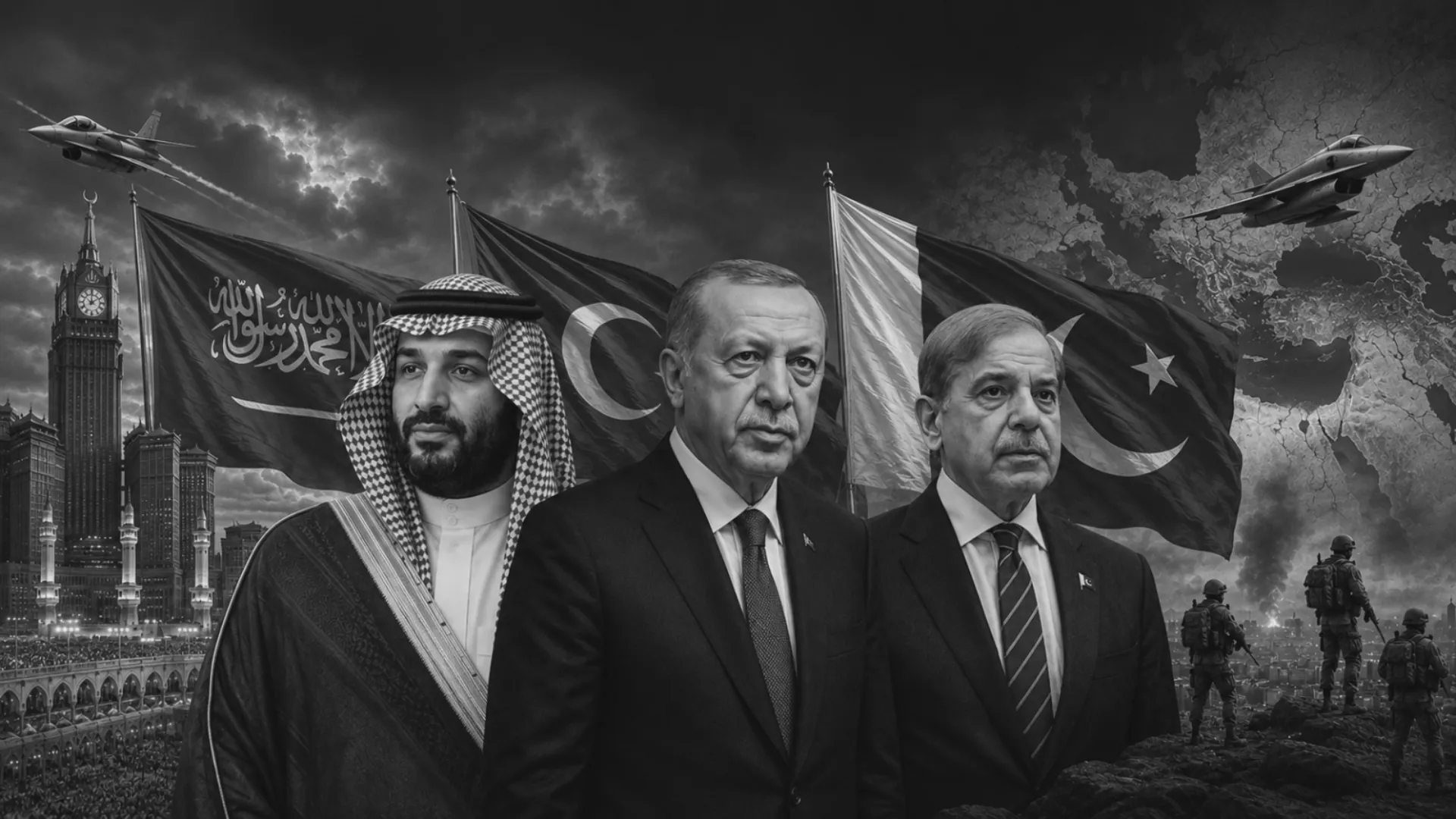
In this alliance, Riyadh supplies economic heft while Turkey provides NATO’s second biggest army and neutral Pakistan a nuclear arsenal. Their agreement seems to mark a breaking point.
“The political symbolism of the summit is significant,” said Abdulaziz Sager, who heads the Gulf Research Center, an institute based in Saudi Arabia. “Three of the Muslim world’s most influential states are convening at a moment of heightened uncertainty, demonstrating a growing willingness among regional and middle powers to coordinate more closely on security matters.”
The Mirage of US Deterrence
Faltering confidence in the supposed deterrence provided by the US military presence is an important motivation, observers say. Iran has bombed US-allied states and brought parts of the world economy to a near standstill. The strategic message: US protection is worthless and American allies ought to persuade Trump to call of the war.
There was perhaps a misperception among Gulf Arab rulers about the level of defense the US would provide. When Iran began bombing allied territory, Washington withdrew hundreds of its military personnel from Gulf bases, leaving leaders there wondering whether US deterrence was a mirage.
“A lot of these Gulf states are looking at us and thinking: Wait. We thought you built those bases to protect us,” Harvard University economist Ken Rogoff mused, during a Wall Street Journal TV talk show about the possible impact the war might have on global US influence. “I didn’t know you built those various military complexes in our countries so we could be target practice.”
What the Mecca Defense Agreement Lacks
The accord does not indicate creation of a ready-for-action “mutual defense pact,” said Ozgur Unluhisarcikli, an expert on Turkish foreign policy in the Ankara office of the German Marshall Fund, an American think tank. Rather, he told Qatar-based al-Jazeera television, this is a modest “framework for closer strategic, military, and defense-industrial coordination.” In any event, a full divorce is unlikely: all the countries buy key armaments from the US, a dependence that can’t evaporate overnight.
Iran’s formal response was both dismissive and avuncular. Foreign Minister Abbas Araghchi said the Mecca group’s search for security was misguided. Iran’s armed forces had displayed “readiness, capability and might” in fighting off “the world’s most expensive military,” Araghchi boasted. “When Muslims stand together, we can face every challenge by malicious outsiders head-on. It’s time to rely only on ourselves and embrace true brotherhood,” he wrote online.
Ebrahim Rezaei, a member of Iran’s parliament, added a more belligerent tone. “Saudis must know that a paper agreement with Turkey and Pakistan will not bring them security, just as years of one-sided dependence on the Americans did not bring them security,” he wrote online. “Reform your policies so that you do not need to beg for security from others.”
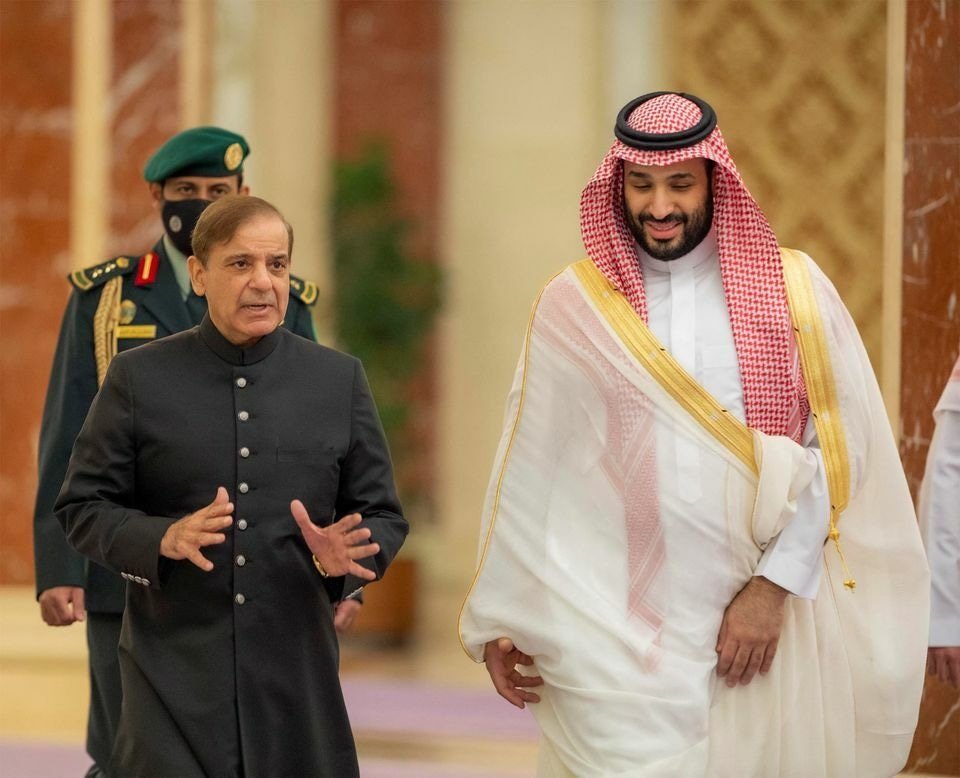
Riyadh and Islamabad’s Eastern Pivot
Beyond the immediate searrch for a new securty architecture, as Western military observers put it, the war reflected ancillary needs and opportunities for the partners:
Saudi Arabia
For several years, Saudi Arabia has been trying to perusue diplomacy to pacify its region and also extend its influence globally.
In 2023, top Iranian and Saudi officials met in Beijing and announced resumption of diplomatic relations that had been broken off in 2016 when an Iranian mob stormed the Saudi embassy in Tehran. That pact not only signaled reduced tensions, but also suggested that the Saudi’s might look beyond Washington for new diplomatic friendship: The agreement was brokered by Wang Yi, China’s foreign minister.
The Saudis had already long collaborated with Russia to keep oil prices high even as various US administrations wanted them lower.
There had also been disillusion with Trump during his first term in office. In 2019, he failed to punish Iranian attacks on Saudi-flagged oil tankers in the Gulf even as an Iranian-sponsored drone attack fromYemen hit a Saudi oil processing facility.
Saudi Arabia now finds itself in a vastly different geopolitical landscape: China and Russia are allied with Tehran – and the US is, so far, unable to defeat Iran. Can Turkey and Pakistan prove more reliable security partners?
Pakistan
Pakistan is trying to escape the twin straitjacket sewn together by its long border dispute with India and its interventions in Afghanistan, so as to better engage the world beyond.
Like Saudi Arabia, Pakistan had already turned to China to increase its geopolitical value. It signed onto China’s global Belt and Road Initiative – letting Beijing construct a highway from far western China to Pakistan’s Indian Ocean coast, where China manages a port close to the entrance of the Persian Gulf.
Islamabad’s effort to mediate a US-Iran peace deal has failed so far, but it keeps friendship with Washington intact. A partnership with Turkey provides access to Ankara’s military production, and technology.
Grabbing a role in Middle East diplomacy provides a role for Pakistan in an area where it had little influence or impact.
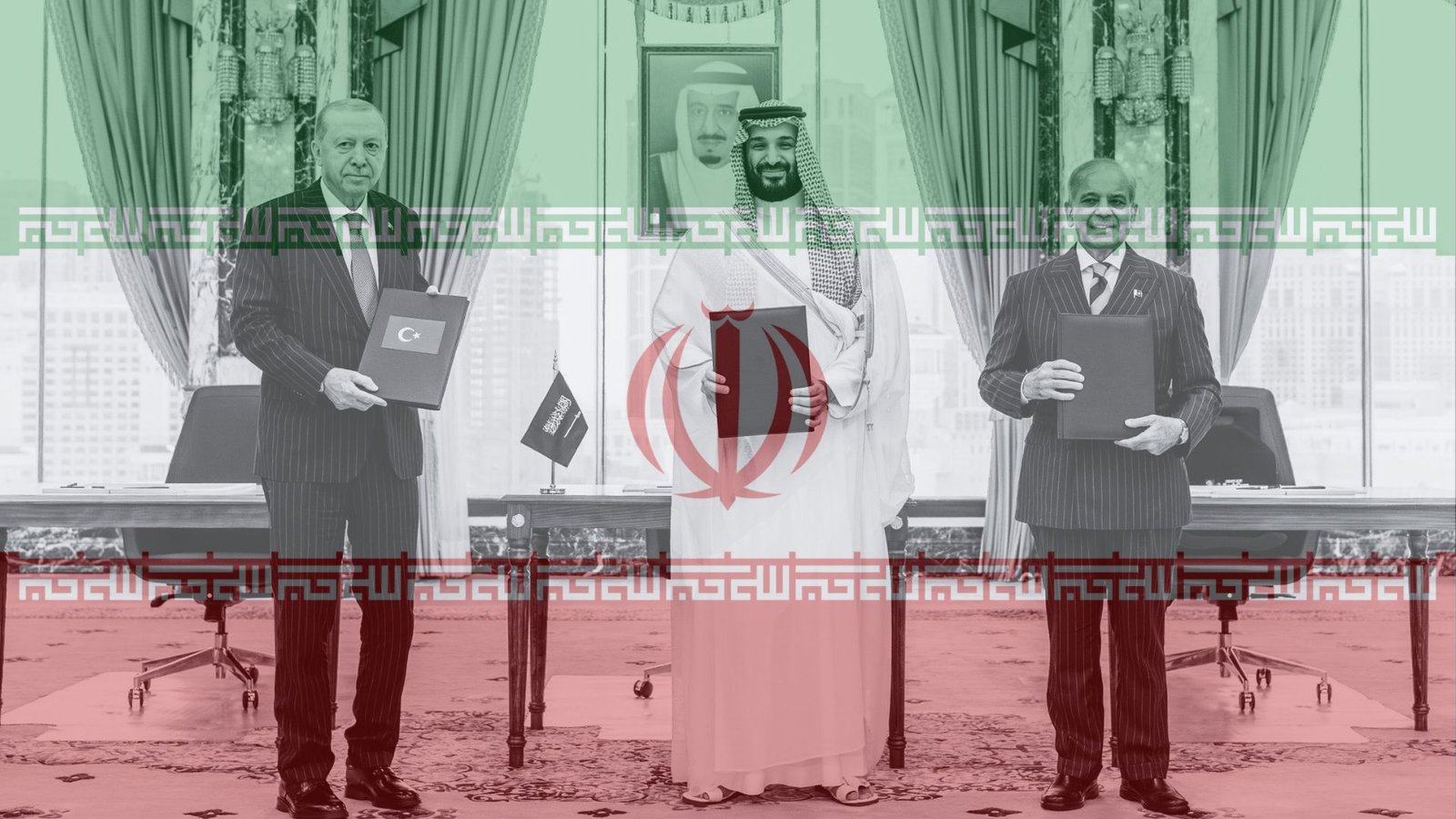
Turkey’s Ottoman Legacy Resurfaces
Turkey
Erdogan regards his country as a kind of Ottoman Empire-lite with important interests to protect and historic responsibilities to assume in the Middle East as well as Central Asia. (The Ottomans had been expelled via World War I: See “Lawrence if Arabia.”)
The alliance with Saudi Arabia puts Ankara at the center of regional geopolitics; the Islamic reference adopted by the Mecca trio also provides an aura of historical redemption.
There are economic benefits. Saudi Arabia already invests in Turkish high-tech industry. Turkey is a major planning, construction and security player in the development of NEOM, a Saudi five-hundred billion dollar high tech “mega-city” currently being built near Saudi Arabia’s northwest Red Sea coast
Turkey is likely to earn reductions in tariffs on its exports to Saudi Arabia, opening beneficial market for Turkish consumer exports.
In the military realm, Turkey offers Saudi Arabia advanced drone and naval modernization equipment. In addition, it could possibly help in unblocking Iran’s Yemen proxy ally’s closure of the entrance to the Red Sea.
Turkey has a naval base in Somalia near Mogadishu, the capital. It is constructing a missile base on the Indian Ocean coast to accommodate rockets with ranges of up to 1,250 miles. That puts Turkish projectiles in range of the whole Arabian Peninsula, Red Sea shipping lanes and the Strait of Hormuz, where the Iranians currently block access to the Persian Gulf.
Turkish ambitions challenge Israel’s ambitions. In the wake of the Gaza war, the Israelis appeared bent on establishing a Pax Israeliana across the Middle East via military conquest. Turkey sees Israel’s efforts to take over all Palestinian areas, dominate the Lebanese and bring down Islamic rule in Iran as elements of a single scheme.
“As Turkey deepened its involvement in regional affairs, its interests increasingly collided with Israel’s,” writes the Jazeera Center for Studies, a think-tank associated with the Jazeera TV news network. Thus, Israel’s military moves “have direct consequences for Turkish security and economic interests.”