
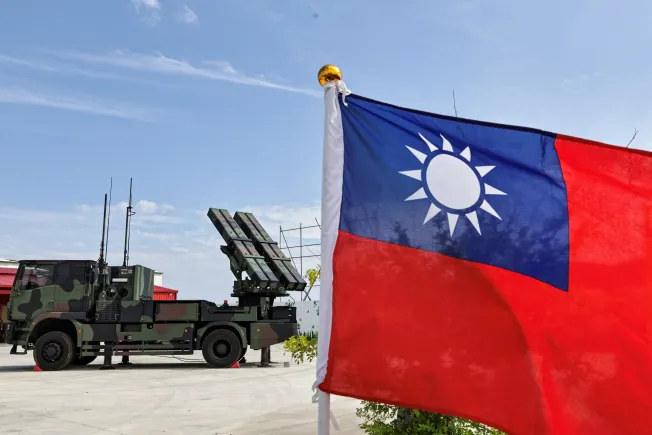
Taiwan’s growing role in advanced technology supply chains has elevated its strategic importance, increasing the risks of miscalculation as shifting American signals and expanding Chinese coercive capabilities alter the balance of deterrence across the Taiwan Strait.
Mixed Signals From Washington
Just a few years ago, U.S. President Joe Biden caused a stir when he confirmed publicly that his administration would defend Taiwan if the island were attacked by China—a divergence from the traditional U.S. policy of strategic ambiguity, in which Washington does not commit to taking any particular action. In May, U.S. President Donald Trump made waves for taking a different position.
In a television interview, he described Taiwan as “a very good negotiating chip” in dealings with Beijing and mused that the island was close to China but far from the United States, implying that U.S. interests in Taiwan were negligible. In doing so, Trump seemed to confirm something many Asia watchers had feared: that this U.S. president would be willing to loosen the United States’ commitment to Taiwan to bolster his relationship with Chinese leader Xi Jinping.
A few days later, Secretary of State Marco Rubio told the Senate Foreign Relations Committee that there had been no change in U.S. policy toward Taiwan. But Trump’s words were alarming nonetheless—in part because they reflect a shift in Washington that goes beyond the Oval Office. Since 2025, politicians from both parties have been shying away from affirming the United States’ long-standing support for Taiwan. Meanwhile, China is developing new strategies to coerce Taiwan without going to war, and Beijing will be increasingly tempted to use them if it judges that the U.S. commitment to Taiwan is waning among both politicians and the public.
Yet that would be a grave miscalculation on China’s part. In fact, the United States’ interests in Taiwan are growing, not diminishing. Whatever the nature of Washington’s rhetoric right now, the United States would have to respond to any action by Beijing that threatened those interests, and both countries would then face a great-power crisis. To defuse this dangerous situation, American leaders must update the United States’ Taiwan strategy to reflect a new reality—and they should begin immediately.
A GROWING DANGER
Taiwan’s unique international status has long made U.S. policy complex. The Republic of China, now known as Taiwan, was a World War II ally of the United States. When the People’s Republic of China was founded on the mainland, in 1949, the Republic of China’s president, Chiang Kai-shek, decamped to Taiwan, and the United States maintained formal diplomatic ties with Chiang’s government, not the People’s Republic of China.
In 1954, as the Cold War crested in the Pacific, the United States concluded a formal mutual defense treaty with Taiwan, in part to forestall increasingly aggressive artillery barrages from the mainland. Nearly 20 years later, however, when U.S. President Richard Nixon and his national security adviser, Henry Kissinger, began to engineer a diplomatic opening to the government in Beijing, they knew it would cost Taiwan.
In part because they understood that building diplomatic ties with Beijing would be painful for Taiwan and cause controversy in Congress, where Taipei had many boosters, Nixon and Kissinger slow-walked the process. So did Nixon’s successor, President Gerald Ford. It finally fell to President Jimmy Carter to make the change. On January 1, 1979, the United States ended its alliance with Taiwan and recognized the mainland government as “the sole legal Government of China.” Congress was irate.
Lawmakers from both parties quickly drafted the 1979 Taiwan Relations Act, which remains in force. The law requires Washington to provide Taipei with defensive arms, creating the trappings of an alliance with Taiwan despite the relationship’s unofficial status. In 1982, the Reagan administration made an additional set of commitments to Taiwan, known as the Six Assurances. These include an affirmation that Washington does not endorse Beijing’s sovereignty claims over Taiwan and a promise that the United States would not use arms sales to Taiwan as a bargaining chip.
U.S. Support for Taiwan Under Pressure
In the 50 years since, U.S. Taiwan policy has been remarkably successful. Through its partnership and arms sales, the United States has helped underwrite peace and stability in the Taiwan Strait, and Taiwan has thrived as a democracy and an economy, even as Washington has maintained a relationship with Beijing.
But U.S. commitments to Taiwan have lately come under increasing strain. China has proceeded with a massive military buildup designed to give Beijing the option to take Taiwan by force; used coercive economic tactics, launched cyberattacks, and interfered in elections to put pressure on Taipei; and run frequent army and coast guard exercises to demonstrate its ability to strangle the island. All of this has stoked concerns across the Pacific that the United States’ long-standing partnership might not be enough to keep the peace in the Taiwan Strait.
The fear that China could attempt to retake Taiwan by force, possibly during Xi’s tenure, has grown in recent years. Analysts have frequently cited 2027 as the beginning of the window of maximum danger, based on a 2021 statement made by Philip Davidson, the former commander of U.S. Indo-Pacific Command, about when the People’s Liberation Army might be prepared for an invasion.
But this timeline was never hard and fast, and Xi’s recent purge of more than 100 officers has likely delayed the military’s readiness. U.S. intelligence assessments do not anticipate an invasion of Taiwan next year, and most scholars believe the Chinese government would consider such a move as a last resort only if unification could not be accomplished by other means.
Beijing’s New Coercion Playbook
The primary danger now is that Xi will escalate a pressure campaign designed to coerce Taiwan into negotiating a change in its status. Since 2025, China’s leaders have used their diplomatic channels to the Trump administration, including Xi’s direct line to Trump, to insist on American concessions on Taiwan in exchange for progress in trade talks. In May, China secured a pause on a planned $14 billion U.S. arms sale and other defense funding for Taiwan. Beijing may hope that additional incremental moves will further weaken Taiwanese confidence in the United States and that such actions will be difficult for Trump or a future U.S. president to reverse.
China is also clearly planning for more dramatic forms of coercion. It has a few options: since 2022, China’s military has practiced blockades of Taiwan, and its coast guard has simulated a quarantine of the island’s major ports. Beijing could also use customs enforcement or other administrative measures to attempt to assert its jurisdiction over Taiwan while minimizing the likelihood that the United States would intervene to stop it.
If Taiwanese President Lai Ching-te, who favors Taiwanese independence but has not pursued it in office, is reelected in 2028 and Chinese leaders believe that the path to a peaceful unification is closing, Xi may consider using these tools against the island in late 2028 or early 2029, before a new U.S. administration takes office.
Given Trump’s alienation of U.S. allies in Asia and Europe and Washington’s limited means to respond to a maritime quarantine, Beijing might hope to get away with such a large-scale coercion campaign without inviting serious pushback.
THE INDISPENSABLE ISLAND
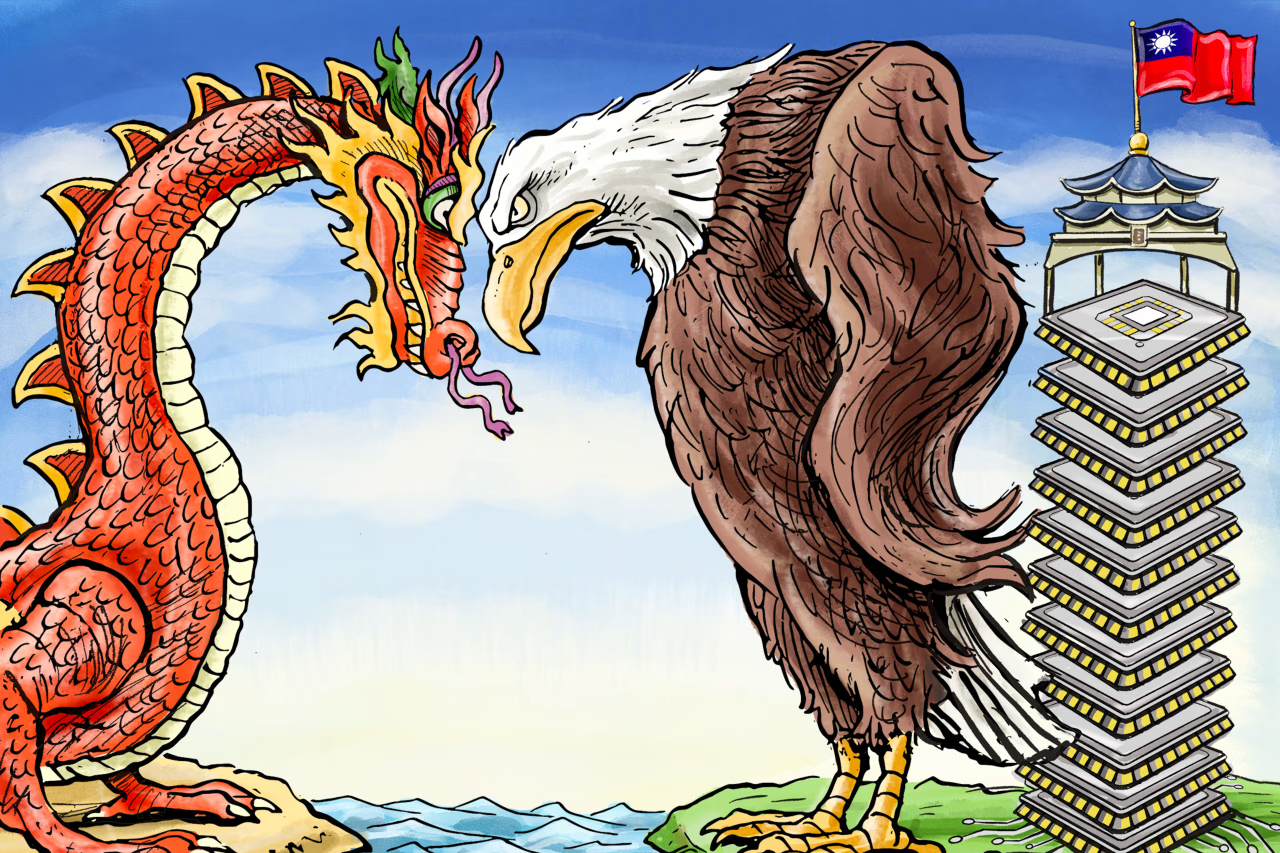
Taiwan’s growing strategic importance makes Beijing’s development of new coercive options more concerning. Washington is no longer maintaining a partnership with Taipei because of a historical commitment or, as Beijing would have the world believe, to needle China. The artificial intelligence boom has put Taiwan at the center of the global economy. Taiwan is a critical supplier for the U.S. tech industry, and the United States recognizes that it cannot be a leader in AI without Taiwan.
The scale of the United States’ economic dependence on Taiwan is revealing. Taiwan is the country’s fifth-largest trading partner; a Chinese blockade of the island would imperil more than $250 billion in trade and could shave more than three percent off U.S. GDP in a year, according to a Bloomberg report. As much as 97 percent of the global supply of the high-end logic chips used in smartphones and other advanced electronics are produced or packaged in Taiwan.
Losing access to Taiwanese chips could reduce advanced electronics production globally by 60 percent, with factories forced to rely on their chip inventories. The United States’ auto and medical device industries could deplete their inventories in a matter of weeks.
The U.S. firms Amazon, Apple, and Nvidia are among the Taiwan Semiconductor Manufacturing Company’s ten largest customers, which together represent more than $14 trillion in market capitalization. With AI growth buoying the U.S. stock market and the broader economy, a crisis in Taiwan would trigger a crash—potentially one similar in scale to the stock market crash at the start of the COVID-19 pandemic.
The economic effects of a Chinese effort to squeeze Taiwan would not be limited to the United States. The research firm Rhodium Group has conservatively estimated that a yearlong blockade of the island could cost the global economy between $2 trillion and $3 trillion. A full-scale war would be far worse; Bloomberg has estimated that it would cause $10 trillion in economic losses and a global recession. It is therefore increasingly likely that the United States would be forced to act if Taiwan’s supply chains were put in jeopardy. The cost of standing aside would simply be too high.
U.S. Support for Taiwan Faces Doubts
Yet just when the United States needs to be doing all it can to prevent a crisis, Washington’s support for Taiwan appears to be wobbling. Trump’s musings about Taiwan’s geographical distance from the United States and his use of arms sales as a bargaining chip are the headline examples, but they are not the only indicators of a shaky U.S. commitment. Policy analysts have argued that the United States should change its position to definitively oppose Taiwanese independence or even withdraw U.S. forces from the military bases in Japan and the Philippines that are closest to Taiwan.
Public opinion in the United States is shifting, too. Americans’ feelings toward China have warmed considerably over the past two years, according to a July 2026 Chicago Council on Global Affairs survey. A majority, 57 percent, support friendly cooperation and engagement with China, whereas 40 percent support an active effort to limit the growth of China’s power. The share of Americans who see China’s territorial ambitions as “a critical threat” has decreased by more than ten percentage points since 2022, and those who favor the use of U.S. troops if China invaded Taiwan has fallen from 52 percent to just 38 percent.
In part, the declining support for defending Taiwan reflects Americans’ growing wariness of instability and conflict. A sense that the world was descending into chaos helped fuel Trump’s 2024 campaign; as president, Trump has heightened that sense by taking assertive military action in places such as Iran and Venezuela. Americans are now suffering the economic consequences of nine months of war in the Middle East, further deepening antiwar sentiment, as the midterm election results vividly demonstrate.
Candidates for office used to clamor to sound tough on China, but many now blanch at the idea of suggesting that the U.S. military should defend Taiwan against a Chinese invasion, calculating that this is not the time to be seen as a hawk.
Of course, public attitudes can change quickly during a crisis. If China actually committed aggression against Taiwan, Americans could become more supportive of a strong U.S. response. And if the early stages of a conflict saw American casualties or a Chinese attack on U.S. critical infrastructure, the U.S. public could very well rally around the flag and demand a muscular intervention.
For now, however, China may believe that the United States’ will and ability to fight are both diminishing. The war with Iran has substantially reduced U.S. military readiness for a Taiwan contingency. The United States has used up much of its missile defense stock, including roughly two-thirds of its Patriot interceptor inventory, which was already depleted by U.S. aid to Ukraine, and as much as 80 percent of THAAD interceptors against Iranian drones and missiles.
Even before the Iran war, analysts had warned that the U.S. military could run out of long-range, precision-guided munitions in a fight over Taiwan; now, the munitions shortfalls have become perilously acute. The war has also drawn military assets away from the Indo-Pacific. In August, Washington moved its last aircraft carrier in Asia, the USS George Washington, out of the region. It has also relocated missile defense systems to the Middle East, including Patriot and THAAD systems that had been deployed in South Korea.
THE NEW PLAYBOOK
The result is an increased risk of dangerous miscalculation. Should Chinese leaders assess that the United States’ commitment to Taiwan is wavering in both political parties and that the country is ill prepared for a fight, they might conclude that they have an opportunity to pressure Taiwan without inviting an American response. Yet because the United States has a greater interest in Taiwan today than at any point in history, Beijing’s bet could turn out to be wrong. China could announce a maritime quarantine of Taiwan or another coercive measure only to have the United States intervene, potentially prompting a great-power standoff.
Avoiding such a showdown will require American leaders to recommit to deterrence. First, Washington needs to update the way it communicates its positions. In their public remarks, policymakers should clearly state that the U.S. economy’s dependence on Taiwanese exports makes peace and stability across the Taiwan Strait a vital interest of the United States. American political leaders should emphasize to Beijing that the United States has an obligation to prevent a crisis that would tank the U.S. stock market, cut critical supply chains, and fell many American industries.
Clarifying U.S. interests would not impugn 50 years of careful diplomacy with China, nor would it require any change to U.S. policy as established by the Taiwan Relations Act, the Six Assurances, or the series of joint U.S.-Chinese statements, made between 1972 and 1982, known as the Three Communiqués. The updated statements, rather, would convey to Chinese leaders that certain changes to the cross-strait status quo would be unacceptable to the United States, even if Taiwan were to acquiesce to those changes under pressure. Washington would support a peaceful unification, for example, only if the process guaranteed the security of critical supply chains.
Once the United States makes its interests clear, it will also have to back up its statements with a new playbook to deter Chinese actions that fall below the military threshold. Beijing may already be in the early stages of imposing a quarantine on the island. Washington should not tolerate additional measures that interfere with commerce and maritime traffic in and out of Taiwan.
To deter China from taking such steps, the next U.S. Congress should use legislation to clarify its wholesale, bipartisan opposition to Chinese blockades, quarantines, and other restrictions. Even if the White House continued to take a softer position, this would send a message to Beijing that other political actors might force the president’s hand.
Congress should also press the administration to prepare punitive diplomatic and financial measures for use in the event of an escalating Chinese quarantine of Taiwan. By planning these reprisals well ahead of any coercive action, Washington would signal that a maritime pressure campaign would entail clear costs for Beijing and carry dangerous escalation risks.
The United States should strengthen military deterrence, too. The next Congress must pressure the Trump administration to release the stalled $14 billion package of arms sales to Taiwan, as well as other security assistance the administration is slow-rolling. Congress has a legal obligation to do so under the Taiwan Relations Act. Pausing security aid violates U.S. policy, and allowing the Trump team to make this concession in its likely quixotic pursuit of rapprochement with Xi only weakens Washington’s hand.
Washington does not have to—and shouldn’t—take these steps alone. U.S. allies such as Germany, Japan, and South Korea would suffer nearly as much as the United States if China were to take control of Taiwan’s semiconductor industry. These countries have an interest in working quietly together to deter and develop joint responses to Chinese coercion while also collaborating to diversify their chip supply chains and make them more resilient. In the United States, this work does not have to wait for a new presidential administration. Congress can send delegations and use other diplomatic opportunities to start developing plans with parliamentary counterparts abroad.
As the 2028 U.S. presidential election approaches, moreover, candidates from both parties should speak clearly about the country’s strong economic interests in Taiwan and about their commitment to deterrence. This does not require embracing bellicose positions, but presidential candidates do need to state firmly that any move by Beijing to choke off vital supply chains would harm U.S. interests and demand an American response. Consistent messaging would also signal to China’s leaders that they should not expect a future administration to be bound by Trump’s policy concessions—and signal to allies that come 2029, the United States will again be a reliable partner in standing up to China’s economic aggression.
The United States needs to update its Taiwan policy, but ceding ground as Trump has done only makes the cross-strait balance less stable. Unlike other Cold War–era policies, the importance of preventing Chinese aggression against Taiwan has become more—not less—vital with the passage of time. U.S. interests in Taiwan are plainer and easier to explain than they have ever been. Only by stating those interests clearly and backing up the words with actions can the United States continue to avert a crisis or conflict that would be devastating for all.