
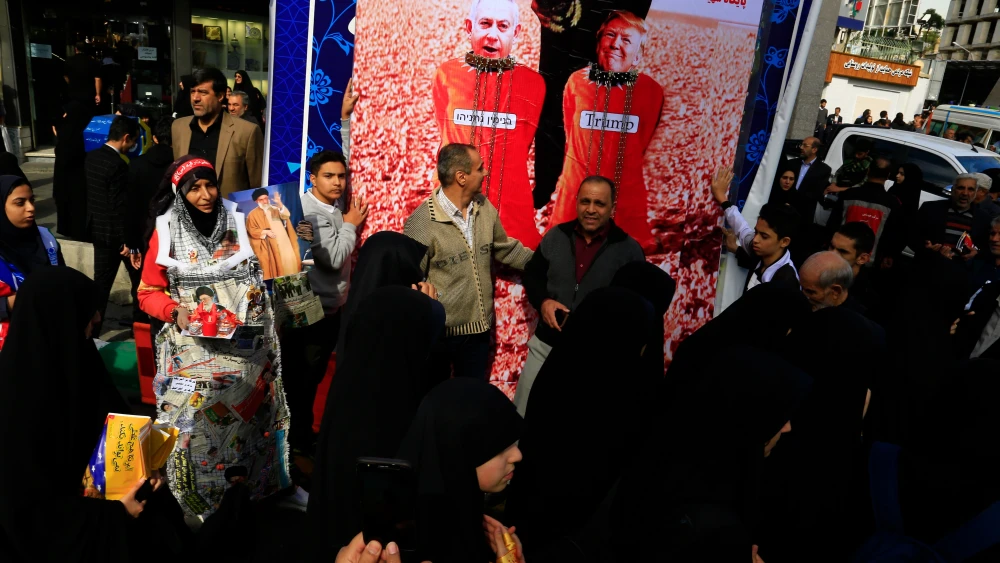
Iranian Jews possess constitutional recognition yet remain subject to political suspicion. The Islamic Republic’s distinction between Judaism and Zionism creates conditional belonging, where loyalty requires demonstration and Jewish identity carries exceptional scrutiny.
Across more than two millennia of Iranian history, Iranian Jews have occupied a position that defies simple categorization. They are constitutionally recognized, maintain synagogues and communal institutions, and possess a reserved seat in parliament. Yet this formal recognition exists within a political order that privileges Twelver Shi’ism and defines Zionism as an existential enemy.
The result is a paradox of conditional belonging: Jews may practice their religion, but their political loyalty remains subject to exceptional scrutiny. Since 1979, the Islamic Republic has insisted on a distinction between Judaism and Zionism, between the acceptable Iranian Jew and the suspect Zionist. But the state alone determines where that boundary lies.
Demonstrations of national loyalty—public condemnations of Israel, participation in anti-Zionist rallies, avoidance of contact with relatives in Israel—become evidence of political reliability. The question is not whether Iranian Jews are persecuted or tolerated, but whether recognition can coexist with equal citizenship. The answer requires examining how successive political orders, from dhimma through the Pahlavi modernization to the Islamic Republic, have defined the terms of Jewish belonging.
A Paradox of Recognition and Suspicion
Iranian Jews occupy one of the most historically rooted yet politically paradoxical positions among the religious minorities of modern Iran. Their presence in the country extends across more than two millennia, linking Jewish history to the political and cultural history of Iran long before the emergence of the modern Iranian state.
Yet the meaning of Jewish belonging has changed dramatically across successive political orders. From the hierarchical status associated with non-Muslim communities under traditional Islamic rule, through the expansion of secular institutions and modern citizenship during the Pahlavi period, to the establishment of an explicitly Islamic state after 1979, the position of Iranian Jews provides an unusually revealing case through which to examine the relationship between religious identity, citizenship, and political loyalty.
This article argues that the Islamic Republic has produced a distinctive paradox of recognized but conditional belonging. Jews are explicitly recognized as a religious minority under the Constitution, possess a reserved representative in parliament, and retain synagogues, communal organizations, and limited autonomy in religious affairs.
Yet this formal recognition operates within a political system whose revolutionary identity and foreign-policy ideology have been profoundly shaped by hostility toward Israel and Zionism. Consequently, the legal distinction between Judaism and Zionism—repeatedly asserted by the state since 1979—has not eliminated the political vulnerability created by their possible conflation. Iranian Jewish citizenship therefore exists within an environment in which religious recognition can coexist with political suspicion and in which demonstrations of national loyalty may acquire exceptional significance.
Drawing on constitutional provisions, historical scholarship, legal and political analysis, documentary evidence, human-rights reporting, and contemporary accounts, the article traces this contradiction historically rather than treating it as an exclusively post-revolutionary phenomenon. It examines the legacy of dhimma, the transformation of minority citizenship under the Pahlavis, the rupture of 1979, and the subsequent construction of a political boundary separating the acceptable Iranian Jew from the politically suspect “Zionist.” The contemporary experience of Iranian Jews ultimately demonstrates a broader principle: constitutional recognition is not synonymous with equal citizenship. A political order moves beyond religious hierarchy only when belonging ceases to depend upon communal toleration, ideological conformity, or recurring demonstrations of loyalty to the state.
Iranian Jews present one of the most revealing paradoxes in the political history of the Islamic Republic. They belong to one of Iran’s oldest continuously rooted communities, possess formal constitutional recognition, maintain religious institutions, and are guaranteed representation in parliament. Yet since 1979 they have lived under a revolutionary state whose political vocabulary identifies Zionism as an enemy and whose confrontation with Israel has become an increasingly important element of its ideological and security worldview. The central question is therefore more complicated than whether Iranian Jews are simply “recognized” or “persecuted”: what does constitutional recognition mean when the political loyalty of the recognized minority can remain subject to exceptional suspicion?
The question acquires particular historical significance because Jewish presence in Iran is neither recent nor foreign. Jewish communities have existed in the Iranian world for more than two millennia and became deeply embedded in the country’s linguistic, economic, cultural, and social history. Their circumstances varied enormously across dynasties and periods, but their antiquity establishes a fundamental point: Iranian Jews were not outsiders seeking admission into an already constituted Iranian nation. They participated in the historical formation of Iranian society itself. The issue examined here is consequently not whether Jews historically belong to Iran, but how successive political orders have defined the terms of that belonging.
The Islamic Republic offers an especially revealing answer. Article 13 of its Constitution recognizes Jews, Christians, and Zoroastrians as religious minorities and permits them, “within the limits of the law,” to practice their religious ceremonies and follow their own canon in matters of personal status and religious education. Article 64 provides separate parliamentary representation, including one seat for Iranian Jews. These guarantees are real and distinguish Jews sharply from communities such as the Baha’is, who lack comparable constitutional recognition. Some scholarship consequently offers a strikingly affirmative interpretation. Al Rousan and his co-authors emphasize constitutional protection, religious practice, communal institutions, and parliamentary representation in arguing that recognized minorities enjoy significant cultural, social, and political freedoms.
Yet constitutional recognition exists within a political order that is explicitly religious rather than religiously neutral. Twelver Ja’fari Shi’ism is the official religion of Iran, while Article 4 requires the country’s laws and regulations to conform to Islamic criteria. Religious minorities are therefore not recognized because religion has become irrelevant to citizenship; they are constitutionally identified as minorities within an Islamic political hierarchy. This distinction is fundamental. A state may permit a community to worship, maintain institutions, regulate aspects of communal life, and possess designated representation while still assigning religious identity legal and political significance. Recognition and equality, in other words, are not synonymous.
For Iranian Jews, 1979 introduced an additional complication. The revolution did not merely replace the monarchy with an Islamic state. It also transformed Israel from a country with which Iran had maintained substantial political, economic, and security relations under Mohammad Reza Shah into an ideological enemy of the revolutionary order. Iranian Jews consequently occupied a distinctive position among Iran’s recognized minorities: their religion remained constitutionally legitimate while Zionism and Israel became objects of sustained ideological hostility.
The Islamic Republic sought to reconcile these positions through a distinction between Judaism and Zionism, and between the Iranian Jew and the Zionist. Khomeini articulated this distinction around the revolutionary period, presenting Iranian Jews as members of the Iranian community while treating Zionism as a political phenomenon rather than an authentic expression of Judaism. On its surface, the distinction performed an important protective function. It allowed the revolutionary leadership to insist that hostility toward Israel and Zionism did not constitute hostility toward Jews and that Iranian Jews could remain members of the national community.
But the same distinction contained an inherent political problem: who determined when the boundary between Judaism and Zionism had been crossed? Ultimately, the revolutionary state did. Scholarship examining Iranian Jewish religiosity after 1979 identifies precisely this tension. One study describes an environment in which the “obedient” and “trustworthy” Jew was understood as a religious citizen who remained demonstrably detached from Israel and Zionism, while allegations involving espionage, Zionist organizations, or foreign powers could move Jewish identity into the domain of national-security suspicion. Thus, a formula designed to protect Jews simultaneously established the political boundary across which a Jew could become suspect.
The early revolutionary experience demonstrated that this was not an abstract problem. Habib Elghanian, a prominent Jewish businessman and former leader of the Tehran Jewish community, was executed in May 1979 after a revolutionary trial involving, among other accusations, connections with Israel. Jewish communal leaders subsequently traveled to Qom to seek assurances from Khomeini concerning their position under the new regime. The importance of this episode for the present argument lies not in treating Elghanian’s fate as representative of every Iranian Jew, but in the political atmosphere it revealed: the distinction between the Iranian Jew and the Zionist emerged amid profound communal uncertainty over how the revolutionary state would interpret Jewish belonging.
Even scholarship broadly sympathetic to the Islamic Republic’s treatment of recognized minorities acknowledges this tension. Al Rousan and his co-authors record that relations with the Jewish community became strained after the revolution, that Jewish figures suspected of Israeli connections were arrested, that espionage allegations occurred, and that substantial emigration followed. These acknowledgments are particularly significant because they coexist in the same scholarship with an affirmative account of constitutional recognition and minority freedoms. The apparent contradiction is analytically valuable: communal survival and constitutional protection can coexist with insecurity and political suspicion.
This article therefore rejects two simplifying narratives. The first treats the history of Jews under Muslim rule in Iran as an uninterrupted continuum of identical persecution, obscuring enormous differences among dynasties, rulers, cities, jurisprudential environments, and historical periods. The second assumes that constitutional recognition, functioning synagogues, parliamentary representation, or official distinctions between Judaism and Zionism are sufficient evidence of equal citizenship. Neither proposition adequately explains the historical record.
The argument advanced here is more precise. The Islamic Republic has produced a system of recognized yet conditional belonging. Iranian Jews possess a legitimate institutional place within the state, but that place exists inside a constitutional order privileging Shi’ite Islam and an ideological order in which Israel and Zionism are defined as enemies. This does not mean that every Iranian Jew is continuously suspected, nor that every anti-Zionist policy constitutes antisemitism. It means that Jewish citizenship operates within a political environment in which the boundary between protected religious identity and prohibited political affiliation carries exceptional consequences.
The historical comparison with the Pahlavi era is consequently important but must not be romanticized. Antisemitism and inherited social prejudice did not disappear under Reza Shah or Mohammad Reza Shah, and the monarchy itself remained authoritarian. Nevertheless, scholarship on twentieth-century Iranian Jewry documents substantial movement away from earlier marginality through secularization, centralized state-building, education, urbanization, professional advancement, and economic mobility. The significance of this transformation was not that Iranian Jews suddenly became Iranian. They already were. Rather, the modernizing state increasingly reduced the extent to which religious identity determined their position within national life.
The revolution did not literally restore classical dhimma. Modern Iranian Jews do not occupy the legal position of Jews under Safavid or Qajar rule. Instead, 1979 restored religious classification to the constitutional architecture of political belonging. The resulting system is therefore neither classical dhimmitude nor religion-neutral citizenship. It is a modern configuration in which religious minorities can be formally recognized and institutionally accommodated while remaining differentiated within an explicitly Islamic political order.
The sections that follow trace the historical development of this contradiction: from the ancient roots of Jewish life in Iran and the architecture of dhimma, through the transformation of Jewish citizenship under the Pahlavis and the rupture of 1979, to the Islamic Republic’s combination of formal recognition and ideological suspicion. The final sections examine how the intensifying confrontation between Iran and Israel has sharpened the problem of political loyalty in the contemporary period.
The broader question is ultimately not about Judaism alone. It concerns the difference between toleration and citizenship. A state has not necessarily achieved religious equality because it allows a minority to survive, worship, or maintain institutions. The more demanding measure is whether religious identity affects the political trust, legal standing, and civic freedom to which the individual is entitled. The history of Iranian Jews provides an unusually revealing test of that distinction.
Recognition stands at the center of the Islamic Republic’s defense of its treatment of Iranian Jews. The constitutional argument appears formidable: Judaism is officially recognized; synagogues operate; Jewish communal institutions survive; and the community possesses a reserved seat in the Majles. Article 13 identifies Jews, Christians, and Zoroastrians as Iran’s recognized religious minorities, while Article 64 guarantees them parliamentary representation. The Islamic Republic can therefore point to an institutional Jewish presence that has survived more than four decades of revolutionary rule and argue that its hostility is directed not toward Judaism, but toward Zionism and Israel.
Some scholarship adopts a surprisingly affirmative version of this argument. Al Rousan and his co-authors emphasize constitutional recognition, religious practice, educational and cultural activity, and parliamentary representation in concluding that recognized minorities enjoy substantial cultural, social, and political freedoms. That evidence should not be dismissed simply because it complicates a critical account of the Islamic Republic. Iranian Jews do maintain synagogues and communal organizations; Judaism has not been outlawed; and Jewish representation in parliament is constitutionally guaranteed. Any serious analysis must begin by acknowledging these facts.
The difficulty begins when recognition is separated from equality.
Article 13 does not establish a religion-neutral conception of citizenship. It designates only Zoroastrians, Jews, and Christians as recognized non-Muslim minorities and permits them to exercise their religious rites and regulate certain personal affairs “within the limits of the law.” The same Constitution declares Twelver Ja’fari Shi’ism the official religion and requires all laws and regulations to conform to Islamic criteria. Recognition consequently occurs within an explicitly Islamic constitutional order. The minority is protected, but it is protected as a minority, within boundaries defined by a state whose religious identity is constitutionally prior.
For Iranian Jews, this hierarchy intersects with a second and uniquely consequential distinction. Since 1979, the Islamic Republic has maintained two propositions simultaneously: the Jew can belong to Iran; the Zionist belongs to the enemy camp. Khomeini articulated this distinction during the revolutionary period, separating Iranian Jews from Zionists and portraying Zionism as a political phenomenon rather than an authentic expression of Judaism. The formulation served an important protective purpose. It enabled the new regime to insist that revolutionary hostility toward Israel should not be translated automatically into collective hostility toward Iranian Jews.
Yet the same distinction contained a structural vulnerability. The state that promised to distinguish the Jew from the Zionist also possessed the authority to decide when that boundary had been crossed. Research on Iranian Jewish religiosity after the revolution describes the “obedient” or “trustworthy” Jew as one whose religious identity remained visibly separated from Israel, Zionism, and hostile foreign powers. The same study records allegations of espionage and collaboration when individuals were deemed to have moved from permissible religiosity into prohibited politics. Thus, the protective formula simultaneously created a political loyalty test.
The importance of this distinction appeared almost immediately. Habib Elghanian, a prominent businessman and former leader of Tehran’s Jewish community, was executed in May 1979 after a revolutionary trial involving accusations that included connections with Israel. His execution produced profound anxiety within the Jewish community. Jewish leaders subsequently traveled to Qom and sought assurances from Khomeini concerning their status under the revolutionary regime. Khomeini’s distinction between Jews and Zionists consequently offered genuine reassurance—but the circumstances in which reassurance became necessary were themselves revealing.
The episode can therefore be read in two ways. A favorable interpretation emphasizes that the revolutionary leader explicitly prevented Jews from being collectively equated with Zionists. A more critical interpretation asks why a community rooted in Iran for more than two millennia suddenly needed the supreme revolutionary authority to affirm that it belonged. Both readings contain part of the historical truth. Protection was real; so was the insecurity that made protection politically necessary.
Even scholarship broadly favorable to the Islamic Republic reveals this contradiction. Al Rousan et al., while emphasizing constitutional protection and minority freedoms, acknowledge that relations with Iranian Jews became strained after the revolution, that Jewish figures suspected of Israeli connections were arrested, that espionage allegations occurred, and that insecurity contributed to emigration. These admissions are especially valuable precisely because they do not originate in an account constructed principally as an indictment of the regime. They demonstrate that constitutional recognition and political vulnerability need not be mutually exclusive.
The demographic rupture was substantial. Iran had one of the largest Jewish populations in the Muslim Middle East before the revolution; large numbers left in its aftermath, particularly for the United States and Israel. The causes should not be reduced to persecution alone. Revolutionary instability, economic uncertainty, family networks abroad, professional considerations, the Iran-Iraq War, and broader middle-class emigration all mattered. But neither can the exodus be analytically detached from Elghanian’s execution, security accusations, revolutionary uncertainty, and the abrupt transformation of Israel from a partner of the Iranian monarchy into an ideological enemy of the new state.
Those who remained did not simply endure the new order passively. They adapted to it. Scholarship on post-revolutionary Jewish religiosity suggests that intensified religious identification could reinforce communal cohesion while also fitting the Islamic Republic’s preferred distinction between authentic Judaism and Zionist politics. This produced an unusual paradox: a revolutionary Islamic state could accommodate—and in some respects validate—a visibly religious Jewish community precisely because traditional Judaism could be presented as the ideological opposite of Zionism.
This helps explain why the binary vocabulary of either “persecution” or “tolerance” is inadequate. Synagogues may remain open while political speech is constrained. Religious observance may be protected while relationships interpreted as connections with Israel attract scrutiny. A Jewish representative may sit in parliament while communal institutions remain acutely conscious of the political necessity of distinguishing Iranian Jewish identity from Zionism. These conditions can exist simultaneously without contradiction because they concern different dimensions of minority life.
Public expressions of Jewish loyalty must consequently be interpreted with equal caution. Iranian Jewish leaders have repeatedly affirmed their Iranian identity and, at times, condemned Israeli policies. Such declarations should not automatically be dismissed as coerced. Iranian Jewish attachment to Iran is historically deep and persisted even among substantial portions of the diaspora. But official declarations cannot automatically establish the absence of political pressure either. Where association with Israel can carry national-security implications, public speech occurs within incentives and constraints that cannot simply be ignored.
This is where suspicion becomes a more useful analytical category than formal discrimination alone. Suspicion does not require the closure of synagogues or abolition of parliamentary representation. It can operate through a presumption that a particular minority possesses transnational attachments requiring additional political scrutiny. The problem is not that a state prosecutes genuine espionage; every state does. The problem arises when membership in a particular religious community makes the boundary between ordinary transnational connection and suspected political disloyalty unusually consequential.
The resulting hierarchy is therefore not solely a hierarchy of legal rights. It is also a hierarchy of political trust. Iranian Jews possess recognized rights and institutions, but their religious identity exists beside an ideological conflict capable of transforming questions of family connection, foreign association, political expression, and communal solidarity into questions of national security. The claim is not that every Iranian Jew is continuously suspected or that every prosecution of a Jewish citizen is antisemitic. The evidence does not justify either proposition. The more defensible argument is structural: the Islamic Republic has created circumstances in which Jewish identity and political loyalty can become entangled in ways that do not apply equally to the Shi’ite majority.
The survival of Jewish communal life therefore answers an important question, but not the decisive one. Synagogues, schools, kosher establishments, charitable organizations, and parliamentary representation demonstrate that organized Jewish life is permitted to exist. They do not establish that Jewish citizenship carries no exceptional political burden. Equal citizenship requires more than permission to worship; it requires that belonging itself not remain perpetually open to examination.
The paradox is therefore neither that Iranian Jews are completely free nor that they are continuously persecuted. It is that institutional recognition and political vulnerability can coexist. Recognition defines a legitimate space for Jewish life; suspicion reveals the limits surrounding that space.
And this tension did not begin in 1979. The distinction between protection and equality has a much longer history in Iran. To understand what the Islamic Republic changed—and what it did not simply resurrect unchanged—we must first move backward. Iranian Jews were part of Iran long before the Islamic conquest, modern Zionism, or the creation of Israel. Their history begins not with Iran’s contemporary enemy, but with their ancient place in Iran itself.
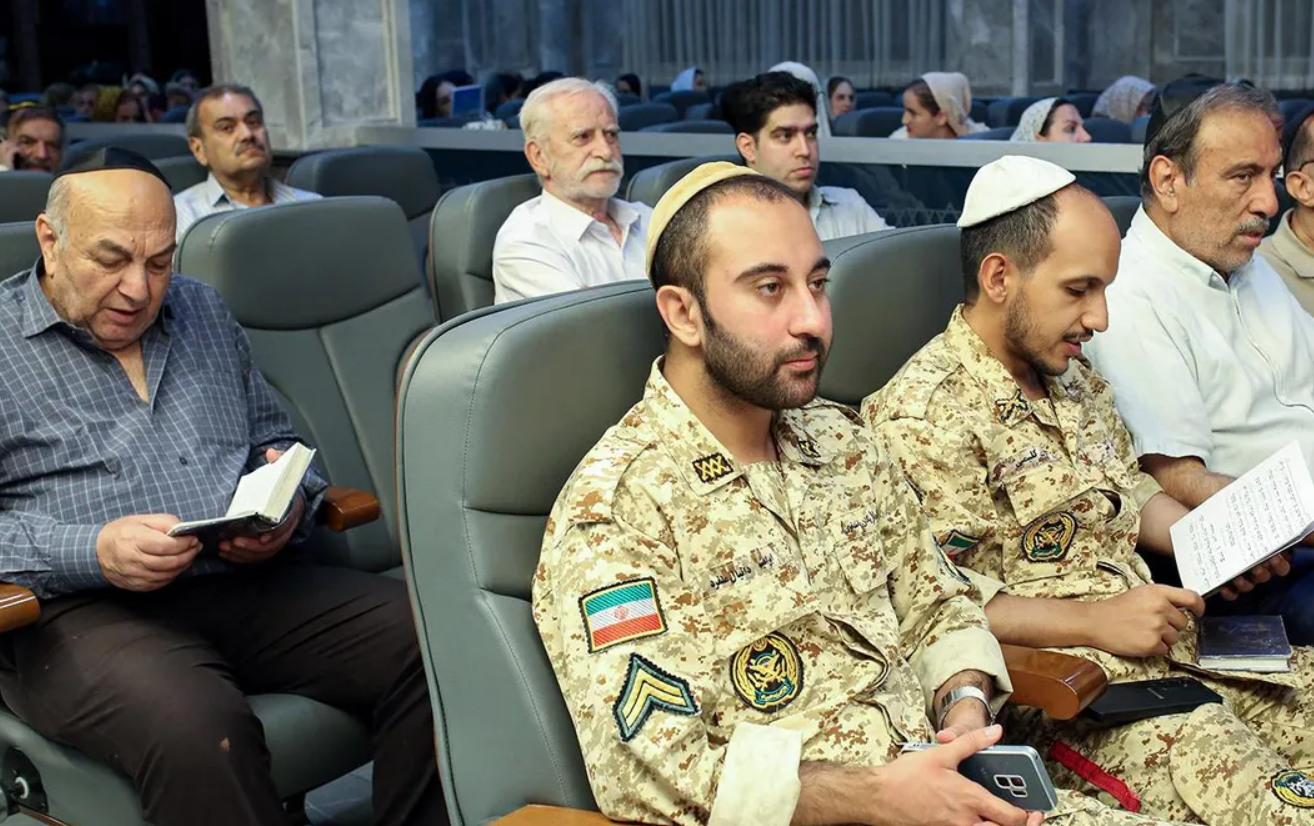
Iranian Jews Rooted Before Islam
Any analysis of Iranian Jews must begin with a chronology that contemporary politics often obscures: Jewish presence in Iran predates Islam, the Shi’ite state, modern Zionism, and the State of Israel. Persian Jewry is one of the oldest Jewish communities of the Diaspora, with roots extending at least to the sixth century BCE. This chronology is not merely historical background. It establishes the premise upon which the rest of this article rests: Iranian Jews are not a foreign population whose place in Iran originated in the toleration of a Muslim state. Their history in the Iranian world is older than the political and religious orders that later classified them as a minority.
The formative encounter came with Cyrus the Great’s conquest of Babylon in 539 BCE. Jewish tradition remembers Cyrus with exceptional favor because Persian rule permitted exiled Jews to return to Jerusalem and restore their religious institutions. Ezra and Second Isaiah preserve this positive memory of the Persian monarch, making the Achaemenid encounter unusual in Jewish historical consciousness: Persia entered the narrative not principally as a persecutor, but as the imperial power associated with liberation from Babylonian captivity. This memory should not be converted into a mythology of timeless Persian tolerance, but its historical significance is unmistakable.
Jewish communities remained within the Persian imperial world. Susa and Hamadan became enduringly associated with Jewish life, while biblical traditions in Esther, Ezra, Nehemiah, and Daniel place Jews within the political geography of ancient Persia. The Book of Esther, whose narrative unfolds at the Persian court in Susa, is religious literature rather than a modern archival source; nevertheless, its place in Jewish memory demonstrates how deeply Persia entered the Jewish historical imagination. Traditions surrounding Esther and Mordecai in Hamadan and Daniel in Susa reinforced this association across subsequent centuries.
Jewish life continued under later Iranian empires, including the Sasanians. Conditions varied considerably: periods of communal development alternated with episodes of restriction and persecution. This variation matters because there was never a single, timeless “Persian treatment of the Jews.” Political authority, religious doctrine, local conditions, economic position, and individual rulers all shaped minority life. Iranian Jewish history can therefore be reduced neither to an uninterrupted golden age nor to an uninterrupted history of oppression.
The Arab-Muslim conquest of the seventh century fundamentally changed the juridical environment but did not create the Jewish presence in Iran. Jewish communities continued to inhabit Iranian cities, engage in commerce, preserve religious traditions, and maintain communal institutions under successive Muslim dynasties. At exceptional moments, Jews could even achieve considerable political prominence. Al Rousan et al. cite Sa’d al-Dawla’s rise under the Ilkhanids in the late thirteenth century as an example of Jewish participation at the highest levels of political life. Such cases demonstrate opportunity, but not equality; individual advancement did not erase the legal hierarchy governing relations between Muslims and non-Muslims.
Across the Iranian plateau, distinctive Jewish communities developed in Isfahan, Shiraz, Hamadan, Sanandaj, Kashan, Yazd, Kermanshah, Tehran, and numerous smaller towns. Their diversity is itself evidence of historical rootedness. These communities differed in dialect, occupation, religious practice, and relations with surrounding Muslim populations. Iranian Jewry was not simply a religious enclave reproduced identically from city to city; it formed part of Iran’s varied local societies.
Perhaps the clearest cultural evidence is the Judeo-Persian tradition. Iranian Jews wrote Persian in Hebrew script and produced religious, historical, poetic, and communal literature in the language. This fusion makes the inadequacy of treating “Jewish” and “Iranian” as competing identities especially clear. Persian was not merely a language borrowed from the surrounding population; over centuries it became part of a specifically Iranian Jewish cultural world. The persistence of Iranian language, food, memory, ritual, and cultural identification among later Jewish emigrants reflects the depth of that historical formation.
Antiquity, however, did not guarantee equality. Under Safavid Shi’ite rule, Jews experienced periods of discrimination, social exclusion, and forced conversion. Bābāʾī ben Lutf’s seventeenth-century Judeo-Persian Kitāb-i Anūsī preserves an important internal Jewish account of such coercion. Concepts such as najasat, or ritual impurity, could also reinforce social distance between Shi’ite Muslims and Jews. These experiences matter here chiefly because they establish the distinction developed in the following section: historical belonging and political equality are separate questions.
The same distinction remained visible under the Qajars. Nineteenth-century sources document violence, property seizure, accusations against Jews, and coerced conversion. The 1839 Allahdad in Mashhad, in which the Jewish community was attacked and survivors were forced publicly to convert to Islam, remains the most dramatic example. Many subsequently maintained Jewish practices clandestinely, producing a crypto-Jewish community that survived for generations. The episode demonstrates that the durability of a community cannot itself be treated as evidence of tolerance.
By the late nineteenth and early twentieth centuries, however, older structures of religious hierarchy were beginning to confront new ideas of law and citizenship. International Jewish organizations became increasingly involved in Iranian Jewish affairs, while the Constitutional Revolution introduced parliamentary representation and weakened older legal distinctions. These changes did not eliminate prejudice, but they marked the beginning of a transition from the language of protected religious community toward that of modern political membership.
The essential historical conclusion is therefore straightforward. Modern citizenship did not create the Jewish relationship with Iran. It attempted to give a new legal form to a relationship already more than two millennia old. Jews had lived under Achaemenids, Sasanians, Muslim dynasties, Mongols, Safavids, and Qajars; they had spoken Iranian languages, produced Persian literature, participated in local economies, and constructed identities that were simultaneously Jewish and Iranian.
This is why “minority” must never become a synonym for “foreigner.” It describes demographic or constitutional status, not historical depth. Iranian Jews predate the Islamic conquest by more than a millennium and the establishment of a Shi’ite Iranian state by roughly two thousand years. To interpret their Iranian identity primarily through Israel and Zionism is therefore to reverse the chronology.
Iranian Jewish history begins with belonging, not tolerance. The harder question is what happened to that belonging once Islamic law transformed religious difference into a structured juridical relationship between Muslim ruler and non-Muslim subject. That relationship—the dhimma—is the subject of the next section.
How Dhimma Built Inequality
To understand the historical position of Iranian Jews, one distinction is indispensable: protection was not equality. Modern discussions of dhimma often collapse into two competing simplifications. One portrays Jewish life under Muslim rule as an uninterrupted history of persecution; the other emphasizes coexistence so heavily that the hierarchy built into the institution nearly disappears. Neither adequately explains the Iranian experience. Classical dhimma incorporated recognized non-Muslim monotheistic communities into a Muslim political order and afforded them protection, but it did so through differentiated rather than equal belonging.
Jews and Christians, as ahl al-kitab—People of the Book—could generally retain their religion, communal institutions, and a measure of juridical autonomy in return for accepting Muslim sovereignty and obligations associated with protected status, most notably the jizya. The arrangement was therefore more complex than either “tolerance” or “persecution.” Protection could be meaningful; but it was protection within hierarchy. As Laurence D. Loeb argues in his study of Persian Jewry, the Muslim-dhimmi relationship regulated relations between dominant and subordinate populations.
Loeb’s contribution is especially valuable because it connects legal status to social behavior. Drawing on fieldwork in Shiraz, he describes a pattern of low social visibility through which Jews adapted to an environment of unequal power while performing economic and social functions useful to the surrounding society. Such strategies were not necessarily signs of passivity; they could represent rational mechanisms of survival. Yet their necessity reveals the structure itself: security could depend upon understanding the boundaries of permissible visibility.
Those boundaries were neither static nor uniformly enforced. Jewish experience differed across rulers, dynasties, cities, and periods; central authority and local clerical power could radically alter conditions. Matthias B. Lehmann, discussing Daniel Tsadik’s research on nineteenth-century Iran, rightly cautions against reducing Jewish-Muslim relations to continuous persecution. But uneven enforcement did not erase hierarchy. Lehmann notes Tsadik’s finding that expectations of Jewish humiliation associated with dhimma appear to have been widespread even where particular restrictions were inconsistently applied. The distinction is crucial: a hierarchical order need not persecute continuously in order to remain hierarchical.
In Shi’ite Iran, this structure acquired an especially intimate dimension through najasat, or ritual impurity. Imami Shi’ite jurisprudential discussions could classify Jews and other non-Muslims as ritually impure, carrying implications for food, physical contact, occupation, and public interaction. An extraordinary illustration appeared in Tehran in 1871, when authorities attempted to regulate Jews and Armenians during wet weather in order to prevent the ritual contamination of Shi’ites. The measure ultimately failed amid resistance and the prospect of foreign intervention. Its significance lies precisely in its extremity: theological hierarchy could migrate from jurisprudence into the regulation of physical presence in everyday life.
The Safavid period demonstrates how rapidly such vulnerability could become coercion. The establishment of Twelver Shi’ism as the religion of the state intensified the political significance of confessional identity. Conditions varied among rulers, but under Shah ʿAbbas II anti-Jewish measures included distinctive clothing, taxation, restrictions involving Hebrew books, and a forced-conversion decree in 1656. Many nominal converts reportedly continued Jewish practices clandestinely until policy was later relaxed. Bābāʾī ben Lutf’s Judeo-Persian Kitāb-i Anūsī—The Book of a Forced Convert—is especially valuable because it preserves this experience from within the affected community rather than solely through the decrees of rulers or prescriptions of jurists.
The Safavid record also cautions against theological determinism. Economic interests, administrative calculations, political conflict, and the usefulness of minority merchants could influence both persecution and its retreat. The relaxation of some measures under ʿAbbas II appears to have been shaped partly by commercial and fiscal considerations. Religious hierarchy created vulnerability; politics determined how aggressively that vulnerability was exploited.
That relationship became still clearer under the Qajars. Jews remained a recognized monotheistic community, yet weak central authority often left them exposed to local officials and clerics. Fiscal pressure could exceed formal jizya obligations, while customs and regulations affected occupation, residence, dress, public religious activity, and, in some settings, horseback riding. Hierarchy was therefore not merely a jurisprudential abstraction. It could become visible in where one lived, what one wore, which occupations one entered, and how one moved through public space.
The 1839 Allahdad in Mashhad represents the most dramatic limit of this arrangement. Jews were killed and the surviving community compelled to convert to Islam. Many of the resulting Jadid al-Islam, or “New Muslims,” subsequently performed Muslim identity publicly while preserving Jewish ritual and communal life in private. Mashhad cannot stand as a description of Jewish life throughout Iran, and Tsadik explicitly warns against portraying nineteenth-century Jews as continuously persecuted by all Muslims. But precisely for that reason the episode is analytically revealing. Institutional inequality does not require permanent violence. Its significance lies also in the boundaries it establishes and in the possibility of coercion when those boundaries are challenged.
Lehmann’s reading of nineteenth-century anti-Jewish violence sharpens this point. Drawing on Tsadik, he interprets some outbreaks not simply as failures of coexistence but as attempts to reassert a traditional social hierarchy when Jews appeared to exceed an established subordinate position. Violence could therefore become a mechanism of boundary restoration. Protection endured so long as the protected population remained within the political and social limits attached to its status.
By the nineteenth century, however, those limits were increasingly contested. European diplomatic pressure, Jewish international organizations, reformist currents, and new conceptions of civic equality challenged inherited religious distinctions. Naser al-Din Shah instructed his prime minister in 1865 that oppressed Jews should receive justice and kindness and, during his European travels in 1873, invoked equality among subjects regardless of religion. Lehmann notes that such initiatives could provoke resistance from elements of the ulama and local elites. The conflict was therefore becoming conceptual as well as political: should the ruler merely protect religious minorities, or should religion cease to determine civil standing?
The Constitutional Revolution moved that question into a new institutional framework. Parliamentary representation and an emerging language of citizenship did not eliminate discrimination, but they began to weaken the older assumption that political status should derive principally from religious community. The Iranian Jew could increasingly be imagined not merely as a protected Jew, but as an Iranian citizen who was Jewish.
This distinction is essential to the argument of this article. It would be historically inaccurate to claim that the Islamic Republic simply restored classical dhimma in 1979. Contemporary Jews possess nationality, do not pay jizya, participate in modern institutions, and hold constitutionally designated parliamentary representation. Classical dhimma and the Islamic Republic are not identical systems.
The historical comparison nevertheless matters because dhimma exposes a political distinction that can survive the disappearance of its medieval legal forms: recognition does not necessarily produce equality. A minority may be permitted to worship, organize, and maintain communal institutions while remaining differentiated within a religiously ordered political system. The instruments may change; the underlying question remains—whether the state recognizes a minority as equal citizens or merely recognizes a legitimate place for them within a hierarchy.
The importance of the Pahlavi period lies precisely here. Modernization did not eradicate prejudice. What it increasingly challenged was the political architecture that made religious community determinative of civic standing. Centralization, secularization, education, and economic mobility pushed Iranian Jews away from the inherited status of a protected religious collectivity and toward membership in a national political community.
The decisive historical transition, then, was not from persecution to tolerance. It was from protected minority toward citizen. That transformation—and its limits—is the subject of the next section.
Widening Jewish Belonging Under Pahlavis
The Pahlavi dynasty did not create Iranian Jewish belonging, nor did it eliminate inherited prejudice. Its significance was different and politically more consequential: it accelerated the transition from religiously differentiated status toward national citizenship. Reza Shah’s centralization, secularization, bureaucratic expansion, and construction of a stronger national state weakened institutions through which local religious authorities had historically exercised power over minorities. For Iranian Jews, the decisive change was therefore not simply greater “tolerance,” but the emergence of a state increasingly inclined to define political membership through Iranian nationality rather than communal religious hierarchy.
The transformation had begun with the Constitutional Revolution, which expanded the formal political standing of recognized minorities, provided parliamentary representation, and abolished the jizya. Yet legal reform did not immediately erase inherited social boundaries. The Pahlavi state accelerated this incomplete transition by concentrating authority in Tehran and reducing the autonomy of local structures that had sustained religious differentiation.
The change became visible in the geography of Jewish life. Under Reza Shah, Jews increasingly moved beyond the traditional mahalla, entering neighborhoods and public spaces shared with Muslim Iranians. This was more than residential mobility. A community historically encouraged toward low visibility was becoming more present within the national public sphere.
Education was central to that transformation. The Alliance Israélite Universelle had opened its first Tehran school in 1898 and subsequently established schools across Iran, expanding literacy, secular education, and access to foreign languages. Under the Pahlavis, these educational foundations converged with urbanization and economic modernization. Jews increasingly entered universities, medicine, pharmacy, commerce, and other professions. By the later decades of Mohammad Reza Shah’s reign, a community much of which had remained economically disadvantaged earlier in the century had experienced substantial upward mobility.
Integration did not require communal disappearance. Jewish schools, newspapers, charitable associations, cultural organizations, and medical institutions flourished alongside growing participation in Iranian public life. Dr. Rouhollah Sapir’s charitable clinic, founded in 1942 and later developed into Sapir Hospital, treated Jewish and non-Jewish patients alike. Such institutions embodied an important transformation: Jewish communal identity and Iranian civic participation could reinforce rather than negate one another.
Pahlavi nationalism also altered the symbolic foundations of belonging. Its emphasis on ancient Persia and Iran’s pre-Islamic past did not produce complete religious neutrality, but it weakened Islam’s exclusive claim to define Iranian identity. For Jews whose presence in Persia extended into antiquity, this national narrative offered a particularly powerful form of inclusion. Cyrus could belong simultaneously to Jewish historical memory and Iranian national memory. The Jew did not have to become less Jewish to become more Iranian; the political imagination of Iran itself had widened.
Under Mohammad Reza Shah, this process became more visible. Iranian Jews increasingly interacted with non-Jewish Iranians, entered professional and university life, and participated in the expanding urban middle and upper-middle classes. In this respect, the contrast with Loeb’s description of traditional Jewish “low social visibility” is striking. The historical movement was from communal survival toward public citizenship.
Iran’s relationship with Israel reinforced that distinction. Under Mohammad Reza Shah, Iran and Israel developed extensive economic, political, security, and strategic relations. The existence of Israel therefore did not automatically transform Iranian Jewish identity into a question of political loyalty. An Iranian Jew could possess familial, cultural, or religious connections extending beyond Iran without those connections necessarily contradicting the foreign policy of the Iranian state. This would change radically after 1979, when Israel moved from strategic partner to ideological enemy.
None of this makes the Pahlavi period an uncomplicated golden age. Shi’ite notions of Jewish ritual impurity and other forms of anti-Jewish prejudice persisted within parts of society despite state-led secularization. Nor did increased Jewish equality transform the monarchy into a democracy. Jewish opponents of the Shah could be imprisoned or exiled just as Muslim dissidents could be. The analytical claim is therefore narrower and stronger: the direction of institutional change increasingly reduced, rather than reinforced, the political significance of religious identity.
Migration further demonstrates the complexity of the period. Approximately 22,000 Iranian Jews emigrated to Israel between 1948 and 1952, many from economically disadvantaged backgrounds, while some later returned after encountering difficult conditions there. By the 1960s, emigration had slowed substantially. Meanwhile, large numbers of Jews moved from provincial communities to Tehran as part of the wider urbanization transforming Iranian society. The creation of Israel therefore did not automatically dissolve Jewish attachment to Iran. For many, Iran remained homeland, language, culture, citizenship, and social world.
By the eve of the Islamic Revolution, the historical distance traveled was considerable. A community once associated with dhimmi status, segregated quarters, occupational limitations, ritual impurity, and strategies of low visibility had become increasingly urban, educated, professionally successful, institutionally confident, and integrated into national life. The old prejudices had not disappeared. What had changed was the relationship between those prejudices and the state: religious hierarchy was increasingly losing its capacity to organize Jewish citizenship.
This is what makes 1979 a genuine rupture. The revolution did not mechanically return Iranian Jews to Safavid or Qajar dhimma. It did, however, reverse an essential direction of Pahlavi state-building by placing religious identity once again at the constitutional center of political order. At the same time, the new regime transformed Israel from a strategic partner into an ideological enemy.
The Jew remained Iranian. What changed after 1979 was not the antiquity of that belonging, but the political conditions under which it would have to be demonstrated.
1979 Restored Religion to Citizenship
For Iranian Jews, 1979 was more than a change of regime. It reversed the direction in which the relationship between religion and citizenship had been moving. The Pahlavi state had not eliminated antisemitism or social prejudice, but it had progressively reduced religion’s importance as an organizing principle of public status. The Islamic Republic moved in the opposite direction, placing Twelver Shi’ism at the constitutional and ideological center of political authority. Religion once again became a formal category through which the state defined political belonging.
The rupture was immediate. On May 9, 1979, Habib Elghanian, a prominent Jewish industrialist, philanthropist, and former leader of Tehran’s Jewish community, was executed after a revolutionary trial on charges that included espionage for Israel and “economic imperialism.” His execution carried consequences far beyond one individual. In the new revolutionary environment, connections with Israel—real, alleged, commercial, or communal—could suddenly acquire existential political significance. Jewish emigration, already occurring amid revolutionary instability, accelerated.
The response of Jewish leaders revealed the depth of the uncertainty. A delegation traveled to Qom to seek assurances from Ruhollah Khomeini, who drew a sharp distinction between Judaism and Zionism, affirming Iranian Jews as members of the nation while defining Zionists as political enemies. This distinction became foundational to the Islamic Republic’s treatment of Iranian Jewry: Judaism could remain a recognized religion even as Zionism became an ideological enemy.
Accounts favorable to the Islamic Republic understandably emphasize the protective significance of this distinction. Al Rousan and his co-authors point to Khomeini’s assurances, his prohibition of violence against Jews, and the continued existence of synagogues, Jewish schools, communal institutions, and parliamentary representation as evidence that the revolutionary state did not adopt a policy of collective persecution. These facts matter. The Islamic Republic did not outlaw Judaism or abolish organized Jewish life.
Yet the formula contained a profound political asymmetry: who determined when a Jew ceased to be merely Jewish and became “Zionist”? The state did. The distinction that protected Iranian Jews therefore also defined the condition under which protection could become politically precarious. Religious identity was legitimate; political sympathy, association, or activity interpreted as Zionist was not. The boundary between the two belonged ultimately to the revolutionary authorities rather than to the minority itself.
Research on Iranian Jewish religiosity after 1979 identifies precisely this tension. It describes the separation of permissible “religiosity” from suspect “politics” as central to the post-revolutionary condition: Jews could remain observant and communally active, while alleged connections with Israel, Zionism, or hostile foreign powers could move questions of identity into the realm of national security. The same study interprets aspects of this arrangement as a regenerated form of dhimmitude—not a literal restoration of classical Islamic law, but a modern condition in which communal security could become connected to political conformity and demonstrable loyalty.
Here the contrast with the Pahlavi period becomes especially important. Before 1979, Iran’s extensive relationship with Israel meant that Jewish identity and the existence of a Jewish state did not inherently produce a contradiction of national loyalty. The revolution severed those relations and made opposition to Zionism central to revolutionary ideology. Iranian Jews consequently entered an unusual political position: the state formally insisted that Judaism and Zionism were entirely different while making suspected Zionist affiliation one of the gravest accusations that could attach to a Jewish citizen.
The demographic consequences were substantial. Estimates in the sources vary from approximately 60,000 to 80,000 or more Jews in Iran around the revolution, but they agree that most subsequently emigrated. Causation, however, requires caution. Jews left amid a much broader exodus of middle- and upper-middle-class Iranians, revolutionary instability, economic uncertainty, and eventually the Iran-Iraq War. Yet Elghanian’s execution, arrests, anti-Israel agitation, and uncertainty surrounding the boundary between Jewishness and suspected Zionism gave Jewish emigration a distinctive political dimension.
The paradox of the new order was therefore already visible: Judaism survived constitutionally, but Jewish citizenship operated within an ideological environment that could attach exceptional political significance to Jewish transnational connections. Synagogues remained open, communal institutions survived, and Jews retained parliamentary representation. Recognition was real. But recognition and equality were not identical.
The distinction became especially visible when allegations of espionage arose. In 1999, thirteen Jews from Shiraz and Isfahan were arrested and accused of spying for Israel and the United States; ten were ultimately convicted and sentenced to prison terms ranging from two to nine years, with the remaining prisoners released by 2002. The importance of the episode here is not to assume that every prosecution of a Jewish citizen constitutes antisemitism. Rather, it demonstrates the extraordinary political sensitivity created when a religious minority possesses historical, familial, or transnational connections associated with a state defined by the government as an enemy.
The same analytical caution must govern discussion of anti-Zionism and antisemitism. Judaism, Zionism, and Israel are distinct categories, and criticism of Israel cannot simply be classified as antisemitic. The problem arises when the distinction collapses—when hostility toward Israel produces generalized suspicion of Jews, or when explicitly antisemitic material circulates under the language of anti-Zionism. The research assembled for this study documents antisemitic propaganda in state-controlled media and the publication in Iran of The Protocols of the Elders of Zion, the notorious antisemitic forgery.
One of the most revealing features of the post-revolutionary order was therefore not the destruction of Jewish religious life, but its adaptation. Research on Iranian Jewish religiosity suggests that emphasizing traditional religious identity could itself provide a measure of communal security by demonstrating distance from Zionist politics. The paradox is striking: religiosity could become evidence of political acceptability. The more clearly Judaism could be represented as faith rather than politics, the more securely it could fit within the Islamic Republic’s constitutional order.
The Islamic Republic thus created neither complete exclusion nor religious neutrality. It created recognition accompanied by ideological conditionality. Jews could belong, worship, organize, and possess representation, but the political meaning of Jewish identity was continually differentiated from Zionism and Israel. The state protected that distinction while simultaneously reserving to itself the authority to police its boundary.
This is the deeper meaning of the rupture of 1979. The Pahlavi state had increasingly made religious identity less determinative of public status; the Islamic Republic restored religion to the constitutional architecture of the state. For Iranian Jews, that transformation was intensified by the conversion of Israel from strategic partner into ideological enemy. They remained Iranian citizens and members of a recognized religion, but their position now contained a question far less consequential before the revolution:
Could Jewish identity remain unquestionably Iranian when the state itself determined where Judaism ended and political disloyalty began?
That question leads directly to the Islamic Republic’s central contradiction: recognition without religious neutrality, institutional survival without necessarily equal political trust.
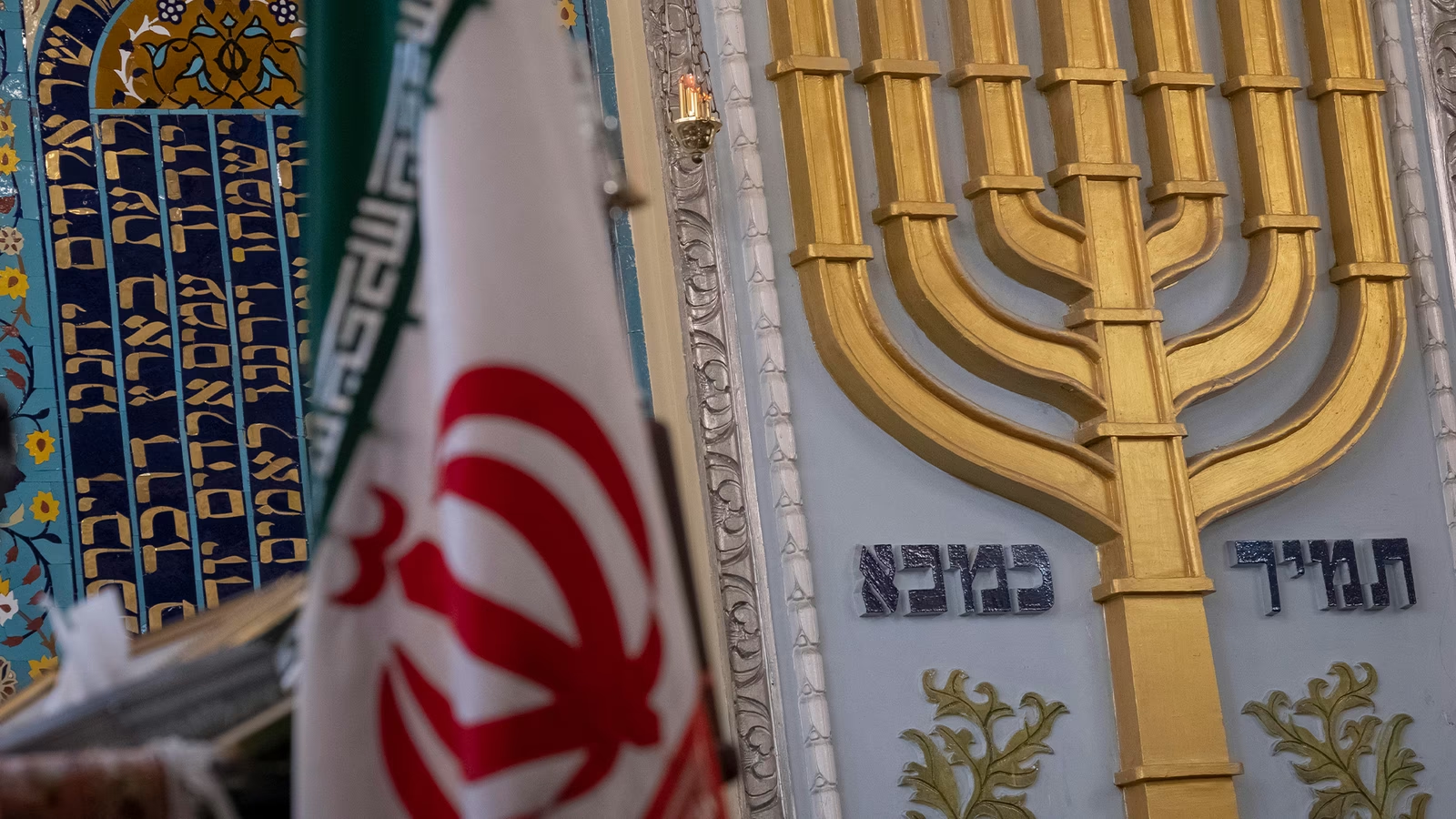
Iranian Jews Face Wartime Loyalty Tests
The central contradiction of Jewish life under the Islamic Republic is not that Judaism is prohibited. It is not. Iranian Jews possess synagogues, communal institutions, constitutional recognition, and parliamentary representation. The contradiction is more subtle: the state recognizes Jews as a legitimate religious community while preserving a political order in which religion remains consequential to citizenship. Communal existence is protected; civic equality is more complicated.
The constitutional case for recognition is substantial. Article 13 recognizes Jews, Christians, and Zoroastrians and permits them, “within the limits of the law,” to conduct religious ceremonies and regulate personal-status matters according to their traditions. Article 64 guarantees Jewish representation in parliament, and Article 67 permits minority representatives to swear the parliamentary oath upon their own scriptures. Al Rousan and his co-authors interpret these provisions as evidence of meaningful religious, cultural, social, and political protection. These guarantees should not be dismissed simply because they complicate criticism of the regime.
Nor are they merely constitutional abstractions. Iranian Jews have maintained synagogues, schools, charitable organizations, kosher facilities, and communal institutions, particularly in Tehran, Shiraz, and Isfahan. Under Hassan Rouhani, measures affecting inheritance and Jewish school attendance on the Sabbath reportedly improved, while a memorial was unveiled honoring Jewish Iranian soldiers killed during the Iran-Iraq War. Such evidence matters. A serious account cannot describe four decades of Jewish life in Iran as uninterrupted persecution.
But these protections illuminate the problem as much as they mitigate it. Jews are constitutionally protected as a recognized religious minority within an explicitly Islamic state. The distinction is fundamental. Recognition acknowledges a legitimate place for difference; equality requires that difference not determine the quality of citizenship. The reserved Jewish parliamentary seat captures both dimensions simultaneously: it guarantees inclusion precisely because Jews remain a legally differentiated community.
The political significance of that differentiation becomes sharper because of Israel. Khomeini’s distinction between Judaism and Zionism protected Iranian Jews from formal identification with the Islamic Republic’s enemy, but it also established what might be called a loyalty boundary. Judaism was permissible; Zionism was not. Research on Iranian Jewish religiosity describes the politically “trustworthy” Jew as one who publicly separates religious identity from Israel and Zionism, while alleged sympathy or espionage can move the individual from protected religion into prohibited politics. The critical issue is therefore not merely that a boundary exists, but that the state determines where it lies.
The distinction would be less consequential if anti-Zionism and antisemitism remained consistently separate in official discourse. The evidence is more complicated. The materials assembled for this study document recurring accusations of Zionist connections alongside antisemitic propaganda, including publication in Iran of The Protocols of the Elders of Zion. Under Mahmoud Ahmadinejad, Holocaust denial and antisemitic rhetoric became particularly visible, although some scholars and observers have argued that several of his most notorious statements concerning Israel were mistranslated or distorted. Analytical precision requires acknowledging both points. Criticism of Israel or Zionism is not inherently antisemitic; Holocaust denial and classical antisemitic conspiracy literature, however, cannot be made non-antisemitic simply by placing them within an anti-Zionist political vocabulary.
The consequence is a distinctive form of political vulnerability. Iranian Jews may be profoundly attached to Iran while also possessing family, religious, historical, or emotional connections across the global Jewish world. Because Israel occupies an exceptional position in the Islamic Republic’s security ideology, relationships ordinarily belonging to private or transnational life can acquire political significance. The project materials describe suspicion surrounding contacts with Israel and Zionist organizations, as well as surveillance and restrictions connected to foreign travel.
This is the heart of the contradiction: communal permission is not necessarily civic equality. A synagogue can remain open while the citizens inside it belong to a constitutionally differentiated category. A Jew can sit in parliament while the ideological limits surrounding Israel remain fixed by the state. Religious education can continue while expressions interpreted as Zionist sympathy carry political risk. These realities do not cancel one another. Their coexistence defines the system.
It is in this limited structural sense that neo-dhimmitude remains analytically useful. The Islamic Republic has not restored the jizya or recreated Safavid law. Iranian Jews possess modern citizenship, vote, attend universities, own property, and maintain communal institutions. Yet one study used in this research explicitly interprets post-revolutionary Jewish adaptation as resembling a regenerated form of dhimmitude, in which religious conformity and acceptance of the dominant political order can contribute to communal security. The analogy should therefore illuminate a structure, not imply historical identity: protection without religious neutrality, recognition without the disappearance of hierarchy.
The agency of Iranian Jews must also remain visible. Those who stayed after 1979 did not merely submit to state policy. They preserved synagogues and institutions, maintained Persian Jewish traditions, participated in Iranian society, and constructed what one study calls a modus vivendi or “endurable coexistence” with the Islamic order. Such adaptation demonstrates resilience, not necessarily equality. The capacity of a minority to negotiate political constraints cannot itself prove that those constraints do not exist.
The distinction ultimately returns us to tolerance and citizenship. Tolerance asks what a dominant order permits a minority to do. Equal citizenship asks whether permission is relevant in the first place. The Islamic Republic can truthfully point to synagogues, Jewish schools, communal organizations, religious practice, and parliamentary representation. Its critics can truthfully point to ideological boundaries, antisemitic rhetoric, security suspicion, and the exceptional political sensitivity surrounding Israel. The two accounts are not mutually exclusive. Together, they explain the system.
Iranian Jews are recognized, institutionally organized, and deeply rooted in Iran. The decisive question is therefore no longer whether Jewish life has survived the Islamic Republic. It plainly has. The harder question is whether equal citizenship can exist when one minority’s identity carries an exceptional burden of political explanation.
The true measure of equality is not whether the state permits Jews to belong, but whether they can belong without continually having to prove that their Jewishness is politically harmless.
The contradiction becomes most visible during confrontation. Since October 7, 2023, and especially as the Iran–Israel conflict moved from proxy warfare toward direct military exchange, the position of Iranian Jews has faced an unusually revealing test. The question is no longer whether Jews may practice Judaism in Iran. They may. The harder question is whether, in wartime, Jewish citizens can remain politically neutral—or are expected to demonstrate that Jewish identity implies no loyalty to Israel.
Reports collected for this study indicate that after October 7, Jews in Tehran and Shiraz were warned against communicating with relatives in Israel; some reportedly withdrew from family WhatsApp groups or blocked communications out of fear that ordinary contact could be interpreted as prohibited association. The reports require appropriate caution, but the issue they raise is significant. When Israel is defined as an existential enemy, even the ordinary transnational reality of Jewish family life can acquire security implications.
That pressure became publicly visible on October 30, 2023, when hundreds of Iranian Jews participated in anti-Israel demonstrations in Tehran, Shiraz, Isfahan, Yazd, and Kermanshah. Critics described the demonstrations as coerced; Iran’s U.N. mission rejected that characterization and maintained that participants genuinely opposed Israeli actions in Gaza. Both claims belong in the record. Iranian Jews are not politically homogeneous, and opposition to Israeli policy cannot simply be presumed insincere. The analytical question is narrower: what political freedom exists to take the opposite position—or no position at all?
David Menashri has noted both the community’s persistent efforts to demonstrate loyalty to Iran and the tendency of public statements by Jewish communal leaders to remain aligned with state policy. This does not establish coercion in every case. It does, however, make public declarations an imperfect measure of private belief. Political freedom is demonstrated not merely by the ability to express the government-approved position, but by the ability to reject it without fear.
Reports surrounding Quds Day sharpen this problem. In 2023, sources alleged pressure on Jewish communities to alter Passover observances and participate in anti-Israel demonstrations, while messages attributed to communal institutions emphasized separation from Zionism and solidarity with Iranian Muslims. One expert further alleged security monitoring of synagogue discussions concerning Israel and the regime. These claims should not be generalized beyond their evidence. But if accurate, they illustrate how public anti-Zionism can function not merely as political expression, but as evidence of political reliability.
A similar dynamic followed the assassination of Hamas leader Ismail Haniyeh in Tehran in July 2024. The Tehran Jewish community publicly condemned the killing, as did representatives of recognized religious minorities in parliament. Critics characterized such declarations as coerced. The private motives of individual signatories cannot be established from public statements alone. What can be observed is the asymmetry: condemning Israel conforms to the ideological order; publicly defending Zionism or Israel would carry an entirely different political and potentially legal risk.
Direct warfare intensified that vulnerability. Following the June 2025 Israel–Iran war, reports described Jewish communities in Tehran, Shiraz, and Isfahan suspending public gatherings and synagogue prayers while communal representatives condemned Israeli attacks and affirmed loyalty to Iran. Iranian authorities reportedly summoned at least thirty-five Jews for questioning concerning possible connections with Israel, including relatives there and contacts with foreigners.
Here, evidentiary discipline is essential. Early reports included unconfirmed claims concerning arrests of rabbis and communal figures. Later information in the research materials states that by August 2026 all thirty-five Jewish community members who had been detained or questioned had been released. The responsible conclusion is therefore limited but important: the evidence supports heightened scrutiny and interrogation during an acute national-security crisis, not a claim that these individuals were permanently imprisoned or disappeared.
Other evidence makes the picture still more complex. Sources familiar with the community reported comparatively stable conditions and no unusual generalized campaign against Jews, even while Jewish families kept a low profile, canceled weddings and gatherings, and avoided conduct that could be interpreted as celebrating attacks on Iran. Jewish organizations abroad reportedly advised against contacting Jews inside the country because doing so might expose them to risk. Stability and apprehension can coexist. Indeed, their coexistence is central to understanding minority life under conditions of geopolitical crisis.
The case of Kamran Hekmati makes the intersection between private Jewish life and national security particularly concrete. According to the materials assembled for this study, the Iranian-American Jewish jeweler was detained in Iran in 2025 and sentenced in connection with a visit to Israel thirteen years earlier for his son’s bar mitzvah; an initial four-year sentence was subsequently reduced to one year. Whatever the broader circumstances of the prosecution, the reported basis of the case illustrates how a familial and religious event involving Israel can acquire retrospective security significance.
None of this negates Iranian Jewish attachment to Iran. Contemporary interviews describe Jews expressing profound identification with their Iranian homeland while also discussing fear, unequal treatment, and concern that anti-Israel rhetoric can cross into antisemitism. There is no contradiction in these sentiments. Jewishness and Iranianness are not naturally competing identities. The political tension arises when the state demands a rigid separation between dimensions of identity that ordinary human life may connect through family, religion, memory, and culture.
The post-October 7 period therefore serves as a stress test of the Islamic Republic’s model of minority recognition. Classical dhimma required minorities to understand the political conditions attached to protection. The Islamic Republic does not reproduce that institution, but moments of war reveal a comparable structural problem: recognition remains secure so long as the state is satisfied that Jewish identity has not crossed into prohibited political affiliation.
The ultimate test of equality is consequently not whether Iranian Jews can pray in synagogues during periods of calm. It is whether their citizenship remains equally trusted when Iran and Israel are at war.
A minority is not fully equal if geopolitical crisis transforms its ancestry, relatives, religion, or transnational ties into an exceptional test of political loyalty.
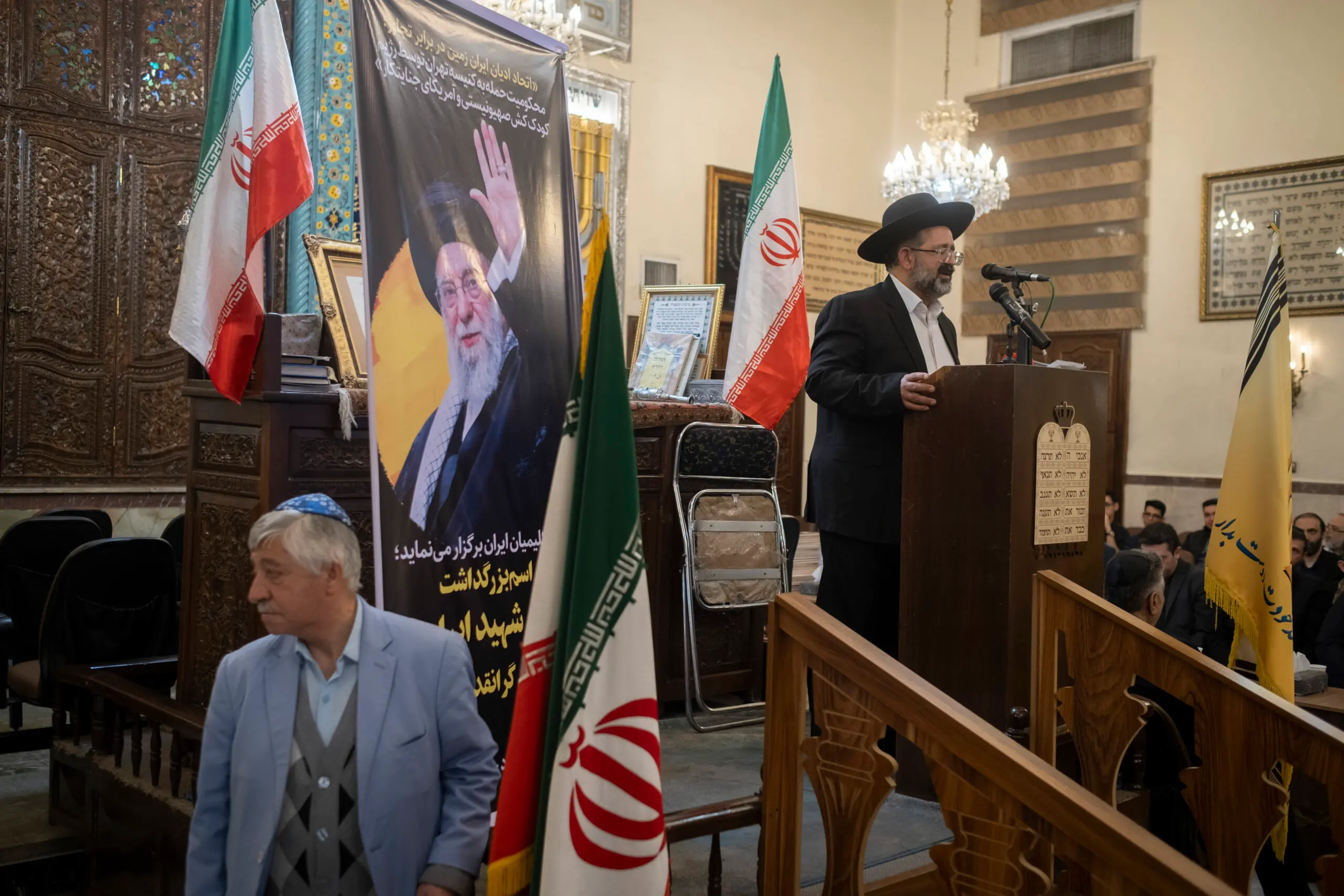
Beyond Tolerance Toward Equal Citizenship
The history of Iranian Jewry cannot be reduced to either persecution or tolerance. Jews have lived in Iran for more than two millennia, through changing dynasties, religions, political systems, revolutions, and wars. Their circumstances have ranged from severe vulnerability to remarkable integration, but their presence in Iran has endured. Iranian Jewish history is therefore not principally the history of a foreign minority seeking permission to remain; it is the history of an ancient Iranian community confronting successive definitions of political belonging.
The distinction between tolerance and citizenship is the thread connecting that history. Classical dhimma could provide protection and communal continuity, but not equality. The transformation that began with constitutionalism and accelerated under the Pahlavis gradually weakened this inherited architecture. Modernization, secularization, education, urbanization, and economic mobility did not eliminate prejudice, but they increasingly allowed Jews to participate in national life as Iranian citizens who were Jewish, rather than principally as members of a protected religious collectivity.
The revolution of 1979 altered that trajectory without simply restoring the past. Iranian Jews retained citizenship, synagogues, communal institutions, religious schools, and parliamentary representation. Articles 13 and 64 of the Islamic Republic’s Constitution formally recognize this place. These protections are real and distinguish the contemporary system from classical dhimma. Yet recognition operates inside a constitutional order in which religion remains politically consequential. Article 14 conditions obligations toward non-Muslims, while Article 20 promises equality “in conformity with Islamic criteria.” Scholarship on Iran’s constitutional treatment of religious minorities consequently identifies a persistent tension between formal protection and institutional religious differentiation.
For Iranian Jews, that tension is intensified by the Islamic Republic’s confrontation with Israel. Khomeini’s distinction between Judaism and Zionism offered an important form of protection after the revolution: the Iranian Jew could belong while the Zionist was defined as an ideological enemy. Yet this formula also created a political boundary whose interpretation remained in the hands of the state. The central vulnerability was therefore never Jewish religion alone. It was the possibility that family ties, travel, political expression, or transnational Jewish connections could be interpreted through the security category of Zionism.
The period since October 7, 2023, and the subsequent direct Iran–Israel confrontation exposed this structure with particular clarity. The evidence examined here does not justify describing every Iranian Jew as continuously persecuted, nor does every security prosecution involving Israel constitute antisemitism. The more defensible conclusion is both narrower and more consequential: the burden of political suspicion is not distributed equally. For Jewish citizens, connections that may ordinarily belong to family, religion, memory, or transnational community can acquire exceptional security significance because of the state’s ideological conflict with Israel.
This is why synagogues, Jewish schools, kosher facilities, parliamentary representation, and constitutional recognition cannot alone settle the question of equality. They establish that organized Jewish life is permitted. They do not establish that religious identity has ceased to influence the boundaries of political trust. Survival is not equality; recognition is not neutrality; tolerance is not citizenship.
A future Iranian constitutional order should therefore move beyond the concept of the state “tolerating” religious minorities. Tolerance may be preferable to persecution, but it retains an implicit hierarchy: the person who tolerates possesses the power to withdraw tolerance; the citizen possesses rights that do not depend upon another citizen’s permission. The proper standard is whether religious identity is irrelevant to the possession of fundamental civic and political rights.
That principle necessarily extends beyond Jews. Christians, Zoroastrians, Baha’is, Muslims of different schools, converts, agnostics, atheists, and citizens outside officially recognized religious categories should derive their rights from citizenship itself. Article 13 demonstrates the limitation of enumerated recognition: once the state determines which religions qualify for recognition, recognition itself becomes an instrument for determining who stands inside and outside the protected constitutional order.
The larger lesson of Iranian Jewish history is therefore about Iran itself. A civilization of extraordinary religious and cultural depth does not require uniformity of belief to sustain a common political identity. The transition from protected community to equal citizenship remains incomplete so long as the state continues to classify the rights, opportunities, or presumed loyalty of its citizens through religion.
Governments have risen and fallen around Iranian Jews. Their rights have expanded and contracted; rulers have protected them, persecuted them, and attempted to redefine their place in the nation. But the deepest historical fact precedes all of those political arrangements: Iranian Jews do not need permission to belong to Iran. They already do.
And the measure of a genuinely post-theocratic Iran will not be whether its next government chooses to tolerate them. It will be whether the question of toleration has become obsolete—because a Jew, a Baha’i, a Christian, a Zoroastrian, a Muslim, or a citizen of no faith at all stands before the law simply as an Iranian: equal in citizenship and equal in right.