
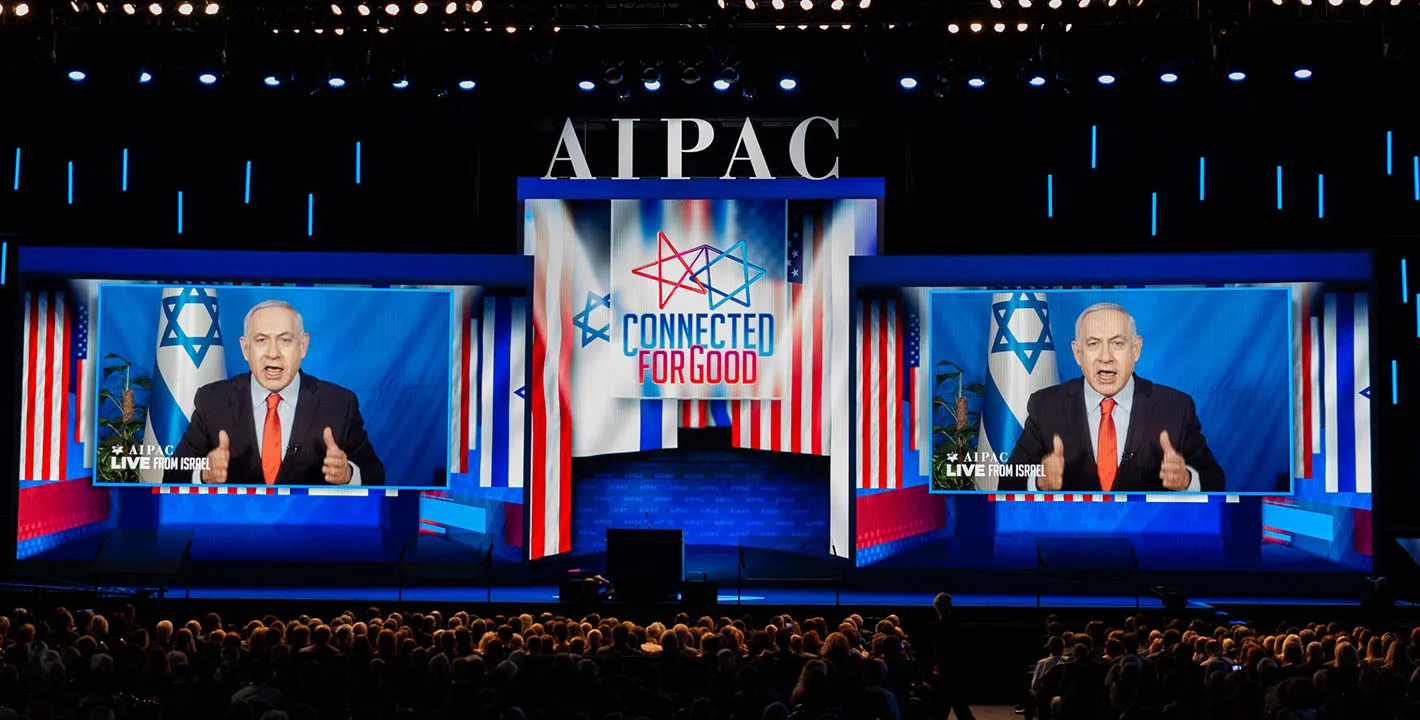
Ian Lustick and Eli Clifton argue that Citizens United enabled wealthy donors and AIPAC to replace declining public support with campaign spending, while Gaza war opposition and IHRA definitions chill criticism of Israel.
The release of Ian Lustick and Eli Clifton’s study on the Israel Lobby arrives at a moment when American public opinion on Israel has fractured along generational and partisan lines. Their work traces how a coalition of donors, advocacy groups, and political action committees moved from arguing its case in the marketplace of ideas to policing the boundaries of acceptable speech.
The Israel Lobby, in this account, no longer relies on persuasion alone; it deploys campaign finance, university oversight, and antisemitism allegations to silence critics. Lustick grounds this shift in George Washington’s farewell warning about factions passionately attached to foreign powers. Clifton links it to Citizens United, which allowed a small group of wealthy donors to replace declining grassroots support with enormous campaign spending. The authors contend that this strategy has sustained aid to Israel even as two-thirds of Democrats and one-third of Republicans oppose it.
They also argue that the Gaza war, which they call October 8, transformed American perceptions by evoking Holocaust memory and moral revulsion. Their conclusion points toward a one-state reality and a Democratic Party caught between its base and its donors. The lobby’s future depends on whether public opinion can overcome concentrated financial power.
Washington Warned Against Foreign Factions
Ian Lustick holds the Bess W. Heyman chair emeritus in the Political Science Department of the University of Pennsylvania. He teaches Middle Eastern politics, comparative politics, and computer modeling. He is a recipient of awards from the Carnegie Corporation, the National Science Foundation, the National Endowment for the Humanities, and the Social Sciences Research Council.
Eli Clifton is an investigative journalist who focuses on money in politics and U.S. foreign policy. He is a cofounder of the Quincy Institute for Responsible Statecraft, where he serves as senior adviser. Together, the two recently authored Israel’s Lobby: America in the Grip of a Foreign Power (One Signal Publishers, 2026), examining the Israel Lobby in the United States and its influence on political life, civil liberties, and U.S. foreign policy. Diwan interviewed the authors in late September in order to discuss their book.
Michael Young: In your book, you make two central points about the Israel Lobby that I found very interesting. First, you situate it in the shadow of George Washington’s comments on factionalism in the United States and his warnings about avoiding foreign entanglements. Second, you examine the lobby in the context of the change in election financing laws since the Citizens United Decision of 2010. Ian, can you address the first part of the question, on George Washington, and outline what you argue in your book? Eli, can you address the matter of election financing and its impact on the lobby?
Ian Lustick: In his farewell address, our first president offered a profound analysis of American politics and issued a prescient warning. He noted that at the heart of our constitutional system was the expectation that factional interest could not be tamed by exhortations to think only about what was good for the country as a whole. Only by allowing every faction to mobilize and fight for its narrow self-interest could each narrow self-interest be checked by the mobilization of the countervailing power of those of opposing interests. Government policies would evolve as a resolution of forces, producing imperfect but good-enough outcomes.
However, Washington warned, this would not work in foreign affairs. Americans would not and, he thought, should not, care much about the affairs of other countries. So, if there arose a faction or a group within the United States that had a “passionate attachment” to a foreign country it would exert an influence on American policies that would not be naturally checked by any opposing faction.
That would result in the unnecessary and disastrous involvement of the nation in foreign disputes and radically distort the use of its resources. He therefore argued that, because of the structure of American democracy, politics should stop at the water’s edge: foreign policy, he argued, should not be a subject of domestic political dispute. He had in mind Jeffersonian Democrats who had a particular love for the French Revolution, but his analysis and warning were much more general than that and he anticipated, rather impressively, how distorted U.S. foreign policy would be whenever there arose a domestic faction with a passionate attachment to a foreign country—whether that country be Israel or Cuba.
Campaign Finance Reshaped Lobbying Power
Eli Clifton: The Citizens United and SpeechNow decisions in 2010 opened the floodgates to our campaign finance system. For Israel’s Lobby, this provided an opportunity to directly coerce, intimidate, incentivize and punish elected officials.
Public support for Israel was diminishing as of the early 2000s, but the court decisions gave the lobby a means of pushing back against increasing calls for a recalibration of the U.S.-Israel relationship. Just nine plutocrats who prioritized status quo policies supporting Israel (as evidenced through their public statements and/or philanthropy) contributed over $1.7 billion to campaigns between 2012 and 2024. These individuals, many of whom regularly topped the lists of top donors in each election cycle, effectively backfilled the loss in grassroots support for Israel, replacing it with enormous campaign spending.
MY: When John Mearsheimer and Stephen Walt published their book on the Israel Lobby in 2007, the topic was widely regarded as taboo, and in the case of Walt likely had damaging consequences for his career. Is it easier to write about the subject today, and what has been the backlash to your book from the lobby and its allies?
IL: A couple of pieces have been published accusing us of antisemitism, but so far, in general, the Israel Lobby has kept quiet about the book. Now that the American Israel Public Affairs Committee, or AIPAC, and the Israel Lobby are real issues in the public mind, the calculations that the lobby must make are different than they were in 2007 when the Mearsheimer and Walt book was published.
At the time, the various arms and mouthpieces of the Israel Lobby could flood the space with smears of the authors and the book as antisemitic, thereby ignoring the actual argument of the book or its evidence and discouraging people from engaging or even, really, reading the book. Now the lobby fears the increased attention to our argument and evidence that would result from attacks on us, in part because we both are Jewish, but mostly because the public is now convinced that there is much they need to know about the Israel Lobby that they do not.
How Israel Lobby Suppresses Debate
MY: What is it about the Gaza war in particular that appears to have changed the entire discussion of Israel and the Israel Lobby in the United States?
IL: Since World War II, the Holocaust, and the slogan of “Never Again for Anyone,” have become deeply held and emotionally powerful elements in the American public consciousness. Anything that looks like genocide, such as the systematic destruction of a society or the slaughter of thousands of men, women, and children, triggers thoughts of the Holocaust and the moral imperative to stop genocidal projects and punish the perpetrators.
No action Israel has ever taken comes close to what I call “October 8,” or what Israel did after the October 7 attacks against Israeli communities located near Gaza—the three years of slaughter inflicted on Gaza’s Palestinians. Despite severe self-censorship in the U.S. media, the scale of this campaign was so large and its intent to inflict punishment so obvious, that large segments of the American public felt real horror toward Israeli actions and real sympathy for the Palestinian victims.
MY: One of your main arguments is that the lobby has changed tactics, from a previous focus on persuasion to one of repressing and blacklisting anyone critical of Israel, in that way reshaping American laws on freedom of expression. Can you explain what you mean?
IL: The Mearsheimer and Walt book, 20 years ago, focused on the serious compromises of U.S. national interests abroad consequent to the political clout of the Israel Lobby. Our book makes the same argument. We also link costly failures of American foreign policy in the Middle East—including a series of humiliating diplomatic failures to coax Israel toward some kind of compromise with the Palestinians and, most recently, a disastrous war against Iran—to the influence of Israeli governments and Israel’s Lobby.
However, what is new is the lobby’s attack on American liberties and, indeed, on American civil society. In the last two decades Israel’s policies became so extreme that even the lobby came to realize it could not win arguments before the American public by defending them.
The objective thus shifted to preventing public debate on issues, first by attacking the arguments of critics as antisemitic (the infamous “three D’s”—marking the “sins” of delegitimizing, demonizing, or using a double-standards when referencing Israel); then by using a hoax, the so-called “International Holocaust Remembrance Alliance (IHRA) definition of antisemitism,” to label people who make those arguments as antisemites; and most recently by attacking institutions that produce people who make those arguments as antisemitic—especially colleges and universities.
As Israel has become crazier and crazier, the blunt use of intimidation, blacklisting, Orwellian manipulation of language and data, and the ruthless use of state power to prevent public protest and discussion have become more apparent, more brutally contradictory to American norms, and more reminiscent of the McCarthy era than anything we’ve seen since in American politics.
IHRA Definition Chills Protected Speech
MY: following on from the previous question, you take a very critical view of the IHRA definition of antisemitism. What is it in the definition that leads you to describe it as a “hoax”? And even assuming you are right, hasn’t it been effective in chilling criticism of Israel, or has it?
IL: Yes, it is a hoax, and yes it has been effective. It is an effective hoax. Its effectiveness has been due, not to its analytic or descriptive utility, but entirely to the political power of Israel’s Lobby and its enormous investment in this device for preventing, punishing, and even criminalizing speech about Israel that it does not like. There are three reasons we call it a hoax. First, it fronts itself as a “working definition” of antisemitism, but it is in reality not a definition of anything.
The definition of any definition is that a line is drawn around a category so you know, by applying that definition, what counts as within the category and what does not. A triangle is, for example, a “three-sided polygon within a two-dimensional space.”
The IHRA formula begins by saying that “Antisemitism is a certain perception of Jews, which may be expressed as …” By saying “may be,” the formulation contradicts itself. It can’t be a definition of anything. One simply cannot define a triangle as a polygon which “may have” three sides! That would mean that four or five or six sided polygons, or even ham sandwiches, might be triangles!
Second, it’s a hoax because it did not originate with the International Holocaust Remembrance Alliance at all. It was drafted in New York by a group of Israel advocates and theorists who treat Israel as the “collective Jew.” The lead drafter was Kenneth Stern, who worked for the American Jewish Committee. He has lately written an entire book repudiating the formulation he worked so hard to produce because of how widely it has been used to smother debate by using false accusations of antisemitism.
Third, it is a hoax because it is self-contradictory. It insists that describing Israel as racist is antisemitic, while allowing other countries to be called racist. In other words, it insists that a double standard must be used when it comes to Israel to avoid the charge of antisemitism, but then also says that using a double standard when referring to Israel is itself antisemitic!
Is One-State Reality Inevitable Now
MY: You speculate in your conclusion that Democrats in the United States, because the prospect of a two-state solution will no longer be realistic, may be pushed into supporting a one-state reality in which Jews and Palestinians would have equal citizenship “within a transformed liberal and democratic polity.” But how realistic is such an outcome insofar as Israel has clearly indicated in the past three years that it prefers to embark on a vast project of ethnic cleansing in Gaza and the West Bank, and the United States has done little to prevent this? Or is this Israeli goal unachievable in your mind?
EC: The goal of ethnically cleansing the West Bank and Gaza is largely unachievable. Genocide or population transfers on this scale would be unthinkable (even in the wake of the genocide in Gaza) and forced resettlement of Palestinians in Jordan and Egypt would be hugely destabilizing to both countries and threaten Israel’s security.
Furthermore, Israel’s ongoing occupation of the West Bank and reoccupation of Gaza underscore the one-state reality facing Israelis and Palestinians. The pathway to one state within a transformed liberal and democratic polity will not be easy or rapid. But it is the most likely long-term outcome based on historical precedents from other countries in which discrimination, apartheid, and unequal recognition of rights were imposed on populations within the same borders.
Israel Lobby Faces Public Backlash
MY: More generally, can you summarize your main conclusions about where you see the Israel Lobby, and U.S. support for Israel in general, going in the coming decade? You provide very hard-hitting comments, can you share them?
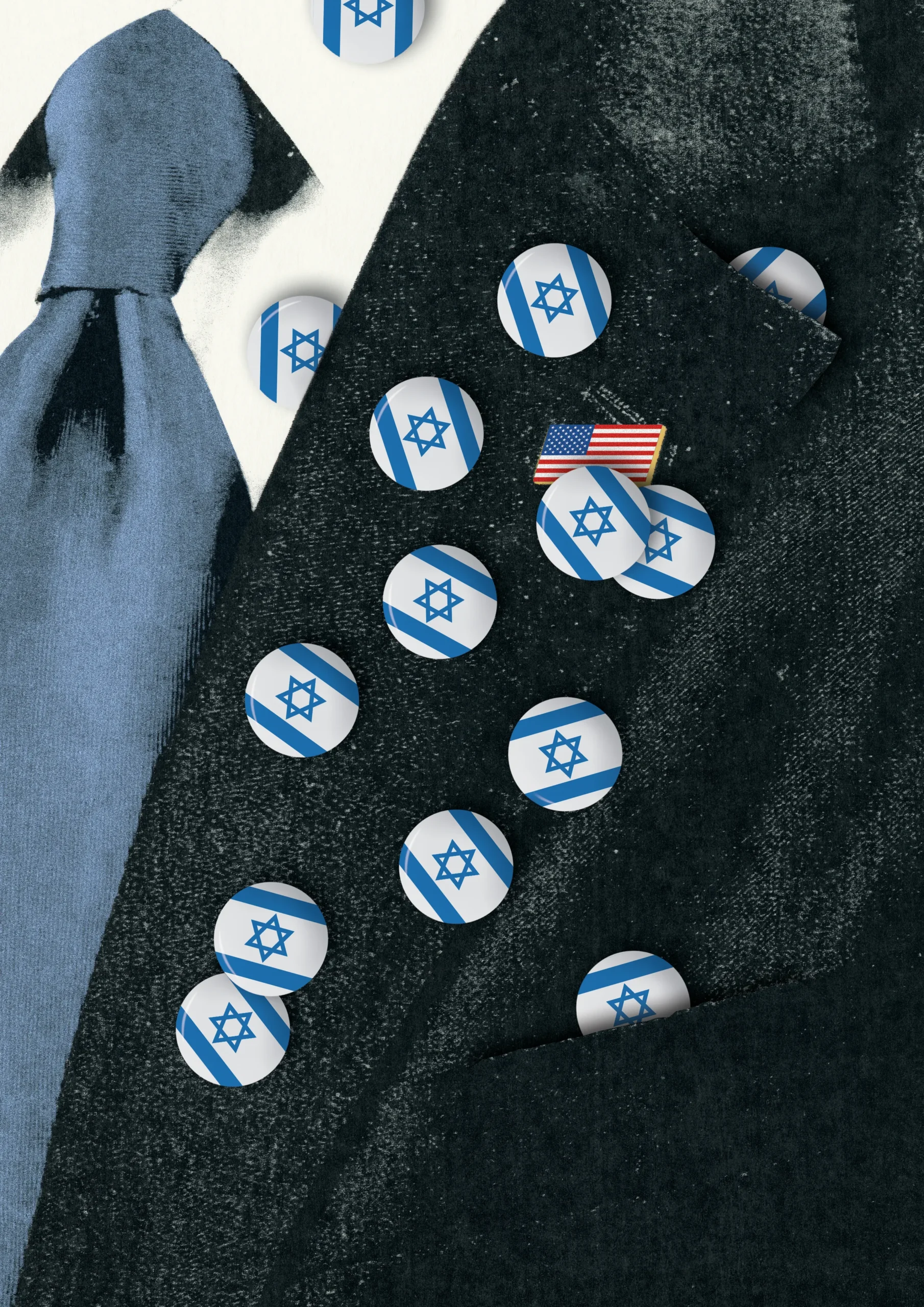
EC: The genocide in Gaza has driven what is likely an irreversible shift in U.S. public opinion across the political spectrum. Over two-thirds of Democrats and one-third of Republicans oppose ongoing aid to Israel. Israel’s Lobby has responded with enormous sums of political spending to prevent the transmission of public opinion into public policy.
This effort, alongside efforts to restrict speech on university campuses and in other areas of civic society, has so far succeeded in sustaining the increasingly unpopular flows of aid to Israel. But this strategy will have its limits as AIPAC, Israel, and Israel’s network of lobbying groups become increasingly toxic in our political debates. After the midterm elections this coming November, the next major electoral test will be how Democratic presidential candidates position themselves on this issue heading into the 2028 primaries. They will quite literally be caught between their voting base and some of the largest donors to their campaigns.