
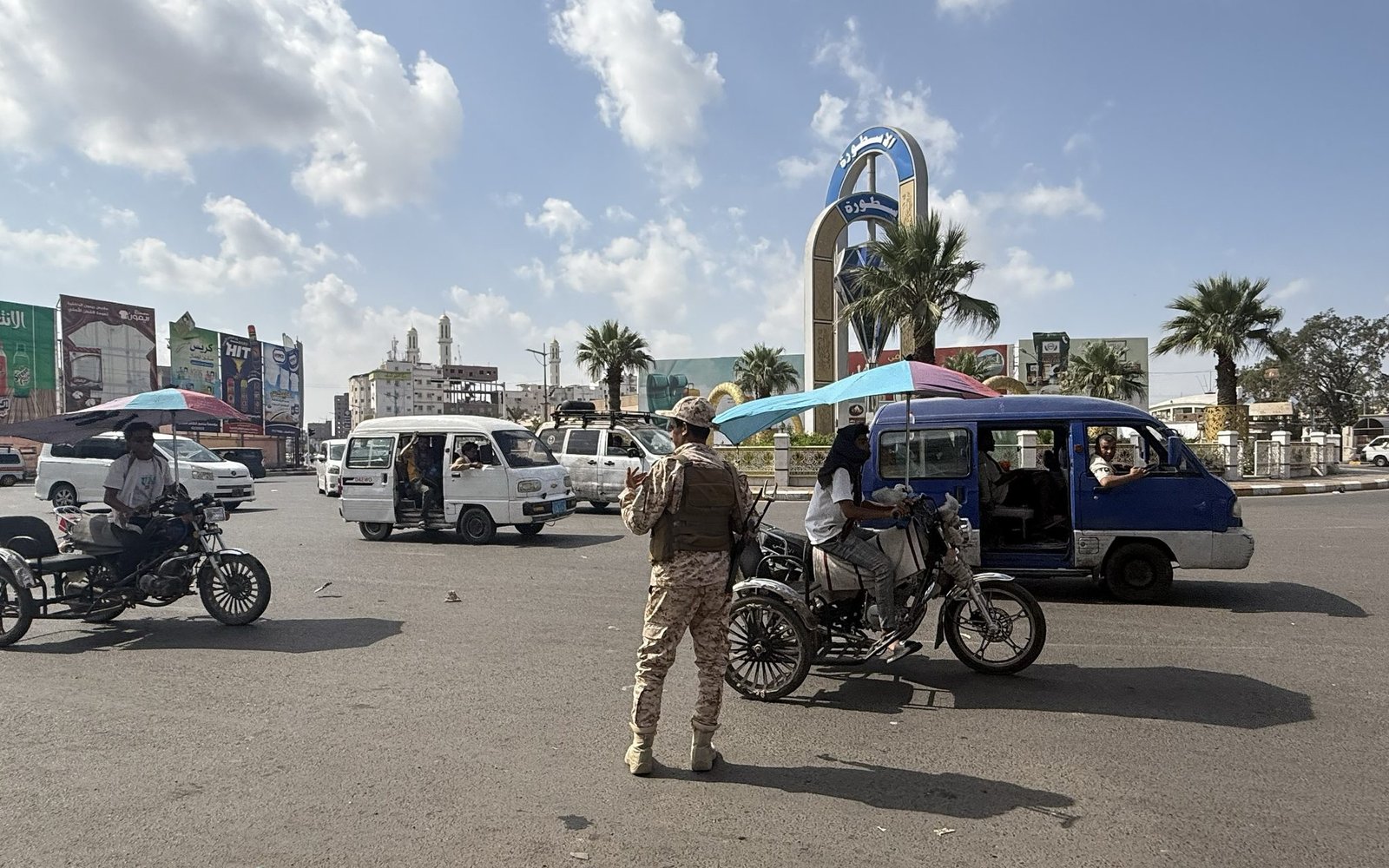
Since July 2026, Houthi offensives and Red Sea seizures have exposed fractures between the UAE-backed STC and Saudi-backed Yemeni government, even after the STC’s January 2026 dissolution, leaving Riyadh unable to unify its anti-Houthi coalition.
Southern Yemen tests Saudi authority
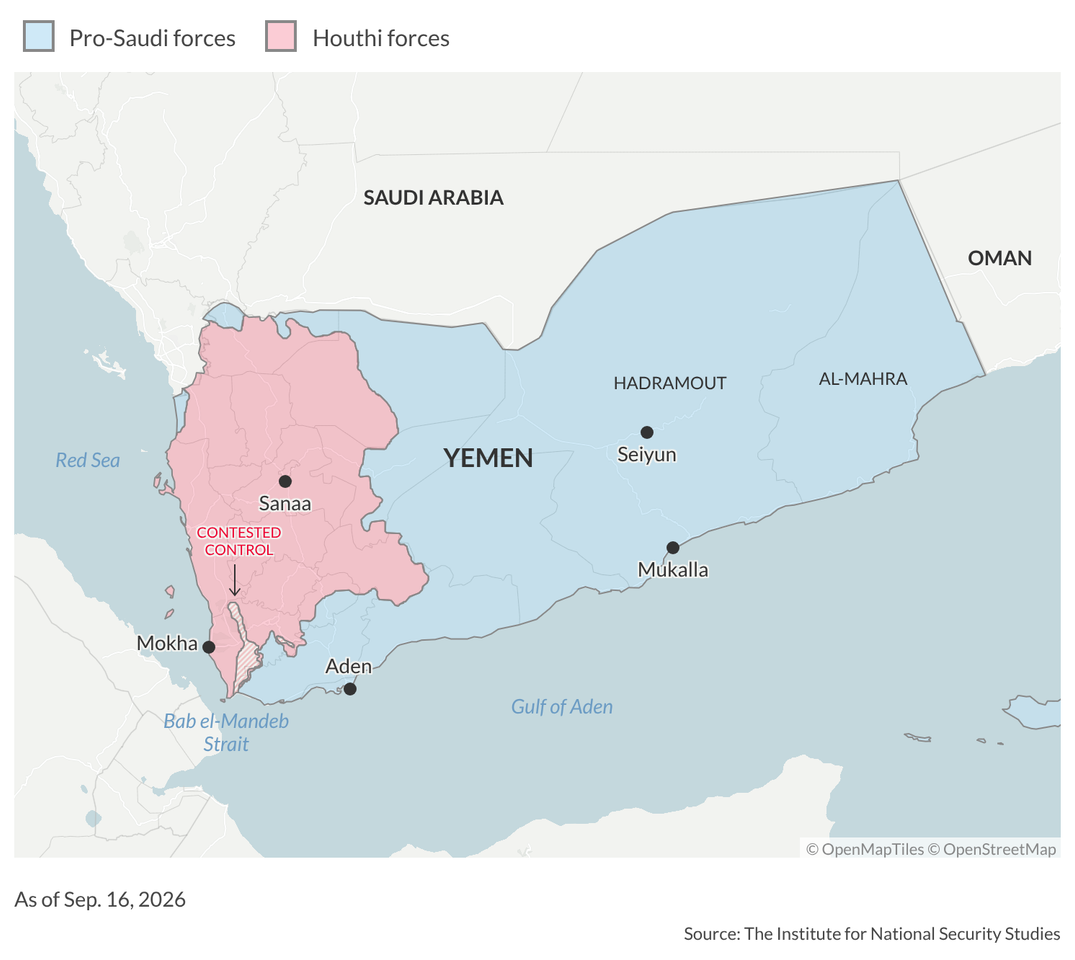
Since July 2026, the international community has been paying close attention to the Houthis’ renewed hostilities with Saudi Arabia and the seizure of more land on Yemen’s Red Sea coast. The anti-Houthi coalition, despite its recent successes in Mokha and around the Bab el-Mandab, has struggled to counter Ansar Allah (commonly known as the Houthis) in no small part due to deep division among its diverse actors. Unresolved tensions between the United Arab Emirates-backed Southern Transitional Council (STC) and the Saudi-backed internationally recognized Yemeni government continue to play out. Each side blames the other for Ansar Allah’s territorial gains in recent weeks.
Such divisions are not new. The power struggle between the STC and Saudi-backed actors in Yemen has fueled tensions between Riyadh and Abu Dhabi ever since the separatist group’s formation in 2017 with Emirati support. This friction between Saudi Arabia and the UAE vis-a-vis Yemen reached an unprecedented level in December 2025 and early January 2026, when armed clashes erupted in southern and eastern Yemen. The fighting seemed to signal a pivotal shift. The STC, the main separatist group in southern Yemen, appeared to have imploded, leaving Saudi Arabia as the predominant external power in the south.
The fighting was triggered by the STC’s December push into Hadramawt and al-Mahra, provinces beyond its traditional strongholds. Saudi Arabia saw the move as a direct challenge to its border security. It responded with military and political pressure, culminating in the STC’s dissolution, announced in Riyadh on January 9, 2026, by its secretary-general. Other council leaders rejected the announcement as illegitimate.
Riyadh’s Wartime Dilemma Deepens
Saudi Arabia, while under attack by Iran, the Houthis and pro-Tehran groups in Iraq, is determined to reduce tension in its rivalry with the UAE. A major incentive for doing so stems from the situation in Yemen as the country’s civil war heats up and Ansar Allah becomes increasingly involved in the wider United States-Iran crisis. Riyadh may not expect the UAE to intervene militarily in Yemen.
But it seems to want a new understanding with Abu Dhabi that would prevent the STC and other Emirati-backed actors from undermining support for Yemen’s internationally recognized government as it struggles to counter the Houthis. With Riyadh now waging a major air campaign, officially known as Operation Yemen Dawn, along the Red Sea coast and backing a government offensive eventually aimed at Sanaa, arriving at this common ground with Abu Dhabi has become particularly important to Saudi Arabia’s wartime strategies in Yemen.
On October 5, Saudi-backed government forces staged a lightning advance that, according to the government, retook the coast around the Bab el-Mandeb Strait up to Mokha, pushing the Houthis out of most of the areas they had seized in September. The Houthis deny the gains, and fighting continues with the Yemeni rebel movement continuing to carry out strikes against sites in Saudi Arabia, including Riyadh’s King Khalid International Airport. The stakes are high, with the Strait of Hormuz and Bab el-Mandeb disrupted.
Whether recent meetings between the Saudi and Emirati leadership can produce greater unity among the actors within Yemen’s loose and fragmented anti-Houthi coalition remains an open question. However, any such understanding will be incomplete without accounting for the STC.
The STC’s enduring cause
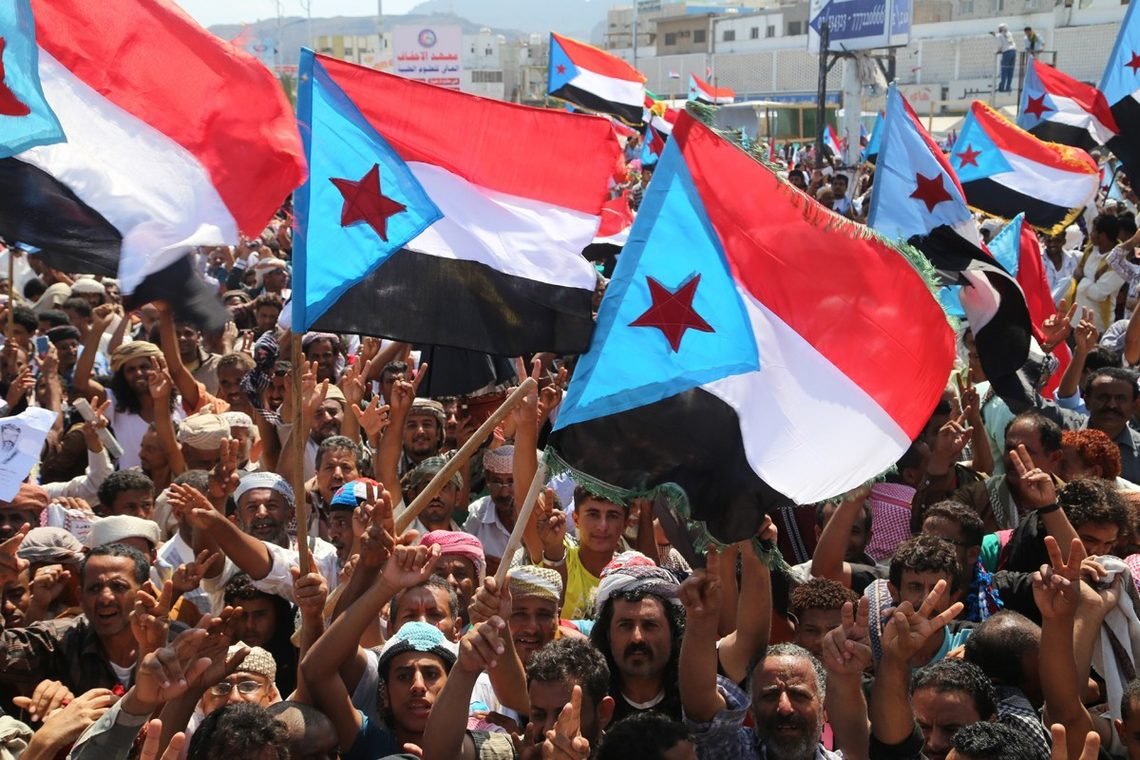
Despite the STC’s setbacks in January, the organization remains an influential force in southern Yemen. Any Yemeni-Yemeni dialogue will need to include the group and its constituents. Even after the STC’s “dissolution” in early 2026, the group continued to command meaningful grassroots support and to demonstrate its ability to mobilize large numbers of Yemenis around its separatist agenda. Recurring pro-STC demonstrations in Aden, Mukalla, Seiyun and elsewhere underscored that the faction had not been eradicated at the start of the year and that it remained a potent political force. The protests also exposed Riyadh’s limited ability to translate military and political ascendancy into lasting influence over southern Yemen.
The STC’s vision of an independent South Yemen still resonates in much of the territory that formed a separate state from 1967 to 1990. The reunification of Yemen at the end of the Cold War proved fragile, and many southerners harbor longstanding grievances about life in the unified state since 1990. Although the STC is only one faction within a broader independence movement, it positions itself as the umbrella organization for all pro-independence groups in southern Yemen.
But not every southern faction accepts the STC in this role. In fact, Abdulrahman al-Muharrami, a Salafist leader who commands the powerful and highly disciplined Southern Giants Brigades, has increasingly challenged the STC’s role as the guardian of the southern cause throughout 2026.
The STC says it will pursue independence through peaceful and diplomatic means. It believes that all key stakeholders in Yemen, including the Houthis and neighboring countries such as Saudi Arabia and the UAE, should participate in discussions about Yemen’s future. Nevertheless, it warns that if diplomatic efforts fail, it will resort to armed struggle. In the ongoing war with Ansar Allah, the STC argues that an independent southern state is the most realistic way to stop the Houthis from further expanding and consolidating their power.
The STC’s case against Riyadh
Pro-STC protests held earlier this year were mainly directed at Saudi Arabia rather than the Houthis. Supporters of the STC widely agree that the turmoil in southern Yemen since January chiefly stems from Riyadh’s actions. The group contends that Sunni jihadist groups such as al-Qaeda in the Arabian Peninsula have gained ground since Saudi Arabia assumed oversight of the south following the departure of UAE counterterrorism forces in late 2025 and the STC’s dissolution in January. Whereas Riyadh presented itself as responsibly restoring the internationally recognized Yemeni government’s authority, the STC saw a dangerous vacuum being created under Riyadh’s watch that benefitted extremists.
Beyond the jihadist threat, the STC questions Saudi Arabia’s military capacity itself. It attributes Riyadh’s inability to manage Yemen’s security environment largely to limited ground-combat capabilities, pointing to the deployment of Pakistani troops to the Kingdom under a mutual defense pact signed in September 2025. Turkiye has since joined Saudi Arabia and Pakistan in a trilateral defense configuration known as the Mecca Defense Pact, and both countries are now deploying troops to the Kingdom as Houthi attacks escalate.
Nonetheless, officials in Ankara and Islamabad have clarified that Turkish and Pakistani troops will be in Saudi Arabia for defensive purposes, rather than to perform any active combat roles. The STC has read the deployment of foreign troops to the Kingdom as a sign that Saudi Arabia needs outside help to guard its own southern border and argues that the same weakness is on display in southern Yemen. The STC holds Saudi Arabia responsible for the rapid Houthi offensive along Yemen’s Red Sea coast in September, maintaining that Riyadh was blindsided.
Al-Islah Rivalry and U.S. Distance
The group reserves particular hostility for al-Islah, Yemen’s main Sunni Islamist party, often described as the Yemeni branch of the Muslim Brotherhood. The STC argues that al-Islah is the only intact political party within Yemen’s internationally recognized government and portrays the Muslim Brotherhood as entirely focused on asserting control over southern Yemen rather than on reclaiming Houthi-held territory in the north.
The group also claims that Muslim Brotherhood-linked figures and other factions in the Presidential Leadership Council (PLC) have worked against the STC and southern interests, while al-Islah has sought to convince Riyadh that it can defeat the STC. Its officials go further, alleging growing cooperation or convergence between the Houthis and Somalia’s al-Shabaab, with al-Islah situated between them. These accusations reflect a deep-seated rivalry. Al-Islah, for its part, has long accused the STC of undermining state institutions and the anti-Houthi front.
That rivalry feeds into a broader STC charge against Riyadh, which is that Saudi Arabia takes a contradictory line on political Islam and jihadist groups, opposing the Muslim Brotherhood and al-Qaeda at home while exploiting their presence in Yemen for its own ends. Riyadh maintains that its role in Yemen is to support the internationally recognized government and the PLC.
The STC’s frustration extends to Washington. The group believes that Riyadh has persuaded U.S. President Donald Trump’s administration to treat the STC as effectively defunct and to disregard southern demands for independence. In its reading, the administration’s experience with Operation Rough Rider, conducted from March to May 2025, has reinforced Washington’s desire to avoid further entanglement in Yemen and to let local actors, particularly Saudi Arabia, take the lead.
After Saudi-Houthi hostilities resumed in July 2026, President Trump rejected requests by Saudi Crown Prince and Prime Minister Mohammed bin Salman for U.S. military intervention against the Houthis. The decision underscores the White House’s determination to avoid being pulled deeper into the Yemeni and Red Sea crises. From Riyadh’s standpoint, Washington views the Saudi-Houthi conflict as a bilateral issue between the Kingdom and the Houthis, overlooking the broader global implications of Ansar Allah’s actions.
STC officials maintain that the Trump administration privately acknowledges what the group sees as Saudi failures in Yemen, despite public statements to the contrary. The STC wants the U.S. to play a more active and decisive role in Yemen rather than remain an observer. In particular, they hope Washington will revive the Yemen Quad (the U.S., the United Kingdom, Saudi Arabia and the UAE) as a framework for addressing the country’s challenges. Abu Dhabi, they argue, has incentives to support that framework and resume a role in Yemen, where Emirati economic interests remain.
Despite its grievances, the STC leadership says it wants a constructive relationship with Riyadh and insists that an independent, STC-governed state would pose no threat to Saudi Arabia. However, its December 2025 advance into provinces bordering the Kingdom has made that assurance harder for Riyadh to accept.
Southern Yemen Defies Saudi Consolidation
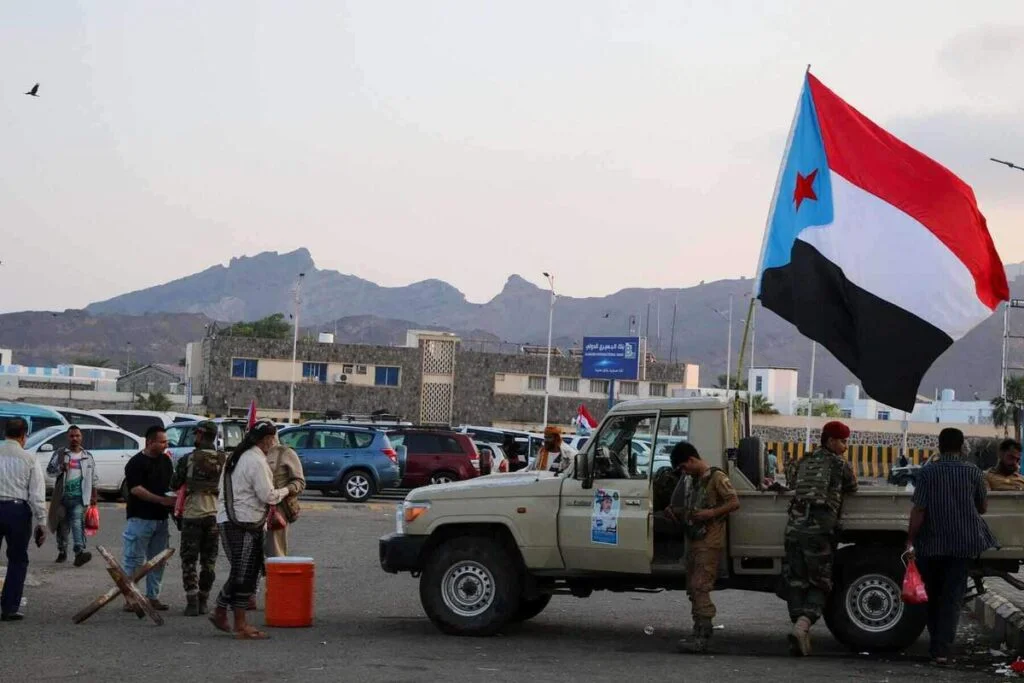
Saudi Arabia and Riyadh-backed Yemeni actors may have dismantled the STC’s formal institutional and military position early in 2026, but they did not eliminate the constituency that gave the organization its influence and legitimacy. If Riyadh cannot deliver stability and basic services in the south, it risks strengthening the very separatist sentiment it sought to contain.
The STC’s continued ability to mobilize supporters, frame local grievances as evidence of Saudi misrule and present itself as the vehicle for an independent South Yemen shows that the conflict has never been simply a contest between Saudi Arabia on one side and the STC and the UAE on the other. It is also a contest over whether a unified Yemeni state can accommodate the south’s distinct political identity and aspirations.
This has direct implications for any political settlement. A deal that excludes the STC would leave the south’s grievances unaddressed and give the separatists every reason to reject it. Past efforts to include the group, from the 2019 Riyadh Agreement to the PLC’s formation in 2022, brought it into government without settling the south’s status. A credible process will need to give the STC a seat at the table and put the south’s future on the agenda.