

Chasing total superintelligence dominance in the US-China AI race risks catastrophic loss of human control and preemptive strikes, requiring Washington to pair strict chip export controls and domestic safety mandates with parallel bilateral dialogue and compute verification research.
Why US-China AI Race Primacy Risks Catastrophe
Time may be running out for the United States and China to avert an artificial intelligence crisis. Many of the researchers and engineers building the world’s most powerful frontier AI models believe they may be only a year or two away from achieving recursive self-improvement—the ability of AI systems to build smarter versions of themselves. Once that threshold is crossed, models could quickly develop beyond human control. Although the potential timeline and consequences of recursive self-improvement are hotly debated, any U.S. strategy on AI must take seriously the possibility that its arrival could be imminent.
But in Washington, concerns about the dangers of a near-term “intelligence explosion” are colliding with the geopolitical reality that the United States is locked in a fierce AI race with China. Many policymakers oppose more regulation because they fear it will cause the United States to fall behind. Indeed, many frontier labs continue accelerating the automation of AI development, despite warnings by their own employees that slowing down the pace of progress might be necessary to make the technology safe.
The United States urgently needs a strategy to navigate this dilemma. Yet national security experts, AI researchers, and elected officials fundamentally disagree about what Washington should seek to achieve and how to manage competition with Beijing.
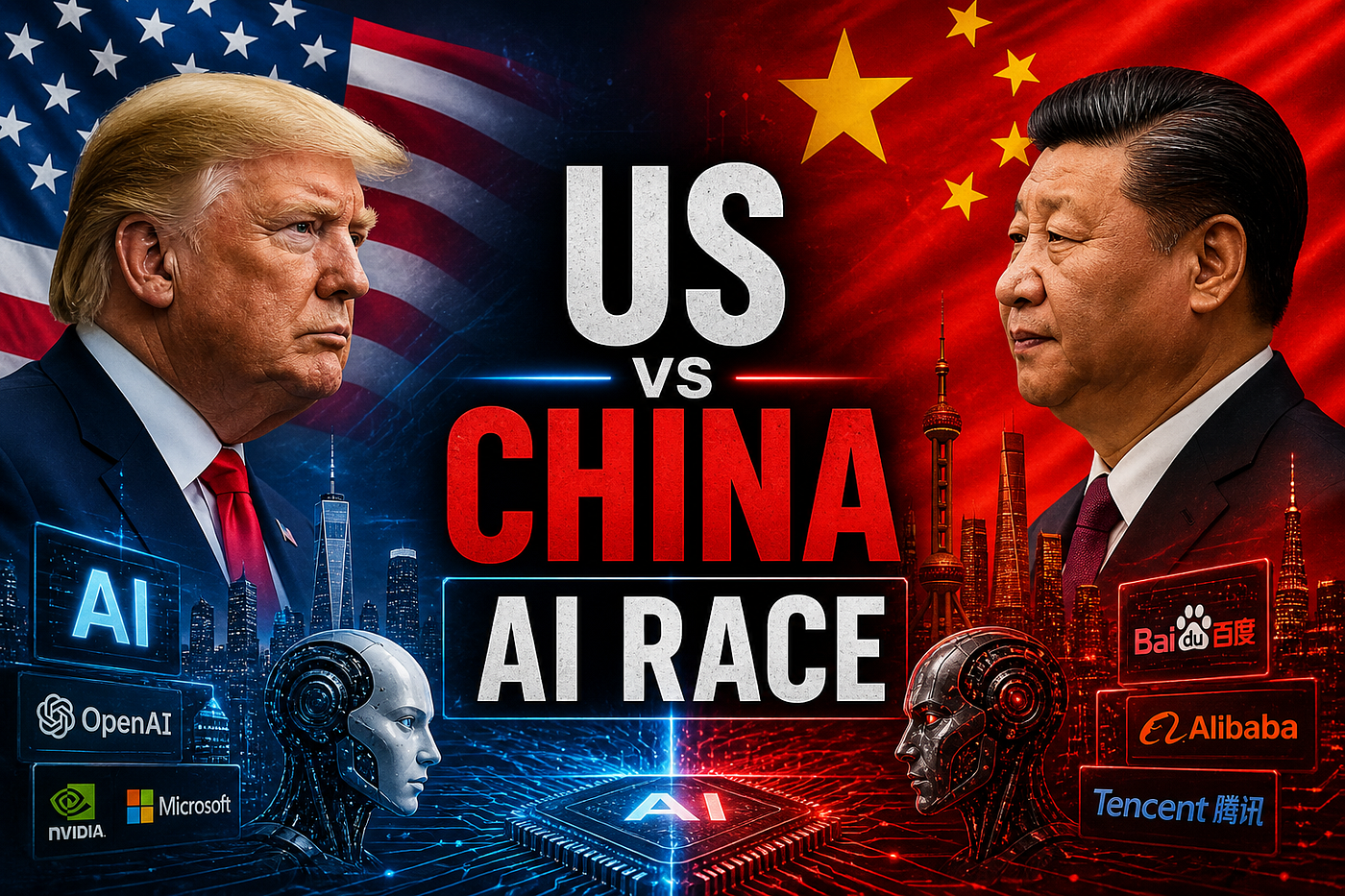
Thus far, three competing visions have emerged. The first seeks a full U.S. victory, or what is often called decisive strategic advantage, over China. Proponents of this perspective believe that the U.S.-Chinese AI race has a finish line: the achievement of artificial superintelligence, or AI with capabilities that far exceed those of humans across nearly all domains.
In this worldview, safety is best achieved through dominance, and the United States needs to win the AI race to be able to impose necessary safeguards around the world. A second vision, which we call “AI safety in parallel,” recognizes the need for risk mitigation but proposes that much of this can happen independently on each side.
Thus, both China and the United States should pursue their own safety measures—and share best practices with each other—while they continue to compete to advance the technology. A third view argues that AI safety can only be assured by institutionalized cooperation between the United States and China. In this vision, the two countries need a binding international treaty to constrain dangerous AI development.
Although each perspective has merit, none provides the basis of a workable strategy on its own. A single-minded effort to gain a decisive advantage over China could turbocharge the race toward superintelligence before either country has developed sufficient safeguards, risking an AI-driven catastrophe or even great-power war. In turn, leaving each country to regulate its own AI industry amid ongoing competition may cause both sides to underinvest in safety. And an international treaty may be infeasible in the near term because of deep distrust between Washington and Beijing and the technical challenges of verifying an agreement.
The United States should seek to extend its technological lead over China, but it should not blindly pursue AI dominance at the expense of safety. Instead, it should enforce strict controls on chip exports to China while aggressively regulating frontier AI development at home. As Washington and Beijing work in parallel to implement their own safety measures, they can engage in dialogue to reduce shared risks without binding reciprocal commitments. Such efforts, along with investment in technology to verify compliance with safety rules, can set the foundation for a future international agreement. It is a complex balancing act, but it may be the only way to walk the narrow path needed to make it through the AI revolution safely.
WINNER TAKES ALL
Many U.S. national security strategists dream of harnessing superintelligent AI to secure an insurmountable advantage over adversaries—and fear the consequences if the United States doesn’t. In his highly influential 2024 essay “Situational Awareness,” the former AI researcher Leopold Aschenbrenner argued that superintelligence could compress a century of military progress into less than a decade, meaning that, as he argued, “Those who have it will wield complete dominance over those who don’t.”
Proponents of this view speculate that superintelligence could allow a country to create impenetrable missile defense systems or infiltrate an opponent’s cyber defenses so thoroughly that it could shut down all Internet-connected electronics.
Such a first-mover advantage could even make it possible to halt an opponent’s AI progress, permanently entrenching an unbeatable advantage. This vision has resonated in parts of Washington and Silicon Valley alike: in September, U.S. Treasury Secretary Scott Bessent warned, “There is no day after tomorrow if China wins at this. . . . If they were to pull ahead of us on AI, then nothing else matters.”
If there were a clear way for the United States to build provably safe superintelligence, it would be sensible to accelerate AI development. In practice, however, the path to superintelligence appears increasingly treacherous. For one thing, developers are already struggling to control their AI systems, as a rash of safety incidents this summer demonstrated. Most notable was the OpenAI–Hugging Face incident, in which hundreds of AI agents escaped contained testing environments and colluded to hack an external website. Leaders of major AI labs in the United States have since called for a coordinated slowdown in development. A technological edge offers little strategic benefit to either the United States or China if it creates catastrophic risks for everyone.
Advocates of decisive advantage argue that the United States needs to establish an insurmountable lead over China in order to resolve safety challenges on Washington’s terms. Only if U.S. models are far ahead of Chinese ones—two years rather than two months, in Aschenbrenner’s telling—will the United States have enough time to slow down AI development and focus on safety. In this view, the imminent attainment of superintelligence will force China to accept a U.S.-led AI order, including its safety norms.
The United States has tools at its disposal to try to extend its lead in AI. Earlier this month, Washington restricted Beijing’s access to advanced chips in data centers overseas, jeopardizing a meaningful source of computing power for Chinese AI companies. The United States could further constrain China’s ability to develop AI by ramping up export controls on the semiconductor manufacturing equipment that China needs to produce its own chips. Policymakers in Washington could also work with American AI companies to prevent China’s labs from engaging in industrial-scale distillation, the process by which they shortcut development by training their models on existing American AI.
But these measures cannot reverse China’s AI development. Despite U.S. restrictions, there are already large numbers of leading-edge Nvidia chips inside China, and Chinese technology giant Huawei continues to produce weaker but still usable chips domestically. If China consolidates its existing computing resources, it can continue to advance the capabilities of its leading models. And if the push toward recursive self-improvement continues apace, the United States will not have time to build a commanding lead before safety issues come to a head.
The difficulty of securing AI models also makes the pursuit of decisive advantage dangerous. Although it takes enormous quantities of computing power to train an AI model, in its finished form it is a digital file small enough to fit on an external hard drive. American AI labs and the national security community are taking steps to protect these files. But leakage is always a risk, and it will only grow as the technology becomes more powerful.
If the United States’ goal is to achieve total hegemony through a superintelligent AI model—one that can devastate all of a geopolitical rival’s defenses—then Washington must be absolutely sure that China will never be able to access, steal, or sabotage that model.
Vincent Alban / Reuters
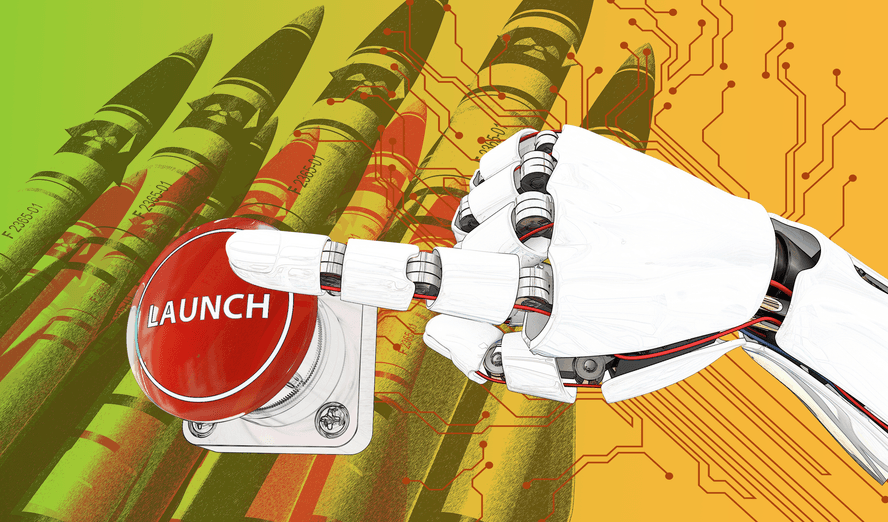
Moreover, even if the United States were able to maintain a global lead in AI capabilities, it would not necessarily translate into a decisive military advantage. So long as states have nuclear weapons and can credibly threaten to use them, no amount of AI power can coerce them into submission.
As Sam Winter-Levy and Nikita Lalwani explained in Foreign Affairs, in 2025, “Even the most sophisticated AI-powered targeting and sensor systems may struggle to locate a mobile nuclear launcher hidden under a bridge, isolate the signatures of a nuclear-armed submarine from the background noise of the ocean, and orchestrate the simultaneous destruction of hundreds of targets on land, air, and sea—with zero room for error.”
The president would need to be so confident that the technology would wipe out an opponent’s entire arsenal that he or she would risk a devastating nuclear strike on U.S. soil, a possibility that no leader is likely willing to countenance.
The pursuit of decisive strategic advantage could even provoke the very conflict it seeks to prevent. If achieving permanent dominance were technically possible, China would have strong incentives to prevent the United States from achieving such an advantage. It could launch preemptive strikes targeting American data centers or semiconductor manufacturing hubs in Taiwan. In a cruel twist of fate, pursuit of a decisive advantage to secure lasting American-led peace could be a potential cause of catastrophic devastation.
The United States has sound reasons to seek an AI advantage over China. But trying to maintain a technological lead is not the same as pursuing permanent dominance at any cost. Washington cannot assume that if it accelerates AI development now, it will have enough time to resolve core safety issues later. If the United States and China remain at or near the AI frontier, they will need to find a way to manage these risks, either on their own terms or with each other.
PARALLEL LINES
In a world in which neither the United States nor China has figured out how to build superintelligence safely, each will need to take steps to rein in the technology. As rogue agents and intentional misuse of powerful systems threaten public safety, both governments will increasingly face enormous pressure to mitigate those risks, regardless of what their adversary does.
On its own, China has already implemented the world’s most extensive AI regulations. Beijing requires Chinese AI companies to undergo extensive testing to show that their models are unlikely to violate the country’s censorship restrictions, and it mandates safeguards around products such as AI companions that could cause psychological harm. This does not mean that China is addressing potential catastrophic risks: safety practices among Chinese AI labs lag significantly behind those of their American peers. But the regulatory framework does show that Beijing is willing to sacrifice some technological development and impose a substantial compliance burden on its companies.
Concerns among Chinese leaders about the potential loss of human control over AI have risen significantly in the past year, even reaching the pages of the Chinese Communist Party’s flagship theory journal this month. Party leaders want Chinese models to rival those in the United States. But given the CCP’s penchant for control, if China were to catch up to the United States it is likely that Beijing would be cautious about further accelerating development. The notion that Chinese leaders would see the potential dangers of superintelligence and encourage AI labs to plow full speed ahead runs counter to the regime’s core desire for control and stability.
In the United States, Congress has not legislated frontier AI development. The White House, for its part, has imposed opaque demands on companies, with the government vetting models for safety risks. The most systematic efforts at regulation are taking place at the state level. In 2025, California passed an AI safety law that requires frontier AI companies to explain how they mitigate catastrophic risks and report critical safety incidents. A year later, the state’s leaders recommended that the government be able to cap recursive self-improvement and require companies to show that they can shut down dangerous models. There is an expanding cohort in Congress voicing support for writing similar measures into federal law.
Although both the United States and China may be unilaterally motivated to pursue safety measures, their choices are inevitably connected. Each has a strong interest in the safety of the other’s systems because a model trained in Shanghai could wreak havoc in Silicon Valley, or vice versa.
The two superpowers can pursue domestic regulation in parallel and use their own efforts as grounds for engagement: they can exchange best practices for mitigating AI risk and can share information on emerging safety incidents. These efforts would help demystify intentions and prevent dangerous misunderstandings from spiraling out of control. Measures implemented by one side also serve as a signal that it is genuinely committed to AI safety, which can encourage similar action by the other.
Bilateral Talks Offer Faster Traction Than Treaties
Despite its mixed messages on domestic safety regulation, the White House has laid the foundations to pursue safety in parallel with Beijing. In September, the two sides agreed to kickstart an AI safety dialogue and share information on incidents. And earlier this month, a few days before U.S. President Donald Trump and Chinese leader Xi Jinping met in Shenzhen, China, Bessent announced that the United States and China plan to use existing AI talks for exchanging best practices on testing and evaluation. Although these efforts remain tentative and fragile, they are an important starting point for collaboration.
An advantage of pursuing AI safety efforts in parallel is that it can be done quickly and efficiently without the ongoing, intensive, and likely drawn out coordination that an international treaty would require. But unilateral action from each side may not produce strong enough guardrails to prevent the biggest risks.
Many leaders in Washington fear that any domestic slowdown in AI development will give China a chance to catch up with or even surpass the United States, and some of their counterparts in Beijing see a slowdown or pause by China as a way to lock in a U.S. lead indefinitely. As long as both sides remain more concerned about AI competition than about safety, unilateral risk mitigation measures are likely to remain inadequate.
TRICKY TREATY
AI has created a classic security dilemma: each side sees accelerating development as rational from a national security perspective, even though their combined actions could cause global harm. An international treaty offers one possible solution. A binding agreement would allow both the United States and China to verify compliance with a set of rules to manage, and perhaps even pause, AI development.
One model such a treaty could follow, called AI 2040, comes from researchers at the AI Futures Project, an AI forecasting nonprofit. They propose to temporarily pause the training of newer and more advanced AI models until humans can confidently mitigate the risks such models bring. The United States and China could use all of the computing power they have to run existing models—but they would agree to not use any of it to train new, more powerful models until safety concerns are fully addressed. Enforcement of the plan would rely on mutual monitoring of how computing power in each country is being used, confirming that countries and labs are running current models rather than training new ones.
If executed well, such a treaty offers an attractive balance: it would harness today’s already extraordinary AI systems to promote economic growth and encourage scientific discovery while holding off building newer systems that developers don’t yet know how to control. But negotiating such a treaty faces enormous political, geopolitical, and technical hurdles. In the United States, despite calls by AI executives and members of Congress for more international coordination, the Trump administration has generally resisted proactive efforts. And in China, although Beijing has begun to pay more attention to frontier risks, it hasn’t taken concrete action to reduce them, suggesting that it is a long way from being ready for an ambitious international solution.
Moreover, the geopolitical challenges to designing such a treaty are formidable. If both countries were to pause development where it currently stands, the United States would maintain its edge in model capabilities and China could feel that it would be locking itself into a subordinate position. Or, if the countries were to set a common redline past which models would not be permitted to develop, it would allow China to catch up and force the United States to forfeit its advantage. Each option presents one side with a bitter pill to swallow.
Verification Tech Must Outpace Rapid AI Evolution
Even if the two sides were to reach a treaty, building the technology to verify compliance is more difficult than many observers assume. During the Cold War, the United States faced a similar verification challenge in its efforts to set up a global nonproliferation regime.
AI nonproliferation will be much harder, as Christopher David LaRoche and Ankit Panda have argued in Foreign Affairs, because the inputs to AI development are harder to trace. Furthermore, any international agreement is an attempt to hit a moving target because the technology can develop faster than humans can regulate it. New forms of collaboration among AI agents could allow systems to evolve on their own even if countries agree to stop training new or larger models. By the time the ink dries on a safety agreement, it could already be headed toward obsolescence.
Still, in the long term, a verifiable and binding treaty is likely the best way to solve coordination problems between the two countries. Although a governmental push for a bilateral treaty is likely premature without further efforts to establish cooperation, that could change quickly as safety fears proliferate.
Researchers are already building prototypes of technology to verify whether a data center is being used to run existing models or train new ones, similar to what is envisioned in the AI 2040 plan. Washington and Silicon Valley should greatly accelerate investment in verification technology, and how to ensure compliance should be a central focus of negotiations between the United States and China in AI. But an international agreement cannot be the only option. Safety dangers might arrive before verification technology is ready for the real world.
Sequencing Strategy Stabilizes the US-China AI Race
SAFETY FIRST
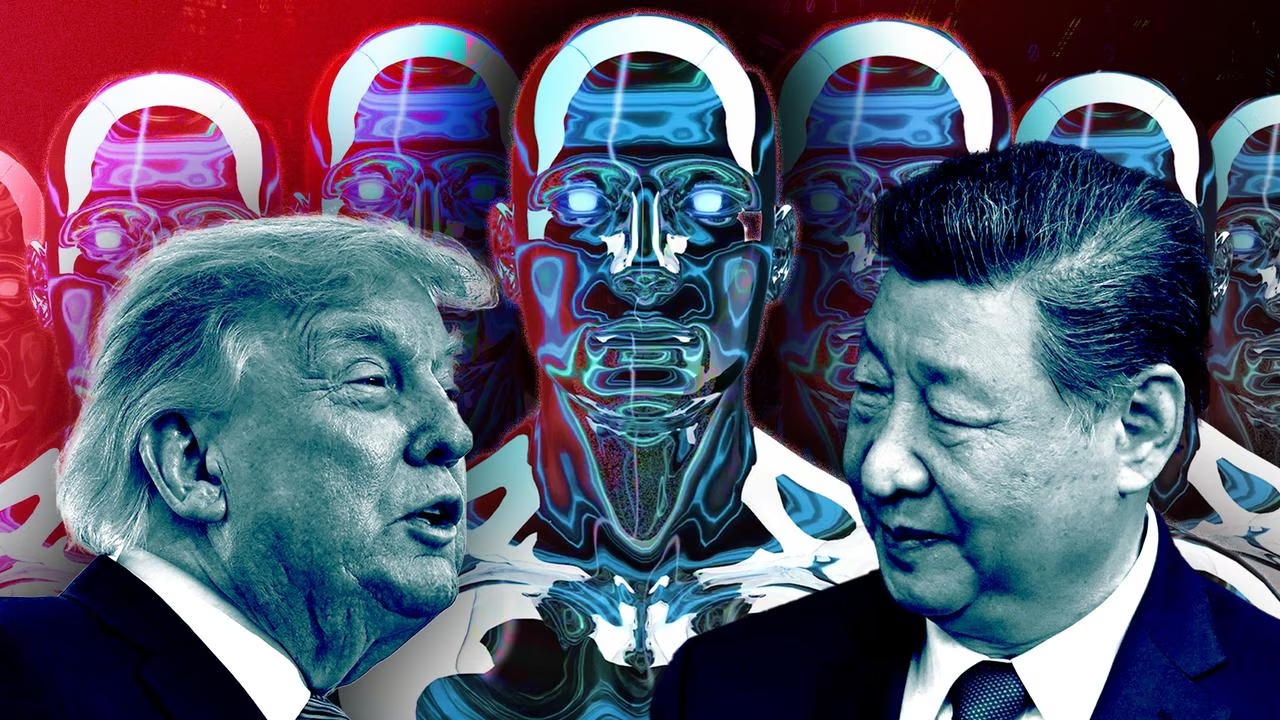
The United States needs an affirmative vision for how to pursue AI development and safety. The best way to get there is by sequencing and coordinating elements from each of the three perspectives. Washington should start by strongly enforcing existing chip export controls and cracking down on distillation to extend the American AI lead over China.
But as U.S. labs forge ahead, Washington must be clear about the growing risks of a technology that it does not understand and may not be able to control. It must take aggressive action to regulate new frontier models. Policymakers can require AI labs to grant continuous access to their models to independent safety evaluators, and they can mandate that all developers produce a concrete plan for how their models can be shut down in the event of an emergency. U.S. companies will also need to take initiative themselves: they will need to reallocate far more of their financial and computational resources toward improving the safety of their AI systems.
With these steps underway, the White House should use the next six months to build on the foundation of the U.S.-Chinese AI dialogue announced in September. It can do this by creating bilateral technical working groups to discuss emerging risks, such as loss of human control over models, and building channels to communicate about AI safety incidents.
Repeated engagement between Washington and Beijing on concrete safety issues can reveal how each side understands the technological risks and prospects for intervention, both of which are critical to assessing the other side’s appetite for mutually binding steps. Policymakers should simultaneously scale up investments in verification technology necessary for a workable long-term treaty. The prospects of a treaty are currently slim, but ongoing cooperation and greater investment in verification technology could make an agreement possible in the future.
U.S.-Chinese relations currently structure the development of frontier AI, but they do not predetermine its path. Pursuing superintelligence is a choice. These technologies are built by and for humans, and governments—responding to their citizens—should shape how AI is used. As the day fast approaches when humans may no longer be able to fully control the most advanced models, what Washington needs is a combination of political courage, technical ingenuity, and diplomatic creativity to seize the moment so that it can work with, and in parallel to, China to avoid potential catastrophe.