
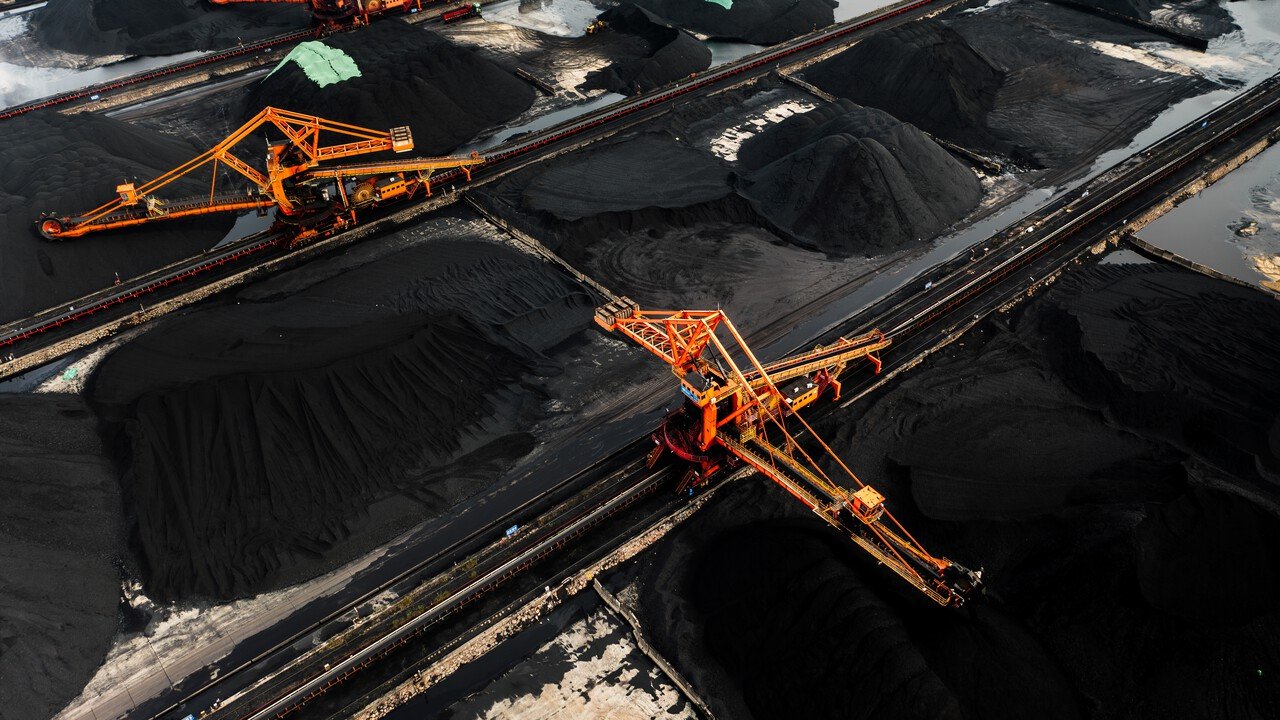
China added roughly 30 GW of thermal capacity even as solar reached 1,274 GW. Wartime infrastructure strikes and Hormuz disruption push states toward overlapping domestic coal, renewables, and nuclear hedges, prioritizing security.
Energy transition no longer means decarbonization alone. It now describes a competitive search for fuels that reduce exposure to supply coercion, price shocks, and contested chokepoints. Beijing’s decision to expand thermal capacity by roughly 30 GW within six months, even as solar capacity reached 1,274 GW and thermal output share dropped to 64 percent, demonstrates how security selects the portfolio. Reserve margin now operates as insurance rather than waste.
This choice appears irrational through a climate lens but coherent under a security lens, because domestic coal and manufactured renewables both reduce dependence on imported oil and gas. The same pressure is visible in wartime attacks on energy infrastructure, the effective closure of the Strait of Hormuz, and the hedging behavior of India, Japan, South Korea, and Thailand. States are assembling overlapping hedges, accepting higher costs and emissions when redundancy protects against chokepoints. The result is not a retreat from Energy transition but a return to plural transitions, where the deciding test is no longer whether a fuel is clean, but whether it is secure, domestic, stockpilable, multi-sourced, and defensible.
Why Energy Transition Now Favors Security
Beijing has settled on a new name for coal: the power system’s “ballast stone,” a reserve that steadies a grid increasingly run on renewables and reduces the security risks of depending on imported oil and gas. The numbers behind the label describe a transformed energy system. Solar capacity (1,274 Gigawatts [GW]) pulled level with coal capacity (1,275 GW) in June.
Thermal generation’s share of output has fallen from 80 percent in 2010 to 64 percent; non-fossil sources now cover all demand growth essentially, and coal plants ran just 47 percent of hours last year. Yet in six months China deliberately added roughly 30 GW of new thermal capacity to widen its reserve margin. This is an obvious incoherence if viewed through a climate lens but not when energy security is considered.
It is a harbinger of things to come. The transition of the 2010s, conceived for a world of open sea lanes and great-power peace, ran toward clean fuels. The transition now underway runs toward secure fuels. Where the categories overlap, expect acceleration of wind, solar, and other renewables (if available) with a security lever of stable backup power. Where they diverge, security is likely to win, with climate arguments increasingly serving as public justification for choices taken on security grounds.
Do Transitions Ever Really End?
After all, energy has always been in transition; it has been the drivers that differed. The Royal Navy swapped Welsh coal for imported oil before World War I for speed and range; France answered the 1973 oil shock with the fastest nuclear buildout in history.
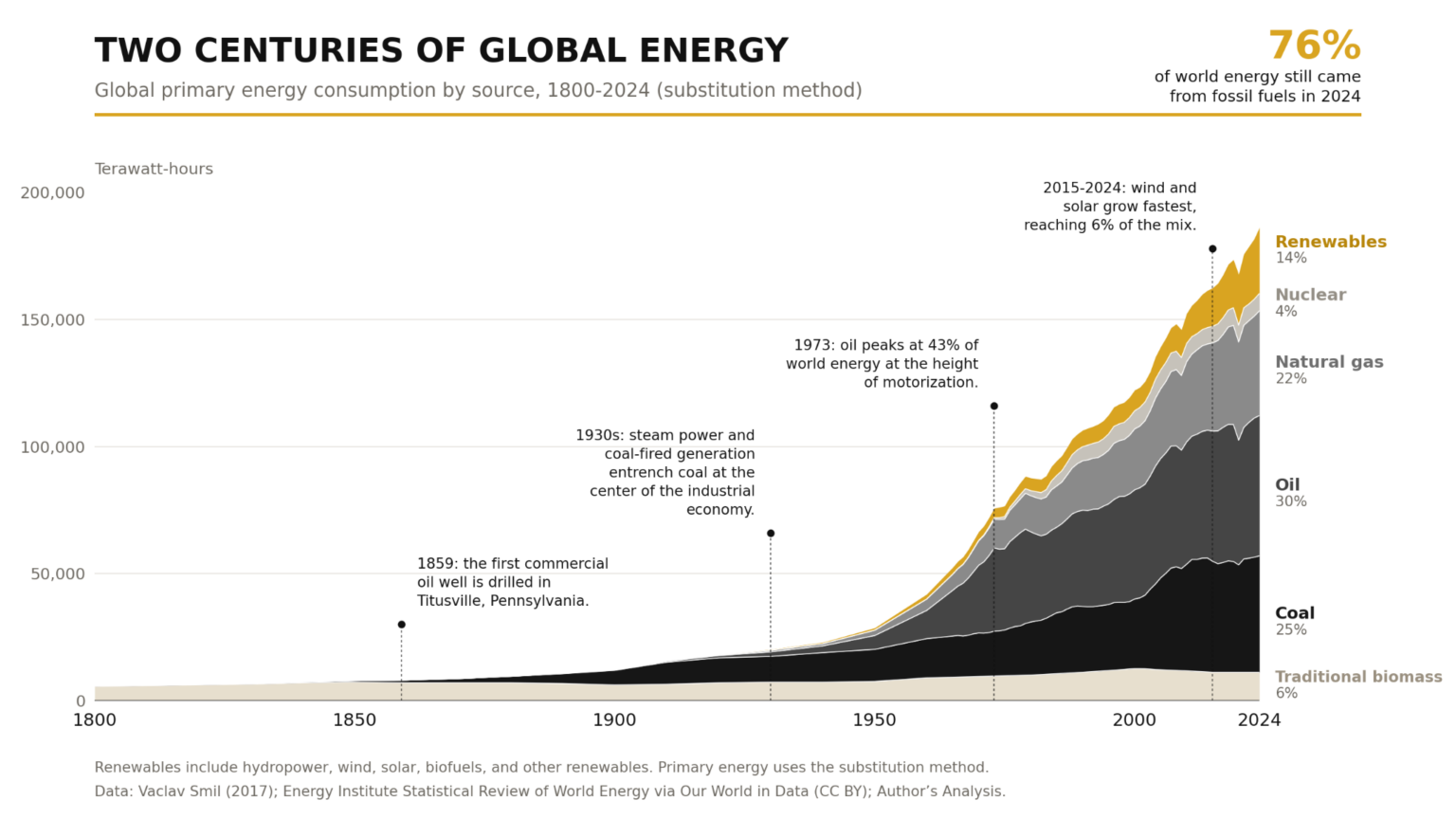
The global arc (Figure 1) shows what transitions actually look like: traditional biomass was the largest source until coal passed it early in the 20th century, oil did not pass coal until the mid-1960s, and after two centuries of change, fossil fuels still supplied 76 percent of global primary energy in 2024. Transitions are slow and additive; today the world burns twice as much traditional biomass as in 1800. Only in the globalization era did “the energy transition” come to mean one thing: a coordinated exit from fossil fuels. That reading has ended, and transition is plural again.
Four Security Dimensions Shape Fuel Choices
What binds the plural transitions together is security. As I argued in The National Interest last November, energy security has four dimensions—availability, accessibility, affordability, and acceptability—and what matters is which is the binding constraint. Globalization made the first three look resolved, so acceptability, defined by carbon content or its lack, bound.
Deglobalization reverses the ordering and redefines acceptability itself: a fuel increasingly qualifies when it does not leave a country hostage, is produced at home, is stockpilable, multi-sourced, and defensible. Redundancy changes sign too, from waste in market logic to insurance in security logic.
War Exposes the Cost of Imported Fuels
Current wars supply the proof abundantly. Russia wielded natural gas as a weapon and since 2022 has been bombing Ukraine’s energy system in an attempt to bring the country to its knees; its October strikes left almost 60 percent of Ukrainian gas production offline. Ukraine adopted the strategy as it struck at least 16 of Russia’s 38 refineries by last October and reached Omsk, 2,500 kilometers away (about 1,550 miles), in July.
Iran’s war has effectively closed the Strait of Hormuz, a channel for a fifth of global oil consumption and a fifth of global liquefied natural gas (LNG), and Qatar declared force majeure after the Ras Laffan attacks. Thailand is restarting retired coal plants, South Korea lifted its coal operating cap, and Japan eased coal limits. Fuel that crosses a contested chokepoint now carries a security discount, whatever its carbon advantage.
China’s Hedge: Domestic Coal and Solar
Hence the Chinese ballast-stone strategy. Even as coal’s operating role shrinks, China added 315 GW of solar in 2025 while coal proposals surged to a record 161 GW, justified in permits by “power supply security”. Coal is what China has: domestic, stockpilable, priced independently of the Strait of Hormuz. So are renewables; China manufactures the equipment, and Chinese firms took the top six places in BloombergNEF’s turbine ranking. In contrast, oil and natural gas are a source of China’s energy dependency.
India and Europe Build Overlapping Hedges
India is buying everything at once: 50 percent non-fossil capacity five years early, roughly 80 GW more coal by 2032, coal still projected at 51 percent of generation in 2035–36, and the SHANTI Act opening nuclear to private capital toward 100 GW by 2047. A portfolio of deliberately overlapping hedges.
Europe faces the narrowest menu. The conclusion hardening in Brussels, that fossil fuels as such are insecure, misses the mechanism: insecurity attaches to concentration, a single seller, a single route, a single price point. Because Europe’s acceptability politics closed Groningen mid-crisis and keep long-term gas contracts toxic, it will pay a premium for whatever mix it assembles, fossil fuels included, even coal when needed. The bet is allied molecules, $750 billion in pledged American energy purchases, plus a nuclear return: Belgium repealed its phaseout 102 votes to 8, France plans six new reactors, and Ursula von der Leyen calls the nuclear retreat a “strategic mistake”.
How Energy Transition Redraws Fuel Hedges
The United States is an outlier in many ways as it holds the advantage that no one else has: its cheap fuels and secure fuels are one and the same. Energy production hit a record 107 quadrillion Btu in 2025, and executive orders aim to quadruple nuclear capacity by 2050. For Washington, the secure-fuels transition ratifies its endowment and opens an export market as allies shop for non-adversarial supply.
For any energy announcement, ask which “A” binds. Security now selects the portfolio, sometimes using climate vocabulary to ratify the selection. Analysts who take these statements at face value will keep expecting retirements that never come and treat redundancy as irrationality when redundancy is the security anchor. The energy transition is alive because energy is always in transition. What has ended is the singular reading that equated it with decarbonization alone. Countries will decarbonize where and to the extent to which clean fuels are also secure and affordable. Otherwise, they will hedge.