
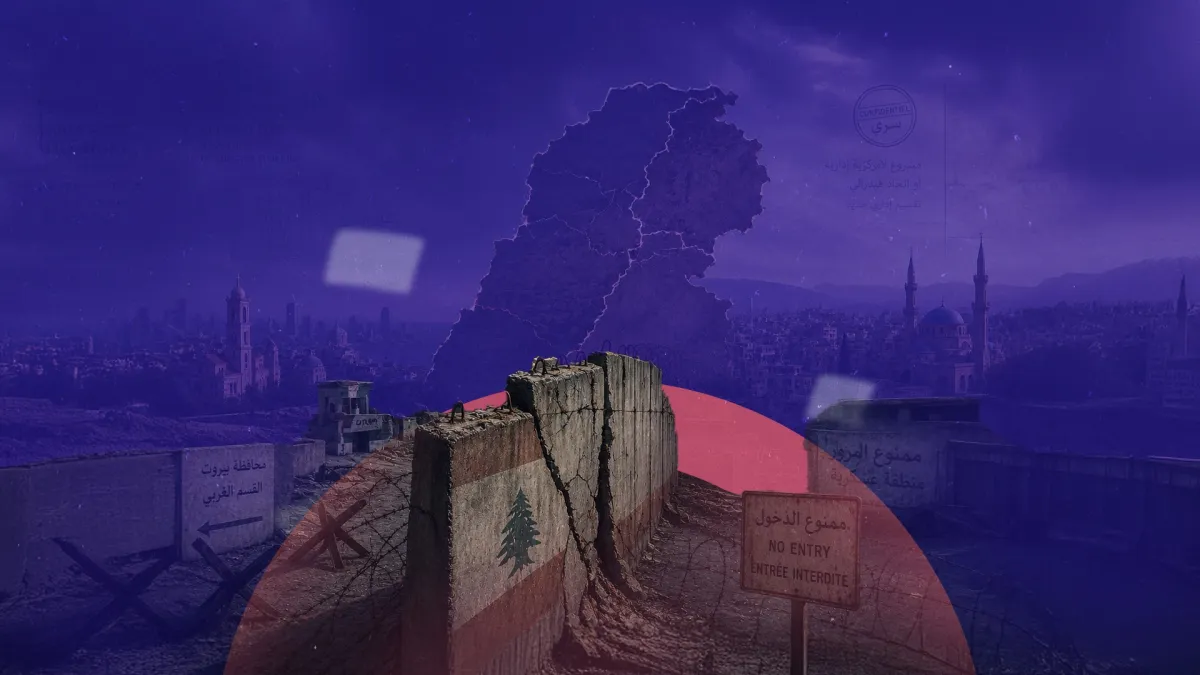
Lebanon’s federalism debate masks sectarian fear, not administrative reform. Civil war’s “cantons” haunt proposals. Imported “new Middle East” rhetoric threatens amputation. True division should separate state-believers from militia loyalists, not sects—but all are Lebanese.
The resurfacing discourse regarding Federalism in Lebanon treats a complex, deeply embedded national wound as a mere administrative puzzle. While proponents present Federalism in Lebanon as a clinical, reasonable solution to institutional paralysis,
the reality on the ground translates this structure into pure tribal ethno-federalism. Pushing for Federalism in Lebanon during a period of intense regional convulsion invites external intervention and risks turning internal borders into active fault lines.
True coexistence cannot be engineered by retreating into enclaves, making Federalism in Lebanon a dangerous shortcut born out of exhaustion and despair rather than sustainable state-building.
The Corporate Media Fixation and Federalism in Lebanon
There’s this old joke between me and my best friend. He says it lightly, the way one says something only to avoid saying something else: “Promise me… if they ever divide Lebanon, you’ll help me come to your side.
” H. is Muslim, and by “my side,” he means the Christian one, not out of any sudden theological conversion, God forbid, but because the man likes his glass full, his meat haram, his women free, his nights loud, and all the other clichés that somehow became, in our absurd sectarian folklore, “Lebanese Christian values.” Whenever the joke comes up, we laugh. Of course we laugh. What else can you do when the only way to endure a wound is to pretend it’s a joke?
But the joke is not a joke. It is a premonition dressed as humor. Because Lebanon has already been divided once, not on paper or maps, but in blood, in checkpoints, in invisible borders that smelled of fear and gunpowder. During the civil war, the country did not need a constitution to fragment.
Militias drew their own maps, carving “cantons” where each community governed itself, often violently, obsessively, like a body attacking its own organs. And now, as the region convulses yet again, as war is redrawing fantasies faster than it redraws borders, as Hezbollah’s usurping arms, Iran’s predatory reach, Israel’s security mantra, America’s brokered solutions, and the feverish rhetoric of a “new Middle East” push Lebanon once more into the geopolitical operating room, the old discourse returns, as it always does when this country begins to look fragile enough to dissect: federalism. Or its cousins: decentralization, confederation, partition.
Words that pretend to be technical, administrative, reasonable. Words that are anything but innocent. They resurface in political salons, in diaspora debates, in social media posts, in sophisticated think tanks, in frightened living rooms, with each camp projecting onto them its own desperation, fantasy, or threat. Because what are we really talking about here? In theory, federalism is not a sin. It is a structure.
Switzerland lives by it. Germany breathes through it. In its purest form, it is a pact: unity without uniformity. But Lebanon does not speak the language of theory. Lebanon translates everything into sect. Here, federalism is not imagined as administrative efficiency. It is imagined as ethno-federalism, a system where territories correspond to religious or communal identities. Not regions, but tribes. Not governance, but primeval belonging.
Western Commentators and the Cycle of Federalism in Lebanon
Federalism’s advocates today speak the language of salvation: sovereignty, neutrality, escape from paralysis, from corruption, from the suffocating grip of a centralized system that has failed spectacularly. And let us be honest: On paper, it can sound almost reasonable. Even seductive. Perhaps all of us, at one point or another, in one moment of exhaustion, fear, or political nausea, have looked at this country and thought: Maybe this is the only way left. Maybe divorce would hurt less than this daily forced intimacy. Maybe autonomy would be more honest than the indecent comedy of unity we keep performing.
And they are not entirely wrong. The current system, this dysfunctional monstrosity called confessional power-sharing, has not only failed to protect us; it has perfected the art of dividing us while pretending to unite us. It institutionalized sectarianism instead of overcoming it, turning citizenship into religious identity and democracy into a weapon of paralysis. So yes, one understands the temptation. To say: enough. Let each govern itself. Let us separate in order to survive.
But separate into what, exactly? This is where the dream begins to rot. Because federalism in Lebanon is rarely about better governance. It is where sect meets scalpel, where fear begins to imagine dismemberment as architecture: fear of the other, fear of domination, fear of disappearance. And fear is a terrible urban planner.
Bipartisan Consistency and Historical Federalism in Lebanon
What would these regions look like? Orderly, coherent, neatly bordered? Or would they resemble the grotesque geography of the war years, where enclaves were never intact, where every “side” contained the other like a buried secret, like a future revenge already learning its route? Lebanon is not a puzzle whose pieces can be neatly separated. It is a wound. It seeps. Every attempt to divide it would produce not relief, not resolution, not safety, but new minorities inside new majorities, new lines, new grievances, new exiles within the homeland. And history is merciless here: once you legitimize division, you do not stop at one.
The Swiss model is often invoked in our country like a talisman, as if one could import not only a system, but a culture. But Switzerland did not become federal because it was divided. It became federal after it learned how to coexist. Lebanon wants to reverse the process: to divide in order to learn coexistence. This is not engineering. This is desperation. Federalism works where there is a shared agreement on the state itself. Lebanon still struggles to agree on something far more basic: do we even want the same country?
Is it feasible? Technically, yes. Anything is feasible in a place where the impossible happens daily. Politically, almost impossible without violence. Because every federal project here immediately triggers existential panic in others. It is perceived not as reform, but as prelude to feud. And in a region where borders are never innocent, any redrawing invites not only internal conflict, but external appetites. Lebanon is too small to fragment autonomously, and too exposed to fragment safely.
Strategic Realities Perpetuating Federalism in Lebanon
Is it on the horizon? Not officially. Not yet. But ideas do not need legality to exist. They circulate in whispers, in jokes between friends who pretend they are not afraid. And perhaps this is the most dangerous stage: when a taboo stops being unthinkable, and becomes discussable.
And as if our own deliriums were not enough, all this is now unfolding beneath another discourse, one imported from outside and repeated with that chilling ease great powers reserve for the destinies of small countries: the discourse of a “new Middle East.” Every time I hear it, every time I hear American and Israeli voices speak of reshaping the region, of security arrangements, of opportunities, of the future,
I cannot help asking the most primitive and most necessary question: new for whom, and at whose expense? Because people here are not stupid. When they hear such language, many do not imagine recovery. They imagine subtraction. They imagine chunks of this country being cut off, trimmed, neutralized, domesticated, turned into a more convenient geography for other people’s interests. What kind of “new Middle East”, exactly? The kind that is created by amputating whatever disturbs the regional design? By redrawing the wound and calling it stability? By shrinking the country into something tidier, more obedient, more legible to those who have never loved it enough to understand its terrible, beautiful, indivisible complexity?
Breaking Federalism in Lebanon Political Windows
Sometimes, I find myself thinking something even more brutal: that if division is truly inevitable, truly tragic, truly beyond repair, then let it at least be drawn not between sects, but between visions. Not between Christian and Muslim, Shiite and Sunni, this region and that one, but between those who still want a state and those who insist on remaining a militia inhabited by the logic of permanent war and governed by loyalties that come from elsewhere. Between those who believe a country should belong to its citizens, and those who keep offering it, body and future, to armed theology, to foreign patrons, to the necrophiliac cult of “resistance” as an eternal excuse for never becoming a nation.
And then there is something else, something that makes even this imagined “division by vision” tremble in my hands. Because every time I hear despicable comments about “sending the Shias of Lebanon to Iraq,” I feel a surge of anger so physical it almost frightens me.
Not only because of the vulgarity, the ignorance, the obscene ease with which people exile others from their own land, but because I know that whatever the brainwashing, whatever the frustration, whatever the propaganda that has tied part of this community to Iran, these people are Lebanese. I know this not as a slogan, but as a memory of soil. We come from the same South. I know what that land does to those who belong to it.
I know how it holds them, how they hold it back, stubbornly, viscerally, as one holds on to a pulse. So perhaps the question is not how to save ourselves by amputating them, but how to save them from what made them this way. Because a country that begins to think of its own people as disposable has already begun to die, slowly, methodically, like a body that mistakes self-mutilation for survival.
There’s this old joke between me and my best friend. Or rather, there used to be. H. laughs when he says it. I used to laugh back. But now something in me resists the laughter. Because I know that if that day ever comes, if the country does indeed fracture into its familiar nightmare, I will not know which side is mine. And neither will he.