
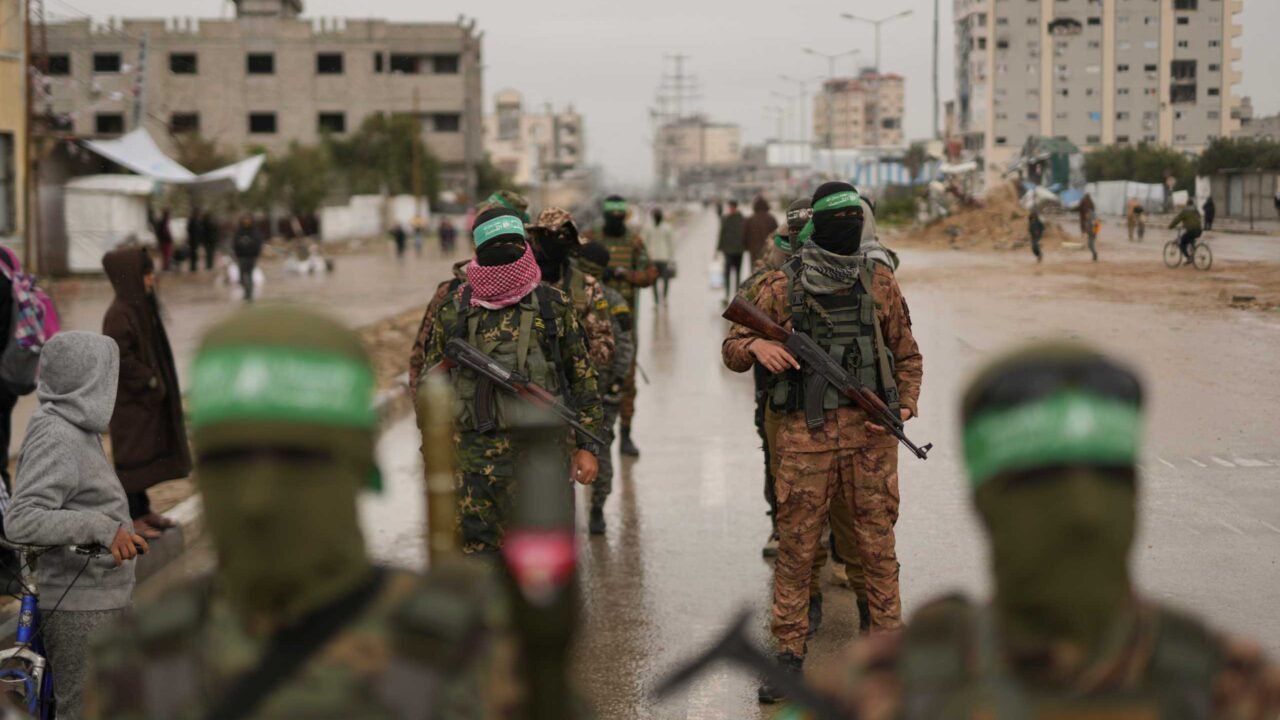
Hamas accepted a Board of Peace plan for Phase 2, committing to weapons decommissioning. Israel has not fulfilled Phase 1 obligations. The Hamas Disarmament Roadmap links decommissioning to phased Israeli withdrawal; Israeli opposition threatens implementation.
The Hamas Disarmament Roadmap has moved from diplomatic abstraction to operational test. At the end of July, Hamas agreed to a Board of Peace plan for Phase 2 of the ceasefire, accepting the decommissioning of its weapons as a central condition. That concession offers a realistic path toward ending the group’s governance and security control over Gaza. But the process depends on Israel fulfilling Phase 1 obligations, including full humanitarian access and withdrawal to the Yellow Line, which it has not done.
More fundamentally, the Hamas Disarmament Roadmap links decommissioning to phased Israeli military withdrawal and eventual negotiations on Palestinian self-determination. Prime Minister Benjamin Netanyahu and his government reject this framework, making Israeli obstruction the most immediate threat to the deal. European states, largely sidelined until now, hold relevant expertise in disarmament and security-sector reform. The central tension is whether the roadmap becomes irreversible political transformation or collapses under renegotiation pressure.
The Board of Peace has secured an unprecedented commitment, but it now appears to be modifying its own terms to placate Israel. That risks undermining Hamas support and granting Israel a permanent veto over withdrawal. Success requires enforcing the original sequence rather than rewriting it.
Can Hamas Disarmament Roadmap Actually Work?
At the end of July, Hamas agreed to a Board of Peace (BoP) roadmap to implement Phase 2 of the three-stage ceasefire agreement. At its core is Hamas’s willingness to decommission its weapons. This would have been unthinkable only a few years ago and offers a realistic pathway for ending the Islamist group’s governance and security control over the devastated Strip.
This process will only begin once Israel has fully complied with its Phase 1 obligations, which it has yet to do. More fundamentally, it will require Israel to accept a process to end its military presence in Gaza and ultimately engage in negotiations towards Palestinian self-determination. Netanyahu and his hardline government have rejected the roadmap out of hand and are now the main threat to the ceasefire deal.
Having been largely sidelined, Europe now has a role to play in ensuring the deal succeeds.
The unfinished phase 1
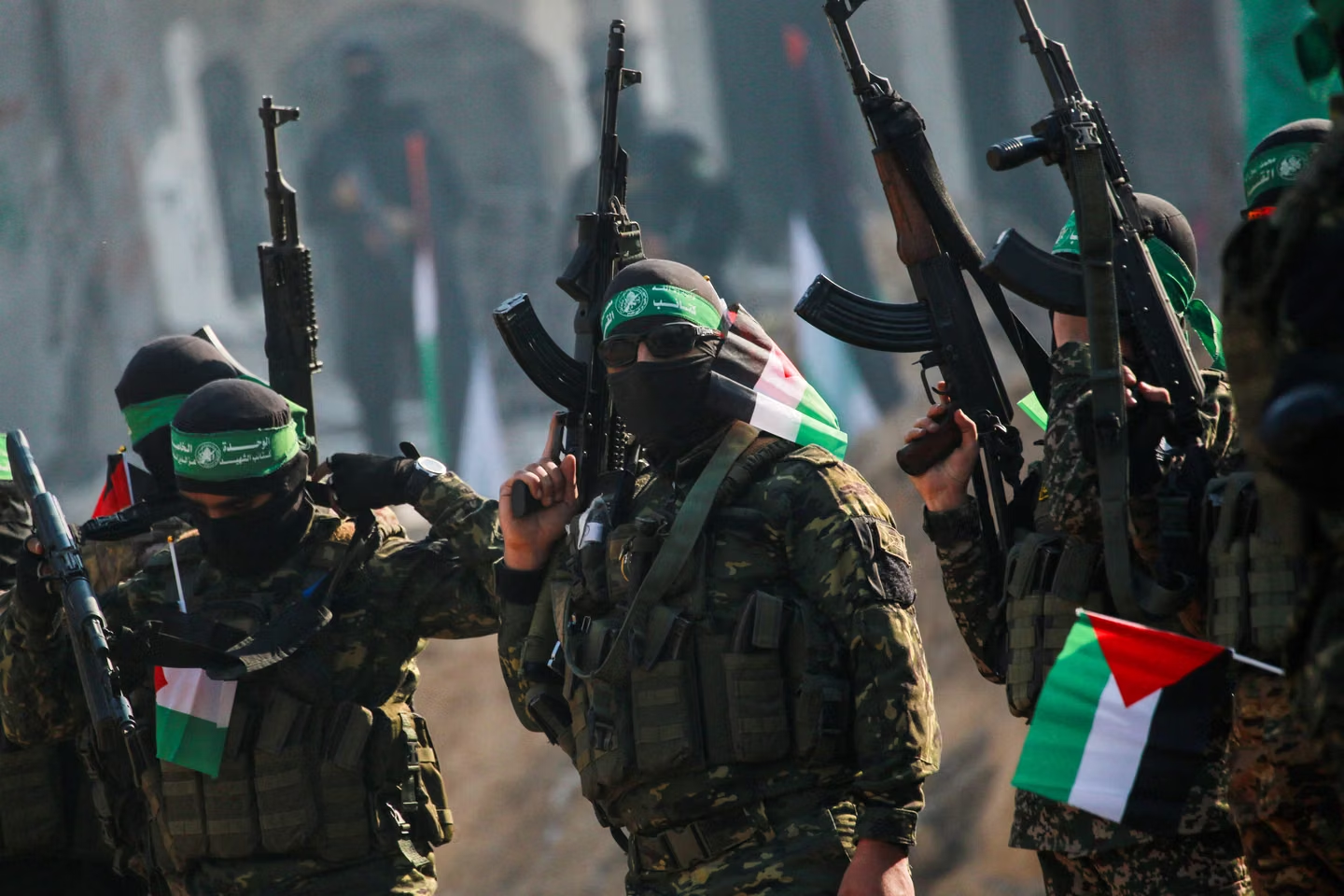
Announced in September 2025, Trump’s 20-point plan aims to end the war in Gaza in three phases. The first phase conditioned the full cessation of hostilities and emergency relief on the release of Israeli hostages held by Palestinian groups. The second phase aims to remove Hamas from power and begin reconstruction—the roadmap Hamas agreed to in July outlines how this stage will work. The final phase would end with Israel’s full withdrawal from Gaza, the return of the Palestinian Authority (PA) and the launch of a “credible pathway to Palestinian self-determination and statehood”.
So far, the plan has significantly reduced violence, secured the return of all Israeli hostages held by Palestinian factions and prompted a partial redeployment of Israeli military forces. However, in violation of the agreement, Israel has continued to strike civilians and militants in Gaza, and impede the entry of humanitarian aid. The Israeli military has also advanced beyond the Yellow Line, to which it was supposed to withdraw in the first phase.
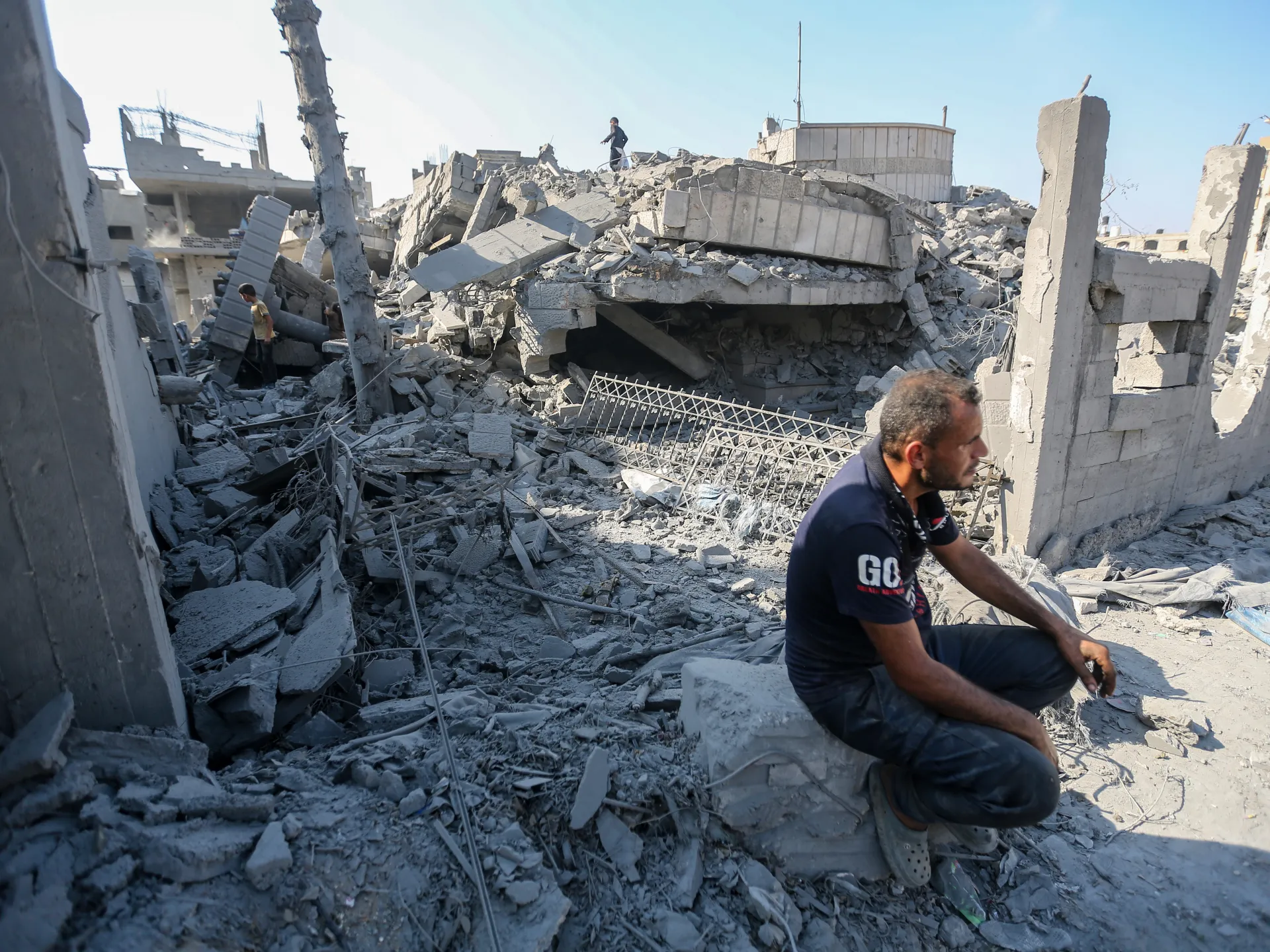
At the same time, Israel has continued to demolish Palestinian homes and infrastructure in the 70% of Gaza that remains under its control. Israel may now be seeking to create a new de facto border with Gaza and effectively annex a large chunk of the territory, potentially preparing for the return of Israeli settlements there in the future.
The roadmap
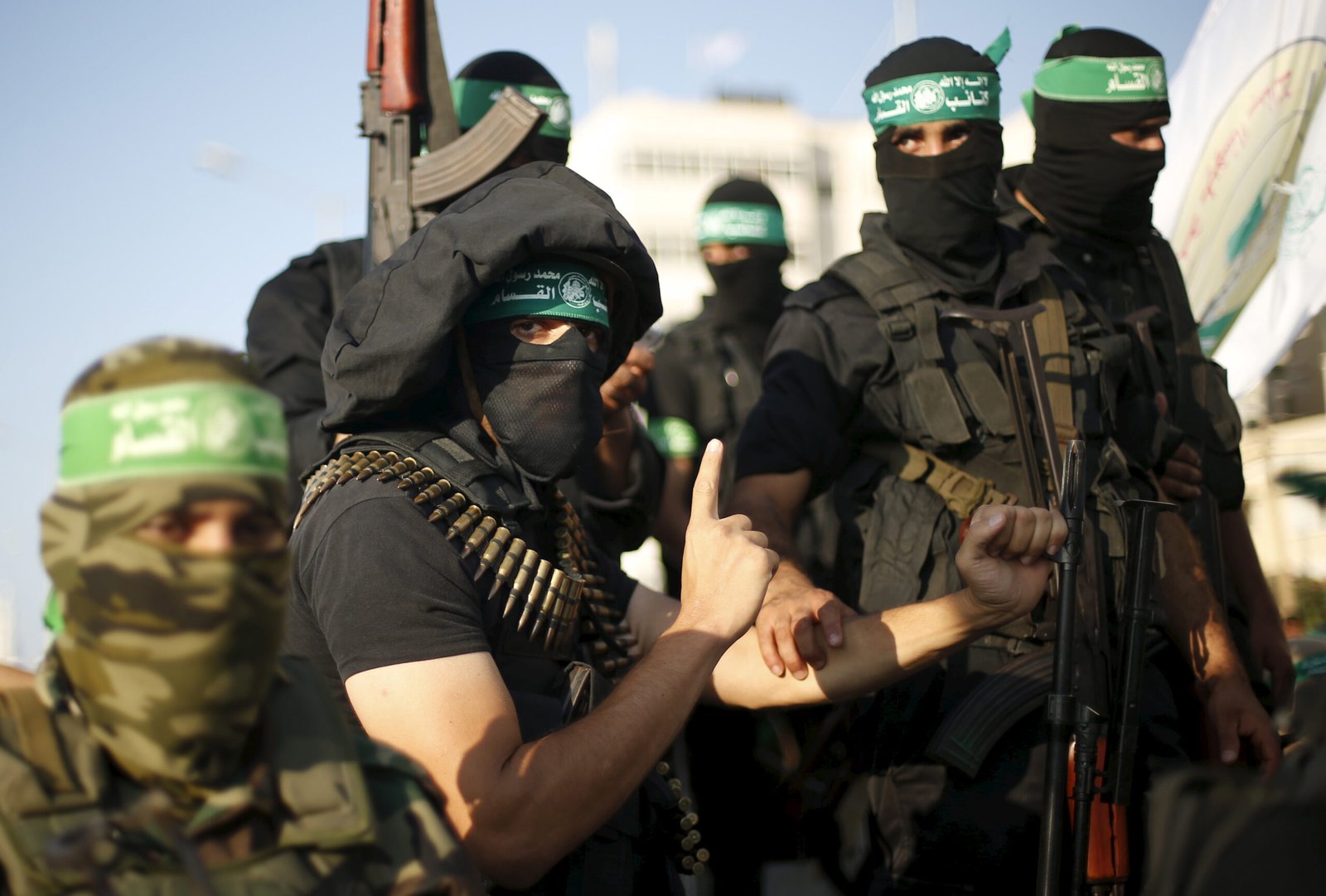
Once Phase 1 is complete, Palestinian factions will begin handing over their heavy weapons to the Palestinian National Committee for the Administration of Gaza (NCAG), a transitional body created as part of the 20-point plan to replace Hamas governance and security control in the Strip. This will include the full alphabet soup of Palestinian armed groups—many of which are more hardline than Hamas—as well as Israeli-backed militias.
Heavy weapons will effectively be placed under lock and key, monitored by the International Stabilisation Force (ISF), which will deploy as a buffer between Israeli forces and NCAG-controlled areas. BoP officials have said Palestinian weapons could ultimately be dismantled and melted down. This would replicate how Northern Ireland’s decommissioning process dealt with weapons held by paramilitary groups. Tunnels and weapons production facilities would also be put out of action.
Small arms like AK-47s will instead be regulated by NCAG through a system of permits. NCAG will also establish a new police force made up of newly trained recruits and members of the Hamas-run civil police vetted and approved by the BoP.
Why Europe Has a Role
Critically, the roadmap links the decommissioning process “to an Israeli withdrawal, in phases, from the areas under its control in Gaza”. According to previous understandings, Israel would withdraw to a new “Red Line” by the end of Phase 2, and from there to a “Black Line” along Gaza’s perimeter, where it would retain a narrow buffer zone until “Gaza is properly secure from any resurgent terror threat.”
While the contours of Phase 2 are now clear, the final operational details still need to be hammered out between the sides during follow-up talks. Questions also remain over the lack of funding for the NCAG and the status of the ISF, which to date has only around 200 pledged troops from Morocco, though smaller numbers may also come from countries including Kosovo and Uganda. Meanwhile, the new Palestinian police force has yet to begin training in Egypt.
Europe is right to avoid directly funding the BoP. But it has considerable expertise in disarmament and security-sector reform, including through the EU’s EUPOL COPPS mission, which was established to assist the PA police in the West Bank. Europeans should offer critical personnel and technical expertise to support both the decommissioning process and the training of the new Palestinian police force.
The spoiler
The biggest obstacle remains Israel’s opposition to any transitional political process that would eventually force it out of the Strip and into talks on Palestinian self-determination. The Israeli government has instead vowed to remain in Gaza and continue its military attacks. It has also opposed NCAG taking over until Hamas fully disarms, and demanded the right to veto troop contributions to the ISF from “hostile” countries such as Turkey and Qatar.
BoP officials now appear to be altering parts of the laboriously negotiated deal (and its own press release) to accommodate Israel’s hardline stance. They now state that Israeli withdrawal beyond the Yellow Line would begin only once the decommissioning process is complete. This appears to contradict the original text and Nikolay Mladenov, the BoP’s high representative, who initially said the two would move forward “in lockstep”. The accompanying Explanatory Note also reinforces this interpretation, outlining “a step-by-step process linking withdrawal phases to verified decommissioning steps.”
Such manoeuvring risks undermining Hamas support for the agreement. Moreover, by conditioning all further Israeli withdrawals on Gaza’s full demilitarisation, the BoP is in effect giving Israel a veto over the process itself, allowing it to deepen its control over the eastern half of Gaza. Given the near impossibility of removing every single Palestinian weapon, as many are held by families, clans, criminal networks and jihadi groups, Israel could argue indefinitely that the conditions for its withdrawal have not been met.
But even BoP efforts to placate Israel have failed to satisfy prime minister Benjamin Netanyahu. He continues to demand that the deal be re-negotiated, insisting that no Israeli redeployment will take place, even to the original Yellow Line, until Hamas has fully disarmed.
Hamas Disarmament Roadmap Needs a Political Horizon
Having secured Hamas’s unprecedented agreement to decommission its weapons, the BoP now needs to show the political will to implement its own deal. US officials have already warned Israel that US president Donald Trump would be “very, very disappointed” if Netanyahu derailed it. Although the prime minister’s far-right coalition limits his room for manoeuvre, Netanyahu has invested heavily in portraying his close relationship with Trump as a political asset—which means he cannot easily afford a public rupture with him.
Mladenov has won wide international praise for brokering the deal. Rather than modifying the terms he himself negotiated and risk the diplomatic gains already achieved, he should use his current political capital and Trump’s momentary re-engagement to insist that Israel implements rather than rewrites the agreement. If necessary, he should be prepared to call out Israeli obstruction, just as he previously cast Hamas as the main obstacle. Europe can further strengthen his hand by also highlighting Israel’s non-compliance with its obligations, as the Arab and Turkish mediators have done. The EU should also resume discussions on suspending the Association Agreement with Israel unless it complies.
Why Phase 3 Must Not Wait
Sustained diplomatic engagement before Israel’s October elections should aim to shift the terms of the domestic debate. The Israeli opposition has also been critical of the deal, accusing Netanyahu of weakness by allowing Hamas to survive, and is unlikely to chart a radical new course on Gaza if it wins. Nevertheless, opposition figures have also acknowledged that Israel’s battlefield gains need to be converted into lasting diplomatic achievements. Europe should use the political framework established by the Gaza roadmap to reinforce this logic and demonstrate how military gains can be converted into a sustainable political settlement.
Ultimately, success will depend on whether both sides conclude that diplomacy offers greater rewards than renewed war. Hamas is unlikely to complete decommissioning unless it believes that concessions today will lead to genuine political gains tomorrow towards Palestinian liberation. Equally, Israel will only embrace a durable ceasefire if it sees political transformation within Hamas that locks it into credible peace negotiations as a means of strengthening its long-term security. This makes Phase 3 every bit as important as Phase 2.
Without a credible pathway towards Palestinian self-determination, decommissioning risks becoming an end in itself rather than the foundation of a lasting Israeli-Palestinian peace. Equally, a future Israeli government will need to view full implementation of the Gaza agreement not as a concession to Hamas, but as the indispensable stepping stone towards normalisation with Saudi Arabia and deeper integration with the Arab and Islamic world.
Europe should therefore work with its Arab partners to ensure that the Gaza deal is tied to a regional package. That would allow a future Israeli government to present withdrawal from Gaza and acceptance of a political process leading to a two-state solution not as unilateral compromises, but as part of a US-brokered grand bargain that underpins Israeli integration and security in the region.