
Saudi strikes on Sanaa airport and Houthi drone retaliation have shattered the four-year de-escalation. Backed by Iranian Mahan Air flights, the Houthis are weaponizing Red Sea shipping leverage to demand oil revenues, salary payments, and an end to UN naval inspections.
Saudi airstrikes targeting Sanaa airport have shattered years of quiet, proving that Yemen’s Truce is now facing its most severe breakdown since 2022. The Houthis are aggressively testing the boundaries of their leverage, exploiting their geographic position to extract major financial and political concessions from Riyadh. This escalating confrontation proves that maintaining Yemen’s Truce has transformed from a localized effort into a critical front line for broader regional deterrence, threatening global trade routes and energy infrastructure.
Yemen’s Truce at Risk completely broken
The four-year Yemen truce is under severe strain. On July 13, the Houthis accused Saudi Arabia of bombing Sanaa International Airport to prevent the landing of an Iranian plane shuttling members of the group back home from the funeral of Supreme Leader Ali Khamenei. Spokesperson Yahya Saree condemned the strike and declared that the period of de-escalation with Riyadh had ended. The Houthis then launched drones and missiles across the border at Abha International Airport (which the kingdom intercepted) and warned that Saudi airspace is unsafe until all restrictions on Sanaa airport are lifted.
Fraying Accords Amid Yemen’s Truce developments
Tensions had already been building for weeks before this exchange. On July 3, the same airline—Mahan Air, an Iranian carrier sanctioned by the United States for supporting the foreign operations branch of Iran’s Islamic Revolutionary Guard Corps (IRGC)—flew to Sanaa to pick up the Houthi funeral delegation without the Yemeni government’s approval.
It was the first flight between Tehran and Sanaa in over ten years and represented a direct challenge to the airspace control arrangements maintained by Yemeni authorities and the Saudi-led coalition. Previously, the Houthis had been ramping up their rhetoric against Riyadh by threatening to restart the war if the kingdom did not fully lift the “siege” on Yemen, facilitate payment of public-sector salaries, and offer war reparations, among other things. The group also tested a key domestic front, launching an unsuccessful attack on Yemeni government forces along the Red Sea coast in some of the most violent clashes in years.
Collapsing Hopes For Yemen’s Truce
The truce was bound to fray at some point. The country’s peace process has been in suspended animation since the Houthis entered the Gaza war in 2023 on Hamas’s side, disrupting traffic through the Bab al-Mandab Strait and earning a terrorism designation from the United States. Prior to that, a UN peace roadmap was on the table that included a ceasefire and significant economic benefits to the group. But much has changed since then, and now the Houthis appear impatient and confident they can demand more.
Yemen’s Truce faces intense pressure
Like their allies in Tehran, the Houthis suffered substantial military setbacks from U.S. and Israeli bombing campaigns in 2024-25 and are under intense economic pressure. Yet they are strategically emboldened. They have proven their ability to disrupt shipping, and this leverage has increased now that Iran’s grip on the Strait of Hormuz is forcing Saudi Arabia to increase oil exports through its Red Sea ports. Moreover, the Iran war has taught them that despite Riyadh’s willingness to signal red lines through limited strikes, the kingdom’s overarching priority is de-escalation. Unlike Tehran’s other regional partners, the Houthis still have an intact leadership core.
In this environment, the group is using the opportunity presented by Khamenei’s funeral to test what type of deal is possible with the Saudis. And the issues at stake go far beyond Sanaa airport.
To be sure, the airport should be opened to civilian flights, and options are available for doing so: the Yemeni government has offered to facilitate limited flights through the domestic airline, Yemenia. But this is not what the Houthis really want. Rather, they are raising the bar by pushing for unfettered access to the outside world, including Tehran, which would enable them to obtain critical military components and expertise more easily.
More important, their specific demands for lifting the “siege” no doubt include a basket of well-known issues—all of which require discussion among Yemeni parties—such as the removal of UN weapons inspections on vessels using Hodeida port, payment of salaries in Houthi-controlled areas, and access to Yemen’s hydrocarbon resources. Ultimately, they seek the economic and political autonomy needed to solidify their control at home and expand their influence across the Red Sea basin.
Aggressive Moves Defying Yemen’s Truce stability
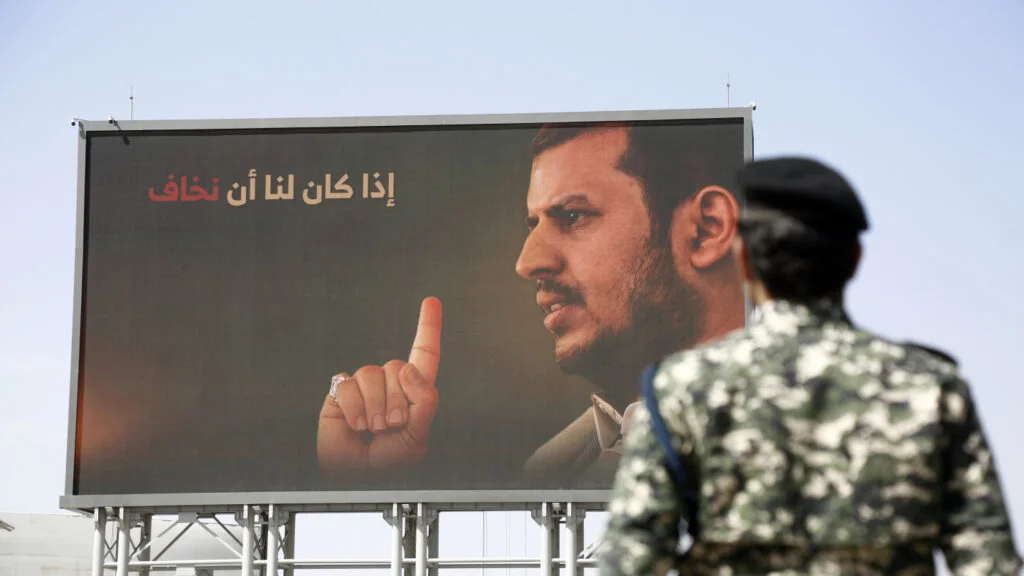
Their leader, Abdul-Malik al-Houthi, confirmed these demands in a fiery speech earlier today. He accused Riyadh of not wanting peace, of favoring broad alignment with the United States, the United Kingdom, and even Israel, and of obstructing the Yemeni people’s basic rights, sovereignty, and dignity. Upping the ante, he closed with a call for popular mobilization against the “siege,” stating that the real equation is “airports for airports, ports for ports, and siege for siege.” He also warned that all of Saudi Arabia’s oil and vital infrastructure are in range of the group’s missiles and drones.
Iran has its own calculations. Facilitating the Sanaa flight signaled that Tehran is willing to continue and even increase support to its armed partners abroad despite U.S. pressure. It was also a reminder that Iran potentially has additional cards to play in the showdown with Washington—namely, asking the Houthis to threaten ship traffic in the Bab al-Mandab at a time when few goods are flowing through Hormuz, thereby clamping down on two routes that the global economy can ill afford to lose.
Until now, the two sides have exchanged carefully calibrated strikes meant to signal demands and red lines without triggering a wider conflict. They may still find a temporary accommodation, but the room for miscalculation is growing. What makes this moment particularly dangerous is that Yemen’s fragile truce is no longer being tested solely by domestic grievances—it is increasingly influenced by a regional contest in which the Houthis see an opportunity to extract greater concessions, while Iran views them as a valuable lever against Riyadh and Washington. The stakes are high for Yemen, but also for the global economy and the evolving balance of power in the Middle East.