
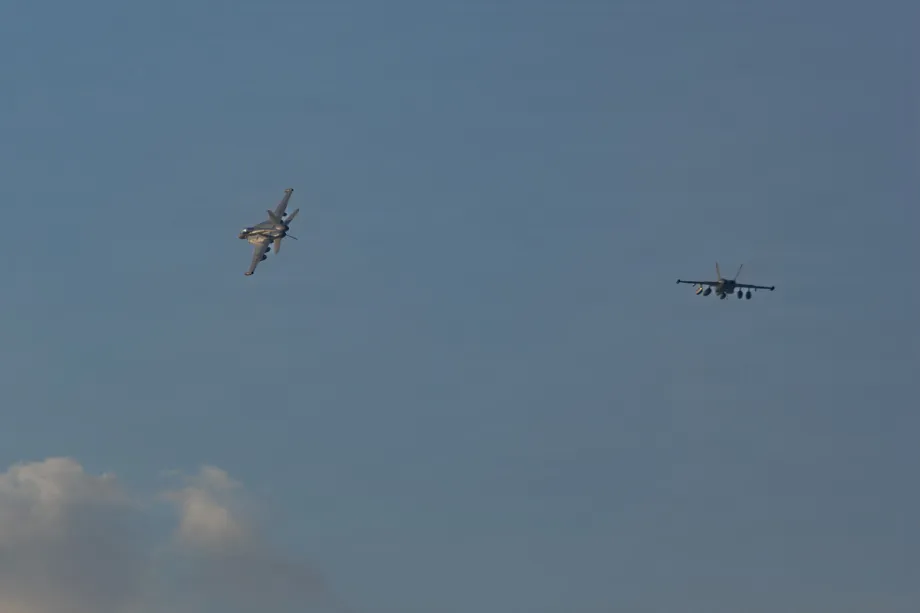
Controlling Iran’s skies doesn’t mean the regime falls. Air supremacy is a military headline, not political reality. The regime retains ground forces,militias, and social control. Collapse requires internal fracture popular uprising or elite defection which hasn’t happened. Ground, not air, decides fate.
When Caroline Levitt says that the United States is “steadily moving toward control of Iranian airspace”
within four to six weeks, she is talking about a military equation, not a rule equation. We have seen this movie before: the skies can be occupied, but the ground is not governed by aircraft.
This type of control, however decisive it may seem, does not necessarily mean the fall of the regime in Tehran. The skies are not the state, and the air does not rule the ground.
The same Western analysts are beginning to question the popular idea that air control means the end of the regime. This is also the belief of British Prime Minister Keir Starmer, who believes that attempting to remove the Iranian leadership through air strikes without a ground invasion will succeed, which is one of the reasons why Britain did not join the US-Israeli strikes against Iran.
Starmer told Parliament, “This government does not believe in regime change from the sky,” stressing that military action requires a legal basis and “a well-thought-out, workable plan with an achievable goal”.
The War Zone magazine wrote that there is “a growing misconception that the US and Israel have achieved complete control of Iranian airspace,“ stressing that talk of “absolute air superiority” is inaccurate and that Iranian defences are still capable of operating in large areas.
Fox News quoted US Secretary of War Pete Haggis as saying that the US is “making decisive progress” and that air control “will be complete within days,” but he did not say that this would lead to the collapse of the regime.
In contrast, a PBS report warned that “air control does not prevent all Iranian attacks,” noting that the regime’s ability to operate from the ground remains intact.
These sources reveal a simple truth: the sky can be occupied, but the ground cannot be controlled by aircraft. The Iranian regime: it takes hits from above and repositions itself below.
Members of the army and the Revolutionary Guard kept their weapons. They left their exposed headquarters. They returned to their homes, waiting for the moment of change to come from within society, not from above. They realize that their headquarters are easy targets and that the sky is not theirs, but the ground still is.
Otherwise, the Afghan, Pakistani, and Iraqi militias trained by Iran’s Quds Force, which were its tools in Syria, are now in Iran, ready to defend the regime. In fact, they are defending themselves, as they have nothing but this regime that employed them as mercenaries.
What happens next will depend on the regime’s military capabilities, its ability to rebuild itself, and whether American and Israeli strikes will create a security vacuum that armed groups can exploit. If that happens, a fragmented republic may emerge.
The regime knows that an air war will not bring it down, but it also knows that a people exhausted by crises might do so if the contract of terror that binds them to it collapses.
This people, who took to the streets in protests in 2009, 2017, 2019, and 2022, does not have the capacity to endure a long war. It awaits the moment when the regime will fall, but it sees no clear signs that the current war will lead it to that moment.
In fact, some Iranians were betting that Donald Trump would fulfill his old promise to “save the Iranian people from the theocratic regime.” But so far, despite the declared air superiority, nothing of the sort has happened. Days after Khamenei’s assassination, Iranians are asking a question that no one dares to answer: If the skies are under control… why is the regime still in place?
The answer, simply put, is that theocratic regimes do not fall through bombing alone. They fall when they lose their tools on the ground, and when popular discontent turns into a critical mass capable of breaking the fear. So far, despite everything that has happened, the Iranian regime has not reached that moment.
Therefore, control of the skies is nothing more than a military headline. The fall of the regime is a political and social issue that can only be achieved when the regime’s monopoly on violence collapses.
Iran today stands between two issues: skies that do not belong to it and a land that has not yet slipped from its grasp. In post-Khamenei Iran, all these groups will assess their influence. Even the air campaign that the the United States considers successful may have strategic repercussions. If the military strikes lead to the fragmentation of the elites, this could lead to the emergence of pockets of rebels, criminal economies, and fragmented sovereignty. If the regime is unable to maintain its monopoly on the use of violence, its control over the entire territory of Iran may not hold.