
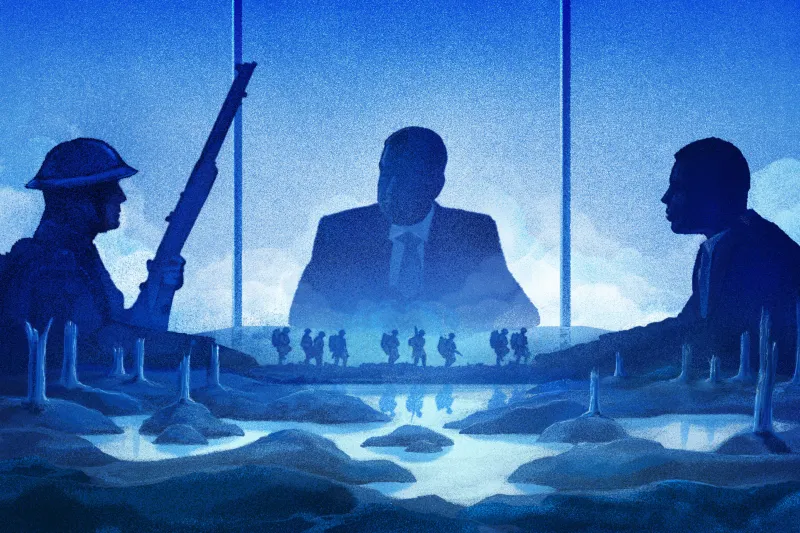
Applied history warns that the current multipolar rivalry resembles pre-WWI Europe: offensive military plans contradict diplomatic deterrence. Fear of war drives preparation that makes war likely. Leaders must gain time, avoid escalation, and reject the fantasy of controlled force.
History, in the hands of a policymaker, can be a dangerous thing. When officials recruit the wrong historical analogy—or misinterpret an apt one—in the decision-making process, the consequences can be catastrophic. During the Vietnam War, to take one notable example, some American leaders perceived in North Vietnam’s Ho Chi Minh another Adolf Hitler. The comparison helped fuel the United States’ misadventures in Southeast Asia by making any accommodation in Vietnam tantamount to the notorious appeasement of the 1938 Munich Agreement. This case became a central example in Ernest May’s 1973 cautionary tale, “Lessons” of the Past. May advocated for more nuanced approaches to historical precedents and argued that analogies might be used responsibly and effectively “to point out criteria for a choice rather than to indicate what the choice ought to be.”
Thirteen years later, in 1986, May teamed up with Richard Neustadt to publish Thinking in Time, a how-to for decision-makers. Instead of searching for perfect analogies, May and Neustadt proposed, policymakers might find more success by looking for not only the similarities but also the crucial differences between the present and potential historical parallels. Building on this work, in 2016, the scholars Graham Allison and Niall Ferguson launched the Applied History Project at Harvard’s Belfer Center. “Applied history,” they explain, “is the explicit attempt to illuminate current challenges and choices by analyzing historical precedents and analogs.”
Analogy is likewise the motor of Odd Arne Westad’s The Coming Storm: Power, Conflict, and Warnings From History. “This world is unlike anything any of us have experienced in our lifetimes,” argues Westad, a professor at Yale and a specialist in modern international and global history. “But it does look quite a bit like the world of more than a hundred years ago, from the late nineteenth century to 1914.” This comparison—between the great-power competition that ultimately erupted in World War I and the increasingly multipolar twenty-first century, characterized by contests for regional dominance among a growing number of great (if no longer decisively super) powers—frames the book.
“China, Russia, and India,” Westad notes, “are not the only Great Powers that are gradually undoing the era of American global hegemony.” Brazil and Turkey (the latter not a great but an expanding power, according to Westad) are exerting stronger regional influence, while two “economic great powers,” Japan and the European Union, have been “increasingly supplementing their productive powers with hard power.” The book’s aim is to warn of the real and looming threat of great-power war. Westad writes that such a war would be nothing short of a “global catastrophe” and proposes that political leaders’ best chance of averting it lies in a sophisticated, historically informed mode of strategic thinking.
Westad makes readers feel the urgency of his task. Large numbers of people living “within the Great Powers believe that those who live in other Great Powers, or at least their leaders, are out to get them” and therefore think that the next war is only a matter of time. He reports high levels of “mutual suspicion,” especially between American and Chinese publics but also between those of other countries. “Two thirds of Russians believe that the war in Ukraine is a life-or-death ‘civilizational struggle’ with the West,” Westad notes, “and about the same percentage of Indians have an unfavorable or very unfavorable view of China. In Europe, a staggering three quarters of Germans and French view China unfavorably.”
Compounding today’s multipolar mistrust, Westad argues, is a widespread ignorance of the true “intensity and scale” of great-power wars and the wholesale devastation they leave behind: “Less than half of one percent of the world’s population,” Westad notes, “has experienced Great Power war.” Post–World War II generations have grown accustomed to limited (often proxy) wars, such as the Vietnam War or the Syrian civil war. Victims of these wars understand the work of violence, but publics viewing these conflicts from afar have lost the ability to imagine war as global apocalypse. Except perhaps in the movies, war in the twenty-first century has lost its epic scale. Westad brings war’s boundless horrors back into view on the book’s very first page with a vision of the Battle of the Somme, which alone produced over a million of World War I’s nearly 40 million casualties.
BEWARE THE ONE-EYED GENERAL
As the ancient Greeks recognized, human beings appear to be hardwired to identify and solve problems through analogy. Aristotle discusses the role of “arguments from likeness” in formulating definitions, as well as in inductive and hypothetical reasoning. Thucydides, whose History of the Peloponnesian War is one of the most popular sources for analogy hunters today, proposed that his own unembellished version of events might prove a useful tool for “people who want a clear view of what happened in the past—and, human nature being what it is, of what is going to happen again in the future in an approximate or closely similar way.” In fact, it is not unusual for the main actors in his history—the Athenians during the disastrous Sicilian expedition, say—to miss likeness where it existed and to imagine difference where it wasn’t.
There is a further danger inherent in the love of analogy: seduced by marvelous correspondences, one might sand away incongruities. No writer of antiquity was more alert to the eager analogist’s misreadings than Plutarch (ca. 45–ca. 120), whose paired biographies of famous Greeks and Romans at once embodied and slyly cast doubt on the entire project of historical comparison. At the beginning of his biography of the Roman general, statesman, and champion swimmer Sertorius (126–72 BC), for instance, Plutarch offers what amounts to a masterclass on the perils of analogy. “It is no great wonder,” he observes, that the same, or similar, combinations of events should repeat over time. Many gullible students of history “take a pleasure in making collections of all such fortuitous occurrences that they have heard or read of, as look like works of a rational power and design.” Plutarch goes on to enumerate a series of patently nonsensical coincidences that people have wrongly invested with significance. His list culminates in four brilliant military commanders, Sertorius among them, who all happened to lose an eye.
Nothing attracts analogies like the vertigo of dangerous times. When things are going well, societies, imagining that they have outstripped the past, reject comparisons in favor of superlatives. But analogies return with a vengeance in eras of uncertainty and upheaval, when they can be used to explain, incite, excuse, admonish, or shame. Arguably, the most valuable aspect of analogies is their ability to take the individual out of the current moment, spur reflection, and defuse panic by means of perspective.
Westad hopes that analogies, slippery as they are, might alleviate the paralyzing fear that war—especially one between China and the United States—is unavoidable. Throughout the book, Westad alternates between then and now, helping readers compare the rise of great powers past and present, the fears and resentments that fuel their competition, and the crises that ignite war. He likens the United Kingdom’s early-twentieth-century decline to that of the United States today, for example, and compares China’s rise to that of Germany in the run-up to World War I. Of the several flash points for potential great-power conflict that Westad enumerates, Taiwan receives the most detailed attention. The contest over the island, he suggests, resembles the flash points of 1914: “Alsace, Bosnia, and Belgium rolled into one.” Westad’s other regions of concern are the Korean Peninsula, the South China Sea, the Himalayas, Ukraine, and the Middle East—the last becoming ever more volatile in the wake of the U.S.-Israeli war on Iran and the Islamic Republic’s retaliation.
Other scholars have proposed different future scenarios. The legal historian Samuel Moyn, for one, has persuasively argued that the very technological developments and legal obligations that have combined “to make war more humane” have also made possible the waging of “deterritorialized and endless war.” In contrast to Moyn’s “humane” dystopia, Westad warns of a radically different nightmare in which the great-power competition of a century ago still lurks within today’s geopolitics and threatens—a Freudian return of the repressed on a civilizational scale—to break out into what now seems like old-fashioned war.
THE PARADOX OF PREPARATION
Because Westad tries to be scrupulous, his analogical approach has one unfortunate stylistic side effect. The book is peppered with phrases denoting varying degrees of similitude: unlike, a bit like, increasingly like, more like, much like, just like. But this liability is outweighed by the ultimate force of the parallel and by Westad’s remarkable range. The book’s intercutting between periods and regions also has the admirable effect of slowing things down. In the mode of the ancient historian Polybius, Westad offers a kind of universal history that works to disentangle causes, pretexts, and beginnings.
For example, he carefully examines the timeline that begins with the assassination of the Austrian Archduke Franz Ferdinand, on June 28, 1914, and ends with the declaration of war a month later in order to see afresh the many miscommunications, blind spots, and wrong turns that transformed a political crisis into a global cataclysm. Westad makes a chilling observation about the beginning of this war that destabilized the world: “It was clear that the Austrian leaders wanted war against the Serbs, though it was less clear what they wanted war for.” This aimless belligerence has textured much of the intervening century, stretches of which might be fairly described as a tragedy of nations haplessly blundering into wars large and small before considering their ends.
Westad paints a picture of multipolar world orders—then and now—characterized by rising chauvinism and nationalism, rife with animosity, and marked by technological innovation and socioeconomic instability. War was not inevitable in 1914, and it is not inevitable now. But Westad argues that many of the variables and conditions that led to World War I are once again in play: trade imbalances, territorial disputes, irrational leaders “with big egos and mercurial personalities,” domestic upheavals, inflexible ideologies, and technological disruption. Of particular note is information overload: then by mountains of crisscrossing telegrams, and now by rapid communication, real-time intelligence, and a relentless news cycle.
The real force of the overarching analogy lies in the paradox that, in the run-up to World War I, fear of war led countries to prepare for it “in ways that almost guaranteed” that war would break out. Military strategists and diplomats seemed to be working at cross-purposes. There was, Westad notes, a fundamental contradiction between “offensive military plans to use in case of an immediate risk of war” and “diplomatic aims of deterrence and assurance that each Great Power had developed.” Ambiguous alliances, coupled with advances in technology, such as the railroad and faster, more powerful battleships, that had shortened the timeline for operationalizing military strategy, proved a catastrophic combination.
Fear prompted an arms race (especially between Germany and the United Kingdom), while military planning was predicated on illusions of swift victory and of “one power being able to obtain decisive military advantages over others in peacetime.” Diplomats, meanwhile, ultimately failed to ease tensions because they could not disentangle the concatenated issues that intensified suspicion and resentment. Westad alerts readers to a similar dynamic today: “In Beijing and Washington, everything that one of the countries does is treated as proof of its aggressive intentions against the other, from strategic posture, to naval policies, to alliances and friendships, to trade policy and technology.”
Westad contends that great powers projecting strength while also fearing they are on the brink of decline because of economic stagnation or domestic political turbulence are tempted to strike at the perceived “maximum moment” of their influence and power. In the future, these temptations will be intensified by the speed of artificial-intelligence-driven analysis and targeting, autonomous or semiautonomous weaponry, and other technological changes. “Coming at a time when Great Power tensions are increasing,” Westad observes, such changes “will put tremendous pressure on political decision-making and military command and control systems.” Once these factors have created a “sense of inevitability,” it will be too late.
A DANGEROUS FANTASY
In his final chapter, Westad makes the vital “case for peace.” He emphasizes several necessary brakes, including organs of international cooperation, responsive diplomatic apparatuses, and defensive alliances. NATO during the Cold War is his prime example of a mechanism of “believable deterrence.” He recommends careful monitoring of emerging technologies that may alter the course of social change and the evolution of warfare. And he notes the importance of leaders adept at gaining time and avoiding “uncontrollable escalation,” who can also get each other on the phone, as they once did using hotlines during the Cold War. There is also a less tangible dimension to Westad’s prescription for peace: debunking the persistent faith in war as “catharsis” and the recognition among nations that peace cannot be synonymous with the preservation of the status quo. “A multipolar world is not something that individual Great Powers can choose or prevent,” he writes.
Westad also makes a claim about complacency that is difficult to reconcile with his earlier observations on the widespread belief in the likelihood of great-power conflict. As in the era before 1914, he writes, “there is today a deeply held sense that Great Power war is, if not impossible, then highly unlikely.” The first claim—that the world appears almost resigned to war at this point—is more persuasive than the second. But it does seem to be the case that today’s growing acquiescence to the inevitability of war is coupled with an almost complete refusal to reckon with the scale of destruction that a great-power war would visit.
The once ubiquitous existential terror of nuclear weapons that characterized the Cold War, for instance, seems to have dissipated even as the New START arms control treaty between Russia and the United States has expired and China’s stockpile steadily grows. Since 2004, when the existence of weapons of mass destruction in Iraq proved to be a mirage, the threat of such arms has largely disappeared from popular consciousness. Meanwhile, a combination of technological developments, including “smart” weaponry, artificial intelligence, cyberwarfare, and drones—to say nothing of prediction markets—are teaching people to think of war as a matter of precision, control, and localization. There is “almost no evidence,” Westad insists, that the exponentially increased “destructive potential available to world leaders in the twenty-first century,” including nuclear weapons, “will make war impossible.”
The notion that war’s force can be completely controlled or managed is a persistent and dangerous fantasy, as any reader of War and Peace knows. There, Leo Tolstoy proposes that even Napoleon himself, far from directing all the movements of his war against Russia, was really like “a child who, holding a couple of strings inside a carriage, thinks he is driving it.” It is also the lesson that the French philosopher Simone Weil, writing in the midst of World War II, drew from Homer’s Iliad, literature’s original account of great-power warfare. Weil argued that force, not the warrior, was the poem’s true hero: “Force employed by man, force that enslaves man, force before which man’s flesh shrinks away.” In the Iliad, Weil continues, “at all times, the human spirit is shown as modified by its relations with force, as swept away, blinded, by the very force it imagined it could handle, as deformed by the weight of the force it submits to.”
The Iliad presents readers with a searing vision of great-power cataclysm’s termination: the very earth would split open to vomit forth “the dank, moldering horrors” of the Underworld. The Coming Storm reminds readers of the enormity of unleashed force. Its assessment of the many ways in which the great powers of a hundred years ago went so wrong offers an antidote to the entrenchment and paralysis of imagination that pave the way for the next conflagration. “Though analogy is often misleading,” wrote the iconoclastic nineteenth-century English novelist Samuel Butler, “it is the least misleading thing we have.” Inviting readers to draw the hypothetical analogy between the millions who died in the “war to end all wars” and the millions more who would die in the next great-power war, Westad performs an urgent and inestimable service.