
Iran’s asymmetric resilience—mined straits, small-boat attacks, existential resolve—is outlasting US political will. Polls show only 36% see military success. Trump’s historical analogies to Vietnam and Iraq may backfire. Tehran calculates it can endure economic pain longer than American voters.
President Donald Trump is loudly trying to convince two critical audiences — Iran’s leaders and the American people — that he’s calling the shots in the war.
His problem is that neither may be listening.
With the war’s eight-week mark looming this weekend, a stalemate is tightening as Iran inexorably increases global fallout with its closure of the Strait of Hormuz and Trump tries to throttle its economy with his maritime blockade.
The question that may decide the outcome of the showdown has therefore become which side has the political will to outlast the other.
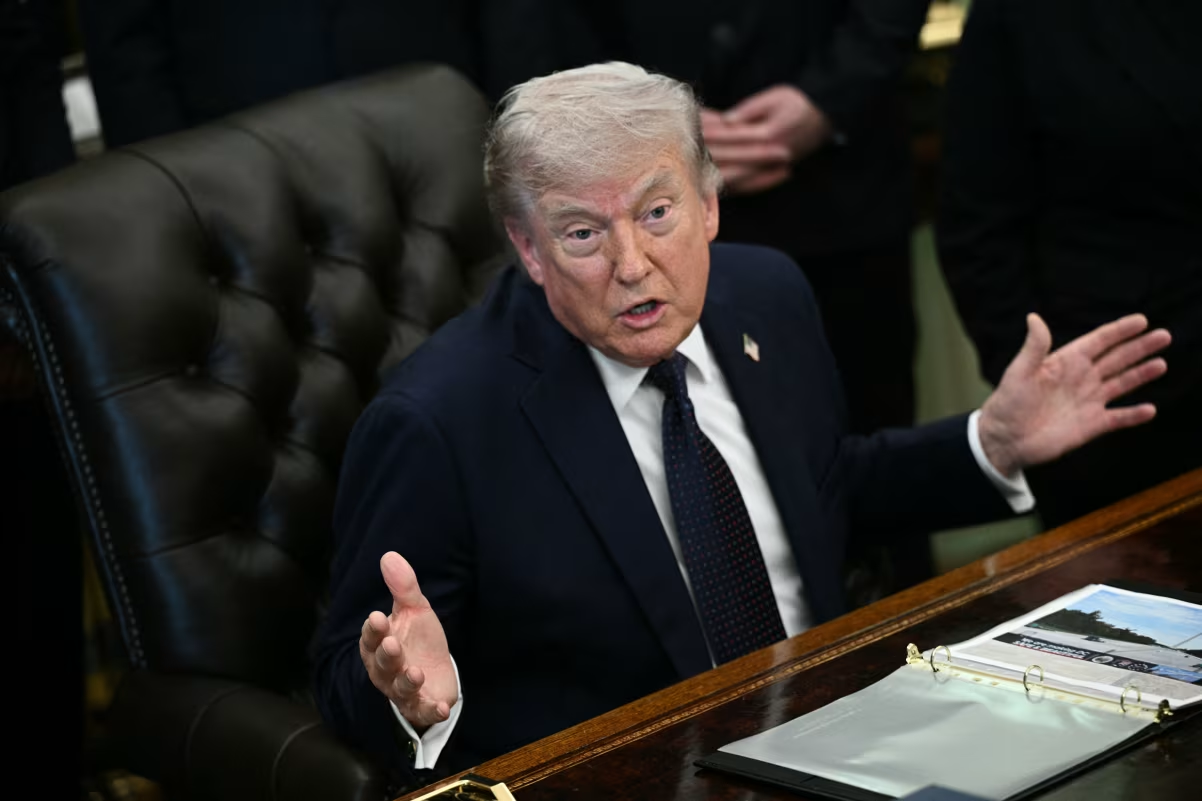
Trump understands the equation. “I have all the time in the World, but Iran doesn’t,” he declared on social media Thursday. He then lashed out at media narratives suggesting he’s desperate to end the war. “Don’t rush me. Don’t rush me,” Trump told reporters. “Every story I see, ‘Oh, Trump is under time pressure,’ I’m not. No, no. You know who’s under time pressure? They are.”
It is imperative to Trump’s hopes of winning the war and creating belated support for it among a skeptical US public that his words are believed. But he’s starting from a tough spot, considering he’s spent weeks making contradictory statements about his strategy that often clash with its realities. And there’s the possibility that his determination to make clear he’s not worried about timelines is an effort to disguise mounting pressure on the president as the conflict extends.
There is growing evidence not only that Iran believes it has the upper hand in a war in which it has used geography as asymmetric leverage against a superpower, but that it is willing to pay whatever price it takes to prevail. This is a country that has regarded itself at war with the United States for 47 years, since the Islamic revolution, and that fought a near eight-year trench warfare conflict against Iraq in the 1980s that caused an estimated 1 million casualties.
Trump on Thursday claimed that the United States has “total control” over the Strait of Hormuz, a critical waterway that is a conduit for 20% of the world’s oil supplies. But this is not true. Iranian small naval boats have attacked several ships headed to the strait to reinforce its stranglehold. Tehran said it received its first tolls from vessels wanting passage. And The Washington Post reported that the Pentagon told Congress it could take six months to fully clear all the mines Iran has dropped in the strait — prolonging the potential impact of the conflict.
CNN’s International Diplomatic Editor Nic Robertson, meanwhile, concluded in an analysis that Iran is emerging as the surprise leader in a game of chicken against the US.
Iran’s navy might be devastated — its missile and drone arsenals ravaged and its leadership devastated by Israeli assassination raids. But it is showing it has staying power in what its new military rulers see as an existential fight.
“All they need to do is show that you don’t need to defeat the adversary, you don’t even need to match their power, you just have to make it too costly to sustain. … The Iranians aren’t really going anywhere and they are surviving,” said Monica Toft, a non-resident Fellow at the Quincy Institute for Responsible Statecraft. “(Iran) may outlast the American political will and military might here.”
Trump’s second audience is the American people. His White House initially told the country that the war would last between four to six weeks, but there is now every sign that the conflict — and its hellish economic half-life — will last much longer.
This leaves the president on political quicksand. The war was not popular to begin with, and history shows that foreign military adventures tend to become less popular the longer they last. Iran war polling is already devastating for Trump. A CBS News/YouGov survey earlier this month found that only 36% of the country thinks military operations were successful and just 25% believe the war is a strategic success.
It’s remarkable that public opinion is so dire considering that, in recent historical terms, the US death toll has been comparatively low because ground troops are not involved. So far, at least 13 US service personnel have been killed in combat operations.
Trump is also reaching for comparisons to the length of previous American conflicts to argue that his Iran “excursion” is a snapshot in time.
“We were in Vietnam, like, for 18 years. We were in Iraq for many, many years,” Trump said Thursday. “I don’t like to say World War II, because that was a biggie. But we were four-and-a-half, almost five years in World War II. We were in the Korean War for seven years. I’ve been doing this for six weeks.”
Maybe the president has a point when he says he has plenty of time to make a deal. But it’s perhaps questionable whether making analogies with lost wars in Iraq, Afghanistan and Vietnam will reassure the public.
The war’s poor polling is important not just because it reflects Trump’s parlous political position less than seven months before midterm elections. It also suggests a prolonged war is politically unsustainable. Iran’s leaders will understand Americans are tired of paying an average of $4 a gallon for gasoline.
Trump has been criticized for his chaotic and often contradictory strategies during the war. But he’s now insisting that he’s got the endgame down.
He argued that a US blockade of Iran’s ships and ports would bring its economy to its knees. “They’re getting no business,” Trump insisted, saying unless Tehran could put oil onto ships soon, the entire oil industry infrastructure would have to shut down. And he argued that Iran’s leadership had been so fractured by the war, “They don’t even know who’s leading the country.”
It’s impossible to judge how a war will turn out while it is still taking place. But if Iran eventually is forced to capitulate to Trump’s demands, his bet on military and then economic coercion will have paid off.
But the president risks repeating a self-destructive trend in recent US foreign policy. Often, officials create scenarios that assume logical responses by an adversary. But US foes have their own perceptions of their natural interest. While Trump sees success in the world as defined by economic prosperity, there’s little evidence that Iran’s revolutionaries feel the same way. If that’s the case, there may be no level of US economic pressure that gets it to back down. Are Trump and the American people really willing to keep bearing the pain at that point?
There is one other possibility to consider. What if Trump really means it when he says he’s under no pressure from time?
Washington conventional wisdom assumes that to mitigate GOP losses in November, Trump will have to end the war soon. But the president has recently seemed almost resigned to a Democratic rout. And at times on Thursday he seemed to be trying to convince Americans, and even himself, that higher gasoline prices for a while longer represent a fair exchange for his war. “You know what they get for that? Iran without a nuclear weapon that’s going to try and blow up one of our cities or blow up the entire Middle East,” he said.
Trump had not presented public evidence that Iran was on the cusp of a nuclear weapon before the war. And this argument might have been more effective had it come before he started bombing.
But sometimes American presidents have prolonged wars they can’t win to avoid being saddled with the stigma of defeat.
Is that what Trump means when he says, “Don’t rush me”?