
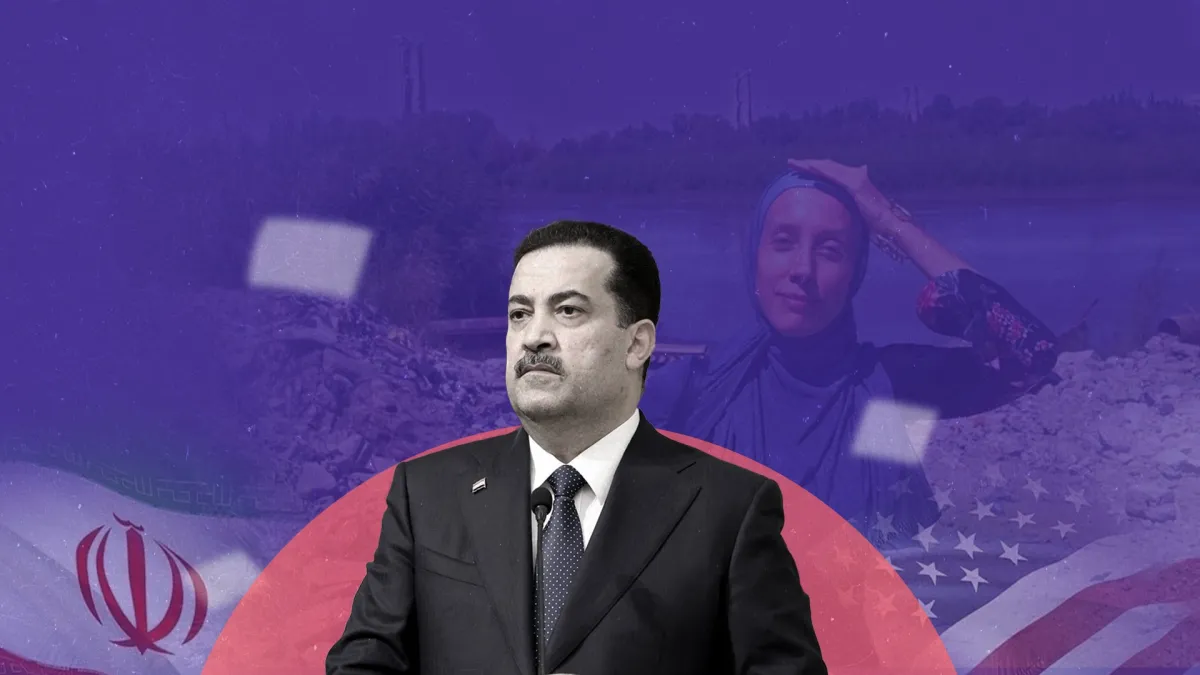
Despite claiming neutrality, Iraq has become a battleground for Iranian interests due to a paralyzed caretaker government fearing political retaliation. The US strategy of backing pragmatic premiers has collapsed, forcing a likely post-war reassessment toward direct confrontation with Iranian influence.
Baghdad can’t find a way out of Iran’s embrace. America is losing patience.
On March 31, the Iraqi militia (and Iranian proxy) Kataib Hezbollah abducted American journalist Shelly Kittleson, a long-time reporter on Iraq and Syria. A few days later, though, the group was compelled to release her – most likely due to significant U.S. pressure.
The Iraqi government, which announced the arrest of one of the kidnappers and had promised to secure the hostage’s release, did not dare to identify the responsible group. U.S. Secretary of State Marco Rubio had no such compunctions, citing the group by its name in a tweet. Notably, in his diplomatically worded note on joint U.S.-Iraqi efforts that led to Kittleson’s release, Rubio did not mention the Iraqi government that had worked to secure her freedom. He referred only to the Iraqi judiciary, represented by the Supreme Judicial Council.
The Iraqi government, led by Mohammed Shia al-Sudani, has found itself in an extremely difficult and embarrassing position since the outbreak of the U.S.-Israeli war against Iran at the end of last February. Baghdad appears unable to prevent Iran-aligned armed factions from attacking American interests in the country. The target list has included companies, the U.S. embassy, and military bases used by American soldiers.
Amid all this, the government has resorted to a contradictory strategy. It has supported the factions by granting them a “right to respond and defend themselves” against attacks by the United States – attacks that it has condemned without naming the attacker. At the same time, in an attempt to deter these same armed groups, the government has announced the formation of a high-level U.S.-Iraqi security committee “to intensify cooperation to prevent terrorist attacks and ensure that Iraqi territory is not used as a launching point for aggression against the Iraqi people, Iraqi security forces, strategic facilities and assets, as well as against American personnel, diplomatic missions, and the international coalition.”
The difficulty facing al-Sudani stems from the fact that he heads a caretaker government with limited powers while awaiting a decision on his nomination for a second term as prime minister. During this exhausting waiting period – which has been going on since the legislative elections held last November and which is likely to continue for months – al-Sudani, like previous prime ministers in similar circumstances, has avoided taking strong or decisive measures that might anger influential Shia forces within the ruling coalition (known as the Coordination Framework). These forces could easily block his nomination as prime minister, given that they represent the largest parliamentary bloc.
For their part, these forces – likely at Iran’s behest – are deliberately delaying his nomination in order to extract maximum concessions. This has included pressuring the government to say nothing about the transformation of Iraq into a battlefield serving Iranian interests.
At the same time, al-Sudani’s refusal to take serious steps against armed factions is undermining Washington’s political support for him. The U.S. administration is dissatisfied with this stance and is unlikely to back his renewal in office. This does not necessarily mean that al-Sudani has lost any chance of gaining a fresh term. Instead it suggests that he may be compelled to invest even more in Iran and its affiliated factions to secure his continuation in power. This political struggle remains intense within the Coordination Framework, where al-Sudani retains some support despite everything.
Since the start of the war Iraq has effectively provided Iran with another front for combating the United States. That raises a question: Where does Iraq, as a state, stand in the ongoing war between the United States and Iran – and, more broadly, in the long-standing U.S.-Iranian conflict? Where exactly do Iraq’s national interests lie?
Iraqi officials have long claimed that Iraq maintains neutrality in this conflict, even portraying it as an unwilling victim. Yet such claims of neutrality and victimhood have never been convincing. In practice, Iraq has for years stood alongside Iran, which has benefited from the fragility of the Iraqi state by extending its influence through armed factions, loyal politicians, and a complex network of interests linking influential Iraqi political forces to Iranian interests.
Meanwhile, across successive administrations, U.S. efforts – through political and financial pressure – have focused on distancing Iraq from Iran’s sphere of influence and maintaining it as an ally, even a weak one, so long as it does not become subordinate to Iran. Despite the scale of American leverage, these efforts have largely failed due to a lack of clear strategy and focus.
This latest war has exposed the depth of Iranian influence in Iraq, as well as the boldness and efficiency of the forces that channel that influence. This may be the war’s most revealing lesson: Despite broad Iraqi popular, institutional, and even unofficial political opposition to entering the war, a determined and well-organized minority of militias and political actors have succeeded in making Iraq fight the United States in defense of Tehran’s interests in a losing war. The outcome is unlikely to be favorable for Iraq. Iran is likely to emerge weakened, wounded, and isolated unless it makes profound concessions that transform it from an expansionist ideological project into a conventional state focused on domestic affairs. And Iraq will find itself forced to pay for its allegiance to this erstwhile ally.
From a U.S. perspective, Iraq’s participation in this war alongside Iran – and the targeting of American and Gulf interests against its official will – may serve as a wake-up call that prompts Washington and its Gulf allies to reconsider and better define the nature of their relationship with Iraq.
Will the United States continue its previous approach – now shown to be completely ineffective – of strengthening Iraqi state institutions and their leadership to counter Iranian influence? One of the most important institutions the U.S. has favored is the prime minister’s office, which, in the American view, tends toward pragmatism due to its executive responsibilities and its constant dealings with everyday policy questions (relating to the economy, finance, and the provision of government services).
This war has shown, however, that this strategy has failed. It is precisely the prime minister – succumbing to pressure, fear, and narrow self-interest – who has aligned with Iranian preferences to turn Iraq into a battleground in the fight against the United States.
Most likely, once this war ends, the United States will reassess its approach to Iraq and how to deal with it in order to determine the nature of the relationship. In this context, it seems plausible that Washington – also driven by rising Gulf anger toward an Iran-dominated Iraq – may move toward directly confronting Iranian influence through a mix of financial, political, and military pressures.
The most important question remains: Can Washington – preoccupied with many other issues it considers more important – develop and sustain the focus on Iraq needed to carry out such a policy?