
Shifting from “Middle East” to “West Asia” as Indian Ocean basin, Soliman urges US realism, offshore balancing, and economic frameworks like I2U2. Prioritizing China denial, West avoids nation-building, recognizing India’s centrality without rigid blocs.
For decades, Western strategists have overlooked the critical transformations occurring within Indian Ocean Basin geopolitics, remaining stubbornly hyper-focused on the Pacific Rim. As international trade corridors fracture, analyzing Indian Ocean Basin geopolitics reveals a massive demographic and economic engine that demands its own systemic evaluation.
The failure to adapt to shifting Indian Ocean Basin geopolitics risks leaving major superpowers entirely unprepared for a highly competitive, multi-aligned maritime domain. Ultimately, mastering Indian Ocean Basin geopolitics requires moving past outdated continental boundaries and treating this crowded, youthful oceanic space as one continuous theater.
The Failure of the Historic Pacific Century Paradigm
For four decades, conventional wisdom has held that the Pacific Rim is the cradle of global dynamism. In 1986, the year Staffan Burenstam Linder published The Pacific Century, Japan was reaching its economic zenith, China was sprouting its first commercial shoots after the Maoist winter, and Taiwan and South Korea were growing into technological heavyweights.
Although the preeminence of the Pacific was undeniable by the turn of the millennium, it took another decade for America’s foreign policy to even consider the economic facts. Even in 2026, the “Pivot to Asia” has still not fully materialized and has become something of a punchline in Washington foreign policy circles. Still, it is now taken as given that the country’s external gaze should be focused on Asia.
Once again, however, America’s body politic risks missing critical geoeconomic shifts. While China’s arrival as a comprehensive pacing challenge demands all the attention it has garnered, framing America’s economic and strategic orientation exclusively around it in the conceptual package of the Indo-Pacific has blinded analysis of a consequential region that merits its own systemic evaluation: the Indian Ocean Basin.
Demographics and the Integrated Trade System
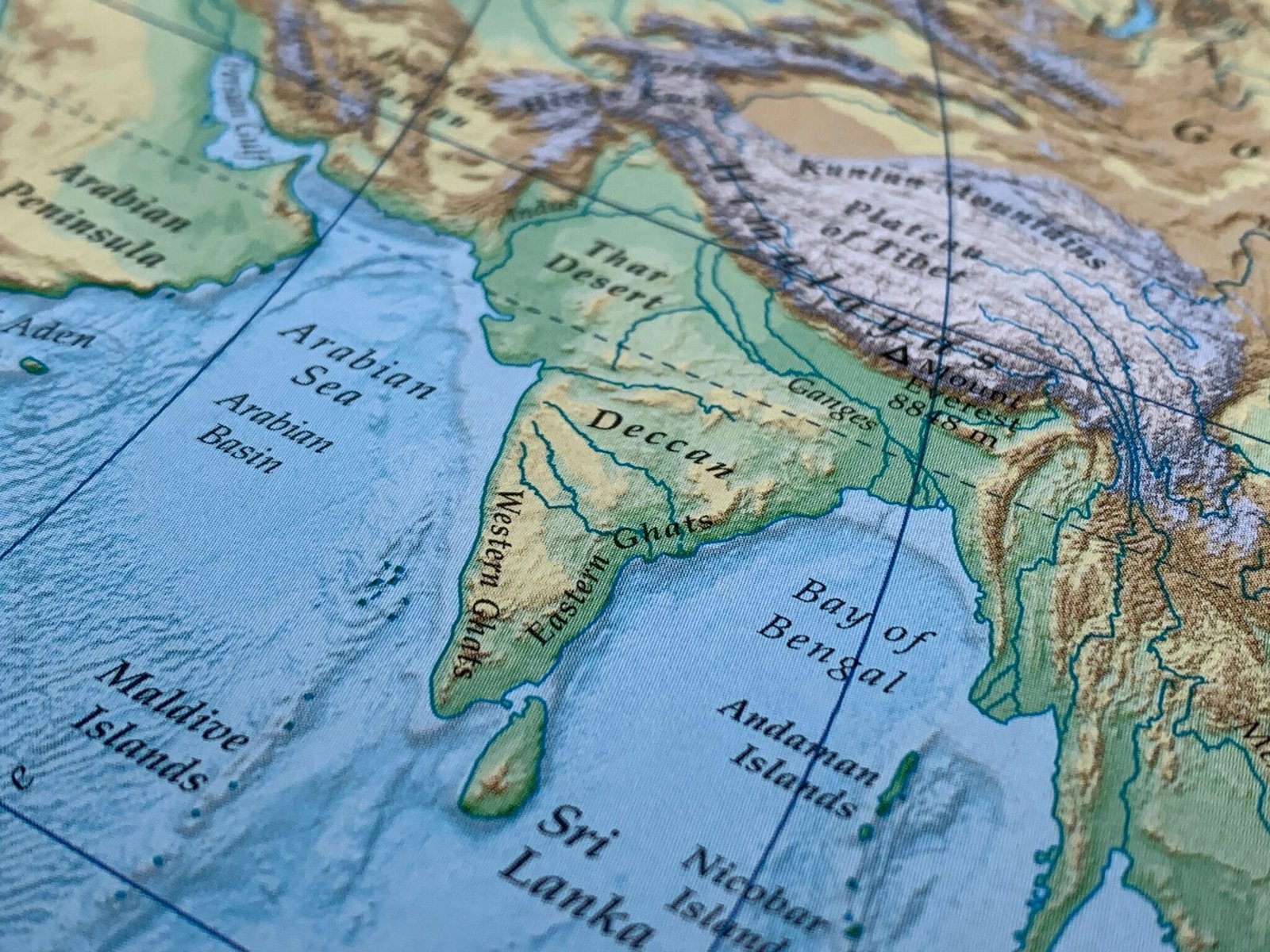
Despite being less than half the size of the Pacific, the Indian Ocean Basin—spanning from the East African seaboard across the Arabian Peninsula, the Persian Gulf, the Indian subcontinent, and the western fringe of Southeast Asia to Australia’s west coast—is the world’s greatest demographic vector. At its center, of course, is India, now more populous than China.
But the Indian Ocean Basin is more than one potential superpower; its economic potential and strategic importance arise from the littoral region’s other large, midsize, and small countries, and from how they interact, synergize, and (often) conflict with New Delhi. Taking into account the coastal countries that ring the basin, including Egypt and Indonesia at its outlet chokepoints of the Suez Canal and the Strait of Malacca, the Indian Ocean Basin’s population exceeds 3 billion.
While the Persian Gulf cul-de-sac is universally recognized as important, the Indian Ocean functions as an integrated system, not just a pumping station for commodity exports. Institutionally underdeveloped though they tend to be, the countries of the Indian Ocean Basin conduct robust internal trade, as they did long before the modern age of globalization. Mozambican coal powers Indian steel mills; Qatari natural gas generates electricity in Indonesia; Malaysian palm oil cooks Bangladeshi food.
Soliman’s West Asian Framework and the Indo-Abrahamic Order
As the Trump administration has embarked on a new war in the region, understanding the Indian Ocean Basin has never been more vital. Fortunately, a new book has hit shelves this spring that can help policymakers with just that task. With West Asia: A New American Grand Strategy in the Middle East, McLarty Associates director and Middle East Institute senior fellow Mohammed Soliman lays out the evidence that an epochal shift is underway, requiring a recalibration from Washington. After a century of orientation toward Europe, Asia’s rise has elicited in the Middle East a renewed Indian Ocean posture that transcends historic identities, or, what he calls, an “Indo-Abrahamic order.”
Correspondingly, Soliman argues, the United States should adopt an ideologically-restrained outlook and replace nation-building with order-building that respects these developments. He cites examples such as the I2U2 minilateral arrangement, including India, Israel, the United States, and the United Arab Emirates. Skeptical of what he calls a “crumbling” liberal international order, Soliman advocates tactical economic engagement in the region. Modeled off the Indo-Pacific Economic Framework, his “West Asian Framework for Development” would embed the United States in supply chain resilience, financial standards, and, most ambitiously, “a US-led techno-economic order” across the Middle East and South Asia.
The Spillover Threats of the Iran War on Indian Ocean Basin geopolitics
West Asia, in Soliman’s mind, is the proper way to conceive of the region from Egypt across the Arab lands and Persia, culminating with South Asia. Zooming out from the traditional confines of the Middle East indeed shows how perilous the present moment is. While the Iran War may yet prove a risk that was worth taking, Soliman’s work suggests it could just as well spiral and destabilize the region. The consequences would not be confined to Iran’s borders or even to the Middle East.
Just as an unintended consequence of the 2003 Iraq invasion was the Syrian Civil War and the fall of the regime of Bashar al-Assad two decades later, the war with Iran could jeopardize Iran’s South Asian neighbor, Pakistan. The Kurds of northern Iraq were to Syria in the 2000s what the Balochis of eastern Iran are to Pakistan today—a restive, transnational ethnic group in pursuit of a state. Is it any surprise, then, that Field Marshal Asim Munir has been so keen to host peace talks in Islamabad?
Soliman’s argument is of a piece with the 2021 book by now-Undersecretary of War Elbridge Colby, The Strategy of Denial: American Defense in an Age of Great Power Conflict, which called for an end to maximalist aims and an embrace of offshore balancing against potential hegemons.
Soliman, likewise, warns against “repeating the mistakes of large-scale interventions that drained national strength, fractured the political consensus, and distracted from the generational challenge posed by China” and recommends “a more grounded strategy: a foreign policy rooted in realism and strategic clarity—where American power is deployed judiciously and always in service of well-defined, achievable objectives.” Like Colby, Soliman views the region as a core concern, but one to be subordinated to the goal of denying China Indo-Pacific hegemony.
West Asia recalls the 20th-century concepts of a Eurasian rimland, à la Nicholas Spykman, juxtaposed with the Eurasian heartland. Soliman sees China’s “Eurasian entente” with Russia as a heartland strategy demanding a rimland response. While dispensing with the Eurocentric definition of the Middle East, Soliman’s perspective is refreshingly free from “decolonization” rhetoric. To wit, Soliman invokes the logic of the British Raj. “This new West Asian order reconstructs the ancient trading routes and partnerships that India, and later the British Raj, once dominated,” he writes, “into a modern strategic model of global technological exchange with Delhi as a central player.”
Correcting the Strategic Map: Maritime Unity vs. Land Mentalities
Yet Soliman’s analysis stops short of recognizing the integrity and potential of the Indian Ocean Basin in its entirety. By drawing his boundary at South Asia’s edge, he misses the opportunities, good and ill, arising out of Myanmar and the west coasts of Malaysia, Thailand, and Indonesia. Similarly, he neglects the nascent economic engines of East Africa.
Yet Indian Ocean entrepôts like Zanzibar and Port Klang, the Raj example shows, are vital nodes in the system that was once, and likely will again be, of paramount importance. For economic dynamism (and the latent power it confers), sea access and youth are a potent combination. While the Pacific Rim is flush with ports, the Indian Ocean Basin countries are significantly younger.
A corrective to Soliman’s boundaries can be found in the work of Darshana Baruah, author of The Contest for the Indian Ocean: And the Making of a New World Order. As Baruah, senior fellow at the International Institute for Strategic Studies in Singapore, wrote in a co-authored article in 2023, “the Indian Ocean region has been erroneously studied through the continental divisions of Africa, the Middle East, and South Asia. But to understand the true importance and strategic advantages of the region, it must be viewed as one continuous theater.”
Whereas Soliman’s West Asia is a reorientation of an existing land-based mentality, conceiving of the region as a maritime domain properly accounts for the primacy of the sea in an ever more trade-linked world, all the more important for a country half a world away.
India, naturally, looms large in West Asia. Soliman guides the reader through its strategy of “multi-alignment” and its relations across its near abroad. Yet it is India’s gravity that ultimately renders Soliman’s thesis unconvincing.
The sharpest regional frame of reference for the geostrategist today is not West Asia, Eurasia, or any other land segment, but rather the Indian Ocean Basin, with India at its heart. Soliman, an admirer of Shinzo Abe, might counter that the “Indo-Pacific” conceptually satisfies this query. The problem is that “Indo-Pacific” can be too encompassing, obscuring the nuances and future risks of the Indian Ocean Basin. What Soliman’s exploration of India’s centrality to the new thinking in the Middle East shows, if unintentionally, is that the Indian Ocean Basin is a dynamic system unto itself.
With China as the only viable Asian hegemon at this time, America’s Indian Ocean analysis, Soliman argues, should derive from the cardinal goal of balancing against Beijing. Geographically, that requires distinguishing between the Pacific and Indian Ocean realms—the latter being important but secondary for now. In the (very) long run, however, a dyed-in-the-wool realist would foresee that an Indian Ocean balancing strategy might need to focus on the region’s native titan in New Delhi.
Considering that distant future, Washington’s relations with the basin’s other capitals and power centers should remain flexible, avoiding rigid bloc-based thinking. As the United States hangs on the precipice of another land war in the region, it is essential that American strategists understand the Indian Ocean Basin, its economic system, and its fractal geopolitics on their own terms. Mohammed Soliman’s trenchant meditation offers us an invitation to do so.