
Reopened cross-border routes for Iraqi fuel, planned rail and pipeline projects, and foreign port concessions are reshaping Syria’s recovery. Centralized investment controls and unresolved local conflicts risk concentrating gains and undermining stability.
Syria Trade Corridors have reemerged as a central variable in the country’s uncertain post-conflict recovery. The reopening of cross-border routes for Iraqi fuel, the proposed Hejaz Railway redevelopment, and the planned Kirkuk-Baniyas oil pipeline signal a rapid shift from wartime isolation toward regional connectivity. Yet the same geography that makes Syria attractive to Gulf, Turkish, and European investors also exposes it to intensifying rivalries over who finances, operates, and secures these passages.
Damascus has moved quickly to court foreign capital, offering ownership rights, tax concessions, and long-term port contracts. This approach may generate much-needed revenue and regional standing, but it also revives older patterns of centralized control and outsourced sovereignty. Without transparent agreements, independent oversight, and reinvestment in local economies, the new transit architecture could concentrate wealth in the capital while leaving peripheral communities and returning refugees further marginalized. The political stakes are clear: if the benefits of reconstruction are not distributed through credible institutions, renewed fragmentation rather than durable stability may follow. Syria Trade Corridors therefore represent both a strategic opportunity and a structural risk for the post-Assad state.
Syria Trade Corridors Reopen Regional Links
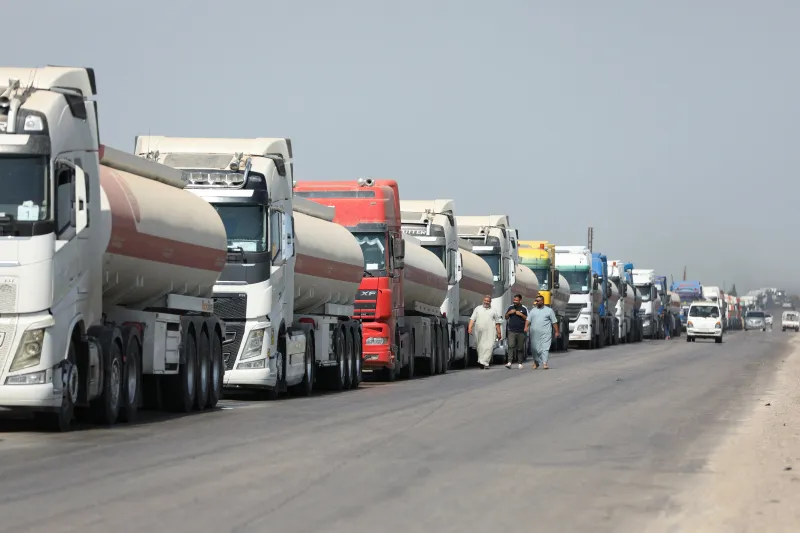
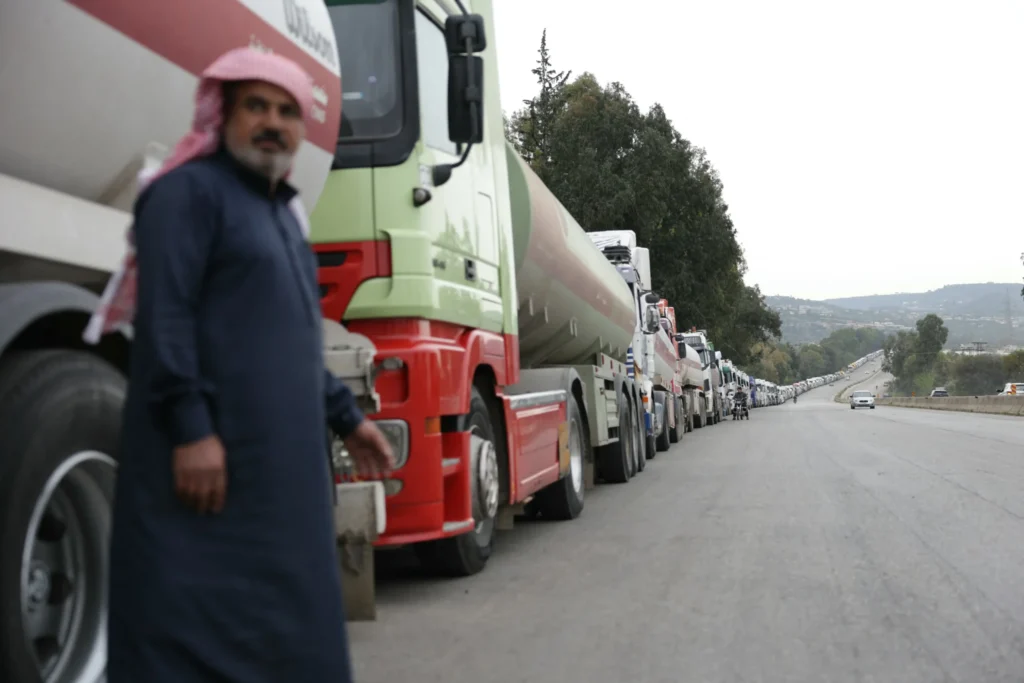
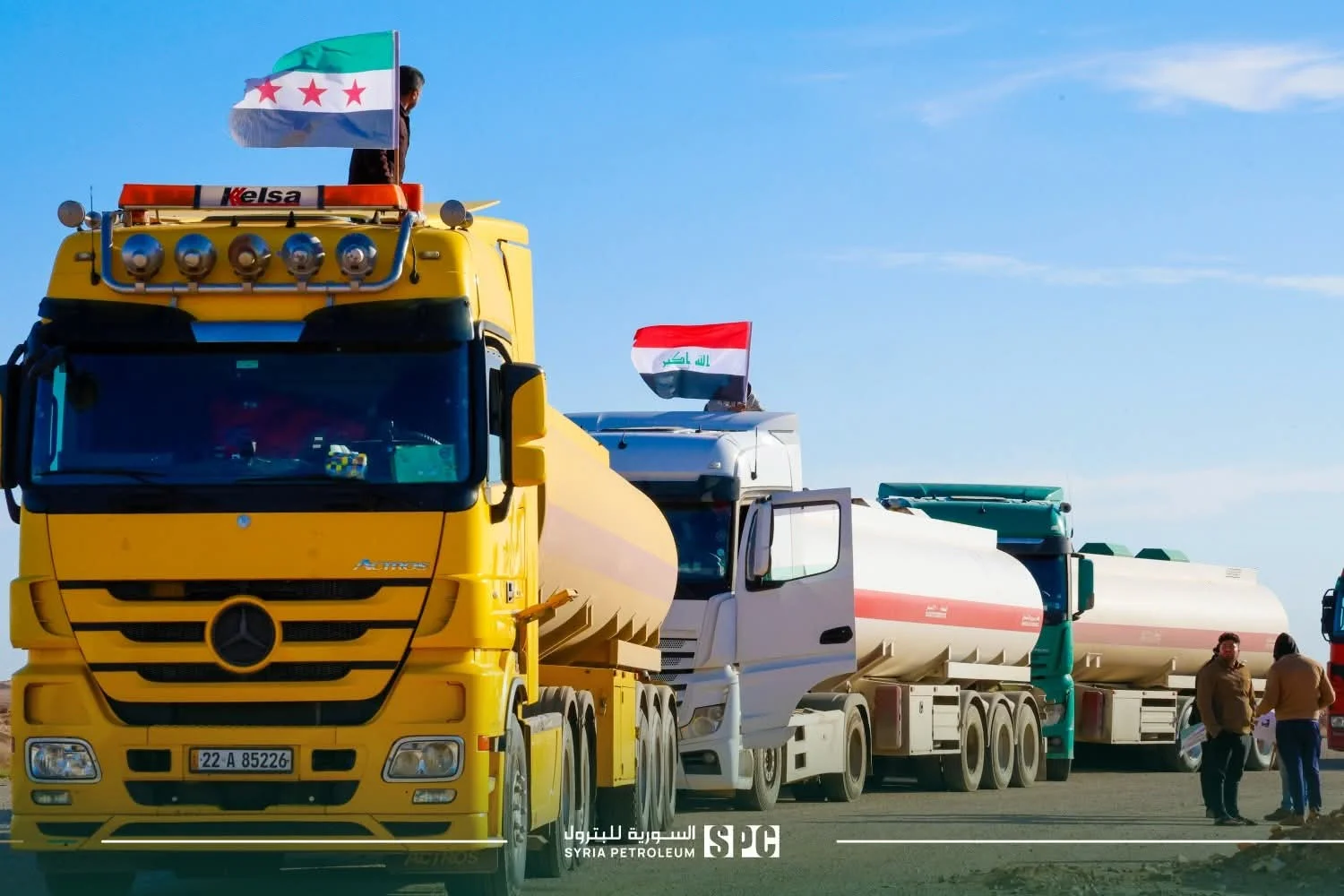
In early April, a convoy of 299 Iraqi fuel tankers crossed into Syria on its way to the Mediterranean port of Baniyas, one of the few remaining paths to international markets amid the closure of the Strait of Hormuz. It was the first time Iraqi oil had crossed through Syria legally since 2003, when the U.S. invasion of Iraq effectively shuttered the cross-border flow of oil from Iraq to Syria. In late April, Iraq expanded the route, reopening its northern Rabia crossing with Syria, a crossing that had been closed for more than a decade during Syria’s civil war. Between April and late July, more than 2.1 million metric tons of Iraqi fuel moved to the Syrian coast.
Before Syria’s civil war began, in 2011, the country had served as a commercial crossroads between Iraq, Jordan, Lebanon, Turkey, and the Mediterranean, connecting Gulf states to European markets. But after 2011, Syria turned into a different kind of transit hub. Trade became dominated by Iranian weapons and logistics support on their way to Hezbollah in Lebanon, as well as fuel, narcotics, and other illicit trade that filled the coffers of the country’s dictator, Bashar al-Assad, but provided few benefits for Syrians.
After Hayat Tahrir al-Sham, the militant group once led by Syria’s new president, Ahmed al-Shara, toppled the Assad regime at the end of 2024, regional trade began to trickle back in. By August 2025, as many as 327,000 trucks carrying over seven million tons of cargo crossed into Syria, according to estimates by Syria’s customs agency. Jordan, Qatar, Saudi Arabia, and Turkey began to normalize relations and do business in the country.
Damascus’s new authorities moved quickly to restore the country’s ties with a wide variety of regional and international partners, with the aim of ending Syria’s economic isolation. Although significant, this is not nearly enough to rebuild the country after over a decade of civil war. In 2025, the World Bank estimated that Syria’s reconstruction would cost $216 billion, nearly ten times Syria’s projected GDP for 2024.
Syria’s leaders are now positioning the country to benefit from a resurgence of regional turmoil. Since the outbreak of the Iran war, in late February, the opportunities for new foreign investment in Syria have proliferated. Because alignment with the United States and Israel and reliance on the Strait of Hormuz carry ever-greater risks of retaliation from Iran, many countries are turning to Syria, which has a variety of well-placed land and sea routes.
Syrian authorities are using the potential rush of capital and trade to create a new source of revenue, allowing the state to recast the country’s image from a source of refugees, terrorism, and regional disorder to a transit power that plays a dominant role in regional connectivity. But the speed and scale of investment could also overwhelm the institutions needed to manage it. If not properly scrutinized or fairly distributed, the rush of new investment that seems so promising now may destabilize the country’s fragile recovery.
AFTERSHOCKS
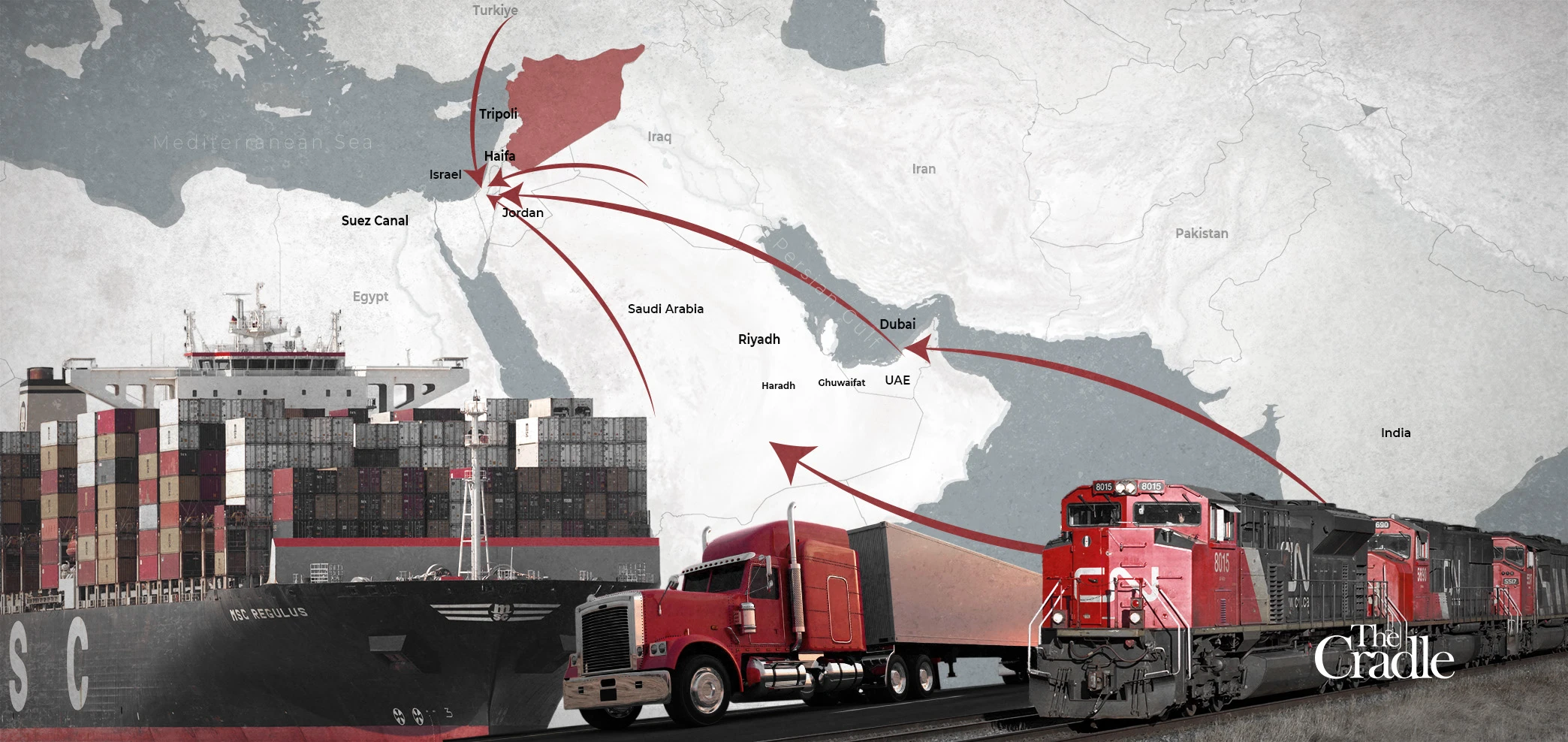
The need for better and more diversified transit through the Middle East is not new, but for nearly 15 years, Syria’s civil war made transit through the country impossible. In 2009, the Saudi and Turkish governments began discussions around redeveloping the Hejaz Railway route, built by the Ottoman Empire and largely destroyed in World War I, but they abandoned these plans with the outbreak of Syria’s civil war.
Between 2010 and 2021, Syrian exports fell by roughly 90 percent. Major transit routes through the country closed entirely as the state fragmented into competing zones of control. In 2023, India, Saudi Arabia, the United Arab Emirates (UAE), the United States, and European partners proposed the India–Middle East–Europe Economic Corridor as a way to spur intraregional and interregional connectivity and integrate Israel, a node on the corridor, with its neighbors.
Disruption in the Strait of Hormuz has made expanding these projects even more urgent. In April and June of this year, the Jordanian, Saudi, Syrian, and Turkish governments agreed to redevelop the Hejaz Railway within three to four years. Analyses of comparable regional rail corridors, such as that by the Atlantic Council, estimate that the railway could initially carry around 1.5 million containers annually, potentially rising to three million with track and port capacity expansion.
This proposal resonates with Shara’s loose vision, laid out at an informal EU summit in April among leaders from Europe and the Middle East, for a Four Seas and Nine Corridors initiative that places Syria at the center of a network connecting the Persian Gulf, the Caspian Sea, the Black Sea, and the Mediterranean, facilitating ground- and sea-based trade in goods, electricity, and oil. Then, in July, Iraq and Syria agreed to rehabilitate the Kirkuk-Baniyas oil pipeline, which was destroyed during the U.S. invasion of Iraq in 2003, to create a permanent Mediterranean outlet for Iraqi oil.
If the pipeline goes online within its four-year estimated timeline, it could transport two million barrels per day by 2030, equivalent to roughly 60 percent of Iraq’s crude exports before the Iran war and an estimated nine percent of the total oil that moved through the Strait of Hormuz. With new routes also planned through Turkey, Iraq is positioned to route more than 80 percent of its export volume around Hormuz, ending its near-total dependence on Gulf terminals.
These trends, however, are not guaranteed to improve Syrians’ economic and political fortunes. Although Syria’s geographic position gives it geopolitical leverage with foreign actors seeking to diversify export routes, it also places the country in the middle of emerging rivalries, as Saudi Arabia and Turkey align on security, the UAE increasingly takes a commercial role in ports and logistics, and Israel attempts to prevent Turkey from establishing influence near its borders. Competition over who finances, operates, and protects these respective corridors could pull Syria into contests it is not stable enough to sustain.
Who Controls the New Corridors?
Damascus has tried to limit this exposure by working with nearly every power willing to support its reconstruction and reintegration, including Qatar, Saudi Arabia, Turkey, the UAE, and the United States, as well as China and Russia. But this strategy is proving more difficult as time wears on. The influence of Syria’s greatest financial supporters is drawing Damascus toward a Qatari-Saudi-Turkish constellation. If competition over the corridors grows faster than Syria’s capacity to manage it, the country could fall victim to greater foreign control and extraction.
Israel may also prove to be a significant obstacle to Syria’s reemergence as a reliable passageway for trade. The reconstruction of the Hejaz Railway, if successful, will decrease Israel’s importance to the India–Middle East–Europe Economic Corridor and as a Mediterranean gateway for Arab states. Israel may well try to resist this development.
In February, Israeli Prime Minister Benjamin Netanyahu warned of an “emerging radical Sunni axis” as Syria drew closer to Qatar, Saudi Arabia, and Turkey, and in June, Israeli Transport Minister Miri Regev warned that regional trade and energy partnerships designed to bypass Israel posed “a genuine strategic threat to national security,” placing Syria’s emergence as an alternative trade corridor within Israel’s wider threat perception.
And Israel has demonstrated its willingness to use force against those countries; in 2025, it bombed a Hamas compound in Doha, carried out extensive attacks across Syria (including on air bases being scoped by Turkish military teams for deployment in Syria), and seized additional territory in the south of the country. In August 2026, Israel struck Syria’s Abu al-Duhur airbase after alleging that Damascus was preparing to permit a Turkish deployment there intended “to harm Israel,” in the words of Israeli Defense Minister Israel Katz.
Damascus, which cannot afford a war with Israel, has avoided military retaliation and sought an Israeli withdrawal by participating in U.S.-brokered negotiations. Such a tempered approach, however, may not deter Israel from expanding its illegal occupation of Syrian territory, targeting Syrian infrastructure, or fomenting instability through its ties with Syrian minorities, all of which are hampering projects critical for Syria’s recovery. As the Middle East analysts Shira Efron and Danny Citrinowicz have argued in Foreign Affairs, the attempts by Syria’s new government to counter those operations could result in Israel and Syria becoming lasting adversaries. Such attempts will also require even more support from foreign actors.
PAY TO PLAY
The growing influence of foreign powers in Syria also affects important political dimensions of the country’s reconstruction. Throughout the civil war, Assad granted countries that supported his repressive regime access to Syrian territory and economic assets. Russia built military bases and received lucrative phosphate, oil and gas, and port concessions. Iran used Syria as a land bridge to Lebanon and stationed thousands of troops in the country.
Efforts to reassemble the Syrian state after Assad’s fall have unfolded under this shadow. The government led by Shara has largely ended this method of outsourcing Syrian sovereignty, ousting Iranian and Hezbollah forces from Syria, dismantling networks that sustained Iran’s military corridor in the country, and reclaiming control of formerly Russian-held military bases, although the bases will still be jointly operated. But the risk of outsourced sovereignty has not disappeared.
Damascus is still grappling with a fragmented system of national governance. For years, customs administration systems across Syrian territory were governed by separate competing state and nonstate actors, chief among them the Kurdish-led Autonomous Administration of North and East Syria. Although Damascus has regained authority over the border crossings with Iraq in territory once led by the Kurdish minority, the main crossing into Turkey from that territory has yet to reopen.
To attract the funding necessary for Syria’s reconstruction, the new government has lowered the barriers for regional and international powers to access and invest in Syria’s routes, ports, and territory, projects that could serve to connect its disjointed regions. Last June, Shara signed a decree permitting foreign investors full ownership rights in most sectors, an unrestricted ability to repatriate their profits, and extensive tax and customs concessions. The decree concentrates authority over investment licenses, access to state land, and eligibility for major tax incentives in institutions closely tied to the president, giving him considerable power to determine who can invest in Syria’s postwar economy.
This centralization will likely help streamline investment. But without independent oversight into such decisions, oversight that Syria has yet to establish, centralization could also revive the Assad-era practice of offering economic access as a reward for political loyalty. Such a system could make reconstruction a new source of political patronage, undermining the new government’s legitimacy in the eyes of Syrians who lose out and possibly reproducing the same inequalities that helped fracture the country in the lead-up to the civil war.
Reconstruction Funds Demand Scrutiny
Long-term concessions give foreign companies considerable influence over critical infrastructure. The French-owned shipping company CMA CGM holds a 30-year concession of Syria’s largest port, Latakia, an arrangement that gives the Syrian government 60 percent of the port’s revenue. The UAE-based logistics company DP World will finance and build new infrastructure at Syria’s second-largest port in exchange for operational control over the facility for 30 years, after which control will return to Damascus. But it remains unclear, in the absence of any published revenue-sharing terms for this deal, how much income the state will receive, or how that income will be managed and distributed.
The scale of Syria’s reconstruction makes foreign financing difficult to resist. Although the World Bank has directed nearly $500 million in grants toward public service projects targeting electricity, water, health, and financial institutions, that will cover less than one percent of the country’s reconstruction needs. In October, Shara said that his government had attracted $28 billion in commitments from a mix of Turkish and Gulf investors during its first ten months, roughly 13 percent of Syria’s total estimated needs.
The largest commitments, however, favor government-awarded infrastructure and development projects—power plants, ports, airports, telecommunications, and urban real estate—but pay little attention to restoring basic services and destroyed homes in Syria’s hardest-hit communities. Moreover, much of the sum comes from preliminary agreements.
Shara’s government has created two funds to manage the reconstruction: the Syrian Development Fund, for donations and grants for rebuilding public infrastructure such as roads, bridges, and water and electricity networks, and the Syrian Sovereign Fund, modeled after the Gulf sovereign wealth funds, to manage state assets, invest in public property, and take stakes in strategic projects.
Dedicated reconstruction funds are common in postconflict states, and a sovereign wealth fund may be justified to streamline the management of fragmented, distressed, and historically poorly managed public assets. The concern, however, is that under its current formulation, the Syrian Sovereign Fund concentrates the management of public assets directly under the president without independent oversight and with limited public disclosure around its structure and management, as similar reconstruction programs in Afghanistan, Iraq, and Somalia have done. Even reforms intended to strengthen accountability are centralized under the president.
The planned center for arbitrating investment and commercial disputes, for example, will sit within the Syrian Investment Authority, which is itself attached to the presidency. This architecture could give the president undue influence over which investors, regions, and communities benefit from recovery. In a country that has suffered from the state’s abuse of power and wealth since the 1960s, this pattern of control is uncomfortably familiar.
PAYING DIVIDENDS
Transportation corridors and investments cannot generate durable returns if renewed fragmentation preserves the disconnect between a strong, wealthy Damascus and a poor, underdeveloped periphery. Ultimately, whether Syria can convert foreign investment into local gains depends on whether Damascus can establish a predictable political order. So far, the government seems to be making steady gains, but it still has a long way to go. Over the past two years, Shara’s campaign to reunify the country has been violent. Fighting along the Alawite-majority coast, in the Druze-majority Suwayda region, and across the Kurdish-led northeast has deepened mistrust between the state and the communities it seeks to govern.
Renewed confrontation between Damascus and the Syrian Democratic Forces—a U.S. backed, Kurdish-led coalition that governed much of northeast Syria after pushing the Islamic State (also known as ISIS) out of the area—offered the clearest warning of renewed civil war. Although the central government and the SDF signed an agreement to merge in March 2025, disputes over military integration and Kurdish autonomy at first prevented its implementation, leading to an outbreak of fighting in January that displaced more than 170,000 people.
After a U.S.-brokered cease-fire halted the government’s advance north, Damascus and SDF leadership signed an agreement that mandated the transfer of control of border crossings, oil and gas fields, and local institutions to Damascus and the integration of SDF fighters into the Syrian military. In August, after months of gradual implementation, the SDF commander Mazloum Abdi announced the coalition’s dissolution as an independent force and the end of Kurdish-led self-governance in Northeast Syria.
Even infrastructure and resources under the Kurds’ de facto control is now being handed over to Damascus. On paper, the January agreement between Damascus and the SDF provides a framework for resolving informal wartime boundaries and closed routes and for harmonizing competing duties and parallel systems of governance. If the Kurdish majority living in the northeast perceives this reintegration to be insufficient or failing to preserve Kurdish rights and representation, however, they may begin to resist, obstructing Damascus’s attempts to consolidate full control over the country and its transit corridors.
Can Syria Trade Corridors Deliver Locally?
The repatriation of millions of Syrians further raises the political stakes. By the end of May, an estimated 1.67 million refugees and 1.92 million internally displaced Syrians had returned to their home communities. Many are returning from protracted poverty in neighboring states to communities already struggling to meet residents’ basic needs, which has intensified competition over housing, employment, and public services and which may create new sources of local grievance and conflict as the process continues to unfold. To successfully integrate these returnees, Damascus must empower governorates and municipalities with the resources and autonomy to solve problems pertaining to service delivery, job creation, and education in real time.
To avoid reproducing a rentier economy dependent on transit fees and foreign concessions, the Syrian state must reinvest project revenues in local economies. Assad’s dependence on Iran and Russia narrowed his room to maneuver, but the new government can negotiate with Europe, the Gulf states, Turkey, the United States, and international institutions seeking access to Syria’s markets and transit routes. Competition among these partners gives Damascus leverage to negotiate terms that keep as much of the investments’ value in Syria as possible.
But using that leverage effectively will require transparent agreements tied to clear state policy priorities for reconstruction and recovery. To better connect the capital with faraway cities and towns, the central government must invest in improving roads and electricity connectivity and require foreign investors to support local hiring and revenue-sharing agreements. It will also need to forge durable and equitable settlements with minority leaders and tribal communities to strengthen domestic trust.
Renewed interest in Syria as an advantageous transit point for regional trade has presented Damascus with income, relevance, and leverage at a time when it needs all three. But these resources are not immutable. Damascus’s challenge is to use the dividends from its newfound importance in regional trade to build functioning institutions, distribute resources for recovery, and overcome historical animosities. Otherwise, after decades of exclusion, Syria could return to the regional map merely as a fragile conduit for others’ commercial exploits.