
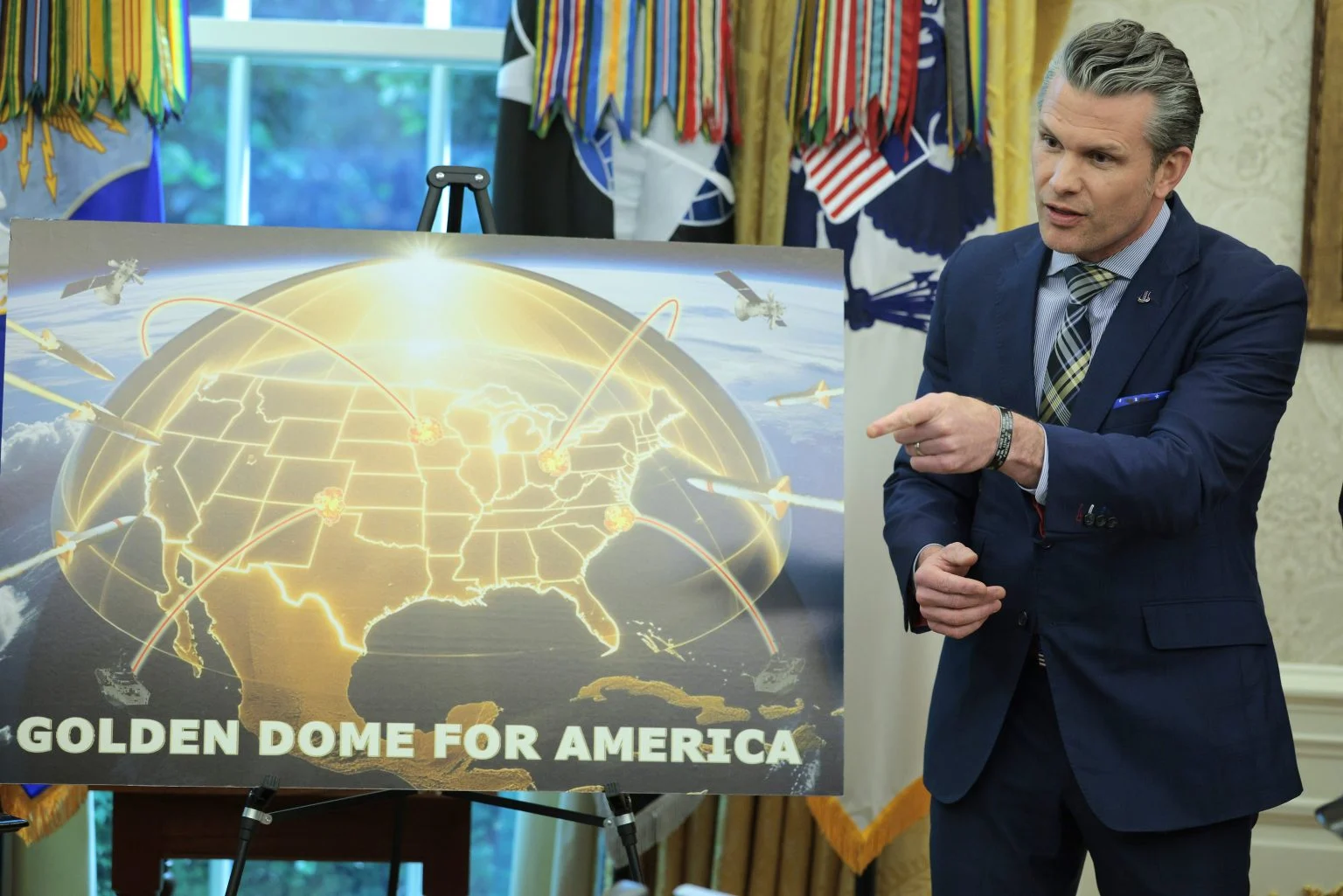
The proposed U.S. Golden Dome system seeks to strengthen homeland missile defense through advanced land, sea, and space capabilities amid growing threats, while facing debates over costs, implementation, strategic stability, and arms control.
The Vision Behind Golden Dome
On May 20, 2025, United States President Donald Trump announced the Golden Dome missile defense initiative. The system is meant to deploy next-generation technologies across land, sea and space to defend the homeland against ballistic, hypersonic and cruise missiles, with improved capacity to counter the strategic arsenals of major adversaries.
Recently, the U.S. Congressional Budget Office estimated that $1.2 trillion would be needed to develop, deploy and maintain such a system over the next 20 years. The evolving strategic environment, emerging technologies and the rapid expansion and decreasing cost of domestic space-launch capability will likely drive Washington to expand the robustness of the nation’s missile defense umbrella. However, it could be several years before the scope and scale of the system’s architecture is fully clear.
Changing geopolitics
Over the past 20 years, missile defense has generally won support from both parties. This is partly because systems such as Israel’s Iron Dome and the U.S. Patriot and Terminal High Altitude Area Defense have proven effective in combat, while efforts to curb the spread of missiles have fallen short. Recent wars in Ukraine and Iran have heightened attention on and demand for missile defense systems.
The dramatic projected growth of China’s ballistic missile force, the steady expansion of the North Korean arsenal and the proliferation of cruise and hypersonic missiles have raised concerns about U.S. vulnerability to missile attacks and the efficacy of strategic deterrence. With the proliferation of both attack and missile defense systems, U.S. strategy has increasingly evolved toward adopting a robust offense-defense mix as the most stable form of deterrence. This includes offensive weapons to hold enemies at risk and defense capabilities demonstrating the capacity to protect forces, populations, infrastructure and other key assets.
Despite changing geopolitical realities, Democrats in Congress were quick to criticize Golden Dome, echoing many past objections to expanding missile defenses. The main concerns are cost, the risk that expanded missile defenses could spur adversaries to build up their offensive arsenals, and the “weaponization of space.”
That said, opposition is much more muted than it was decades ago and Golden Dome ranks far down the list of issues Democrats have focused on for the midterm elections. A recent effort by House Democrats to block Golden Dome funding failed. In addition, there is very little international opposition from allies and partners over missile defense proliferation.
New technology and capabilities
Golden Dome draws on advanced technologies that are already well developed. Although often described as “next generation,” many features are in production. The biggest shift in the U.S. ability to deploy systems in space is the sharp increase in launch capacity and decline in launch costs. The recently released U.S. Space Transportation Strategy projects that American facilities could support 1,000 commercial and government rocket launches per year by 2030.
Another important factor is the development of the U.S. Space Force. Some mocked President Trump when he established the service in 2019, but it has since emerged as an important and effective component of the armed forces. The recent war in Iran has drawn greater attention to its capabilities. According to the head of Space Force Command, General Stephen Whiting, the service has played a crucial, often unseen role, providing missile warnings and satellite communications for drones. He emphasized that these operations demonstrate both the proficiency of the Space Force and its ability to strengthen joint operations across the armed forces. Given its central role in developing Golden Dome, the service’s recent successes could bolster support for the program.
Technical challenges and requirements
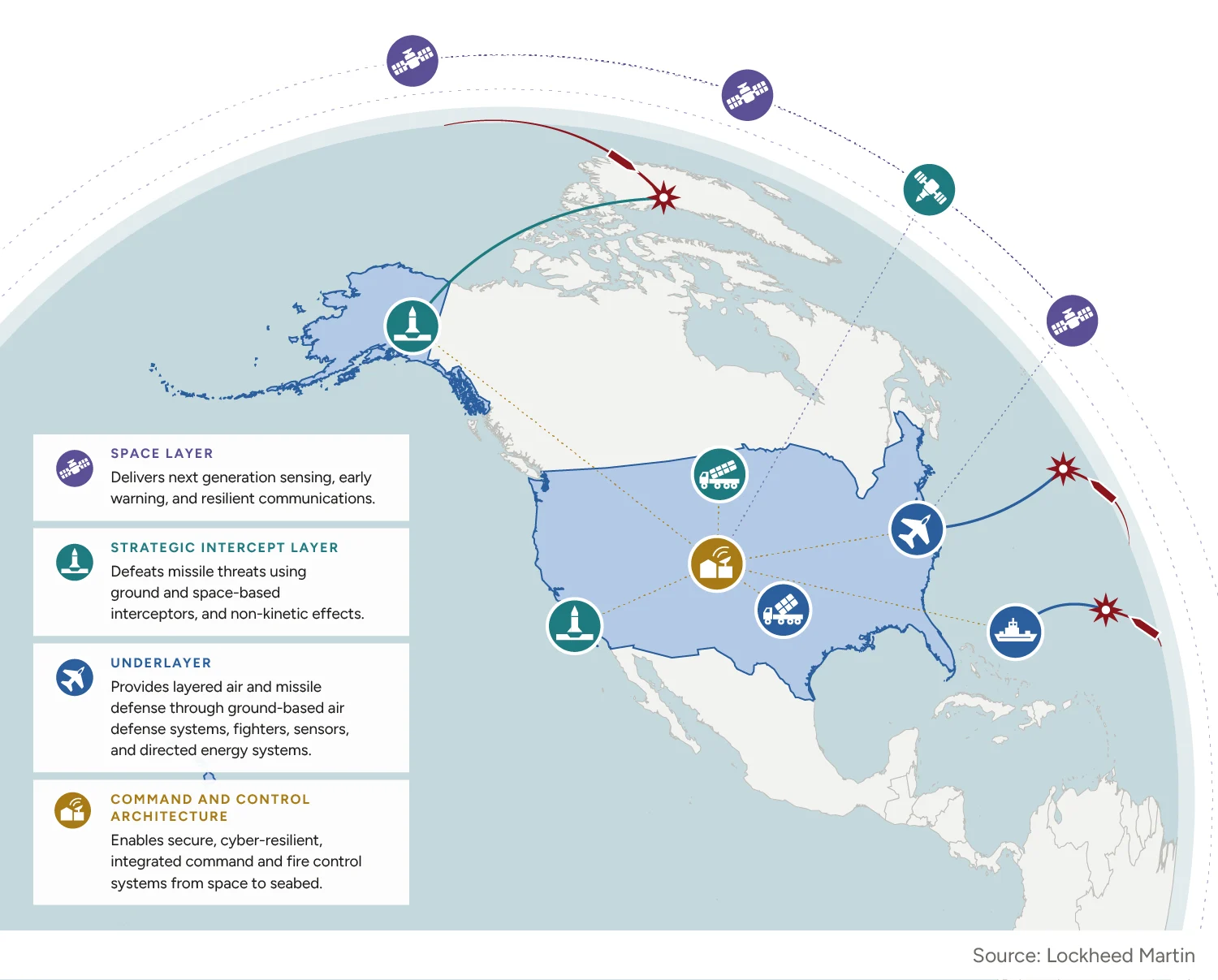
Ballistic, cruise and hypersonic missiles are different threats that require different combinations of three elements: launch detection and tracking sensors; command, control and targeting systems; and interceptors. The required mix will include space-based assets, terrestrial radars, aerostats, sea-based assets and land-, sea-, air- and space-based interceptors.
While the main geographic focus will be on defending against attack over the polar horizon – the most likely and cost-effective path for targeting the U.S. homeland – Golden Dome aims to develop the capability to protect all U.S. territory from attacks from any direction. This ambitious goal presents a considerable technical and operational challenge.
The architecture for this system has to be developed incorporating existing systems, acquisition programs and new requirements. To implement the initiative, the Department of War established a new program office, the Office of Golden Dome for America, directed by a senior Space Force officer. The office’s effort will attempt to overlay several existing programs, offices and commands directing various components of the armed forces.
For example, Golden Dome’s radar requirements differ from those of the North American Aerospace Defense Command, the joint U.S.-Canadian organization, which has already set out funding and procurement plans for modernization in both countries.
Integrating the bureaucracies of ongoing and future programs will take months, if not years, even after the Golden Dome Office scales up a full operational staff and develops an implementation architecture. Without question, Golden Dome will emerge iteratively; it will not function as a single, integrated, fully capable system for some time.
Scenarios
More likely: Golden Dome emerges in some form regardless of 2028 election outcome
In the near term, the current U.S. administration will likely continue to advance the program despite political opposition and criticism over the lack of details on the future architecture and long-term requirements. Projected U.S. defense budgets ranging up to $1.5 trillion should be adequate to support near-term requirements.
Despite current tensions in U.S.-Canadian relations, as well as disputes with Denmark over Greenland’s future, all the countries involved have sufficient common interest in the security of the High North to facilitate adequate cooperation for near-term Golden Dome needs. Golden Dome will emerge in some form even if Republicans lose the presidency in 2028 (though no doubt the first initiative of a Democratic administration would be to drop the name Golden Dome).

American Golden Dome and Space
There is a high likelihood that Golden Dome will incorporate some elements of a space-based interceptor component. This would create sustained demand for launch services, sensors, interceptors and command-and-control systems, opening opportunities for U.S. defense and space companies and allied suppliers. Deployment would gradually strengthen protection of critical infrastructure and military assets. China and Russia would likely invest further in weapons and tactics designed to overwhelm or evade the defenses, intensifying competition in missile and space technologies.
Arms Control Alternative
Less likely: Golden Dome constrained by multinational arms control agreement with China and Russia
An arms control agreement with China and Russia would constrain Golden Dome’s scale, particularly its space-based interceptor component. However, threats from countries outside the agreement would persist. Defense and space companies would face a smaller market for Golden Dome contracts, with investment shifting toward permitted capabilities such as early warning, tracking and terrestrial interception.