
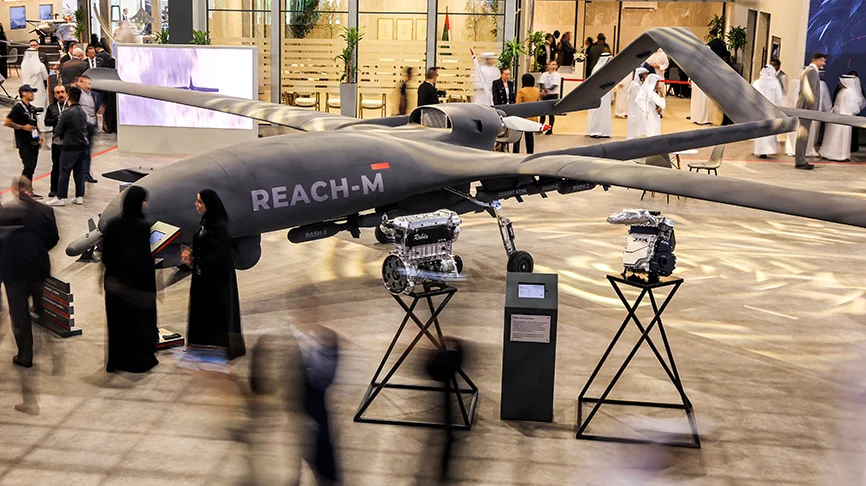
The UAE is investing heavily in sovereign propulsion capabilities through acquisitions, partnerships, and advanced manufacturing, seeking greater defence independence, stronger export flexibility, and a competitive position in global aerospace and engine technologies.
Why Engines Matter Most
In May 2026, the United Arab Emirates’ (UAE) national defence conglomerate EDGE Group agreed to acquire Italian engine manufacturer Costruzioni Motori Diesel (CMD), a move that will bring significant piston-engine expertise into the portfolio of EDGE subsidiary, Powertech, a new company that was unveiled in February 2025 and which forms part of the UAE’s ambition to compete in the global aerospace-propulsion market.
The main driver behind the UAE’s push to develop sovereign propulsion capabilities is the desire for greater strategic autonomy. There are relatively few suppliers, and engine technology is amongst the most tightly restricted under export-control regimes.
There are precedents for export suspensions involving this technology; in 2020, for instance, Bombardier Recreational Products suspended engine deliveries to countries with ‘unclear usage’ after learning that Bayraktar TB2 uninhabited aerial vehicles (UAVs) equipped with its powerplants were being used by Azerbaijan in the Second Nagorno-Karabakh War. Meanwhile, the sale of dozens of F110 engines for Türkiye’s Kaan fighter aircraft was informally frozen for months from February 2026 because several Democratic representatives in the United States Congress raised reservations. Producing engines domestically removes this obstacle and opens the door to international sales and transferring equipment to third parties, provided those engines do not contain other subcomponents subject to export controls.
Players, programmes and partnerships
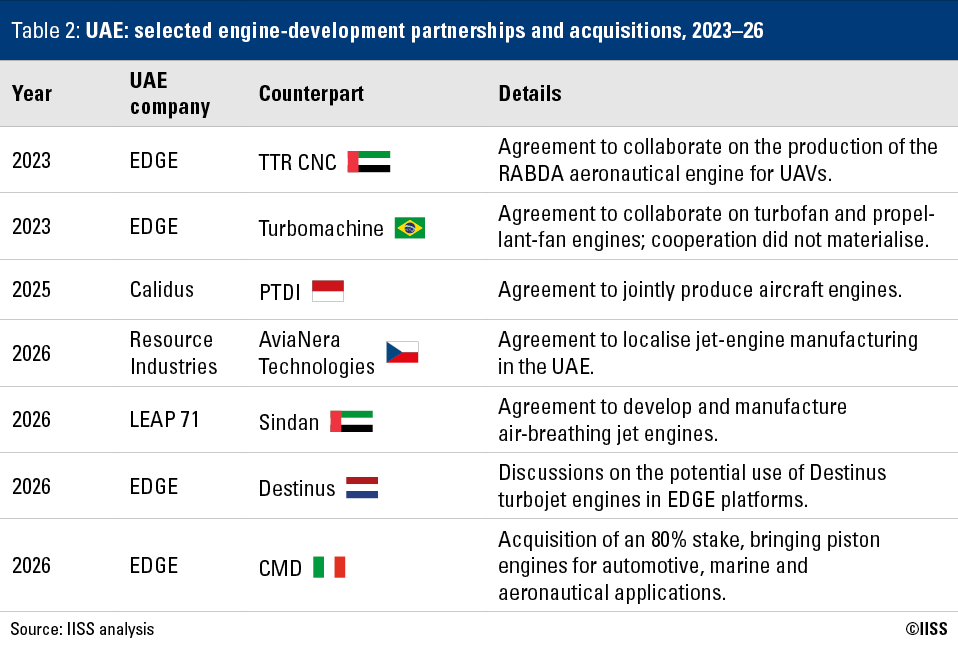
Propulsion-development efforts in the UAE, led primarily by EDGE and its subsidiaries, are relatively new, with little activity before 2023. That year, the conglomerate showed signs of its growing interest in propulsion technologies, announcing an agreement with Brazilian firm Turbomachine to work on turbofan and propellant-fan engines and another agreement with UAE-based company TTR CNC to produce an engine for UAVs. That same year, EDGE also silently established Powertech, while EDGE’s Strategic Development Fund invested in Reaction Engines, a company based in the United Kingdom specialising in high-speed propulsion and cooling technologies.
However, many of these early efforts proved mostly unsuccessful: Reaction Engines became insolvent, discussions with Turbomachine failed to progress and it is unclear whether the agreement with TTR CNC has led to meaningful cooperation.
Progress Begins to Accelerate
In 2025, however, signs of progress emerged. EDGE publicly unveiled Powertech, its new propulsion subsidiary, which by the end of the year boasted around 70 employees. Some of its engineers came from another EDGE subsidiary, Halcon, and Powertech also hired former employees of an Italian UAV engine manufacturer, Zanzottera Technologies, who developed Powertech’s new line of piston engines to power UAVs.
Initially, most employees at Powertech were focused on R&D, but the company is now hiring more production and sales staff after bringing some production lines into operation. Powertech’s international presence is also growing. In June 2026, the company announced it would open a new production site for propulsion systems in France, focused on piston engines and micro- and turbojets to power UAVs and munitions, both to meet EDGE’s own demand and potentially that of the European market.
UAE Defence Autonomy Through Partnerships
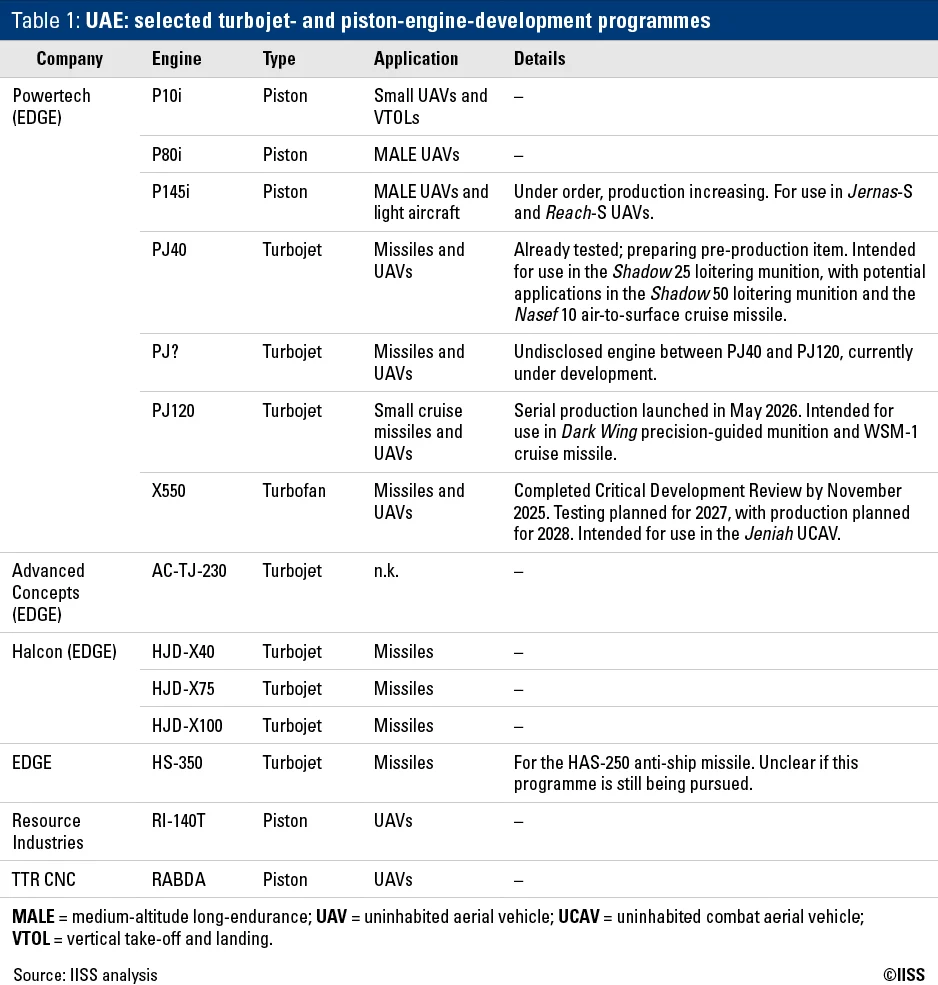
Crucially, Powertech is not working in isolation, and other EDGE subsidiaries are involved in similar efforts (see Table 1). Advanced Concepts, a unit within EDGE dedicated to breakthrough defence technologies, is designing and prototyping turbojet engines, while Halcon appears to be working on several turbojet engines, although their development stage is unknown. It also remains unclear why these efforts have not been folded into Powertech’s portfolio.
EPI, a subsidiary specialising in precision engineering, is building a manufacturing facility to produce EDGE’s engines.
EDGE is also exploring a possible partnership with Dutch company Destinus on turbojet engines, and beyond the EDGE umbrella several other players are contributing to the UAE’s search for sovereign propulsion capabilities. Resource Industries, for example, partnered with Czech company AviaNera Technologies, a member of Czechoslovak Group (CSG), in January 2026 to explore jet-engine production in the UAE (see Table 2).
Challenges and next steps
The UAE’s aerospace ecosystem already has experience servicing commercial engines (see Table 2), but producing engines at scale is more ambitious. Powertech, for instance, hopes to reach a combined production of 1,000 turbojet engines annually. To do that, it plans to rely heavily on automation, robotics and additive manufacturing for production.
The company, however, is outsourcing the production of most components in its early stages, but says this is only temporary, as it aims to bring more of the production process in-house. A key challenge in getting there will be sourcing certain materials and tools.
In the near term, Powertech plans to expand to Poland, and has expressed interest in financing the purchase of its products and localising part of its production in the country, as it has done with France. It also wants to include Polish subcontractors in its global projects.
UAE Defence Autonomy Beyond Aviation
However, EDGE’s plans to compete in the global propulsion market go beyond Powertech. Firetech, another EDGE subsidiary that has not yet been publicly announced, is developing a range of solid-, hybrid- and liquid-propellant rockets, some of which were showcased at the Dubai Airshow 2025.