
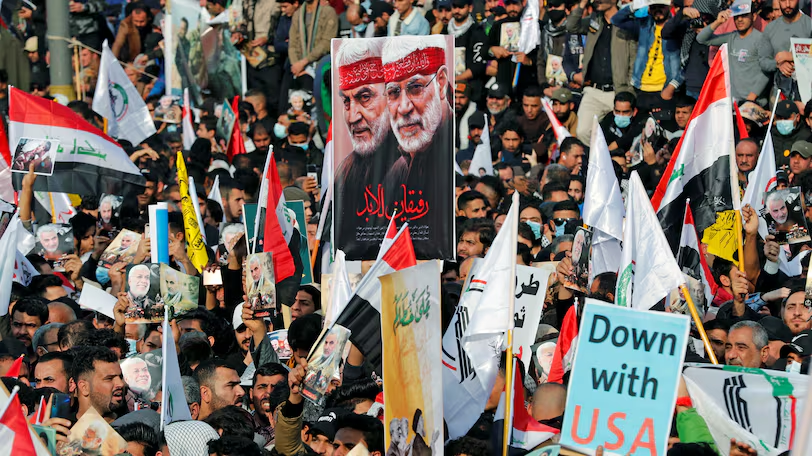
The US Iraq Withdrawal faces a critical test as Iran-aligned militias refuse disarmament and continue attacks on Kurdish energy infrastructure. Washington risks leaving behind a weak state vulnerable to proxy control and Iranian influence.
The scheduled departure of American forces from Iraq on September 30 marks more than a logistical milestone. It represents a strategic inflection point that could determine whether Baghdad consolidates sovereignty or falls deeper under the shadow of Iran-backed militias.
The US Iraq Withdrawal is unfolding against a backdrop of unresolved tensions: Prime Minister Ali Al Zaidi has declared the date “fixed and final,” yet the state cannot detain a single militia intelligence officer for more than 24 hours. That contradiction reveals the core problem. Formal sovereignty and actual control are not the same thing. The hardest-line factions within the Popular Mobilisation Forces—Kataib Hezbollah, Kataib Sayyid Al Shuhada, and Harakat Hezbollah Al Nujaba—have refused to surrender weapons and continue drone strikes against Kurdish energy infrastructure.
They promise to disarm only after the Americans leave, a condition that conveniently removes the reason to disarm. The US Iraq Withdrawal therefore risks handing Tehran an unbroken corridor of armed clients stretching from its border to the Mediterranean. Washington does not need to occupy Iraq forever. But it must refuse to leave on the militias’ schedule. A lean advisory presence in Erbil, tied to the Peshmerga and Counter-Terrorism Service, would preserve intelligence, protect energy assets, and keep pressure on groups that have never accepted the state’s authority.
US Iraq Withdrawal Deadline Looms
On September 30, the last American and coalition troops are scheduled to leave Iraq, ending a military presence that began in 2003. Prime Minister Ali Al Zaidi calls the date “fixed and final”. October 1, he says, will open a new chapter in which Iraq exercises full sovereignty over its own soil.
It is a stirring line. It also collides with the facts on the ground.
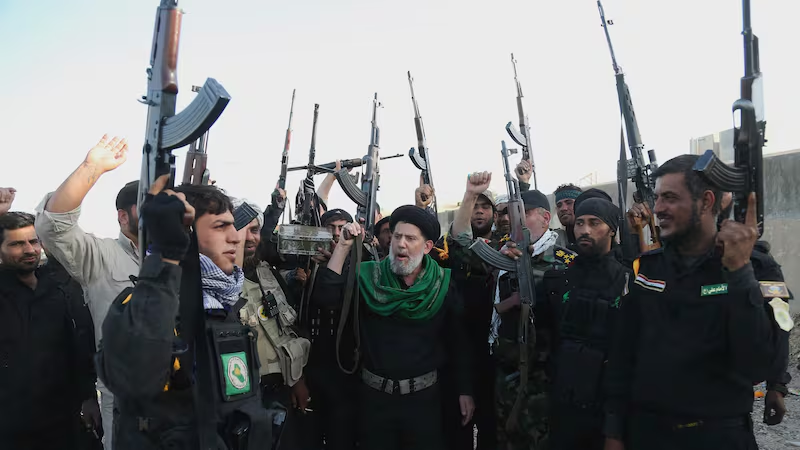
Promises Collide with Reality
Mr Al Zaidi has tied two promises to the single date. The coalition departs by September 30, and every armed group is supposed to place its weapons in the state’s control by the same day. One of those deadlines is real, the other is theatre. And a single arrest this month shows which is which.
On August 17, the Iraqi Counter-Terrorism Service force, the most capable and most heavily US-mentored unit, detained Abbas Al Yaqoubi, the reconnaissance chief of Harakat Hezbollah Al Nujaba and an intelligence official in the Popular Mobilisation Forces, on suspicion of involvement in recent drone strikes against neighbouring countries. Al Nujaba is an Iran-aligned Iraqi armed group established in 2013 and designated as a terrorist organisation by Washington six years later. It operates within the PMF, the state-backed paramilitary coalition.
Detention Proves State Weakness
Al Yaqoubi’s detention lasted barely 24 hours. The governing Co-ordination Framework described the arrest as a “kidnapping” and demanded that he be handed to the very PMF he serves. A Baghdad court then released him for lack of evidence. Iraq’s law enforcement, in other words, functions right up to the point where it touches the men with the guns – and then it stops.
Consider what that sequence teaches the men who run the PMF as well as figures in the Co-Ordination Framework. It’s precisely that they command so much political weight that the state cannot hold one of their intelligence officers for 24 hours. This is the sovereignty that is supposedly set to flower on October 1.
Hardline Militias Refuse Disarmament
To his credit, Mr Al Zaidi has prised open some groups. Asaib Ahl Al Haq, Kataib Al Imam Ali and Moqtada Al Sadr’s Saraya Al Salam have moved to hand weapons to the state, at least symbolically. But the hardest-line groups have refused outright. Kataib Hezbollah, the country’s most powerful militia, has vowed not to surrender “even a single bullet” and to expand its arsenal instead. Kataib Sayyid Al Shuhada and Harakat Hezbollah Al Nujaba have taken the same line.
They have also kept shooting. The Khor Mor gas field, operated by Dana Gas, has been repeatedly struck by drones; one strike knocked out about 80 per cent of Kurdistan’s electricity in a single night. A barrage on Erbil earlier this year had to be shot down by American air defences, with stray missiles landing near the US consulate.
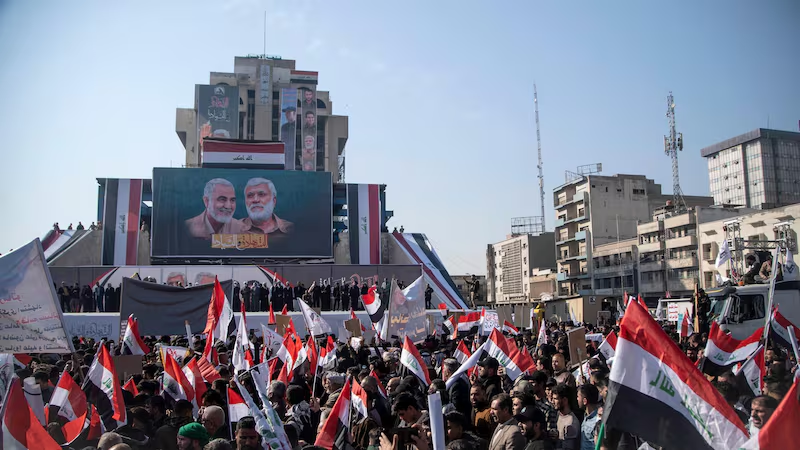
Attacks Target Kurdish Energy Sector
This is not random violence. Attacking the grid and Kurdish energy sector is a strategy: it undermines Kurdish autonomy, wrecks the infrastructure that American energy firms need to make investments in the region, and it reminds everyone who is really in charge. The same groups say they will disarm only after the Americans leave, but it is a trap dressed up as a concession. Leave first, and the reason to disarm conveniently disappears.
A hard exit on September 30 does not just lower a flag. It serves the connective tissue, the intelligence, the air support and the logistics that still let the Peshmerga forces and the Iraqi forces hunt ISIS remnants. It closes the coalition’s eye in Erbil at a moment when watching both ISIS and the militias matters most.
And coming so soon after a war with Iran, a clean American departure will be read across the region as exactly what Tehran says it is: capitulation. It hands Iran the prize it has chased for a decade and an unbroken corridor of armed clients from its own border through Iraq to the Mediterranean. It also signals to every proxy that patient violence drives America out.
The case for leaving is not frivolous. Iraqis never signed up for an endless foreign garrison; the troops give the militias a ready excuse to keep their arsenal; and real sovereignty means Baghdad standing on its own feet. All true. But sovereignty is not a press release. A government that cannot detain an officer for a day or keep the lights on in its own north does not grow stronger when its most powerful partner walks away. It grows more available to coercion. Leaving now does not remove the militia’s pretext. It removes the last restraint on them.
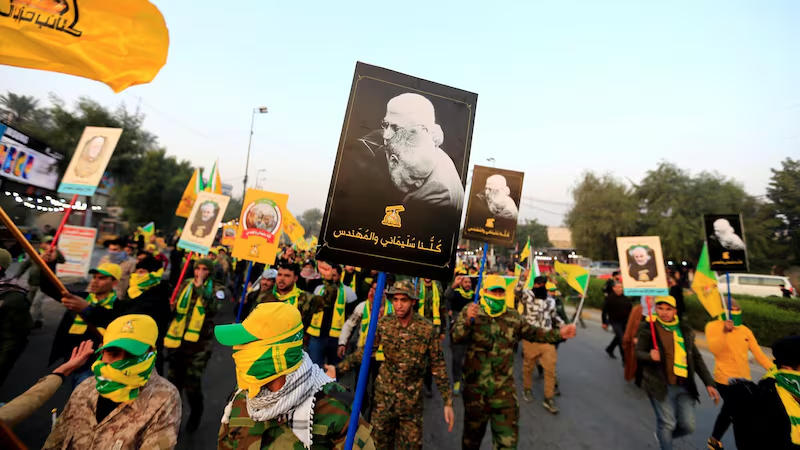
Withdrawal Risks Empowering Iran
So the answer is not to occupy Iraq forever, nor to refuse to leave. It is to refuse to leave on the militias’ schedule.
Washington should make verified results the condition for its final withdrawal: independent confirmation that Kataib Sayyid Al Shuhada, Kataib Hezbollah and Harakat Hezbollah Al Nujaba have actually surrendered their strategic weapons – the drones and the missiles – rather than simply swapping their brigade insignia. The US should keep a lean advisory and counter-terrorism presence in Erbil, tied to the Peshmerga and the Counter-Terrorism Service, as a tripwire and for intelligence. It should help defend Kurdistan’s energy sector, in particular Khor Mor and make the next strike costly.
It should also sequence its exit to Iraq’s capability, not to a date that the militia will celebrate.
September 30 can still mark a transition. It must not be allowed to mark the day that Iraq was quietly handed to Iran. Give Baghdad the one thing that has ever made its authority real: a partner that is willing to stay until the state can finally stand on its own.