
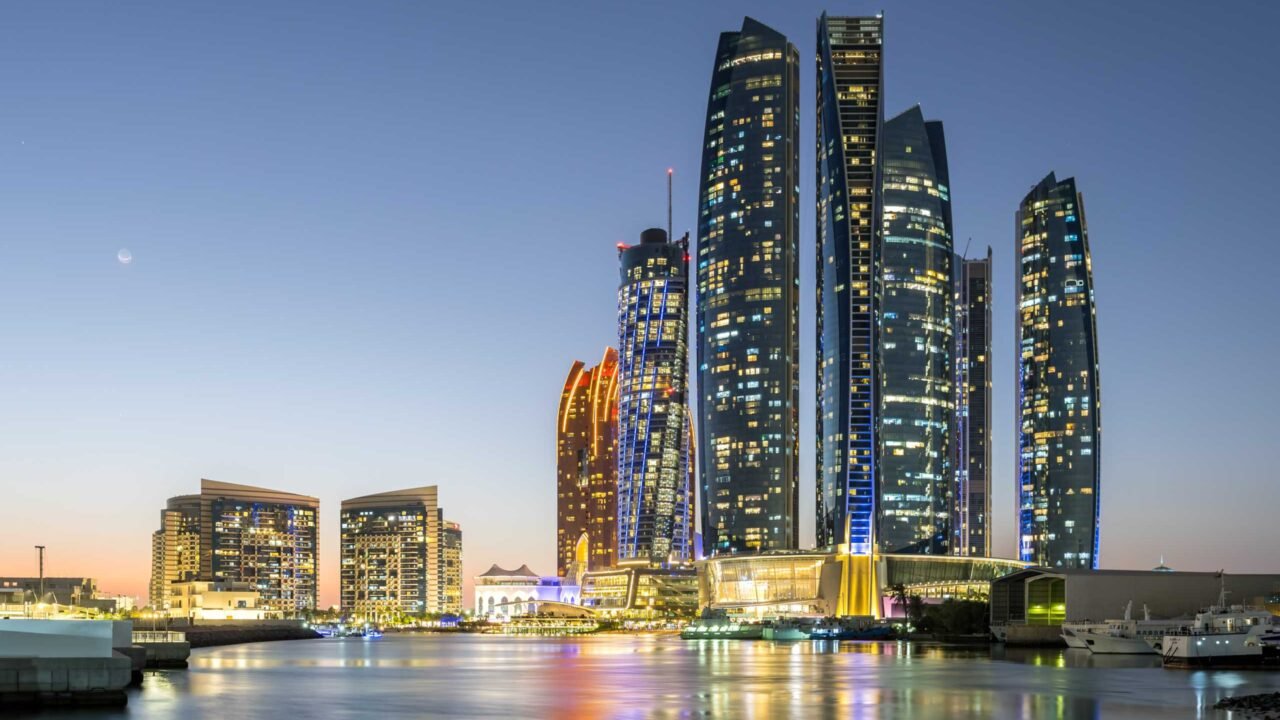
The UAE’s connectivity model survived the 2026 Iran war at higher cost. Iranian strikes hit ports and data centers, exposing reliance on external security. Abu Dhabi now pursues fortified connectivity with redundant routes.
The UAE Connectivity Model has long converted geographic smallness into disproportionate influence by making itself indispensable to flows of energy, capital, data, and goods. This strategy paired commercial openness with a hardened security posture, allowing Abu Dhabi to act as both a trading hub and a regional security actor. The 2026 Iran war subjected that model to its most severe test, as Iranian strikes targeted ports, airports, data centers, and energy infrastructure precisely because the UAE had positioned itself as a secure global node.
The war exposed a central vulnerability: deep commercial entanglement with Iran did not prevent attack, and reliance on American or Israeli security guarantees proved insufficient. In response, Abu Dhabi has begun to pursue a fortified version of the UAE Connectivity Model, one that preserves openness while adding spare capacity, alternative routes, sovereign defense production, and technological redundancy.
This shift carries significant costs, including heightened tensions with Saudi Arabia, greater exposure to great-power rivalry, and the need to balance deterrence with diplomacy. Europe emerges as a potential partner in this effort, offering regulatory predictability, infrastructure protection, and a basis for trusted interdependence. The model survived, but its price has risen, and its future depends on whether Abu Dhabi can keep connectivity from becoming a liability.
UAE Connectivity Model Faces Stress Test
The UAE is the textbook definition of punching above its weight. A country of roughly 1.3 million citizens, it has the sixth-largest oil and gas reserves in the world, the second-largest national pool of sovereign wealth fund capital, and a spacecraft in orbit around Mars.
Abu Dhabi has turned a small country into a middle power through a distinct method: connectivity—linking, and thereby gaining influence over, the places, markets and systems through which people, goods, energy, data and capital move. It has defended its position by strengthening its military capabilities. This dual strategy has seen it emerge as part “Little Venice”, projecting influence through trade, ports and commercial networks, and part “Little Sparta”, embracing an unusually capable and interventionist security posture for a state of its size.
The 2026 war pitting America and Israel against Iran has been the most consequential stress test of this model. For years, Emirati statecraft rested on the assumption that deep commercial entanglement with Iran under a US deterrence umbrella could reduce the risk that regional conflict would affect the UAE directly. Instead, Iranian attacks during the 2026 war relentlessly targeted the country’s central proposition: that it can function as a secure global hub for commerce, finance, logistics, tourism, energy and advanced technology. For Iran, hitting the UAE was the most immediate way to show that it would not let its Gulf neighbours prosper while their closest partner, America, waged full-scale war against it.
The war struck just as Abu Dhabi’s foreign policy absorbed a further blow. Longstanding differences with its closest ally, Saudi Arabia, hardened into an open rupture. Riyadh no longer functioned as a partner to advance Emirati regional ambitions and instead began to contest the UAE’s influence directly.
This paper argues that the connectivity model survived its stress test and can still carry the UAE to middle-power influence, but that the Iran war and other geopolitical shifts have raised its price. The Emirati answer may be a hardened version of the model, a “fortified connectivity” in which openness to global flows is backed by spare capacity, alternative routes and sovereign defence production. The UAE’s stress-tested model gives Europe four openings. It can provide the predictability the UAE cannot get elsewhere, use regulatory leverage to build trusted interdependence, protect the infrastructure that connectivity depends on, and set limits on how far that connectivity can be weaponised.
The UAE’s vision of order
The UAE’s understanding of order is rooted in the realities of its geography, history and socioeconomic as well as sociopolitical dynamics.
Before independence from Britain in 1971 and the establishment of a federal state, the seven emirates—Abu Dhabi, Dubai, Sharjah, Ajman, Umm Al Quwain, Fujairah and Ras Al Khaimah—had formed the Trucial States. Their rulers had ceded control of defence and foreign relations to Britain while retaining authority over internal affairs. That experience shaped the Emirati worldview that a small state could still matter to a great power by making itself useful to it.
After independence, the UAE was built as a bargain among the seven, rather different, hereditary principalities headed by Abu Dhabi, the political heavyweight, and Dubai, the geoeconomic hub. Abu Dhabi covers most of the national territory, holds most of the UAE’s hydrocarbon reserves, and accounts for the largest share of the national GDP. Dubai, meanwhile, cultivated an entrepot economy that today handles the largest share of the UAE’s non-oil trade, hosts the region’s busiest port and airport, and generates the bulk of the country’s tourism and financial-services revenue. The other five emirates depend either on federal transfers, Abu Dhabi-funded infrastructure, or access to the larger Dubai market, and are more socially conservative.
Dubai and Abu Dhabi have at times pulled in different directions on foreign policy. Dubai’s commercial model depends on openness, intermediation and maintaining links with actors that Abu Dhabi may regard primarily through a security lens, most obviously Iran.
This can create implementation gaps and tactical differences. However, Abu Dhabi sees federal unity as essential to being more than a city-state, so these differences rarely translate into genuinely competing foreign policies. Abu Dhabi ultimately sets the strategic line at the federal level and has repeatedly acted as Dubai’s financial backstop, most dramatically during the 2009 debt crisis.
The two models are, in fact, complementary rather than simply contradictory. Dubai leads the connectivity that makes the UAE useful internationally, while Abu Dhabi supplies the fortification that protects and leverages those networks.
Long before the Iran war, the president, Mohammed bin Zayed (MBZ), had made it a priority to stop nearby volatility from threatening the regime at home and Emirati networks across the region. The 2011 Arab uprisings hardened this worldview. Emirati leaders interpreted the uprisings as the ascent of organised Islamist movements, particularly those linked to the Muslim Brotherhood, and responded with an unusually hawkish, near-ideological posture, which the UAE pursued across the Middle East and North Africa. It gave generous support to anti-Islamist strongmen in Egypt, Sudan and Libya, refused to back Islamist opposition in Syria and Yemen, and imposed a severe containment policy on supporters of Islamists in Qatar and Turkey.
Arab Gulf states share the concerns that conflict or unrest, whether homegrown or spreading from a neighbour, could topple a ruling family or cause wider destabilisation, but the Emirati model is not representative of the region. On the contrary, it is rather unique. The UAE has the balance sheet of a large state and the reflexes of a small one.
It can behave, at times, like a privateer state, acting through commercial vehicles and private agents, and taking ambitious and occasionally coercive positions with limited formal exposure that it can abandon when the costs rise. Saudi Arabia and Turkey cannot operate with the same freedom.
Their larger populations and responsibilities, domestic constituencies, visibility, and claims to regional leadership make their actions harder to conceal, more difficult to reverse, and more consequential when they fail. Qatar, another wealthy and small state, instead focused on mediation and diplomatic entrepreneurship rather than on projecting influence in the region and beyond.
The most distinctly unique feature of Emirati policy is the pursuit of strategic autonomy: multiplying ties across actors and regions so that no single partner can credibly threaten isolation. Interdependence via strategic connectivity here preserves room for manoeuvre. At the global level, this has meant a deep security relationship with America, expanding geoeconomic ties with China, and joining south-south political platforms, including BRICS+, while also being eagerly active within NATO.
In its approach to multilateralism and global governance, the UAE treats international institutions mostly as platforms to pursue specific objectives, rather than as orders to belong to.Abu Dhabi invests in convening power, hosting both EXPO 2020 and COP28, and seeks relevance at the UN, but it is cautious about binding frameworks that restrict its choices. The UAE was a cooperative member of the OPEC+ group for years, only to leave in 2025 once membership no longer served its interests. That flexibility shows in its inclination towards bilateral arrangements, minilateral groupings and issue-driven coalitions.
The Iran war strengthened this preference. From Abu Dhabi’s perspective, the Arab League, the Organisation of Islamic Cooperation and the Gulf Cooperation Council (GCC) appeared too rigid and one-dimensional to provide the tangible security it needed against attacks it regarded as existential. As Emirati citizens account for only about one person in nine, the UAE depends on a foreign population for most of its private-sector labour, expertise and commercial dynamism, making stability essential.
Ultimately, like Israel and Singapore, the UAE seeks to compensate for demographic and geographic constraints by becoming disproportionately important in global platforms of technology, finance, security and diplomacy. In fact, the UAE’s decision to normalise relations with Israel in 2020 reflected the judgment that partnering with Israel could deliver simultaneously on the two sides of the Emirati model that matter most: access to advanced technology, investment, trade and innovation on the one hand, and hard military capabilities, intelligence and deterrence on the other.
This marked a significant departure from the post-2011 period, when Emirati strategy operated largely within an exclusively Arab framework. The shift carries obvious costs: from reputational damage across Arab and Muslim publics after Israel’s ethnic cleansing war in Gaza to higher Iranian threat perceptions and deeper tensions with actors uncomfortable with growing Israeli militarism. But Abu Dhabi appears willing to absorb these because it sees Israel as a partner that advances Emirati ambitions.
Regional connectivity under fire
The UAE has most deliberately sought to convert connectivity into power in its own neighbourhood. Lacking the military weight of Iran or Turkey, or the religious standing of Saudi Arabia, the UAE set out instead to become almost impossible to bypass: the first call for outside powers looking for a way into the region, and the port, bank and airport hub its neighbours cannot do without. Abu Dhabi thus shapes which issues get money and attention, and who gets access to whom.
A foothold in the Red Sea
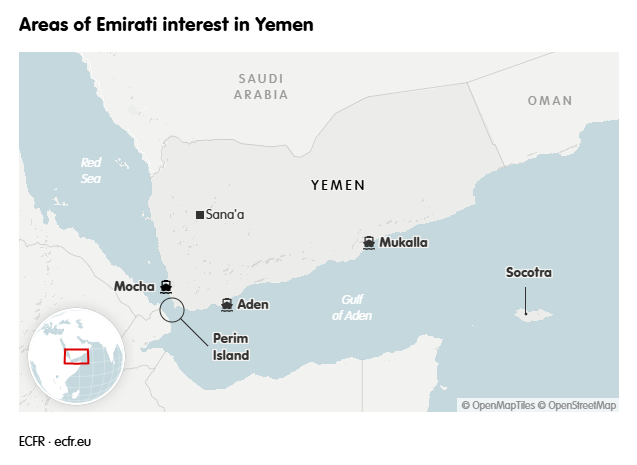
The Red Sea is the clearest case study of how Emirati geoeconomic and security strategies become intertwined. The UAE’s military intervention in Yemen from 2015 gave it a foothold along the Arabian Sea and Red Sea coasts. Emirati forces and the southern Yemeni units like the Southern Transitional Council they armed—mostly opposed to the Saudi-backed internationally recognised government—concentrated on the ports of Aden, Mukalla and Mokha along the southern and Red Sea coasts, and on the islands of Socotra in the Arabian Sea and Perim on the Bab al-Mandab strait itself.
The Houthis have since pursued control of both the Mokha port and Perim island which would enable them to close Bab al-Mandab, like Iran did with the Strait of Hormuz.
On the African shore, the UAE doubled down on its geoeconomic strategy. The Dubai government-owned operator and one of the world’s largest port businesses, DP World, now holds a 30-year concession in the Somali city of Berbera. The port is in Somaliland, a self-declared republic that broke away from Somalia in 1991, and has become one of the UAE’s most important assets. The acquisition illustrates that the Emirates prefer partners that need its recognition and its money to central governments that can refuse it.
The same logic took the UAE to Bosaso, a port in Puntland, the semi-autonomous region of north-eastern Somalia. Both port and region increased in value as Turkey and Qatar expanded their relations with Somalia’s central government at Emirati expense.
Such assets face other dangers as well. The government of Djibouti, for example, terminated DP World’s contract to operate part of Doraleh terminal in 2018, so the UAE looked to the Sudanese coast to retain control along the Red Sea. In Sudan, however, the Emirati strategy ran into two problems: the Sudanese civil war and Saudi interests. In 2022, a consortium led by Abu Dhabi’s state-owned ports operator, AD Ports Group, and Dubai-based Invictus Investment agreed to link Red Sea shipping to Sudanese agriculture, gold and inland transport corridors.
But the Sudanese authorities cancelled the agreement in November 2024, amid UN accusations that Abu Dhabi was supporting the Rapid Support Forces (RSF), the paramilitary force fighting Sudan’s army. Saudi Arabia, courting the Sudanese Armed Forces, cast itself as the defender of state sovereignty against the war-crimes-accused RSF. The RSF link cost Abu Dhabi the port and it exposed a broader weakness: the strategy is hostage to regional rivals bent on containing Emirati ambitions.
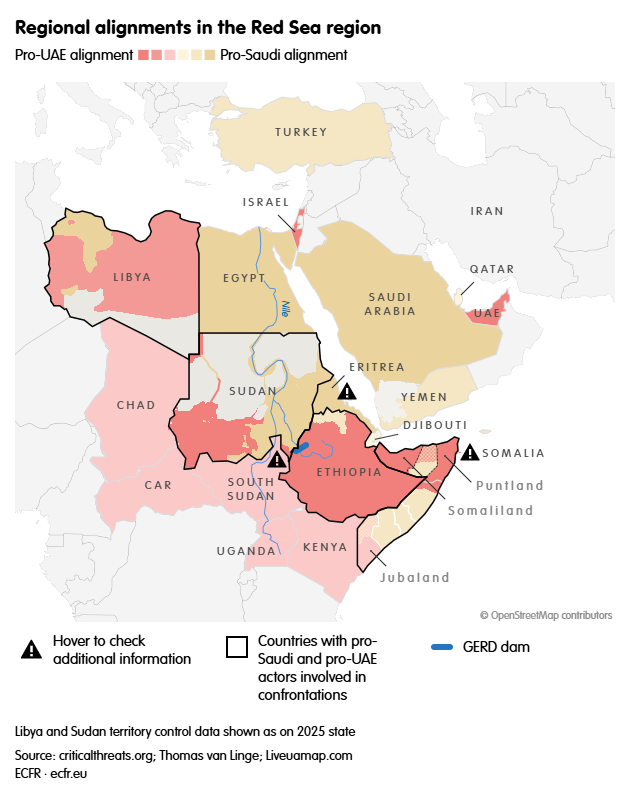
Ultimately, the UAE wants to operate terminals along the passage between the Red Sea and the Mediterranean, both via sea and land.At the southern entrance to the Suez Canal, DP World already operates the Sokhna container terminal and further south on Egypt’s Red Sea coast lies Safaga, where AD Ports has a sizeable role. To the north of the Suez Canal, the UAE agreed with Jordan in 2024 to build a 360km railway to Aqaba, Jordan’s only seaport, with plans to extend it north through Syria.
Syria is where such a corridor would meet the Mediterranean, and Emirati operators are already moving in. In November 2025, DP World secured a 30-year concession at Tartus, Syria’s second-largest port. In May 2026, AD Ports Group agreed to acquire a 20% stake in the container terminal at Latakia, Syria’s principal maritime gateway alongside CMA CGM, the French shipping line. The Iran war showed how easily a single route can be cut off, making alternative connectivity options more important than ever.
The rivalry with Saudi Arabia
The Red Sea is one of the key areas where Emirati ambitions collide with regional rivals, including increasingly Saudi Arabia.
After 2011, Saudi Arabia and the UAE often reinforced each other in a strategic alliance. The two worked together to suppress the Muslim Brotherhood across the region, including through a 2017 political boycott and economic embargo of Qatar over its ties to Islamist groups and Iran. They also pushed back against Iranian influence, notably by fighting side by side in the Yemen war. That phase ended by the early 2020s, giving way to rivalry as each sought to lead the region in its own right.
That rivalry now plays out on multiple fronts, starting with economics. Riyadh’s Vision 2030 transformation agenda, launched in 2016, directly challenges the UAE’s claim to be the hub linking the Gulf to the rest of the world, as Saudi megaprojects such as NEOM compete for the trade and capital that have long flowed through Dubai and Abu Dhabi.
On energy, the UAE asserted its independence by leaving OPEC this year, freeing itself from Saudi-set quotas and the politics attached to them, and giving it more room to fund its own plans. Even on regional order questions, they now disagree. Saudi Arabia increasingly emphasises accommodation and de-escalation, while the UAE has shown a greater appetite for risk. The Iran war sharpened this contrast: since it started, Abu Dhabi has moved further towards defiance and forceful deterrence, while Riyadh has continued to prioritise restraint and a negotiated settlement.
The UAE’s defiance is showing up as readiness to partner with Israel even where doing so unsettles Saudi Arabia. This produced a crisis in 2025, when Saudi officials became persuaded that Abu Dhabi was ready to open its Yemeni footholds to Israel, giving the two a joint stake in Red Sea security at Saudi Arabia’s expense. Saudi officials also believed the UAE had brokered a deal under which Somaliland normalised relations with Israel in return for granting Israel security access to Berbera, and that Abu Dhabi was prepared to broker the same bargain if an independent state ever emerged in Yemen’s secessionist south.
Indeed, Israel has largely displaced Saudi Arabia as the partner that makes Emirati power go further (the “strategic multiplier”). Emirati-Israeli hard security cooperation intensified during the Iran war, as Israel delivered air defence and counter-drone capabilities when Arab and Gulf partners did not. But it also heightened Iranian threat perceptions. Iran’s leadership no longer sees Emirati ports, air links and data centres as commercially neutral infrastructure, but as platforms through which Israel and America can project power, including planning and launching attacks.
Geography still forces pragmatism—every overland route out of the UAE crosses Saudi territory—but tensions are likely to persist regardless. The UAE views Saudi Arabia’s more recent deepening alignment with Egypt, Pakistan, Turkey and Qatar (particularly the Mecca Joint Defence Agreement in August between Riyadh, Ankara and Islamabad) as a potential alternative regional order that may end up encircling the UAE, especially in the Red Sea.However, the UAE’s connectivity strategy may already be defusing that risk: Egypt and Turkey, the two states best placed to anchor such a coalition, are unlikely to join an anti-UAE bloc.
A large, populous country with a strong military, Egypt shares the Emirati aversion to political Islam and an interest in authoritarian stability, which aligns positions on regional crises. Emirati financial support and investment have also given Abu Dhabi substantial influence in Cairo. Ultimately, Egypt does not have the structural autonomy to ostracise Abu Dhabi.
Unlike Egypt, Turkey had been willing to deploy military power against Emirati influence. This came to the fore during the competitive phase of the relationship in the decade after the Arab Spring, when Ankara supported Islamist movements, most obviously in Libya. But Turkey’s relationship with the UAE has since become more cooperative economically, and while this has not eliminated political rivalry, Ankara now benefits from Emirati investment across strategic sectors and firms and cooperation on trade and connectivity in ways that other regional actors cannot easily substitute.
Both countries show how the UAE’s connectivity strategy pays off: each depends too much on the UAE economically to become a reliable member of a coalition against it.
When the hub became the target
Where the connectivity strategy did not pay off was with the Iran war. The UAE had positioned itself as a hub to insulate itself from regional conflict. Before the Iran war, the UAE was Iran’s largest source of imports and its third-largest export market. Dubai also served as a sanctions-era financial interface. An August 2026 Financial Times analysis found that 22% of 1,573 Iran-linked entities and individuals sanctioned by the US Treasury and based outside Iran had a UAE address, making it the most frequently cited country after China.
The relationship was also sustained by an Iranian community in the UAE of almost half a million people and dense air and shipping links that made Iran part of the ecosystem underpinning Dubai’s role as a regional hub.
That entanglement did not spare the UAE from attack. By April 2026, Iran had aimed more than 3,000 projectiles at Emirati military bases, Dubai and Abu Dhabi airports, Jebel Ali and Fujairah ports, hotels, commercial data centres and oil and gas facilities such as Habshan and Ruwais. Air defences limited civilian casualties and let officials showcase the state’s resilience, but the exposure to Iranian attacks became the war’s dominant fact.
Cities emptied as war risk entered the calculations of investors, visitors and companies. The frictionless movement underpinning the UAE’s geoeconomic identity simply stopped and traffic through Emirati ports, including energy exports, nearly halted. Fujairah, the UAE’s only export terminal outside the Strait of Hormuz, became the country’s lifeline—and Iran attacked it repeatedly.
The attacks undercut the assumption that close ties with Iran could offer protection and strengthened the deterrence-first line of Emirati strategy. Yet the war also exposed the limits of deterrence that depends on others, showing that Israel would not win the conflict on the UAE’s behalf, and America did not want an open-ended commitment.
So Abu Dhabi tried to manage that risk itself through various facets of connectivity: contain Iran militarily, stay close to Israel and America, and keep a diplomatic and commercial channel to Tehran open. By early summer, cargo traffic and flights had resumed, and Emirati authorities began readmitting some 20,000 Iranian residents stranded abroad.
But that balancing act collapsed on August 18th when the UAE suspended all commercial and financial exchanges with Iran, and Trump warned the next day that any country giving Iran “any type of lifeline” would face severe consequences. Even so, the UAE is working to keep some channels with Iran open, calculating that this is the best way to stop Tehran and its allies from treating Emirati infrastructure as a pressure point, like they have been doing to Saudi Arabia in September.
Three lessons followed for Abu Dhabi. First, chokepoint diversification and redundancy are more necessary than ever. If Iran treats Hormuz hegemony as its spoils of war, the UAE would have to pursue a “zero Hormuz” dependency: expand capacity at Fujairah, Dibba, Rugaylat and Khorfakkan—all terminals on the Gulf of Oman coast, outside the strait—deepen rail links, extend pipeline networks, or even build a canal to the Arabian Sea. Second, military deterrence alone cannot substitute for a regional political arrangement that limits direct attacks on commercial assets. And third, it should pursue enhanced protection, even putting AI data centres underground.
The global gamble
The Iran war delivered the sharpest rebuke to the UAE’s strategy of binding great powers to its security. Abu Dhabi had made itself indispensable to Washington through military access, intelligence cooperation, arms purchases and decades of interoperability, yet the US launched the war without a plan to contain Iranian retaliation. China disappointed the Emirati leaders too.
It confined itself to diplomatic appeals, did nothing to protect shipping, applied no decisive economic pressure on Iran, and joined Russia in vetoing a Bahrain-led UN Security Council resolution intended to secure commercial navigation through the Strait of Hormuz. This forced a rethink in Abu Dhabi on the merits of extreme strategic hedging, and reinforced the idea that relying on only one or two global players was problematic.
That rethink had deep roots. The UAE-US relationship had thrived in a unipolar order, with America the chief security guarantor and primary geopolitical interlocutor. The US retrenchment from the Middle East beginning under the Obama administration caught Abu Dhabi off guard, but the UAE adjusted faster than any other regional actor. By the time Obama left office in 2017, Abu Dhabi had deepened economic ties with Beijing, joining the Belt and Road Initiative (BRI). By 2020, China had become the UAE’s largest trading partner, with bilateral trade surpassing $95bn in 2023, more than 15,000 Chinese companies operating in the UAE, deep energy relations and robust de-dollarised financial ties.
Still, the relationship with America has remained structurally deeper than any other. The US is the largest destination for Emirati capital, and in 2025 Abu Dhabi announced a 10-year, $1.4trn investment framework, spanning chokepoint technologies where capital is truly transformational: critical minerals, AI infrastructure, semiconductors, quantum computing and biotechnology. More importantly, the US-UAE relationship is shifting from procurement towards co-production.
The UAE’s position in America was greatly advanced by the 2020 normalisation with Israel, which was not only a wager on Israel as an economic and security partner, but also a means of getting access to US constituencies and networks that had previously been much harder to reach. Pro-Israel constituencies and networks were more willing to vouch for Abu Dhabi, blunting congressional criticism of episodes such as its arms transfers to Khalifa Haftar in Libya and its alleged support for Sudan’s RSF. Still, the hedging between Washington and Beijing left the UAE caught in the crossfire of their rivalry.
For example, America stalled the sale of last-generation F-35 fighter jets in 2021 over Emirati exposure to Chinese technology and the alleged dual-use nature of Chinese port infrastructure in Abu Dhabi. This underscored that a bipolar order offered the UAE nothing and Emirati leaders concluded they ought to strengthen a multipolar framework where they could hedge between many players than be forced into a binary, zero-sum choice.
In the years since, Abu Dhabi has positioned the UAE as a hub within a multipolar order, embedding itself in networks as a connector between global players and even competing systems. The UAE has signed 17 Comprehensive Economic Partnership Agreements (CEPAs) with partners across Africa, the Americas, Asia and Europe, with further negotiations taking place. The relationship with the EU shows how deep any one of those nodes can run: the UAE is the EU’s principal commercial partner in the region, with €55bn in goods trade, €39bn in services trade annually and negotiations for a CEPA under way.
That same logic extends even to relationships the West finds harder to tolerate. Since Russia invaded Ukraine in 2022, the UAE has preserved high-level political channels with Moscow, stayed outside Western sanctions beyond the UN framework and absorbed Russian capital and companies into Dubai’s ecosystem. Western officials later warned that the UAE had become a transhipment hub for Russia to obtain foreign technology and equipment as UAE microchip exports to Russia rose fifteenfold in 2022 to $24.3m.
Russia also intersected with Emirati influence in Africa: in Libya, Wagner forces operated alongside Khalifa Haftar’s Libyan National Army, which the UAE also supported; in Sudan, investigative reporting alleged that Wagner helped move arms from Dubai to the RSF, a claim Abu Dhabi denies. Yet the same channels that generated suspicion also gave the UAE diplomatic utility. Abu Dhabi became one of the few actors able to speak routinely with both Moscow and Kyiv and facilitated the exchanges of more than 7,700 prisoners.
The Iran war strained that relationship, however, given that Russia assisted Iran, including by reportedly sharing intelligence, satellite imagery and drone components. Conversely, Ukraine acquired new value for Abu Dhabi because its military had accumulated the world’s deepest battlefield experience against Iranian-designed Shahed drones. This shows the UAE picks partners for what they can offer, not out of loyalty to any one side.

A node on every corridor
The connectivity strategy plays out concretely across two of the world’s biggest infrastructure pushes. The UAE has made itself the key regional interlocutor for the BRI: by 2020, roughly 60% of Chinese exports to the wider region were reported to pass through UAE ports. It has also become a key proponent of the US-sponsored India–Middle East–Europe Economic Corridor (IMEC), which envisions rail and maritime routes linking India to Europe through the Gulf and onward via Israel. The UAE has treated IMEC and the BRI as additive rather than mutually exclusive: better to be a node on every corridor than a partner in one.
The strategy has been implemented via two competing but increasingly complementary command centres: DP World and AD Ports. These have built a chain of ports, logistics platforms, free zones and shipping services running from Jebel Ali, Dubai’s giant container port, and Khalifa Port, Abu Dhabi’s flagship deep-water port, across every continent, connecting Asian production to European and Atlantic markets, with Africa and the Red Sea as central nodes. In 2024, DP World operated in 78 countries, while AD Ports had built a portfolio of 33 terminals in more than 50 countries.
Africa is a central pillar of the UAE’s resource strategy. Since 2017, Emirati entities have announced more than $168bn of investment in the continent, largely through the $240bn International Holding Company, chaired by UAE national security adviser Tahnoon bin Zayed and a second fund, L’MAD, chaired by MBZ’s son Crown Prince Khaled bin Mohammed bin Zayed which owns real estate, logistics and food security assets in sub-Saharan Africa and is worth tens of billions of dollars.
Emirati funds also invested billions in Zambian copper, Congolese gold and Mauritanian iron ore—minerals the tech industry depends on—and in farmland from Egypt to Tanzania to grow crops largely destined for the UAE. Dubai itself acts as Africa’s offshore financial capital, hosting more than 30,000 African companies and serving as the main international market for African gold. More than $1bn of Sudanese gold has passed through the UAE in 2025 including via networks allegedly linked to the RSF.
Where Europe fits into Abu Dhabi’s plans
Against this backdrop of connectivity, Europe is one of several moving parts in Emirati strategy, rather than its centre of gravity. In Emirati strategic thinking, Europe is neither the primary security guarantor nor the central geopolitical decision-maker in the Middle East (those roles stay with Washington)—nor does it offer China’s economic multiplying effect. But, alongside India, Europe can be a great-power partner that lets Abu Dhabi avoid picking sides in a polarised world without forcing it to give up Chinese alternatives.AI is a good example.
The UAE depends on American companies and chips, but Europe offers Abu Dhabi the chance to diversify away from that dependence without the political cost of engaging China on these sensitive files. This softer approach to multi-alignment does not extend to Russia, which Europe has treated almost unanimously as hostile since 2022. However, even here, a few European actors, such as Serbia or Hungary under its former prime minister, Viktor Orban, offered the UAE the openness it sought.
For Europe, the UAE is important because economic dependencies and regional instability in the Gulf increasingly affect European security. Europe needs a Gulf that remains open to trade and energy flows, a Red Sea that does not become permanently militarised, and reliable access to the capital, critical minerals, energy, technology and logistical networks to diversify European supply chains and scale up European capabilities to compete with other great powers.
The UAE can contribute to all these objectives, which gives Europeans reason to actively influence how the UAE uses its power rather than merely accommodating it. A UAE that keeps channels open across geopolitical blocs and uses its access to de-escalate conflicts serves European interests. A UAE that instead helps entrench rivalries will deepen precisely the instability and dependencies Europe is trying to escape.
Geography alone makes Europe the UAE’s main connectivity partner. Europe is physically woven into Emirati supply chains. DP World runs major European gateways, and the continent sits at the end of a chain linking Asian manufacturing, Gulf finance and logistics and African resources to the prized European single market.
The launch of bilateral EU-UAE free trade negotiations in May reflects this vision of Europe as a hedging option and a connectivity partner. In the same pattern of unilateral moves seen elsewhere in Emirati diplomacy, rather than waiting for a collective EU-GCC deal, the UAE broke ranks, pursuing its own bilateral CEPA with Brussels and irking Riyadh, which had wanted a unified GCC-wide agreement.
This CEPA is being negotiated alongside an EU-UAE Strategic Partnership Agreement (SPA)—one of a series of similar bilateral SPAs that Brussels is negotiating separately with each Gulf monarchy. The SPA with the UAE is intended to provide an institutional framework to scale up cooperation on connectivity, the green and digital transitions and technology, alongside a political and security dialogue, at the EU level.
It could further boost the human connectivity enabled by the 2015 visa agreement professional mobility and existing educational links. In the post-war phase, such durable governance infrastructures are a strategic asset.
Finally, Abu Dhabi treats its relationship with Brussels as fundamental because of the EU’s role as a regulatory authority. The UAE’s power depends on moving goods, capital, energy, and data across jurisdictions, and Europe is one of the few powers that can decide, through its own regulations, whether goods, capital and data from the UAE are allowed into its lucrative market. For example, the Carbon Border Adjustment Mechanism imposes new carbon-accounting requirements on imports of aluminium and steel, two sectors where Emirati producers are internationally competitive. The EU’s 2024 Artificial Intelligence Act sets conditions on data management and accountability. Both show how EU regulations cut across Emirati ambitions.
EU sanctions and export-control regimes affect transactions passing through Emirati banks, trading companies and free zones. While it views sanctions as a major obstacle to connectivity, and has often pushed back on both adoption and implementation, the UAE is pragmatic enough to favour adaptation over confrontation. For example, after both the EU and the global anti-money-laundering watchdog, the Financial Action Task Force, added the UAE to watchlists over money-laundering weaknesses in 2023, Abu Dhabi responded by tightening supervision and beneficial-ownership rules, securing removal from both lists by 2025. The same pragmatism shaped its climate diplomacy. Emirati engagement with Europe, especially at COP28, sidestepped fights over fossil fuels to focus on certification, carbon measurement and infrastructure standards.
The UAE engages Brussels on the domains where it has decision-making power, and cultivates individual European countries—EU members and non-members alike—in the others. In fact, Abu Dhabi uses tools like investment commitments, defence contracts, energy concessions and technology partnerships to advance its interests.
A noticeable case is Britain, where in 2024 the UAE was said to have privately pressed London to stay silent on intelligence tying the UAE to Sudan’s RSF. A decade earlier, in 2015, it had dangled a $9bn arms contract to make London crack down on the Muslim Brotherhood. After Brexit, London made attracting investment and expanding trade beyond Europe a central economic priority, making capital-rich Gulf states increasingly valuable interlocutors, increasing their potential leverage.
But the UAE’s most important European partners are three gateways into the EU market: France, Greece and, increasingly, Italy. The UAE also has strong relations with the Netherlands (an important partner also on renewable energy) and Germany, the industrial giant.
These are also the partners the UAE prefers on geopolitics. Greece, together with Cyprus, gives the UAE a foothold in the eastern Mediterranean’s gas politics and security architecture. The UAE is now a recurring participant in Greece’s INIOCHOS air exercises, alongside Israel and the US, and joins Cyprus, Egypt and Greece in the MEDUSA naval drills. Still, despite growing dialogue on geopolitical questions, security and geopolitics remain the most controversial domains between the two sides.
Only a few European capitals accept the UAE’s self-image as a regional political hub or first point of contact. Europeans have long treated other regional countries, especially in North Africa and the Levant, as their primary interlocutors on regional politics. That has changed in recent years, but legacy views of the region still diverge from the Emirati vision.
European governments’ priority for the region is stability. They are generally averse to hard security tools, whereas the UAE has embraced high-risk and kinetic strategies to pursue its interests. In Libya, Sudan and Yemen, the UAE has worked more readily than most European states through armed partners and separatist authorities, including in alignment with Russia. On Iran, both Europeans and Emiratis have an interest in avoiding uncontrolled escalation, but European countries emphasise non-proliferation, sanctions and formal diplomacy, while the UAE alternates between de-escalation and deterrence, via military partners and direct action. The UAE’s deteriorating relationship with Saudi Arabia creates an unwelcome dilemma for Europeans, who have ties to both.
Europe cannot stop Iran from attacking the UAE, but it can bolster the latter’s resilience as a form of deterrence. European leaders never claimed they can match the US security umbrella, but they have the will and capacity to strengthen the infrastructure that Emirati power depends on, especially during the Iran war.
European states have deployed electronic-warfare, naval-defence and cyber-security capabilities to protect key local assets. The EU’s EUNAVFOR Atalanta and Aspides operations in the Red Sea on counter-piracy and freedom of navigation respectively, as well as EMASoH—a European naval mission monitoring the Strait of Hormuz—headquartered in the UAE, demonstrate a preference for protective, defensive and de-escalatory missions. While these mandates are operationally less incisive, they can be useful to the UAE’s deconfliction strategies. The Iran war increases the value of this cooperation while also clarifying its limits.
What Europe should do
Provide predictability where others cannot
The Iran war has increased the UAE’s demand for dependable partners. Europeans can offer something scarce in an increasingly transactional world: regulatory predictability, institutional continuity and cooperation that withstands political turbulence. The EU-GCC Summit at the end of October in Riyadh gives an ideal platform to focus on strategic objectives.
The EU-UAE SPA should become the backbone of this, giving trade, investment, connectivity, climate and technology cooperation a durable framework rather than leaving these files dependent on individual deals or personal ties. EU member states should commit to the SPA process, channelling their priorities through this collective instrument and giving the negotiations real political weight by agreeing a common negotiating mandate that draws in priorities they have traditionally guarded as bilateral prerogatives, including elements of defence-industrial cooperation with Abu Dhabi.
This includes a security and defence partnership that could enable an EU-UAE-Ukraine counter-drone production compact, in which Emirati and European partners jointly finance production lines and contribute capacity to manufacture and integrate Ukrainian counter-drone systems. Such a compact would scale up the UAE-Ukraine 10-year “drone deal” signed in 2026, turning Ukraine’s innovation, Europe’s industry and the UAE’s capital and manufacturing into a capability that serves both European defence and the UAE’s own vulnerability to mass drone attacks.
Member states should set a firm deadline to conclude the SPA before the current commission’s mandate ends in October 2029. Bilateral ties with member states will remain essential, especially on defence, but stronger coordination with Brussels would make Europe a more credible, consistent interlocutor. This would advance Europe’s goal of becoming a partner of choice in key policy fields, increasing its leverage.
Use regulatory leverage to build trusted interdependence
Europe’s regulatory power is one of its strongest assets in dealing with a connectivity state. European leaders should use this leverage strategically rather than punitively. They should offer the UAE clear pathways into European ecosystems, anchored in transparent and enforceable standards. Cooperation on sovereign computing, the green transition and advanced industrial projects could reduce European and Emirati dependence on a narrow set of American or Chinese providers.
At the same time, the EU should press quietly but firmly on sanctions compliance, financial transparency and the re-export of dual-use technology to Russia, Iran and other sanctioned actors. Strategic interdependence requires trust. European openness should depend on credible enforcement, but enforcement should protect cooperation rather than become a pretext for indiscriminate decoupling.
Protect the connective arteries
Infrastructure has always been a target in war. The Iran war showed that commercial infrastructure belonging to a non-combatant can also be struck. Keeping it running under attack is a direct European interest: disruption in the Gulf or the Red Sea rapidly affects European trade, energy security and supply chains. Europe already has naval assets in the region, but they were not built with this threat in mind.
European states should expand maritime security and infrastructure-protection cooperation with the UAE, including via NATO. This should include naval surveillance, minesweeping, counter-drone capabilities, electronic warfare and cybersecurity. Existing European naval missions provide a foundation, but they are too fragmented and under-resourced for the scale of the challenge. In the Red Sea and the Gulf, these missions are mandated to protect shipping alone. European authorities should extend one mission’s mandate to cover ports and undersea cables and resource it for the job. Still, security cooperation should always support inclusive infrastructure rather than exclusive military-geopolitical corridors.
European governments should also apply the principle of redundancy to connectivity projects. IMEC should not depend on one route, one political alignment or one maritime chokepoint. Its value lies in creating alternative connections that can absorb disruption and in an inclusive approach that creates shared interests between neighbours. Europeans should stand firm on an inclusive IMEC that involves all regional actors, without forcing dependence on either.
Set limits on the weaponisation of connectivity
European leaders should distinguish more clearly between the two kinds of Emirati connectivity, that is, between deals that build shared infrastructure and trade ties, and deals that spread political instability, give military access, or link to armed groups. In practice, this means checking investments and infrastructure projects in sensitive sectors and fragile states more closely, examining ownership and financing structures, local partners and subcontractors, and links to sanctioned or armed actors. Europeans can then shape the terms of cooperation, backing projects that generate infrastructure and local value and refusing deals that draw connectivity into armed groups, opaque resource extraction or parallel political authorities.
In the military sector in particular, Europeans should seek an end to material, financial and logistical assistance to militias like the RSF, with greater transparency over supply chains and end users, and closer cooperation with UN monitoring and arms-embargo mechanisms. Progress on these benchmarks should determine how quickly Europe expands access to defence-industrial cooperation, technology partnerships and joint procurement.
Finally, European governments need to coordinate these red lines among themselves so that Abu Dhabi cannot dodge resistance from one government by shifting investment to another. At the same time, European leaders should also avoid the opposite mistake of letting legitimate pushback against Emirati policies turn into alignment with a regional rival of the UAE merely to contain the Emirates, since that would only deepen the divisions already gripping the region.
UAE Connectivity Model Fortifies Itself
Strategic interdependence has lifted the UAE to a middle-power influence disproportionate to its demographic scale. This model is particularly well suited to a fragmenting international system in which middle powers have greater opportunities to operate across shifting coalitions and competing economic networks. The Iran war nevertheless subjected this model to its most severe test, showing that strategic interdependence cannot guarantee protection once the regional order breaks down and polarisation drives countries into competing axes. The central lesson is therefore that network centrality can compensate for smallness, but it cannot abolish geography, give a middle power a veto over the decisions of great powers, or substitute for credible defence and a workable regional security order.
Looking ahead, however, Abu Dhabi appears unlikely to respond by retreating from connectivity. The more plausible trajectory is towards a much more ambitious and hardened version of it, a “fortified connectivity”, in which openness to global flows is backed by spare capacity, alternative routes, sovereign technological capabilities and increasingly sophisticated indigenous defence production. Going forward, the UAE’s ambition will be to cash out on the oil era while it lasts and position itself in the industries and infrastructure that will hold power after oil, like advanced manufacturing, technology and, increasingly, AI.
Strategic interdependence started out as a way to make it hard for others to do without the UAE. Over the next twenty years, it is likely to become just as much about making sure the UAE itself has options if it needs to walk away from a partner.
Spare capacity and sovereign defence production—the hallmarks of fortified connectivity—may make the model more durable, but they cannot eliminate the underlying problem that every additional node also creates a new target an adversary can threaten. And building that fortification has a cost: it can provoke countercoalitions against the UAE that undermine its strategies. Abu Dhabi’s challenge in the years ahead will be to strike the right balance between Little Venice and Little Sparta.