
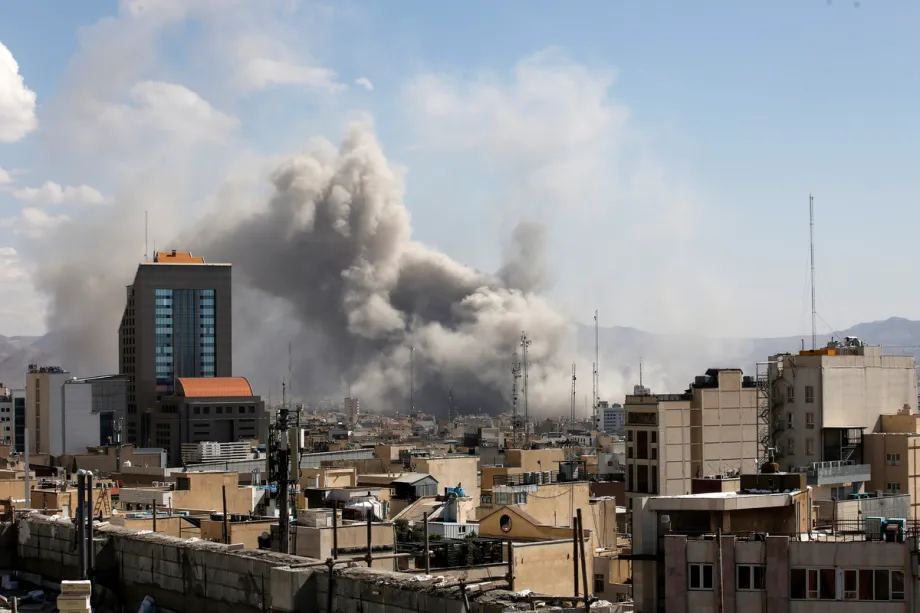
While President Trump cast the opening salvo against Iran as an act of defence—insisting the strikes were necessary “to defend the American people by eliminating imminent threats from the Iranian regime”—the scale of what followed shattered any claim of limited protection.
The world awoke not only to the martyrdom of Ayatollah Ali Khamenei, but to a region in flames. Tehran stands scarred by smoke and fire. In retaliation for the US–Israeli assault, ballistic missiles and drones have crossed the Arabian Peninsula, striking across Qatar, Kuwait, Bahrain, the United Arab Emirates and Saudi Arabia. Air defenses have been activated over Doha and Abu Dhabi. Civil aviation has been disrupted. What was presented in Washington as defensive necessity has already metastasized into a widening Middle Eastern war.
Trump’s own language reveals the scale of ambition. He has vowed to “destroy their missiles,” “raze their missile industry to the ground,” and “annihilate the navy,” promising Iran’s military capacity will be “totally…obliterated.” That is not the vocabulary of neutralising a discrete threat. It is the language of dismantling a sovereign state’s strategic infrastructure.
Under American law, that distinction is decisive.
The American Constitution assigns the power to declare war to Congress. The president serves as commander in chief once war is authorized. The framers separated these roles deliberately. They understood how swiftly executive urgency can become executive war. By requiring legislative consent, they ensured that the gravest decision a republic can make would rest on collective judgment rather than unilateral resolve.
Obviously, a president may repel a sudden attack or respond to a truly imminent danger. But crippling another state’s missile forces, targeting its naval capacity and participating in the killing of its supreme leader is not a fleeting defensive manoeuvre. It is sustained hostilities and a deliberate act of war.
If Congress has not enacted a specific Authorization for Use of Military Force against Iran, then this campaign lacks constitutional grounding. The post-9/11 and Iraq-era authorizations were crafted for distinct enemies and distinct conflicts. To stretch them indefinitely into new theaters transforms them into permanent war licenses—precisely what the Constitution was designed to prevent.
Opposition in Washington reflects that concern. Senator Tim Kaine has called the strikes unconstitutional due to absence of congressional approval. Senator Chuck Schumer has demanded immediate clarification of the legal basis. Representatives Ro Khanna and Thomas Massie have invoked the War Powers Resolution to restrict further escalation without legislative consent. The underlying principle is straightforward: no president may initiate a new war alone.
The measures affected more than $300 billion in imports and generated tens of billions in tariff revenue that businesses later challenged as unlawfully imposed. Portions were reversed. Refund claims followed. Constitutional error in trade policy proved costly and embarrassing—but it was financially reversible. War is not.
The consequences now unfolding across the Gulf cannot be recalculated on a balance sheet. Sovereign states that did not authorize this confrontation now find missiles crossing their skies. Energy corridors face instability. Regional escalation risks multiplying beyond original intent. Once hostilities spread, they acquire their own momentum.
If mediation efforts through Oman had indeed been advancing—as publicly affirmed by Oman’s Foreign Minister, Badr Albusaidi, who stated that a peace deal between Washington and Tehran was “within reach”—then the timing of this strike raises an even more troubling question. Was this truly about averting imminent danger to Americans, or was it a desperate attempt to cater to Israel’s strategic interests and the violent expansionist doctrine embraced by its most hardline leadership? An American president is not empowered to launch transformational war in service of another state’s ideological ambitions. In such circumstances, congressional authorization is not merely prudent; it is constitutionally indispensable.
The constitutional structure exists precisely because war is irreversible. Legislative debate forces clarity about objectives, limits and exit strategies. It compels public accountability. It binds the nation collectively to the costs that follow. When that step is bypassed, the decision to fight rests not with the republic but with a single office.
“Protection” is a powerful word. But in a constitutional republic, it does not grant one individual authority to determine when the nation enters war.
Those costs cannot be undone. That is why the Constitution requires Congress oversight before the bombs fall—not after.