
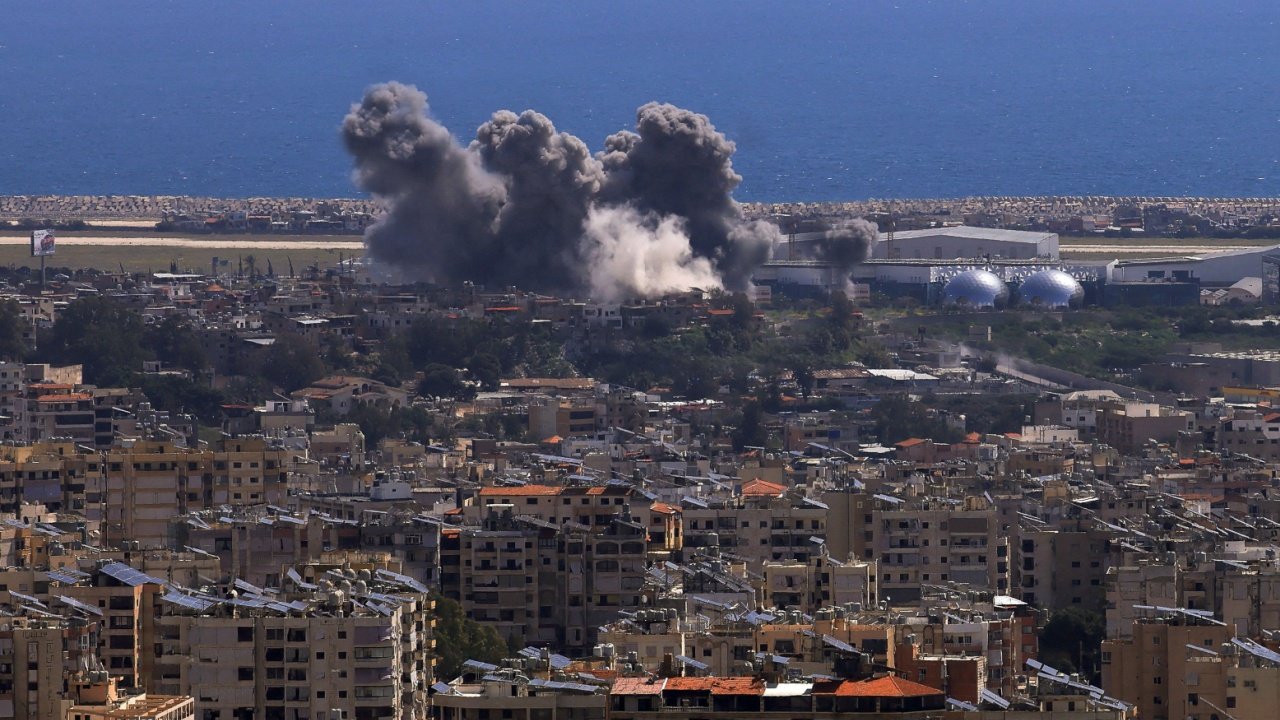
A declared ceasefire masks an Israeli occupation of southern Lebanon, enabled by U.S. weapons and diplomatic cover. Systematic infrastructure destruction and population displacement echo 1982’s invasion, which inadvertently created Hezbollah. Growing Democratic congressional dissent signals a potential but still marginal shift in U.S. military support for Israel.
Israel’s campaign in southern Lebanon is unlikely to end unless the United States stops supporting it.
On April 16, history repeated itself. President Donald Trump announced a 10-day ceasefire between Israel and Lebanon, brokered presumably because Iran made Lebanon a precondition for broader ceasefire negotiations. Israeli Prime Minister Benjamin Netanyahu confirmed the pause but made clear Israel had not agreed to withdraw their troops from southern Lebanon. Israeli forces, he said, would remain in a so-called “expanded security zone.” The Lebanese Army warned civilians not to return to southern villages, and not to approach areas where Israeli military forces had advanced.
The language coming out of Jerusalem has never been ambiguous. Defense Minister Israel Katz has said Israel is accelerating the destruction of Lebanese homes in accordance with tactics used in Gaza, to prevent militants from returning. Prime Minister Netanyahu calls the seized territory a “security zone,” with more than 600,000 displaced residents prohibited from returning south of the Litani River until, as he puts it, northern Israelis feel safe. In just 40 days, the Israeli military partially or fully destroyed 40,000 homes—more than 1,000 per day.
As the death toll climbed past 2,196, and 7,195 people were injured, and as Israeli forces pressed deeper into Lebanese territory, the United States is not acting as a restraining force. It is acting as an enabler of an invasion it has declined to acknowledge, much less try to justify.
After all, just as in the genocide in Gaza, Israel carried out its military campaign on the people of Lebanon with its all-US-origin Air Force, plus thousands of US-origin bombs and missiles, many of which have been paid for by American taxpayers. And just as with Gaza, Israel could not inflict this level of devastation without US funds, weapons, and tacit political support.
The Lebanon Ceasefire Is in Name Only
This is not the first time Washington has blessed a framework for peace that Israel treated as optional. The November 2024 ceasefire was supposed to provide a framework for peace: Hezbollah withdrawing north of the Litani River, Israel halting operations and pulling back from Lebanese territory.
Yet, the United Nations Interim Force in Lebanon has since documented more than 15,400 Israeli violations of that agreement. When Lebanon asked Washington to serve as a guarantor of the agreement, pressing Israel to honor its commitments in exchange for Hezbollah beginning a disarmament process, the response from US Special Envoy Thomas Barrack was blunt: “The US has no business in trying to compel Israel to do anything.”
Nine hours after the United States announced a ceasefire with Iran on April 7, Israel dropped 160 bombs on Lebanon in a mere 10 minutes and called it “Operation Eternal Darkness.” More than 350 people died, and over 1,100 were wounded in a single, unprecedented day. Washington called it a separate skirmish. That tells you what you need to know about what is happening in Lebanon and who enabled it.
After 40,000 homes destroyed, bridges demolished, farmland burned, over a million people driven from their homes, and much more: A 10-day pause is hailed as a ceasefire. It is a diplomatic instrument in a larger bargain—and one that Netanyahu has already signaled he intends to use to consolidate Israeli military control of the entirety of south Lebanon.
Israel’s Occupation of Southern Lebanon
Before an occupation can be consolidated, a territory must first be isolated. In recent weeks, Israeli forces systematically destroyed the bridges connecting central Lebanon to the south. All four crossings considered essential to that link, the Qasmiyeh, Khardali, Qaaqaaiyeh, and Zrarieh-Tayr Felsay bridges, were destroyed. Strikes have reached as far north as the Dlafy Bridge, which was hit twice in late March, with the second strike completing the destruction of its central roadway.
The Litani River, which runs across much of the country before reaching the south, is now largely impassable by road. The strategic logic is not difficult to read. Destroying bridges severs supply lines and humanitarian access, makes the return of displaced civilians dramatically harder, and cuts the Lebanese state’s ability to project authority into its own territory. Infrastructure destruction of this kind does not merely accompany occupation; it prepares the ground for it. It also echoes, with uncomfortable precision, the tactics Israel employed in Gaza, where the systematic destruction of roads and supply routes preceded and accompanied a ground campaign.
What Israel pursued in southern Lebanon has a name, even if Washington refuses to use it. The evacuation of civilian populations, the rendering of border villages uninhabitable, the systematic destruction of infrastructure, and the declared intention to hold ground. This is ethnic cleansing. It is also a strategy Israel has tried before, at enormous cost.
The 1982 invasion of Lebanon began with the stated goal of pushing the Palestinian Liberation Organization (PLO) beyond the artillery range of northern Israel. The operation rapidly grew in scope: a siege of Beirut, an 18-year occupation of the south, and the establishment of a proxy force (the South Lebanon Army or SLA) to administer a “security zone” that included the notorious Khiam detention facility, where Lebanese detainees were held for years without trial. When Israeli forces finally withdrew in 2000 under Prime Minister Ehud Barak, the retreat was chaotic and widely perceived as a rout.
Hezbollah, an organization that had not existed before the 1982 invasion, emerged from 18 years of occupation as the most formidable non-state armed force in the region, its prestige and recruitment built almost entirely on resistance to foreign military control of Lebanese soil.
The 2006 war with Hezbollah, 34 days of intense fighting that killed over 1,200 Lebanese, the vast majority civilians, and ended inconclusively, underscored the same point. A United Nations ceasefire resolution called for Hezbollah’s disarmament. Hezbollah remained armed and politically stronger than before.
US and Israeli leaders appear to believe the current moment is different and that Hezbollah’s recent degradation and the regional pressure from the war with Iran create a window for a decisive outcome. That calculation may prove correct. It may also reproduce precisely the conditions that have historically strengthened rather than weakened the forces Israel claims to want to defeat. Southern Lebanon, under foreign military control, with its bridges destroyed, its villages flattened, is not a foundation for stability. It is a foundation for future conflicts.
The Democrats Shift Against Military Aid to Israel
The political landscape in the United States is shifting, even if slowly. On April 15, the Senate voted on a pair of resolutions introduced by Senator Bernie Sanders (I-VT) to block $447 million in weapons and bulldozer sales to Israel. The resolutions were defeated, but 40 out of 47 Senate Democrats voted to block the bulldozer sale—an unprecedented majority within the caucus. In 2024, only 19 Democrats voted for at least one of Sanders’ resolutions. The number has now more than doubled in two years.
“The last thing in the world that American taxpayers need to do right now,” Sanders said, “is to provide 22,000 new bombs to the Netanyahu government.”
Among the new supporters were several moderates who describe themselves as pro-Israel, as well as multiple senators seen as likely 2028 presidential candidates. Senator Mark Kelly (D-AZ), a longtime Israel supporter, said on the floor that he could not support a partner engaging in what he described as expanded war, putting innocent Lebanese civilians at risk. Only seven Democrats voted against both resolutions, including Senate Minority Leader Chuck Schumer (D-NY).
The resolutions failed. But it is the clearest signal yet that the bipartisan consensus that has underwritten decades of unconditional US military support for Israel is fracturing, not at the fringes, but at the center of the Democratic Party.
Additionally, Representative Rashida Tlaib (D-MI) has introduced two war powers resolutions standing with the people of Lebanon against what she has called a US-backed Israeli invasion.
These measures represent the first serious congressional challenges to the US military support underwriting Israel’s military campaign in Lebanon, and they expose a widening gap between Washington’s stated commitment to Lebanese sovereignty and the reality of American weapons flowing into a military campaign that has very recently displaced over a million people and killed hundreds.
What US Restraint in Lebanon Would Look Like
The argument that the United States is powerless to influence Israeli military operations is not serious. The $660 million in bombs Senator Sanders moved to block were fast-tracked by an administration that invoked emergency authority to circumvent Congress. The weapons enabling this campaign are American. The silence in the face of declared occupation intentions and systematic infrastructure destruction is American.
There is precedent for a different posture. In August 1982, as Israeli bombardments of western Beirut intensified, President Ronald Reagan called Prime Minister Menachem Begin directly and demanded a halt, deliberately invoking the word “holocaust” to convey the moral weight of what he was witnessing. Reagan understood that unconditional support for operations spiraling into a humanitarian catastrophe was not in the American interest, and that the United States had both the leverage and the responsibility to say so. That understanding is absent today.
Lebanon is not simply a “separate skirmish” from the war with Iran. It is a country of 6 million people whose civilians have now lived through multiple rounds of devastating conflict. At least 412 children have been killed and more than 1,600 injured in the last 28 months, according to UNICEF.
If Washington continues to treat Lebanon primarily as a variable in its Iran strategy, it will not produce stability. It will produce a hollowed-out state, a displaced population with profound grievances, and a southern territory under foreign military control that will generate exactly the resistance it was designed to prevent. That is not a prediction. It is a description of what happened once, over 18 years, that the current architects of US foreign policy appear to have entirely forgotten or are choosing to ignore.
Legislators like Sanders and Tlaib cannot force a change in course on their own. But the case they are making, that the United States is not a bystander, that American weapons and American silence are not neutral, is the beginning of the conversation Washington has so far refused to have.