
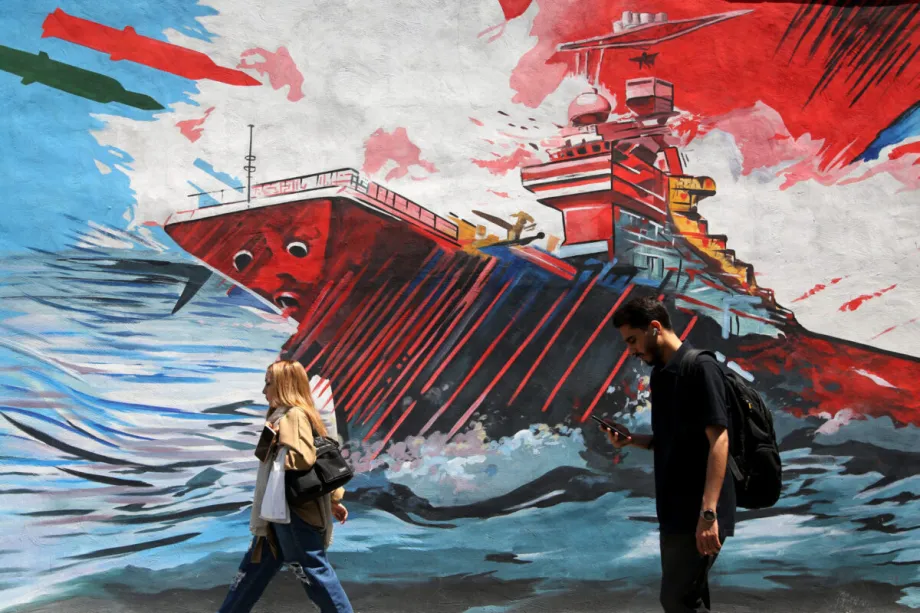
The U.S. military footprint in the Persian Gulf faces terminal decline due to Iranian precision-strike capabilities and regional hedging. This analysis examines how American forward presence has shifted from strategic asset to liability, forcing a painful reappraisal of Washington’s post-1970s dominance.
For forty years, the U.S. Navy’s Fifth Fleet symbolized unchallenged American forward presence , but that era is now terminally undone by Iranian precision-strike capabilities and Gulf states’ hedging. The American forward presence has shifted from a credible deterrent to a hostage liability, as bases designed for air supremacy have become vulnerable kill boxes. This American forward presence now faces its most lethal test: not from grand battles, but from the steady erosion of political will and military feasibility.
American forward presence Collapses Under Iran
Something fundamental has shifted in the Persian Gulf, and the analysts who have spent careers watching American power projection are now saying what was once unsayable: the era of U.S. forward military basing in the Middle East is effectively over. Whether Washington chooses confrontation or withdrawal, the strategic outcome appears to be the same: the slow, irreversible erosion of American influence in a region it has dominated since the 1970s.
This diagnosis has crystallized around the current standoff with Iran. For scholars like John Mearsheimer, the University of Chicago’s preeminent offensive realist, the crisis confirms a structural reality that American strategic culture has long refused to accept.
Betraying the American forward presence
That judgment encapsulates what two decades of costly interventionism have produced: a regional order that has drifted decisively away from Washington, and a military posture that is increasingly difficult to sustain.
The numbers are sobering. The United States currently maintains roughly 40,000 troops across the Gulf Cooperation Council states, concentrated at bases such as Al Udeid in Qatar and the Fifth Fleet’s headquarters in Bahrain. These installations were engineered for an obsolete strategic reality: one characterized by unchallenged U.S. air supremacy, nascent Iranian missile capabilities, and the unwavering compliance of regional partners. None of those conditions holds today. Iran’s ballistic and cruise missile arsenal now numbers in the thousands, and its precision-strike capability has been demonstrated with lethal credibility, most dramatically in the 2019 Abqaiq strikes on Saudi Aramco infrastructure, which temporarily knocked out roughly five percent of global oil supply.
The Dilemma of American forward presence
United States policymakers currently face a profoundly challenging dilemma. Rather than neutralizing the Iranian threat, military intervention targeting its nuclear and missile capabilities would likely catalyse it. Retired Admiral James Stavridis, former NATO Supreme Allied Commander, has warned that a conflict with Iran would be “extraordinarily difficult,” adding that the Gulf’s geography “creates enormous vulnerability for our surface assets and our land bases.” The missile and drone salvos that would follow any American first strike could render the very bases from which the operation was launched operationally unusable within days. The infrastructure underpinning U.S. power, the runways, fuel depots, command nodes — becomes a liability the moment deterrence fails.
Opting instead for a structured drawdown carries distinct strategic penalties, enacted under the watchful eyes of anxious Gulf partners. UAE Minister of State for Foreign Affairs Anwar Gargash has spoken of the need for the region to develop “strategic autonomy,” a phrase that would have been diplomatically unthinkable a generation ago. Saudi Crown Prince Mohammed bin Salman’s government has actively engaged in parallel diplomacy with Beijing. This effort culminated in a landmark 2023 deal, brokered by China, to restore ties with Tehran—a geopolitical shift that would have been unthinkable without Washington’s blessing in the past. The message embedded in these moves is unmistakable: if Washington cannot guarantee security, the Gulf states will hedge elsewhere.
American forward presence Rests on a Paradox
Although American think tanks have lagged in internalizing these strategic dynamics, more rigorous assessments are emerging. Analysts at the RAND Corporation, for instance, have conceptualized a “deterrence gap” in the Gulf, defining it as the discrepancy between the threats the United States purports to deter and the actual capabilities it can effectively deploy in contested environments. The Center for Strategic and International Studies, for its part, has noted that American credibility in the region “rests on a paradox”: the more Washington threatens force, the more it exposes the limits of what force could actually achieve.
What makes this moment distinctive is not the crisis itself, but its finality. The logic was always that America could afford to lose a battle because it would never lose the region. That confidence is harder to sustain now.
Finality and American forward presence
The fundamental issue is no longer the sustainability of the U.S. military footprint in the Gulf, which the evidence heavily refutes. Rather, it is whether Washington possesses the strategic capacity to execute a deliberate drawdown before deteriorating conditions force an involuntary, disorderly exit.