
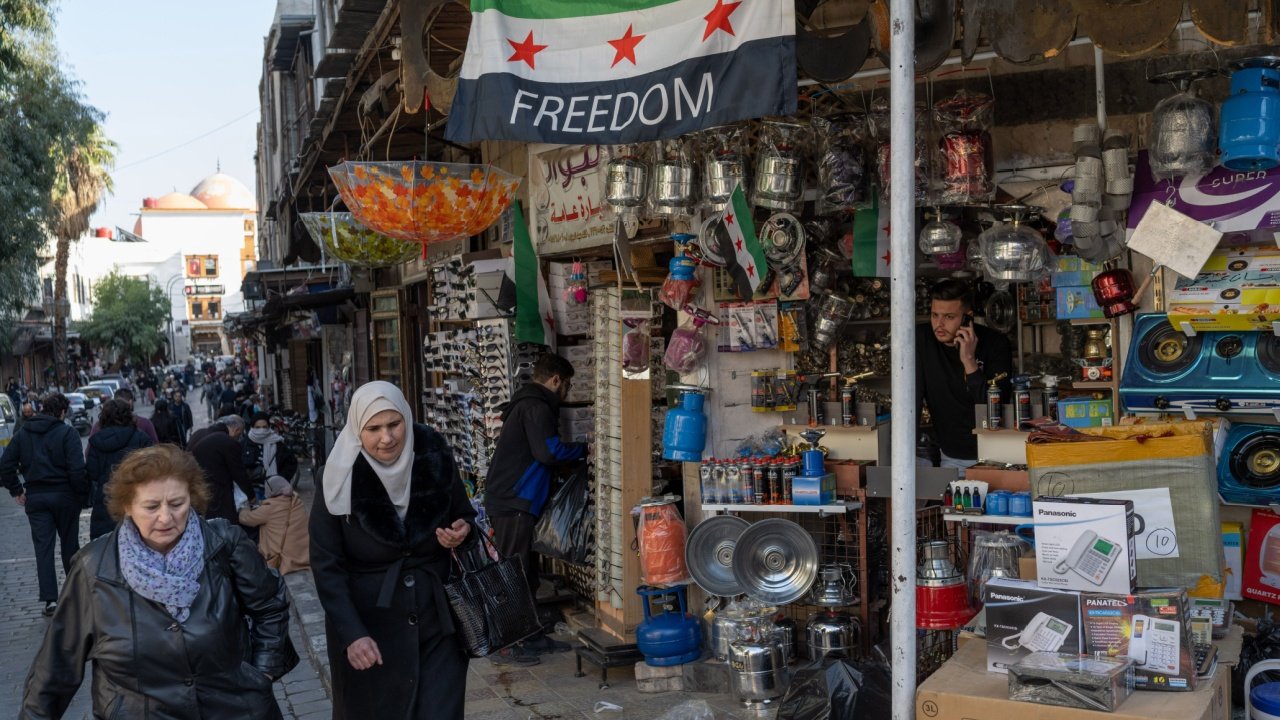
The Iran conflict bypasses Syria, enabling Damascus to capitalize on the Hormuz blockade by offering Mediterranean export alternatives for stranded Iraqi oil. High-level diplomacy with Jordan, Turkey, and Ukraine signals a strategic pivot toward becoming a stable transit hub. This geographic advantage potentially reorders regional trade flows away from volatile Gulf sea lanes.
Damascus has suffered little blowback from the Iran War, and the blockade of the Persian Gulf may make Syria an alternative energy route.
Syria has been navigating the complex challenges of the Middle East, avoiding conflict, while positioning itself to benefit from the aftermath of the US and Israeli strikes on Iran. While most countries in the region have come under Iranian and Iranian-backed proxy attack since late February, Syria has largely remained outside the circle of fire. This isn’t because Syria and Iran enjoy warm ties. The current Syrian government is made up of Syrian rebels who came to power by ousting the Iranian-backed regime of Bashar al-Assad in December 2024. How has Syria remained at relative peace, and what does it stand to gain?
After the fall of Assad, Syria spent most of 2025 trying to establish a new government and solidify its control. Ahmed al-Shara, the transitional president of Syria, has worked tirelessly to get sanctions on Syria removed and also allay concerns in the United States and Europe about his extremist past. He has been largely successful in these efforts. However, many hurdles remain going into 2026.
For example, clashes erupted between Damascus and the US-backed Syrian Democratic Forces (SDF) in July 2025. The SDF, a mostly Kurdish-led group, agreed to integrate into the new Syrian security forces in January. This process was still ongoing when the United States and Israel began strikes on Iran at the end of February. Another hurdle for Syria has been relations with the Druze minority in the country’s southern Suwayda province. The Druze are backed by Israel, and their leadership does not trust Damascus.
After a month and a half of fighting, which saw Iran launch thousands of drone and missile attacks on countries throughout the region, Syria is largely untouched. An Iranian-backed militia did launch rockets from Iraq into Syria, aiming at a US military base. In addition, Syria had to stop commercial flights due to the ballistic missiles flying over the country.
Damascus used this time to hold a high-level meeting with Turkish officials and to host Ukrainian President Volodymyr Zelensky. Turkish Foreign Minister Hakan Fidan went to Damascus and met with Syrian Foreign Minister Asaad al-Shaibani on April 5. Zelensky arrived after touring the Gulf states, sharing know-how on Ukraine’s defenses against drone and missile threats. Fidan, Zelensky, and Syrian officials held a trilateral meeting on April 6.
In the wake of the meetings with Zelensky and Turkish officials, Syria also held high-level meetings with Jordan on April 13. “Jordan and Syria reaffirmed their commitment to expanding bilateral cooperation and advancing towards a comprehensive strategic partnership following a high-level meeting in Amman,” The Jordan Times noted.
This was the second meeting of the Higher Coordination Council between the two countries. It was co-chaired by Deputy Prime Minister and Foreign Minister Ayman Safadi and Syria’s Foreign Minister Asaad Al Shibani. Jordanian media said that 30 ministers from both governments joined. The countries are working on numerous issues because they share an important border, with possibilities for cooperation in telecommunications, water, railway links, and energy.
During the Syrian Civil War, which lasted from 2011 to 2024, Jordan was a destination for many Syrians fleeing the fighting and the Assad regime’s crackdown. In 2018, the Syrian regime swept aside Syrian rebels who held areas near Jordan’s border in the region of Dara’a. After the fall of Assad, this area has been in the spotlight. In part, this is because Israel has demanded the demilitarization of southern Syria. In addition, the Druze area of Suwayda is close to Jordan and Dara’a, and is outside Damascus’s control. Jordan is also very concerned about the flow of drug smuggling from southern Syria over the last decade.
Syria potentially stands to benefit from the Iran conflict. If Syria attains stability, it could become a conduit for energy transport. This could include pipelines for oil or gas, as well as other commodities flowing through them. Syria. The Iranian blockade of the Strait of Hormuz has cut off Iraq’s oil exports. Consequently, Baghdad has sought to export oil through Syria’s Baniyas terminal on the Mediterranean.
There are possibilities for Syria to revive rail connections and also increase traffic on key highways to Syria, Jordan, and Iraq. If Syria and Israel can reach an accommodation, it’s also plausible that additional transport and trade links could be established. In addition, these could help stabilize Lebanon. On April 14, Lebanese and Israeli officials held meetings in Washington to discuss Israel’s campaign in southern Lebanon against Hezbollah. Syria’s potential role in easing tensions over Lebanon is another possibility for Damascus.
Syria’s geography means the country sits astride key trade routes that once linked the Ottoman Empire’s Anatolian heartland with the Arab world. The Arab-Israeli conflict and the Cold War in the 20th century made Syria a front-line state in conflicts with Israel, with which it fought three wars in 1948, 1967, and 1973. The Assad regime also led Syria into the Lebanese Civil War in 1976. Syrian forces only left Lebanon in 2005 after the assassination of former Lebanese Prime Minister Rafic Hariri, a murder involving Hezbollah members, and may have been undertaken with the knowledge of the Assad regime.
Syria’s foreign policies over the last few decades have often fed the chaos that plagues the region. After the US invasion of Iraq in 2003, the Assad regime turned a blind eye as insurgents used the Euphrates River valley to enter Iraq and launch attacks on the US military. Later, during the Syrian Civil War, ISIS used the power vacuum to invade Iraq and carry out massacres and genocide. The fight against ISIS brought US forces into Syria as partners of the SDF. Now, with the SDF integrating into the new Syrian army, a new day may be dawning in Damascus. The recent war in Iran showed how Syria can be an island of stability amid the regional maelstrom.