
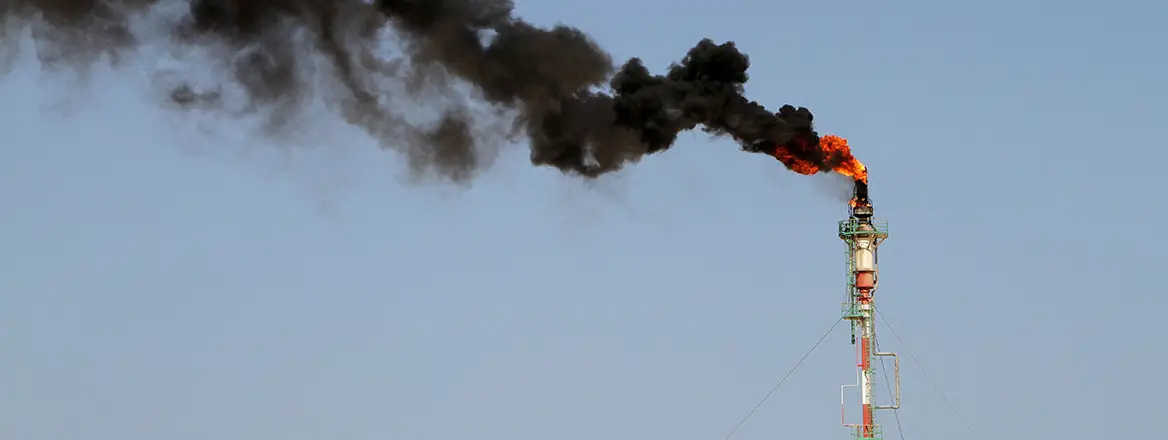
North African producers flare 25 billion cubic metres of natural gas annually while regional pipelines operate at 35% capacity. Redirecting this wasted output gives European markets immediate supply relief, offsetting Middle East disruptions without long-term infrastructure builds.
Escalating Middle East military conflicts and regional energy squeezes have forced European markets into an acute fuel crunch. Capturing flared North African fuel serves as Europe’s Gas Opportunity to secure stable regional supply lines without waiting for distant infrastructure. By conditioning diplomatic engagement on methane capture across Libya and Algeria, Western policymakers can turn Europe’s Gas Opportunity into immediate, lower-cost energy resilience.
Europe’s Gas Opportunity In Libya
The fallout from the Iran War has not been kind to European economies. A UK leadership change presents an opportunity to invest in combatting gas flaring in North Africa, so as to bolster security of supply, and tie ongoing international diplomatic efforts on Libya to that agenda.
As John Archibald Wheeler said, ‘In the middle of difficulty lies opportunity.’
The never-ending war in the Middle East, disruptions to Qatari LNG flows, an exploding Russian LNG tanker, natural gas prices above $20 per MMBtu, and record-low gas storage have again exposed the fragility of Europe’s gas security. But in the mid of this never-ending Iran crisis, there are opportunities for profit and energy independence staring European and British policymakers in the face.
The reality should be finally dawning on them that Trump’s Iran War will never fully be over, or we will never fully return to the status quo ante. Price volatility and bidding wars for crude and LNG between Asia and Europe are now inevitable. For now, US and Russian exporters are cashing in, while Brits and Europeans are paying the bills.
Seizing Europe’s Gas Opportunity Now
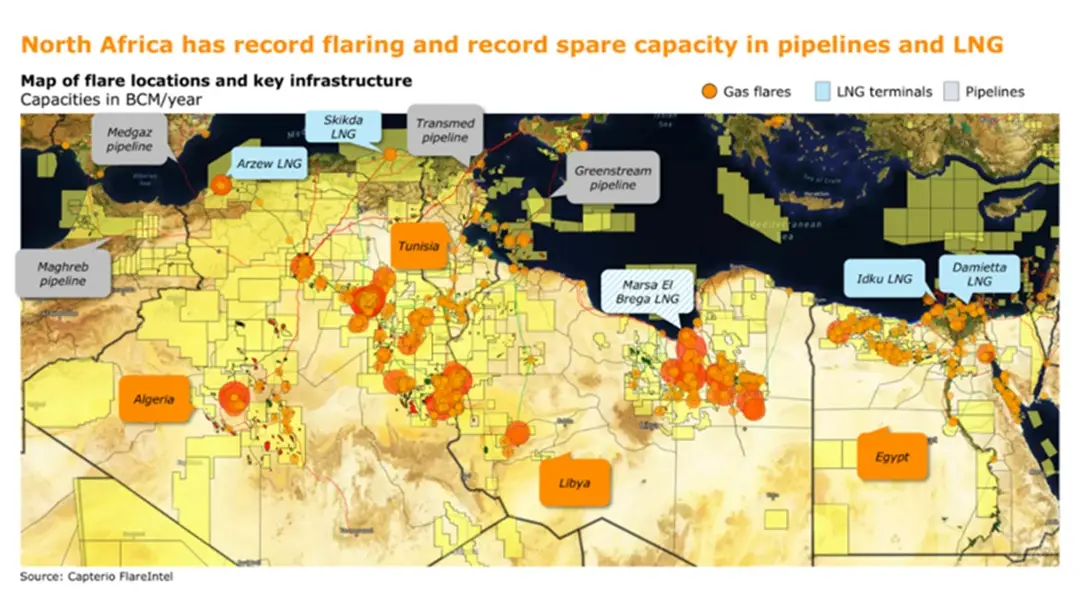
And yet, just across the Mediterranean lies a largely overlooked opportunity. Each year, Algeria, Libya and Egypt waste over 25 billion cubic metres of gas through flaring, venting and leaks – much of it routine and at high intensity relative to their production.
Shifting political sands in Libya present a key opportunity for environmental wins that would also increase European energy security. As Europe seeks reliable supply and North African economies grapple with fiscal pressures, capturing this lost gas could simultaneously bolster energy security, increase export revenues and cut emissions.
For Algeria and Egypt to improve in this domain their sovereign authorities have to invest political capital, but for Libya, gas flaring reduction assistance can be baked into British and European engagement with ongoing global political initiatives on the Libya file, such as the controversial proposals being push forward by US Special Envoy Massad Boulos and the UN Envoy Claudia Tetteh.
Both Tetteh and Boulos are on the verge of announcing new controversial breakthroughs in their initiatives; they need to garner political support and buy-in. The Boulos initiative is flawed on multiple levels as it seeks to enshrine the status quo – elevating the Haftar and Dabaiba families into permanent warlords over Libya. Yet, Europeans can tweak the proposed deals away from the political endgame by working with Boulos on opportunities for economic reform, critical minerals and boosting Libyan oil and gas exports – all issues about which he is also keen.
At the start of Andy Burnham’s premiership, he has messaged strongly about restarting production of North Sea Oil. Announcing a policy to deploy British investment and tech to decrease flaring in North Africa would cut in the same direction—concrete steps towards energy security, while also complying with EU methane emissions regulations.
For Europe and Britain to play ball with Boulos, they should focus on transparency and accountability in the banking and oil and gas sectors and also demand that combating gas flaring is finally considered a top table, non-negotiable issue for global coordination on the Libya file. They should bake it into the political and economic tracks of the UN and Boulos processes and condition engagement in those processes on concrete progress on combatting gas flaring. PM Burnham could make this one of his first foreign policy initiatives.
Unlike some of the more challenging economic reforms related to subsidies, no faction in Libya will oppose combating gas flaring and there are no losers to act as spoilers to block progress on the issue.
Infrastructure For Europe’s Gas Opportunity
The scale of the opportunity is stark. Despite producing 3.8% of global gas, Algeria, Libya and Egypt lose a sizable share to flaring and methane emissions. Libya saw in 2025 the highest flaring since the early post-Qadhafi years. Altogether, the region loses over 13% of its combined gas output. At plausible gas prices, $5–10 billion a year is a great deal of money to be burning. Even worse, the environmental damage is needless and a major contributor to global warming.
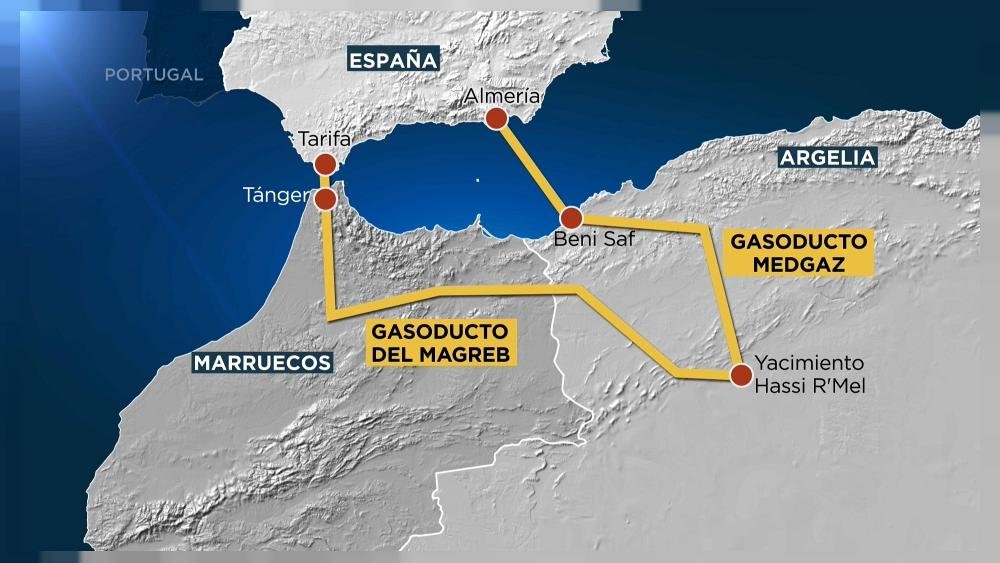
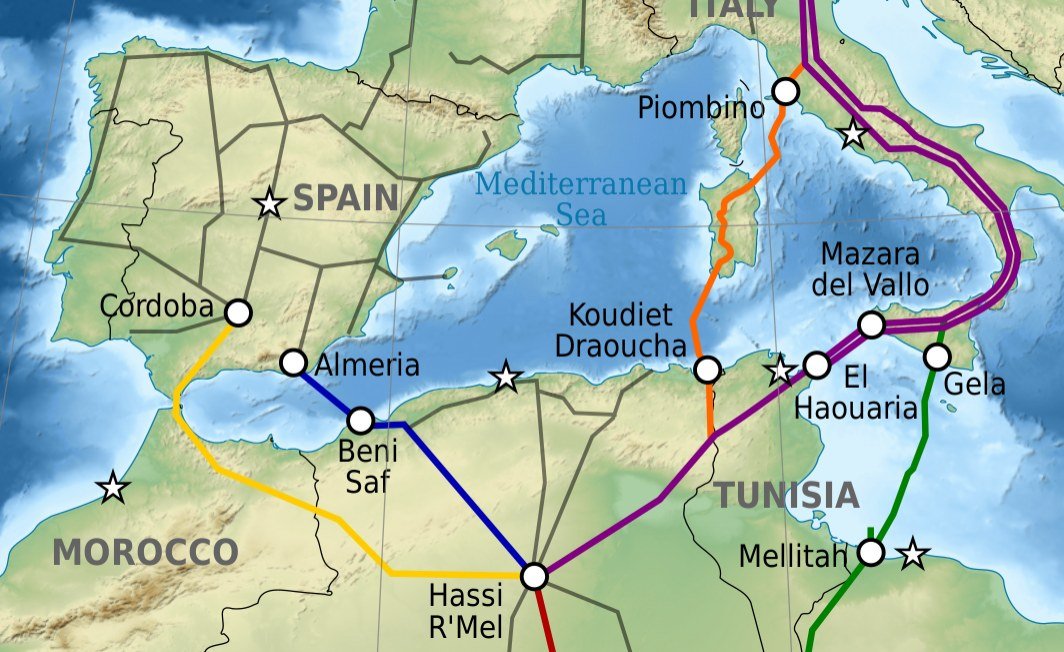
At the same time, export infrastructure linking North Africa to Europe is dramatically underused. The region is already connected to European markets by four pipelines from Algeria and Libya, and four LNG terminals in Algeria and Egypt. Declining exports have pushed utilisation rates down to a record low of 35%, leaving pipelines and liquefaction facilities with oodles of spare capacity. British and European companies can benefit from capturing this flared gas and investing in the networks via which it will be transferred to Europe.
Record high flaring in Libya alongside record low exports exposes a striking paradox. Part of the explanation lies in the changing domestic dynamics of North Africa’s energy systems. Rising electricity demand, ageing oil and gas fields, and growing domestic consumption have squeezed the volumes available for export. Gas exports from Algeria, Libya and Egypt fell to roughly 41 BCM in 2025, down about a third from 2021. LNG exports have been particularly hard hit. All of this at exactly the moment when the world most needs North African LNG.
Europe’s Gas Opportunity Through Tech
Reducing gas flaring and methane losses is likely the fastest and most cost-effective step to capture additional supply from North Africa. Unlike exploration projects, flared gas is already discovered and on production. Capturing it typically requires relatively modest investments in compression, processing or pipeline connections.
Practical solutions are already emerging. In Libya, repairs to legacy compression equipment have helped reduce upset flaring in some oil fields. Plans are afoot to install compressors to transport flared gas through existing underused trunklines, plus two new pipelines in the Sirte basin that can bring more gas to market. Recent developments in the offshore space may bring more gas to the almost-empty Greenstream pipeline. To accelerate progress, Capterio announced a strategic collaboration on this topic with Libya’s National Oil Corporation at London’s Africa Energies Summit.
Algeria has been exploring better ways to use processing plants and pipelines by improving coordination across its joint ventures. In Egypt, projects that capture flared gas for power generation have helped displace liquid fuels, saving costs and lowering emissions. Other options – small-scale LNG, compressed natural gas and using gas to power data centres or cryptocurrency mining – could also be in the frame.
Such ideas also link to Italy’s ‘Mattei Plan’ to become a strategic pillar of both African development and European energy security. By investing in the capture and utilisation of associated gas that is currently flared, countries such as Libya and Algeria can increase domestic energy supply, reduce emissions and create new, secure sources of gas for European markets.
These examples show that reducing flaring is not simply an environmental aspiration. Many gas capture investments deliver attractive returns, particularly where existing infrastructure can move the gas to domestic markets or export facilities.
Driving Europe’s Gas Opportunity Forward
There is a pressing policy imperative, too. The European Union’s Methane Regulation will impose stringent monitoring and reporting requirements on imported fossil fuels from 2030. Exporters with high methane intensities risk regulatory scrutiny, reputational damage and a growing competitive disadvantage in European markets.
Export performance could become an important differentiator if EU gas demand weakens under rising renewable supply or if, after the war, the long-expected wave of new LNG projects materialises. As Libya is facing another crises moment and Europe and the UK get to weigh-in on competing political initiatives nudging stakeholders towards greenlighting efforts to combat gas flaring could become a European pre-condition for engagement with rival plans. It is also an opportunity to divert contentious issues towards win-wins.
For North African producers, reducing flaring and methane emissions is therefore not only about environmental performance but also about improving competitiveness and protecting access to their most important asset: a large export market. For Europe, the same projects strengthen supply resilience while lowering supply-chain emissions.
Capturing flared and vented gas will not solve Europe’s gas security challenges on its own. But it represents one of the fastest ways to unlock additional supply without waiting years for new fields or major infrastructure to be developed. In an era of volatile gas markets and tightening climate regulation, it is a rare example of a solution that aligns economic and environmental interests.
At this moment, when energy security is back at the top of Europe’s agenda, the gas it needs may already be burning in plain sight just across the Mediterranean. When it comes to Libya, the EU and Britain have more than enough political capital to get these objectives over the line, if only they would deploy it.