
Iran maintains functional control over critical shipping corridors via shore-based missiles and mines, rendering Western air campaigns ineffective. With global oil and gas routes blocked, international shipping faces a choice between selective Iranian tolls or indefinite military escalation.
A fragile peace deal has collapsed within three weeks, putting global energy markets back on the brink of acute supply shocks. The Strait of Hormuz conflict has escalated as military strikes resume along the Iranian coast, leaving commercial tankers unable to navigate the waterway safely. Resolving this crisis requires Washington and Tehran to look past military solutions, as long-term stability in the Strait of Hormuz conflict cannot be achieved through air campaigns alone.
Strait of Hormuz conflict Reality
The Palace of Versailles has a way of making peace feel more settled than it is. The last time world leaders left convinced they had ended a global conflict, the peace they secured lasted 20 years before collapsing into World War II. President Donald Trump’s memorandum of understanding (MOU) with Iran, signed at the same palace on June 17, lasted three weeks. President Trump declared the deal “complete” and told the world’s ships to “start your engines.” Three weeks later, standing before NATO leaders in Ankara, he declared the ceasefire “over,” after Iran resumed striking vessels that refused to follow its designated routes.
The memorandum did not fail because of bad faith alone. It failed because the dispute at the core of the Iran War remains unresolved: Iran believes the closure established its right to administer the Strait of Hormuz and charge tolls for passage. At the same time, the United States insists it must remain a free international waterway, and neither side has a clear path to forcing the other to concede.
The pattern of failure, from the US Navy attempt to protect shipping (Project Freedom) to the MOU, has less to do with American hesitation or Iranian bad faith than with a geography that neither diplomacy nor force has yet found a way around. Iran controls the northern coastline of the strait in its entirety, meaning shore-based missiles, armed speedboats, and a mine stockpile in the thousands can be brought to bear on any vessel attempting transit without a single Iranian warship leaving port.
Any power seeking to reopen the strait by force would need to control that coastline, which means defeating Iran on Iranian soil, transforming a maritime operation into something far costlier. The world also cannot simply route around the problem. The strait carries around 20 million barrels of oil per day and virtually all of the region’s liquefied natural gas. At the same time, the existing bypass infrastructure covers at most a quarter of that volume and is not built to handle gas at any meaningful scale. What follows is an attempt to explain why the strait is so difficult to reopen, and what the world is left with once that difficulty is fully reckoned with.
Inside Strait of Hormuz conflict Geopolitics
The Strait of Hormuz Isn’t Going Away
The strait is the only maritime exit from the Persian Gulf to the open ocean, with two shipping lanes each 2 miles wide, separated by a 2-mile buffer. What makes the strait consequential is not just the volume of traffic it carries but the absence of any route that can meaningfully act as an alternative. Only Saudi Arabia and the UAE have operational crude pipelines capable of bypassing the strait, and the IEA estimates their combined available capacity at between 3.5 and 5.5 million barrels per day, compared with the 20 million barrels that move by sea.
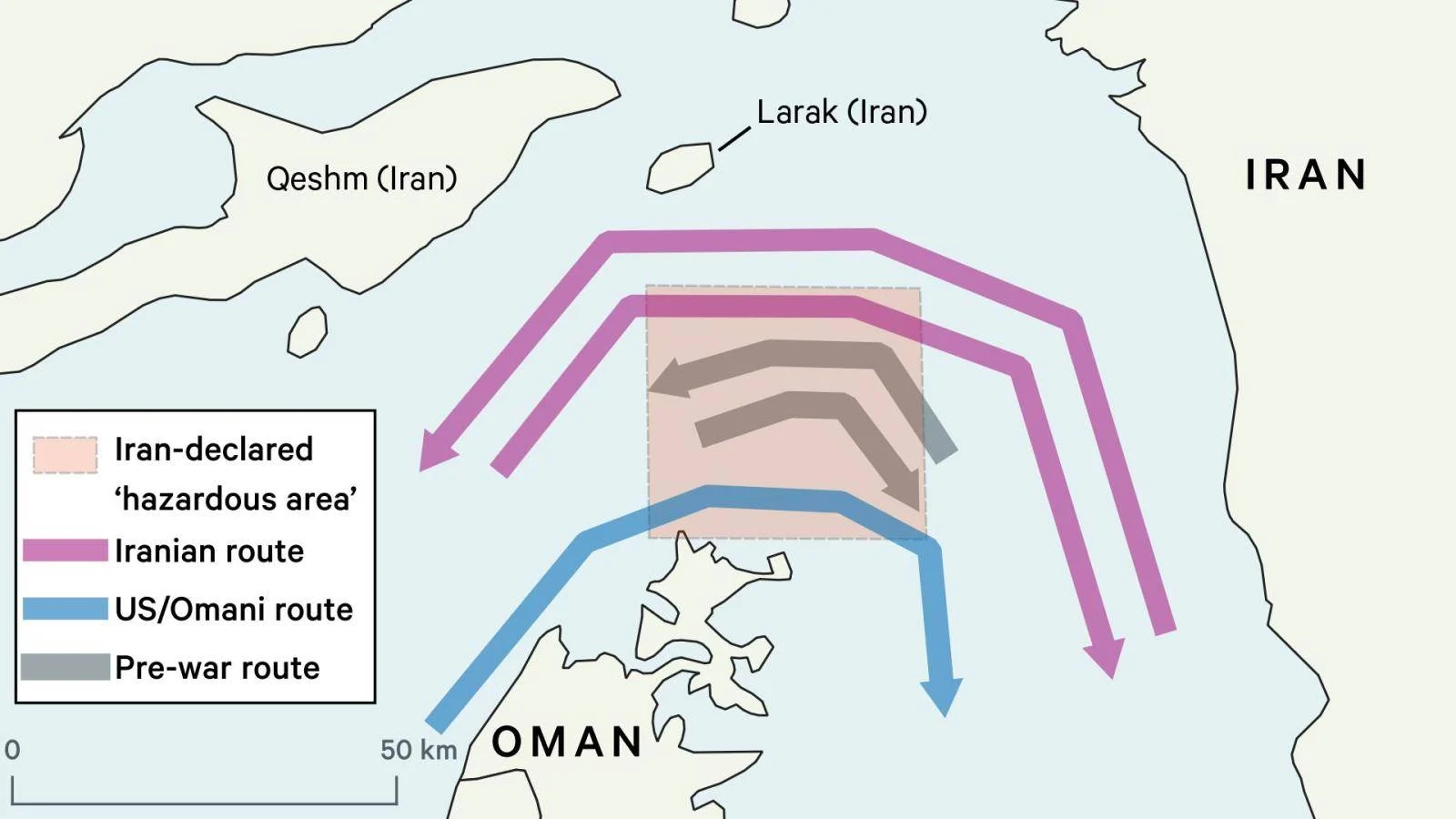
The inadequacy of these alternatives is underscored by the fact that Iranian missiles have struck the Abqaiq-Yanbu pipeline and Iranian drones have hit Fujairah, the very port the UAE bypass was built to protect. What makes Iran’s position so durable is not its navy but its coastline. Bandar Abbas, the port city sitting directly on Iran’s southern shore facing the strait, is the headquarters of the Islamic Revolutionary Guard Corps Navy and the logistical hub through which Iran projects power. Flanking it are the islands of Qeshm, Hormuz, and Larak, each serving as a forward staging position that extends Iran’s reach into the corridor where tankers are most exposed.
From these positions, shore-based missiles can cover the full width of the passage, armed speedboats can be deployed within minutes, and a mine stockpile estimated at between 2,000 and 6,000 can be drawn upon at will. Iran has threatened to close the strait before, but when closure finally came in March, the international legal framework that might have prevented it offered little in the way of a remedy.
Neither the United States nor Iran has ratified the UN Convention on the Law of the Sea (UNCLOS), the closest thing the world has to a shared rulebook for international waterways. Prevailing in this confrontation does not require Iran to win a naval battle.
It only needs to make transit too costly for the insurance market to cover. Major maritime insurers have suspended or repriced war-risk coverage across the entire Persian Gulf, and traffic through the strait collapsed by roughly 95 percent at the height of the closure and has recovered to only a third of normal even after the MOU was signed. Against that backdrop, three futures now present themselves, each with its own logic and its own consequences.
Navigating Strait of Hormuz conflict
Future 1: The Selective Closure of the Strait of Hormuz
The first future is already operational. When Iran closed the strait in early March, it did not impose a simple blockade but rather a managed access system in which passage was granted based on geopolitical alignment rather than at market rates. Ships seeking transit were required to submit cargo details, crew lists, and destinations to IRGC-approved intermediaries, receive a clearance code, and be escorted through Iranian territorial waters.
Countries that negotiated directly with Tehran secured access: China, Russia, India, Iraq, Pakistan, Malaysia, Thailand, Turkey, and the Philippines have all had vessels transit at various points since the closure, while Western-aligned shipping remained effectively blocked. At least two vessels paid $2 million per crossing, settled in Chinese yuan, and Iran’s parliament is now moving to legalize this arrangement as a formal revenue stream. The strategic implications of this future are profound and underappreciated. China, which receives 45 percent of its oil through the strait, has little incentive to pressure Tehran toward a full reopening when its own vessels are already moving.
That logic shifted when Chinese officials told the Trump administration they were not in favor of militarizing the strait or imposing a tolling system, a public position that sits uncomfortably alongside the reality that Chinese vessels are still transiting under Iranian permission while Western shipping remains blocked.
Russia, which stood to gain an estimated $8.5 billion in additional monthly oil revenue from the price surge, has even less incentive to push for a full reopening. The MOU temporarily suspended the tolling system, but Iran has already resumed striking non-compliant vessels, suggesting the managed access system never fully dissolved. The logic of charging for passage has proven contagious as well: Trump briefly proposed a 20 percent US fee for ships transiting under American protection before reversing under Gulf pressure.
Strait of Hormuz conflict Tactics
Future 2: The US Military Seizure of the Strait of Hormuz
The second future is the one the United States has attempted repeatedly and, each time, has found to produce the same result. A military effort to forcibly reopen the strait confronts a geography designed to defeat it. US forces are now on their fifth consecutive day of strikes against Iranian military targets, including islands flanking the strait, after Iran resumed attacking commercial vessels.
It is a pattern that stretches back to March, when the US conducted airstrikes on underground missile silos along the Iranian coast, deploying penetrator munitions to destroy bunkers storing cruise and anti-ship missiles, and launched aerial campaigns targeting Iranian naval assets throughout the Gulf. Trump claimed 158 Iranian naval vessels had been destroyed, and yet the strait remained closed.
The campaign confirmed that destroying assets is not the same as controlling a coastline, and Iran can regenerate asymmetric threat capacity faster than the US can eliminate it from the air. Project Freedom was meant to break this logic. It launched on a Sunday, was met with Iranian missile fire, and was paused by Tuesday, after Saudi Arabia suspended US base access and Kuwait closed its airspace.
The regional coalition the operation required did not materialize: Germany, Spain, Italy, the United Kingdom, Australia, South Korea, and Japan all declined Trump’s request to contribute warships, citing the lack of strategic goals and reluctance to be drawn into the war. With no coalition willing to go further and Vice President JD Vance explicitly ruling out the deployment of ground troops, the one military option that could actually take the coast is off the table. The military track continues to produce escalation without resolution, and both sides will eventually have to return to the negotiating table, where the terms of any agreement will reflect the fact that Iran still holds the coast.
Resolving Strait of Hormuz conflict
Future 3: The Strait of Hormuz Is Left Open but Scarred
The third future remains the most likely, but it is harder to reach than it was three weeks ago. The MOU briefly produced it: the strait partially reopened, traffic recovered to roughly a third of normal, and oil prices fell below pre-war levels for the first time since February.
Then Iran struck a Qatari LNG tanker, a Saudi supertanker, and a Cyprus-flagged container ship in quick succession; the US responded with three rounds of strikes targeting over 100 Iranian military sites, and Iran declared the strait closed again on July 12. The MOU is technically still a possibility; talks continue through Oman and Pakistan, and both sides have signaled they are not entirely done with diplomacy.
The diplomatic architecture for a durable reopening still exists, though both sides are currently exchanging strikes rather than proposals. The economic consequences of nearly five months of conflict are already locked in, regardless of what happens next.
Commercial traffic through the strait collapsed after the closure. Oil markets have swung between panic and relief since February 28, with Brent crude surging more than 55 percent from pre-war levels before reversing sharply each time a deal appeared within reach. This volatility has itself become a form of economic disruption, making long-term planning for energy-dependent economies nearly impossible. Insurance markets have permanently repriced risk, and long-term energy contracts are being rewritten to include straight closure as a force majeure trigger. This provision, lawyers say, was absent or inadequately drafted in most agreements before February 28.
The three futures outlined here do not exhaust all possibilities. Iranian state coherence under Mojtaba Khamenei’s untested authority is not guaranteed, and the Gulf states’ unity is fracturing along lines of exposure, with some states moving toward bilateral accommodation with Tehran. Both dynamics will shape whichever future ultimately prevails.
What Should the United States Do about the Strait of Hormuz? For the United States, this crisis has demonstrated that military dominance alone has failed to resolve a dispute over a waterway it does not control. The resumption of strikes this week, even after Trump declared the military phase largely complete, suggests he has not yet accepted that conclusion. With the original objective of regime change having not materialized, what remains is the question of what Washington can claim as a victory it can sell domestically.
The most credible answer is a verifiable commitment from Tehran to its nuclear stockpile, in exchange for sanctions relief and guaranteed freedom of navigation. Trump has also explicitly linked any settlement to progress on the Abraham Accords, giving him a framework he can present as going further than the original JCPOA. Washington should recognize that the diplomatic track is not a fallback from the military track but the only path to a resolution that does not cost more than it solves. For Iran, the strategic logic of the closure is clear, and its execution has demonstrated a resilience that few analysts anticipated.
The sanctions regime, however, has hollowed out the broader Iranian economy in ways the closure cannot reverse, and those costs are borne by ordinary Iranians whose grievances long predate this war. A negotiated settlement that lifts sanctions, restores Iran’s position in the global energy economy, and offers some reduction in the forward military pressure it faces would do more for Iranian stability than any continuation of the blockade. Regardless of how the conflict resolves, states that depend on the passage are not waiting for a settlement: bypass pipelines are being expanded, alternative corridors are being funded, and long-term energy contracts are being rewritten to ensure that no single chokepoint can hold the global economy hostage.
A waterway whose future is being negotiated in Washington and Tehran is reshaping the conditions of daily life for hundreds of millions of people who have no seat at that table, and which of these futures prevails will define the global order long after the last destroyer has gone home.