
Washington’s conflict with Tehran has caused a pivot of critical military assets away from East Asia, weakening regional alliances. Concurrently, China has utilized global energy disruptions to accelerate its domestic energy transition and yuan internationalization, positioning itself to extract significant technological concessions from a weakened U.S. administratio
At a Meeting With Xi Next Month, Trump Will Be on the Backfoot.
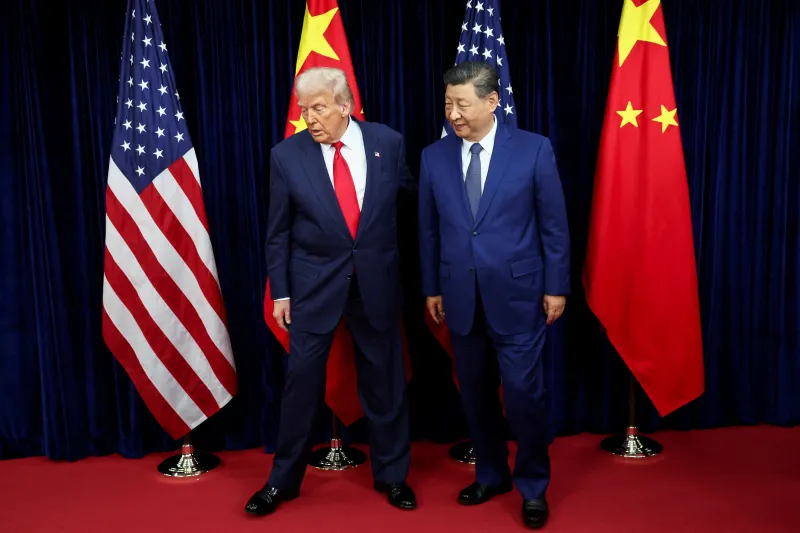
President Donald Trump was meant to meet with his Chinese counterpart, Xi Jinping, at the end of March to stabilize the world’s most consequential bilateral relationship. But as the Middle East burned, energy prices skyrocketed, and the bodies of U.S. service members returned to the United States, Trump reached the conclusion that a trip to Beijing for a high-profile meeting would not be a good look. On March 16, he postponed the trip until May. The fact that he failed to foresee this collision of crises when he originally announced the summit—just eight days before he launched his war of choice on Iran—exposes the administration’s inability to manage multiple global challenges, even those of its own making.
The Trump administration has bandied about a number of goals for its war in Iran, including regime change and destroying the country’s nuclear program. Some Trump boosters have even argued that bombing Iran will help the United States in its competition with China. Matt Pottinger, who served as deputy national security adviser in Trump’s first term, contended in an interview with Bloomberg that the Iran war challenges China’s “axis of chaos,” which also includes Iran, North Korea, and Russia. The Republican senator and Trump loyalist Lindsey Graham, for his part, said in a March interview with Fox News that U.S. military interventions in oil-rich Iran and Venezuela, which are friendly to Beijing, were “China’s nightmare.”
The reality, however, is far different. Despite relying on energy imports that pass through the Strait of Hormuz, China has insulated itself against a near-term disruption in energy supplies. With the U.S. military bogged down in the Middle East, China has a freer hand in East Asia. As Trump behaves erratically and violates international law, China can present itself as a responsible peacemaker. Even if the U.S.-Iranian cease-fire that was agreed to on April 7 holds, the United States has injured its reputation by acting unpredictably, betraying its allies, and starting a war that has done serious damage to the global economy.
When the U.S.-Chinese summit eventually takes place, Xi will enter the talks with significant leverage. While the United States squandered precious military and political capital in the Middle East, China was preparing to get what it wants at the negotiating table. A flailing Trump could trade valuable U.S. assets in exchange for short-term commercial wins—and a lopsided deal with the United States’ biggest rival could undermine U.S. security and prosperity for decades.
UNFORCED ERROR
Trump’s war of choice in Iran has come at the expense of the United States’ security umbrella in the Indo-Pacific, presenting an opportunity for Beijing. The United States has moved materiel from East Asia to the Middle East, including the USS Abraham Lincoln, one of only five U.S. aircraft carriers on active duty globally, and powerful missile defense systems. Many of these batteries were taken from South Korea, which for years endured aggressive Chinese economic pressure in retaliation for hosting U.S. antimissile systems that were supposed to permanently shield the country from an attack by China’s partner, North Korea. The United States’ repossession of those assets over Seoul’s objections showed how little Washington cared about its ally’s sacrifices—and its willingness to divert critical resources sent a message to all U.S. partners in Asia that the region is not a priority. Even if the United States moves key assets back to the Indo-Pacific as soon as the war ends, it has established a precedent that they can be withdrawn at any time, and it will take years for the U.S. military to replace the munitions it has deployed against Iran. The questions that have been raised about American staying power have already weakened deterrence against both North Korea and China.
The war in Iran has also given China a live demonstration of the United States’ military capabilities, which Beijing can now use to hone and adapt its own tactics. By simply observing, the Chinese military has gained a trove of information about U.S. weaponry, decision-making cycles, and use of artificial intelligence that it might put to use in future conflicts in Taiwan or elsewhere. For example, China has likely learned a lot about the way the United States intercepts cruise and ballistic missiles. In a conflict with the United States, China might adjust strike density to overwhelm U.S. defenses or modify sequencing of attacks to exploit reloading windows.
China has benefited from the war in less tangible ways, too. For weeks, Iran has effectively shut the Strait of Hormuz, causing the biggest disruption to oil exports in history and wreaking havoc on the global economy. Trump, meanwhile, called on China and other countries to send warships to keep the strait “open and safe”—effectively inviting Beijing to play the very role it seeks, that of a responsible provider of global stability, while the United States shows itself incapable of managing the fallout of its own unilateral decision to attack Iran.
To capitalize on the chaos, Beijing will likely position itself as a mediator, a muscle it has previously exercised during disputes between Iran and Saudi Arabia and between Cambodia and Thailand. Indeed, according to the New York Times, China helped persuade Iran to accept the April 7 cease-fire. And while the United States is distracted, China will race toward its national goals—reducing reliance on the rest of the world for its energy and technology needs to increase its bargaining power, especially over the United States.
INSULATE TO DOMINATE
To be sure, the war in Iran has caused some problems for China. Its manufacturing sector has been squeezed by higher energy prices, and Chinese farmers have had to deal with higher fertilizer prices during the spring planting season (much of the world’s urea, an ingredient in fertilizer, is shipped through the Strait of Hormuz.)
But China’s economy is resilient and its energy supplies are relatively secure. Beijing has worked for years to insulate itself from price shocks and volatility in global oil markets by developing sources of renewable energy and a massive overcapacity in coal power. Since 2008, renewables have more than doubled as a share of China’s energy mix and now provide more than one-third of the country’s power. In fact, China accounts for a third of the world’s total wind and solar capacity. Chinese manufacturers of batteries and electric vehicles have seen their market valuations surge since the beginning of the war, which investors view as a catalyst for a broader embrace of green energy. Because China already dominates manufacturing of batteries, solar panels, wind turbines, and electric cars, the war will likely increase global adoption of the country’s technology as a cushion against current and future energy shocks.
Although China cannot rival the United States in terms of oil production capacity, its massive stockpiles, now estimated at 1.4 billion barrels, dwarf the depleted U.S. Strategic Petroleum Reserve. For China, this can serve as a backfill for over six months of total disruption in the Strait of Hormuz. And even if China’s energy supplies were to be strained further, the country has other options, such as purchasing more Russian oil. According to the Financial Times, several ships have paid Iran tolls in Chinese yuan to pass through the strait—a success for Beijing, which has been trying to boost the international standing of its currency. A short-term disruption to the Strait of Hormuz, then, is far from a nightmare scenario for Beijing.
In the United States, increases in U.S. oil production can help protect the country against the worst consequences of a global energy shortage, too, but American consumers are still exposed to disruptions in the international oil market. Because of the global nature of the oil marketplace, a reduction in the supply of oil anywhere in the world means an increase in prices everywhere, including in the United States. And, unlike the Chinese leadership, the Trump administration has sought to sabotage the domestic move toward alternative energy sources, leaving American households at the mercy of price fluctuations.
For now, American consumers appear to have been more affected by increases in transportation costs and overall inflation than their Chinese counterparts. Because China has been experiencing a damaging cycle of deflation, higher energy prices could even help by pushing up the price of consumer goods.
EYE ON THE BALL?
The U.S. military intervention in Iran, like the one in Venezuela, is not going to help the United States in its competition with China by isolating Beijing from these two purported partners. China is the ultimate fair-weather friend. It is highly transactional and will not sacrifice its core interests to save Tehran or Caracas. If the goal is to weaken Beijing, U.S. operations in Iran and Venezuela consequently yield a negligible if not zero return on investment, serving only to deplete U.S. resources, tank the United States’ reputation, and raise fuel prices.
If anything, Trump’s impulsive militarism has weakened the United States’ position relative to China’s. It has triggered Iranian attacks on Gulf countries, driving a wedge between Washington and some of its closest partners in the region. These governments are unlikely to abandon the United States entirely in the years to come. But, as U.S. reliability erodes, Gulf countries will increasingly play the superpowers off each other. The United Arab Emirates, for instance, has already increased its cooperation with the Chinese military since Trump’s first term, even as it hosts American bases.
China does not need to replace the United States as a security provider to benefit from Washington’s deteriorating relationship with Gulf capitals. It is enough for Beijing to simply be a predictable partner. Once the smoke clears in Iran and Gulf countries, Beijing will probably step in with reconstruction contracts for damaged ports or energy facilities and long-term investments in infrastructure. The result is likely to be a more transactional Middle East that is less beholden to the United States and more willing to work with China. Put simply, Beijing may be able to pull off what the United States has long sought: significant influence in the Middle East at a manageable cost.
A PORT IN THE STORM
Despite Trump’s “America first” branding, the impulsive war with Iran has been a master class in putting America last. Because of its hubris, United States finds itself in another quagmire without an exit strategy. The Trump administration traded national security for a short-term display of military muscle, and it is now asking the American public to pay the bill. The real winner of this avoidable conflict won’t be Washington or Tehran; it will be Beijing.
As Zongyuan Zoe Liu astutely observed in Foreign Affairs, China prizes stability and does not want to take over every role the United States has filled for decades, such as serving as the Middle East’s policeman. Still, China stands to gain more than it loses from this war. As the United States becomes distracted, alienates its allies, and creates gaps in global leadership, Beijing can improve its relative standing simply by remaining the more predictable actor in an increasingly unpredictable world.
Ahead of the rescheduled Trump-Xi summit, China is likely laying a trap for the Trump administration. According to Bloomberg, Xi may dangle a commitment to buy 500 Boeing airplanes as a high-profile economic win for Trump, who is eager for anything he can spin as a victory. In exchange, Xi could draw an important concession from Trump, such as a loosening of restrictions on the export of advanced American technologies, including AI chips and jet turbines. Such a deal would be catastrophic for the United States. China would gain the tools to be more self-reliant in the long term; the United States would make a quick buck. China could even renege on the airplane order, which would take years to complete.
As the United States speeds up its own decline, China is accelerating its technological self-sufficiency, building its military strength, and upgrading its industrial policy. Its ultimate goal is so-called national rejuvenation. When Trump eventually lands in Beijing, he will represent the United States from a position of self-inflicted weakness. He will face a formidable counterpart in Xi, who has spent years preparing for this exact moment of U.S. overreach. It is time for the United States to stop fighting the wars China wants it to fight and instead train its focus back on its greatest rival: China.