
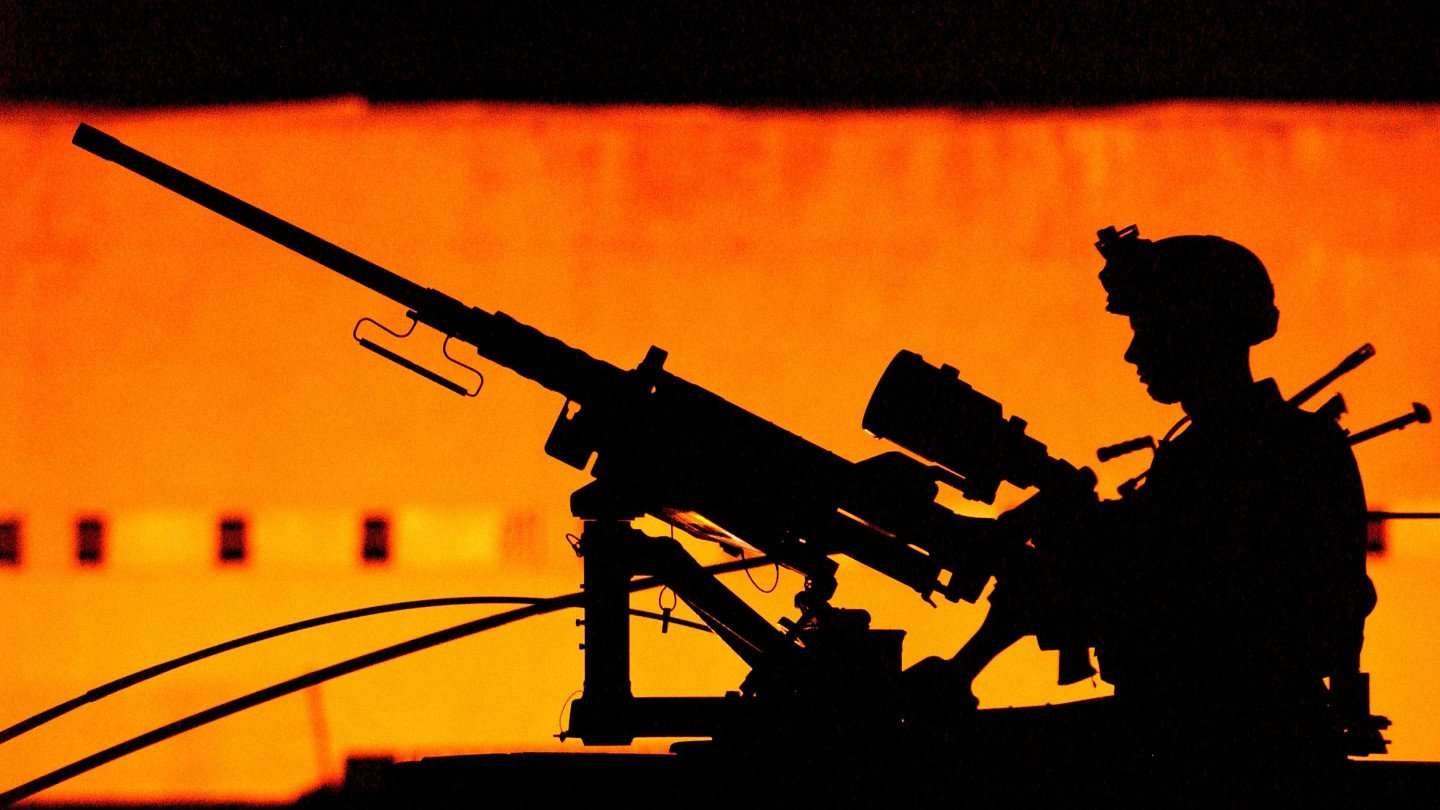
A full-scale U.S. ground invasion of Iran is unlikely due to geographic size, troop requirements, and political risks. Limited tactical operations—Special Forces raids, securing nuclear materials, or targeting Kharg Island—remain possible. Iran’s decentralized “mosaic doctrine” enables sustained resistance, making any ground entry costly and strategically uncertain.
As speculation mounts about whether US troops will be deployed in Iran, analysts say any ground operation would be narrow and tactical, rather than large-scale.
While ground operations in Iran by the US military seem unlikely at this stage of the war, President Donald Trump’s administration has been careful not to rule them out entirely.
Since the US Operation Epic Fury and Israel’s Operation Roaring Lion were launched against Iran on 28 February, the scenario has occasionally resurfaced.
In early March, White House Press Secretary Karoline Leavitt said in a press briefing that ground operations are not currently part of the plan, but that Trump is keeping his options open.
On 6 March, Trump dismissed a ground invasion as “a waste of time”, given what he described as heavy Iranian losses. However, the next day, he suggested that they could be sent in if there was a “good reason”.
Secretary of Defence Pete Hegseth later said the US would not disclose its limits and was prepared to go “as far as we need to” to succeed. Secretary of State Marco Rubio also indicated that ground forces might be required to retrieve Iran’s nuclear material.
These cautious statements over a potential ground operation come as the US claims its attacks are degrading Iran’s military capabilities, in line with its military objectives.
Last week, Hegseth said the US and Israel had carried out more than 15,000 strikes on Iranian targets. He also claimed that Iran’s missile volume has fallen by 95% since the war began.
In a widening conflict, what comes next?
The US and Israeli strikes on Iran have prompted Tehran to broaden the conflict in the region. Iran has retaliated with missile and drone attacks on Israel and US bases and assets in Gulf states and Iraq. Israel has also launched a new war with Hezbollah in Lebanon, and Iran-backed militias have also joined the conflict.
Iran’s retaliation has triggered a crisis in the Strait of Hormuz, halting tanker traffic, disrupting roughly 20% of global oil supply, and driving energy prices higher, amid Iranian threats to block the strait.
Amid the escalating war, any potential US ground operation in Iran would likely aim at limited objectives rather than a full-scale invasion.
Michael Rubin, a senior fellow at the American Enterprise Institute, said that a ground operation is neither realistic nor under consideration. He explained that before Operation Desert Storm in 1991 and Operation Iraqi Freedom in 2003, the US deployed and pre-positioned large numbers of ground troops – something that has not occurred so far.
“That said, there could be some Special Forces actions. But that’s normal,” he told The New Arab, warning that “to conflate that with ‘boots on the ground’ [would] be akin to claiming that the 2011 operation to snatch [founder of al-Qaeda Osama] Bin Laden represented a ground operation in Pakistan”.
A number of factors make a US ground invasion of Iran highly unlikely.
“Iran is far larger and geographically more complex than Iraq, and any invasion would require hundreds of thousands of troops, months of preparation, and regional basing support that currently does not exist,” RANE Mena Global Security Analyst Freddy Khoueiry told TNA.
He suggested that a more realistic scenario would involve ground operations to sabotage missile and drone infrastructure or secure nuclear materials at risk. He also explained that the US is the most capable of a ground operation in Iran but would face political and strategic limits, while Israel, despite stronger incentives, lacks the capacity for such a campaign.
After the US and Israel’s 12-day war on Iran in June 2025, Trump claimed key nuclear sites were “completely obliterated,” contradicting a leaked Defence Intelligence Agency report that only above-ground structures were damaged.
Iran is believed to still possess about 441 kg of near-weapons-grade enriched uranium. Capturing that stockpile is now reportedly being discussed within the Trump administration, according to CNN sources.
Conflicting reports also suggested the US had discussed possible military cooperation with Kurdish groups, including arming them to rise up against the Iranian regime. President Trump at first expressed support for Kurdish involvement, but later said he didn’t want Kurdish forces to enter the conflict.
Andreas Krieg, associate professor at the Defence Studies Department of King’s College London, told TNA that the most likely objectives for any US or Israeli ground element would be narrow and tactical rather than transformative, with brief deployments to secure key targets, run intelligence operations, or assist Kurdish proxies in the northwest.
“But once the objective moves from raid and withdraw to holding territory, protecting a successor authority, or driving regime change, the logic changes completely,” he said.
“At that point, the operation becomes much harder to reconcile with current war aims, and the gap between military action and political purpose becomes very hard to manage.”
Alongside potential US ground operations against Iran’s nuclear, missile, and drone sites, Khoueiry said that locations such as Kharg Island, which handles up to 90% of Iran’s oil exports and is vital to its economy, or ports like Bandar Abbas, “could be targeted to disrupt Iran’s economic lifelines and maritime operations”.
Amid a global energy crisis centred on the Strait of Hormuz, the US and Israel are seeking to prevent Iran from obstructing vessel passage, claiming that recent strikes had largely neutralised Iran’s naval capability.
Part of this effort focused on Kharg Island, about 30 kilometres off the Iranian mainland and vital to the country’s economy.
On Saturday, the US bombed military targets on Kharg Island, with Trump saying on Truth Social that he spared oil facilities for now but warned of retaliation if shipping through the Strait of Hormuz is threatened. Trump later urged allies to help secure the Strait, and analysts have suggested that US troops could potentially target Kharg Island to gain leverage over Iran’s oil exports.
Costly and complex
Despite these options on the table, Ali Alfoneh, a senior fellow at the Arab Gulf States Institute, doesn’t expect such an operation to occur.
“Any such operation would likely entail significant US casualties, something President Donald J. Trump may be reluctant to risk,” he told TNA. It would also pose strategic and political challenges for the US.
Krieg identifies four risks. A ground entry would signal an open-ended campaign and raise the likelihood of regional escalation, he said. It would also bolster Iranian nationalism by allowing Tehran to frame it as foreign aggression and potentially strengthen the regime in the short term.
In addition, Krieg added it would expose US or Israeli forces to Iran’s mix of conventional, irregular and decentralised threats, and, lastly, create occupation challenges as holding territory raises questions of governance, security, and withdrawal without leaving a power vacuum.
“Washington’s public line has focused on degrading capabilities rather than launching an Iraq-style regime-change war, while parts of the Israeli discourse clearly point towards a broader political transformation inside Iran,” he said, adding that sending ground troops would escalate the war, making it harder to claim it’s limited.
Boots on the ground could also unsettle Gulf states, increase pressure to end the war, and raise their risk of Iranian retaliation.
Despite the decapitation of much of Iran’s command structure, including the assassination of Supreme Leader Ayatollah Ali Khamenei, Iran is still believed to have the resources to withstand a potential US ground operation.
In an interview with NBC News on 5 March, Foreign Minister Sayed Abbas Araghchi said that Iran is prepared for such a scenario.
Iran’s military is composed of the regular army (Artesh), with roughly 350,000 active personnel, and the Islamic Revolutionary Guard Corps (IRGC), an elite force loyal to the Supreme Leader, with about 190,000 active members, according to open-source estimates. The Basij, a paramilitary volunteer militia under IRGC control, has about 90,000 active personnel and can mobilise up to 600,000 reservists.
Alfoneh explained that the introduction of the so-called ‘mosaic doctrine’ in the mid-2000s more closely integrated the Basij militia with the IRGC and formalised its decentralised structure.
“Under this system, provincial IRGC commands are designed to continue fighting even if the central leadership is decapitated – or even if Tehran itself were to fall,” he said. “Such a structure is capable of imposing significant casualties on the US military in the case of a ground invasion of Iran.”
Krieg said Iran would unlikely repel a concentrated US raid, especially if the coalition holds local air superiority and surprise.
Yet its system remains intact, with parts of the military-security apparatus acting with greater local autonomy, making Iran “more dangerous in exactly the type of conflict that follows an initial breach: dispersed, adaptive, locally driven resistance rather than a neat hierarchical response,” he said.
This means that Iran could make any ground invasion costly, politically complex, and hard to convert into lasting success.