
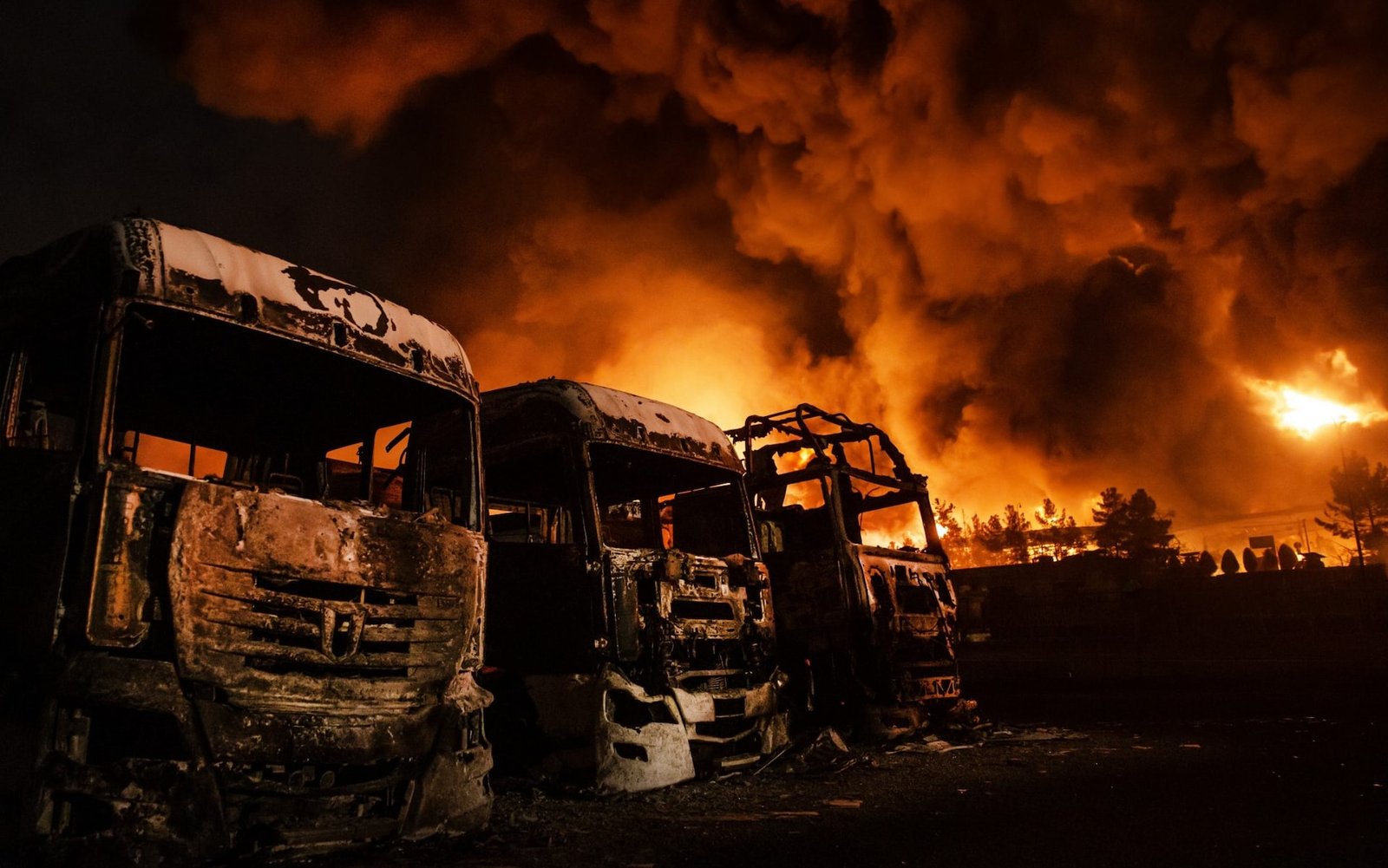
What is wrong with the West’s expert class? Do they really believe, as they keep telling us, that the war against Iran is a disaster, the end of days, the final humiliation for Donald Trump? Such defeatism, such catastrophism are not warranted. It is far too soon to conclude how this war will end, regardless of what Iranian propagandists and other appeasers would have us believe.
I can count seven principal errors clouding “expert” judgments in the West.
Error 1
The first is the European establishment’s inability to accept the scale of Iran’s defeats since the Oct 7, 2023 pogroms against Israel, one of the greatest military miscalculations in modern history.
The regime’s decades-long plan for regional domination lies in tatters. It has wasted tens of billions of dollars, its proxies have been defanged, its economy plunged into depression, its mainland ravaged with close to 20,000 targets bombed, its navy sunk, its air defences crippled, its missile stock and launchers decimated, its military-industrial complex blown up, its nuclear capacity curtailed – but apart from that, all is well in Tehran. It is a strange kind of victory which has seen Iran fail to shoot down a single US or Israeli manned plane or sink a single ship.
The reality is that Iran has been downgraded from regional superpower to a pirate terror state, able only to shoot a few missiles and drones at civilian targets, to threaten crimes against humanity, and to blackmail the shipping industry.
Yes, this residual power matters greatly: controlling the Strait of Hormuz and threatening Gulf oil and gas facilities is a potent form of asymmetric warfare that is inflicting devastating damage. But it hardly amounts to US defeat, or certainly not yet.
I don’t know how this war will end. Trump’s negotiations may fail. He may botch an invasion, or he may launch a successful airborne raid. What is certain is that he must reopen the Strait and will be judged on the outcome.
Error 2
The second myth is that Trump is somehow struggling because he supposedly failed to plan for the obvious. In fact, many US assumptions were either right or too pessimistic. It proved remarkably easy to kill Ali Khamenei. Iran failed to overwhelm US and Israeli defence systems.
Critics warned that stockpiles of allied interceptors would run out almost immediately; that was false. The Gulf states turned out to be more resilient than anticipated; instead of turning to China or hoisting the white flag, they shot down missiles, and the Saudis and UAE are moving closer to Washington. US combat losses have been smaller than expected.
Not everything has gone better than planned. Trump may have hoped that Iran’s ability to deploy missiles and drones would have diminished further. The low-probability possibility of an immediate implosion of the regime hasn’t materialised. It may well be that the US underpriced the chances of attacks on Qatari energy assets.
But the idea that Iran would move to block the Straits of Hormuz was the best-rehearsed risk in geopolitics. Trump probably accepted it as a necessary trade-off, an inevitable hit. It may well be that Trump didn’t expect Iran to move so fast. It might have been a blunder not to dispatch more demining resources to the Gulf ahead of time. We shall soon find out; the stakes are enormous.
Error 3
The third problem is Europe’s inherent defeatism. Writing in Foreign Affairs in 1969, Henry Kissinger argued that “the guerrilla wins if he does not lose. The conventional army loses if it does not win.” This point, sensible in the context of Vietnam, has been universalised to the point of stupidity.
Many in the West now claim that anything short of a total destruction of the Iranian regime signifies victory for the IRGC, and defeat for America, parroting the ayatollahs’ line. Such absurd premises would rule out any Western power ever winning a war again, barring a World War II-style total victory.
In the real world, America and Israel will have succeeded if they severely degrade Iran’s nuclear, missile and military capacities and reopen the Straits of Hormuz. Regime change would be a triumph, but isn’t necessary for victory (and could happen later).
Error 4
The fourth fallacy is caused by critics’ pathological hatred of Trump, a flawed man who is doing the right thing on Iran. His enemies are deploying every argument, however contradictory. Those who dismiss the President as a populist criticise him for pursuing an unpopular policy. If America kills an Iranian leader, we are told it will strengthen the regime; if some survive, that also confirms America’s weakness. Whatever the US does is wrong.
Iran’s (remaining) leaders are depicted as brilliant strategists, while it is assumed that Trump is an imbecile. Iran’s extreme negotiating positions are naively taken to mean that the regime must be winning, rather than as a bluff.
Error 5
It was widely agreed that we should all sacrifice for Ukraine, another war I support. The fifth error of judgment in the West is to argue that the reverse is true over Iran: no financial cost to the public, however trivial, is deemed worth it to remove the regime. Why is it fine for the public to pay taxes to fund greater benefits, or higher prices for net zero, but not to fight a vile terror regime?
Error 6
The sixth error is explained by the virulent spread of anti-Semitism among Western elites. Over the last few years, much “analysis” of Israel has appeared, however unknowingly, to imbibe the grotesque lies of the Blood Libel (Norwich, 1144, child killers), the Protocols of the Elders of Zion (Russia, 1903, Netanyahu controls Trump via an international Jewish conspiracy) and the Soviet Ministry for Propaganda’s anti-Zionist campaign of delegitimisation (USSR, 1960s-70s, Israel is a racist, apartheid, “settler-colonialist” state).
The Saudis were among those pushing for Trump to attack Iran, and are now desperate for him to finish the job. Yet nobody blames them for “controlling” Trump (even though Gulf states bankroll the US economy, unlike Israel); instead, the critics obsess about the Jewish state.
Trump, a longstanding Iran hawk – he told The Guardian in 1988 about “doing a number on Kharg Island” – is portrayed simultaneously as a bullying dictator who refuses to listen to wiser heads, and also as a puppet, a simpleton duped by Netanyahu. The Israelis wanted the war, but the US president is in charge. He pushed the button, and, when he decides to stop, Israel will fall into line.
Error 7
Last, why does the bien-pensant Left not care about the human rights of the oppressed Iranian people? Why do they sound almost gleeful that the regime hasn’t fallen? And why do many Right-wingers – who oppose extremism in the UK – refuse to get involved to chop off the head of the Islamist snake?
This is our war, too. The fact that we cannot see it, that we are convinced that it must fail, is a terrible indictment of our moral degeneration.