
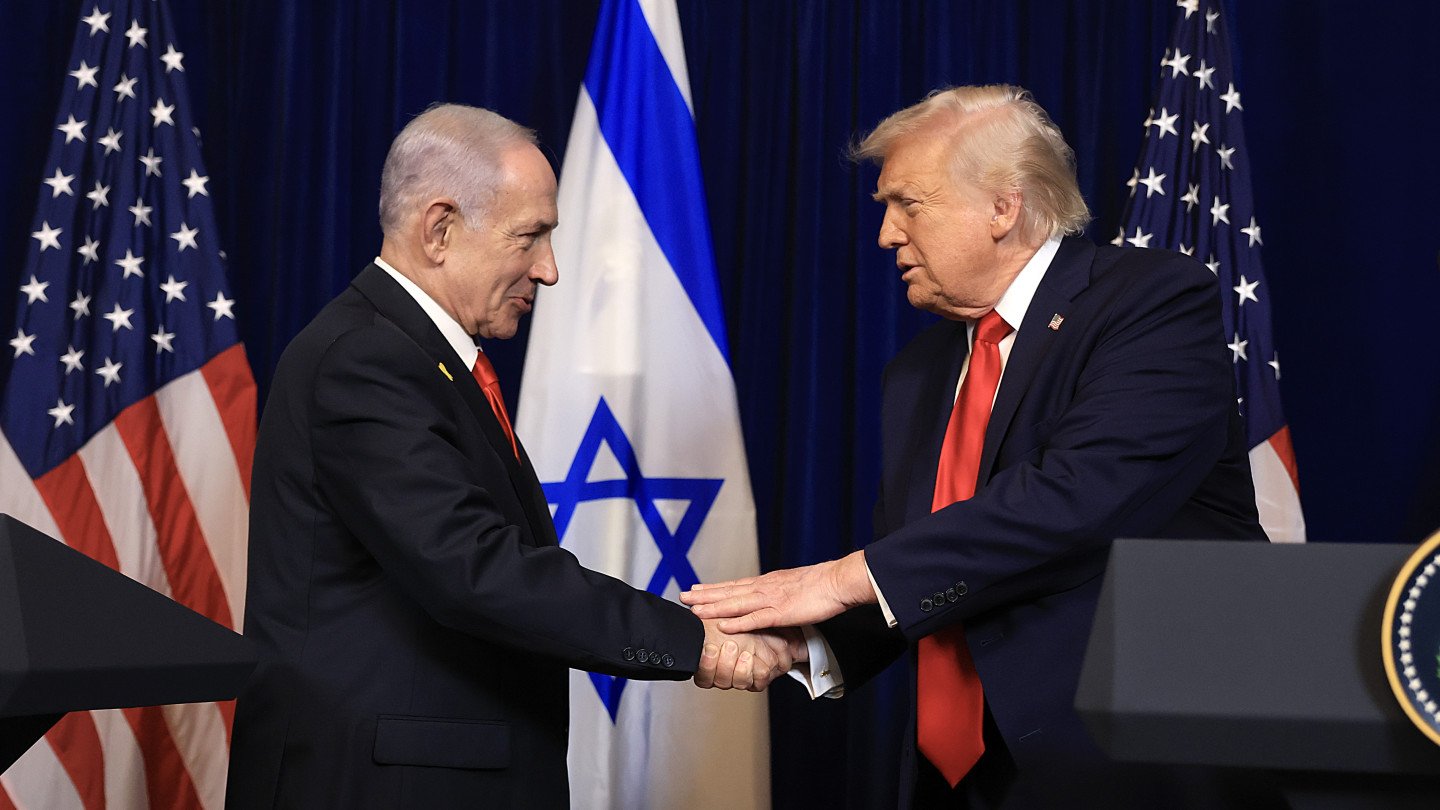
U.S. and Israeli goals diverge: Washington seeks containment and market stability; Israel pursues regime change. Israeli strikes on pragmatists eliminate off-ramps. Trump faces low support and economic pressures, while Netanyahu benefits from escalation. This tension complicates ending the war.
While the US seeks to contain Iran and protect energy markets, Israel is pursuing a scorched-earth policy to collapse the regime, complicating how the war ends.
US President Donald Trump and Israeli Prime Minister Benjamin Netanyahu are showing signs of divergence in their approaches to the American-Israeli war against Iran, which has now reached its one-month mark.
The Israeli strike on Iran’s South Pars gas field on 18 March starkly highlights the uncertainties surrounding just how closely the two leaders are aligned in prosecuting this war.
While hosting Japan’s Prime Minister Sanae Takaichi in the Oval Office one day after Israel’s strike on South Pars, Trump told the press that he disagreed with Tel Aviv’s action and did not approve of it.
“I told [Netanyahu], ‘Don’t do that,’” said Trump. “We get along great. It’s coordinated, but on occasion he’ll do something. And if I don’t like it – and so we’re not doing that anymore.”
Although Trump asserted that he had no prior knowledge of the Israeli strike on Iran’s vital gas field, it is evident that the United States must have been aware before the attack took place.
US and Israeli strategies diverge
While US military efforts in Iran have largely targeted Tehran’s ballistic missile and nuclear programs, as well as its navy, Israel’s strategy has centred on regime change through high-profile assassinations or, at the very least, by efforts to drive Iran toward some sort of civil war.
“The objectives that have been laid out by the president are different from the objectives that have been laid out by the Israeli government,” noted Director of National Intelligence Tulsi Gabbard to House intelligence committee members on 19 March in response to questions about the Trump administration’s stance on the Israeli strike on South Pars one day earlier.
Another senior Trump administration official recently said, “Israel is pursuing a scorched-earth campaign of regime change, which is not what our goal is. Bibi wants to wreck Iran’s economy and decimate its energy infrastructure. Trump wants to keep it intact.”
Economic and energy considerations
In an interview with The New Arab, Dr Sina Azodi, Director of the Middle East Studies Program at George Washington University, addressed these differences in Washington and Tel Aviv wartime goals.
“The US is more concerned about stability in Iran and, of course, the global oil market, whereas the Israelis are laser-focused on creating chaos and instability in Iran.”
Supporting this view, Aron Lund, a non-resident fellow at Century International, told TNA that the United States, far more than Israel, is acutely sensitive to disruptions in energy markets.
Within this context, the decision to grant a sanctions waiver on Iran’s oil that was already seaborne until 19 April, however ironic, becomes understandable as a measure to curb further spikes in oil prices.
“US policy so far has been, more or less, to try to keep the oil out of the war. It’s not just about the fate of Iran’s own energy infrastructure. There’s also the fact that Iran’s stated and proven policy is to retaliate against Gulf Arab oil and gas infrastructure. They’re effectively saying that if we can’t sell oil and gas, no one can – and your gas prices will skyrocket,” noted Lund.
“If the war slides into a full-scale exchange involving energy targets, the economic impact could be catastrophic. As much as he wants to harm the Iranian regime, Trump seems to draw a line around oil and gas,” he explained to TNA.
Fears of even more of a worldwide economic impact should this conflict persist are entirely justified. Within the first month of this conflict, oil prices have surged past $100 a barrel, heightening the risk of a global recession. With European gas prices having doubled and financial markets roiled by volatility, consumers worldwide are bracing for sharp increases in living costs.
Meanwhile, the US Federal Reserve, the Bank of England, and the European Central Bank have all warned that the escalating conflict could drive inflation higher while weighing on global growth.
What must also be considered is that public support in the United States for this war remains low, while Trump faces mounting pressure from his MAGA base to avoid allowing America to become entangled in another protracted conflict in the Middle East.
Netanyahu, by contrast, operates within a domestic political landscape in Israel that rewards his hawkish foreign policy and continued escalation with Iran. In this context, Tel Aviv is uneasy about signs that Trump may seek to wind down the conflict sooner rather than later. Netanyahu’s government, instead, prefers that the United States remain committed to the war until Israel’s regional objectives are achieved.
This brings us to Israel’s motivations for targeting “pragmatists” within Iran’s regime, such as Ali Larijani. Dr Azodi explained that “the objective is to remove the people who have the influence and power to control the armed forces and those who could play a role in the final political settlement.”
In essence, as Dr Azodi noted, influential figures capable of bridging divides within Iran’s political establishment are being killed. He added that “essentially, this would result in less flexibility and eliminating the ‘off ramps’ to end the war sooner.”
Even as Israel’s strikes against figures like Larijani narrow the paths toward a negotiated settlement, some powers in the neighbourhood have stepped in to explore diplomatic avenues to de-escalate the conflict.
Pakistan, with backing from Egypt and Turkey, has emerged as a central diplomatic bridge between the United States and Iran. Officials in Islamabad have also maintained close contact with counterparts in the European Union, Saudi Arabia, and the United Arab Emirates to advance such diplomatic efforts.Whether Pakistan’s attempts at mediation can prevent further escalation remains uncertain. Nonetheless, citing talks with Tehran that are proceeding “very well,” Trump has, for the second time, postponed plans to strike Iranian energy infrastructure, now until 6 April.
This is despite Iran’s denials of the purportedly productive discussions. Pakistani and Egyptian officials have stated that there is a push for in-person US-Iran talks to take place in Pakistan very soon.
Although Trump might calculate that taking a diplomatic off-ramp best serves US interests, Israel, on the other hand, will not welcome any diplomatic breakthroughs between Washington and Tehran.
With Tel Aviv seeking to see the United States continue its war and economic pressure on Iran until the Islamic Republic falls from power, any success at the negotiating table will be a threat from the Israeli government’s perspective.
Israel’s influence in Washington
As divergences between American and Israeli interests in the war on Iran become increasingly apparent amid its mounting impact on the global economy, attention is turning to the role of Netanyahu and his government in influencing Trump to launch Operation Epic Fury late last month.
Although foreign policy experts debate how much responsibility for the decision lies with Tel Aviv, there is little doubt that Israeli influence was among several factors shaping the move.
“It is abundantly clear that Israel played a key role in persuading the US to go to war against Iran. Senior US officials are confirming it, and senior Israeli officials are celebrating it, and stating that with Trump, they have succeeded where with all his predecessors, including the first Trump administration, they have failed,” explained Mouin Rabbani, a political analyst and co-editor of Jadaliyya, in a TNA interview.
“To claim otherwise, or suggest this is a conspiracy theory, is to deny reality. That does not mean that Washington did not have its own reasons for acting in accordance with Israel’s agenda and preferences,” he added.
In this context, as Rabbani noted, the only assessment of US interests that carries weight is that of those in positions of authority. Evidently, a sufficient number of influential figures within the administration – among them war hawks, anti-Iran ideologues, Christian Zionists, and neoconservatives – were able to advance the case for war.
Many experts argue that the Trump administration’s bold military actions in recent months – most notably the June 2025 airstrikes on Iran’s nuclear facilities during Operation Midnight Hammer and the capture of Venezuelan President Nicolás Maduro in January amid Operation Absolute Resolve – served as major foreign‑policy milestones in his second term.
Those high‑profile operations, they contend, bolstered Trump’s confidence and did much to shape his calculation that launching Operation Epic Fury would be another defining achievement.
“Trump apparently overlooked the obvious fact that Iran is not Venezuela and learned the wrong lesson from the success of the military operation in Caracas,” Gordon Gray, the former US ambassador to Tunisia, told TNA.
“Netanyahu has a long history of advocating for military action against Iran, but Trump’s impulsiveness, his failure to appoint senior advisors who speak truth to power, and his purge of career diplomats with expertise in the Middle East and the energy sectors better explain why the United States launched this war of choice,” added Gray.
As the US-Israel-Iran conflict rages on, the divergence between Washington and Tel Aviv’s interests highlights a complex interplay of the White House and the Netanyahu government’s strategies and aims.
With Israel’s leadership prioritising the Islamic Republic’s overthrow, or at least the fragmentation of Iran, the Trump administration’s approach has been more focused on containing Iran’s nuclear and missile capabilities and protecting global energy markets from further chaos, as highlighted by the US response to Tel Aviv’s strike on South Pars.
Trump and Netanyahu’s negotiated tension
Ultimately, even with the US and Israel sharing certain interests vis-à-vis the Islamic Republic and its regional influence, it is not through perfect coordination that Washington and Tel Aviv wage this war on Iran. Instead, it is through a negotiated tension in which Trump and Netanyahu’s overlapping yet distinct ambitions play out.
The reality is that Israel pursues clearly defined objectives, while the US administration’s goals appear ever shifting, with Trump’s team issuing one contradictory statement after another.
“Trump’s approach to Iran validates New York Yankees all-star Yogi Berra’s truism that ‘if you don’t know where you are going, you’ll end up someplace else.’ Trump has test-driven an ever-changing set of objectives, but the most common one is reopening the Strait of Hormuz,” Gray told TNA.
“Simply put, he is trying to extinguish the fire he set. Israel, on the other hand, has had a clear objective all along: ‘A scorched earth policy of regime change,’ in the words of the anonymous Trump administration official.”