
The Iran war ends Gulf hedging: U.S. guarantees proved unreliable, Russia and China failed to act. Gulf states seek new partners. Europe can fill the gap through maritime compacts, air defense, and technology cooperation, offering a durable framework to stabilize the region.
The war on Iran marks a turning point in the security calculus of the Gulf monarchies. Strategic hedging has failed—and Europeans could become just the reliable partners the monarchies need.
The war on Iran has created a “Zeitenwende moment” for the Gulf monarchies. It marks nothing less than the end of their policy of strategic hedging, both globally and regionally. Despite their turbulent relationship with Iran, these islands of stability in the Middle East have never directly experienced such an extreme level of conflict and tensions. The war has changed their security calculus and geopolitical positioning, and they will now be on the lookout for stable and reliable partners. This opens up space for partnerships between Europeans and the Gulf monarchies to stabilise this region of great importance for the global economy.
The paradox of US security guarantees
The war has exposed the big paradox of Gulf security. The backbone of the monarchies’ security architecture, their partnerships with America, has turned out to be less an asset and more a liability. Their hosting of US forces gave Iran a pretext for disproportionate retaliation against them. And yet, the America did not heed their call to avoid an all-out war. Nor did it prioritise defence of their critical infrastructure, even as strikes on oil and gas assets shook the energy market, hits on airports and ports disrupted global connectivity, and the blockade of the Strait of Hormuz upturned trade. To add further irony, America stonewalled Gulf requests for more interceptors since US resources were focused on the defence of Israel, which retains priority in the hierarchy of alliances. Disappointment in America runs deep in almost all Gulf capitals, but the US remains indispensable for the region’s defence architecture.
Doubts about Washington’s willingness to defend the monarchies, already after Iran’s attacks on the UAE and Saudi Arabia in 2019, encouraged them to diversify their partnerships towards a more multipolar regional order and away from the West. The 2026 war has exposed the limits of this approach. Moscow rebuffed Arab requests to press Iran to halt attacks on Gulf states; Russian diplomacy has aligned largely with Tehran’s narrative, while providing coordinates for Iranian military intelligence. China has refused to take on any meaningful responsibility for the Gulf or the Strait of Hormuz, instead opportunistically negotiating for tankers trading oil in renminbi to get exceptional transit permits. Neither Pakistan nor India has acted on the alliances they signed with Saudi Arabia and the UAE, respectively.
The cost of restraint v the cost to deter
Gulf monarchies initially tried above all to avoid direct involvement in the war, given the risk of devastating retaliation were the conflict to escalate. But Iran’s relentless barrage on critical infrastructure in every Gulf Cooperation Council (GCC) member and its utter disregard for the value of regional diplomacy is nudging them closer to joining the war. The monarchies simply cannot live with a surviving but vengeful Iranian regime that can hold them hostage through missiles and maritime blockades, and has lost what little trust it had cultivated over a couple of years of detente. They need to make sure Iran’s ballistic capabilities are neutralised; there will be no return to detente any time soon.
For the foreseeable future, Oman will likely remain the only GCC member able to sustain working relations with Tehran. The other Gulf monarchies may keep de-confliction channels open out of necessity, since Iran is a permanent neighbour. But political and economic relations are unlikely to survive, and mediation will revert to simply facilitating the exchange of messages. Even Dubai will keep the screw tight, despite for decades working as a backchannel for a heavily sanctioned Iranian economy.
Directions for the new Gulf security architecture
The outcome of the war will determine the future security architecture in the region. But in capitals across Gulf states, discussions are already well under way about the possibilities. One option is a regionally anchored architecture that lessens the monarchies’ dependency on any one external actor.[1] This would be built around a GCC core, with integrated missile and air defence, closer command, and control coordination and direct intelligence sharing. A second layer of regional defence could then be represented by regional actors with meaningful military capabilities such as Pakistan, Egypt and Turkey.
This is an architecture that counterbalances both Iran’s and Israel’s hegemonic ambitions. Such a model, however, might collapse under the weight of differences—deepened by the uneven impact of the war—within the GCC itself, especially around the question of Israel. Israel is viewed in most regional capitals—especially Oman and Qatar—as the key architect of this conflict. [2] They see the Israeli government as possessed by a post-October 7th crusading impetus to crush potential threats, by expanding Israeli influence from the Mediterranean to the Arabian Sea.[3] Prime minister Binyamin Netanyahu’s comments that the blockade of Hormuz is a clear encouragement to work on permanent connectivity between the Arab Gulf and Israel has further galvanised theories in Gulf states that Netanyahu sees geoeconomic and strategic gains in regional devastation.
Still, Israel might end up looking like the only option in a reality of such high tensions in the Gulf, as it already does for officials in Abu Dhabi. If the war ends with Iran unable to pose a threat to US interests—its nuclear program obliterated and with no capacity to control regional proxies—this could accelerate a US retrenchment from Gulf security. And if Israel emerges as the only country able to commit to containing Iran and offers comprehensive security guarantees in exchange for normalisation, some Gulf capitals may feel coerced to accept the offer and lock in a permanent state of tensions in the region.
But a third way is possible.
A space for Europe
The war on Iran is undermining core European interests in terms of energy security, trade and connectivity. A state of permanent tensions is simply unacceptable. It is in the European interest to start taking more responsibility for Gulf stability, thereby strengthening the EU’s role as a geopolitical and security actor and thus accruing greater influence.
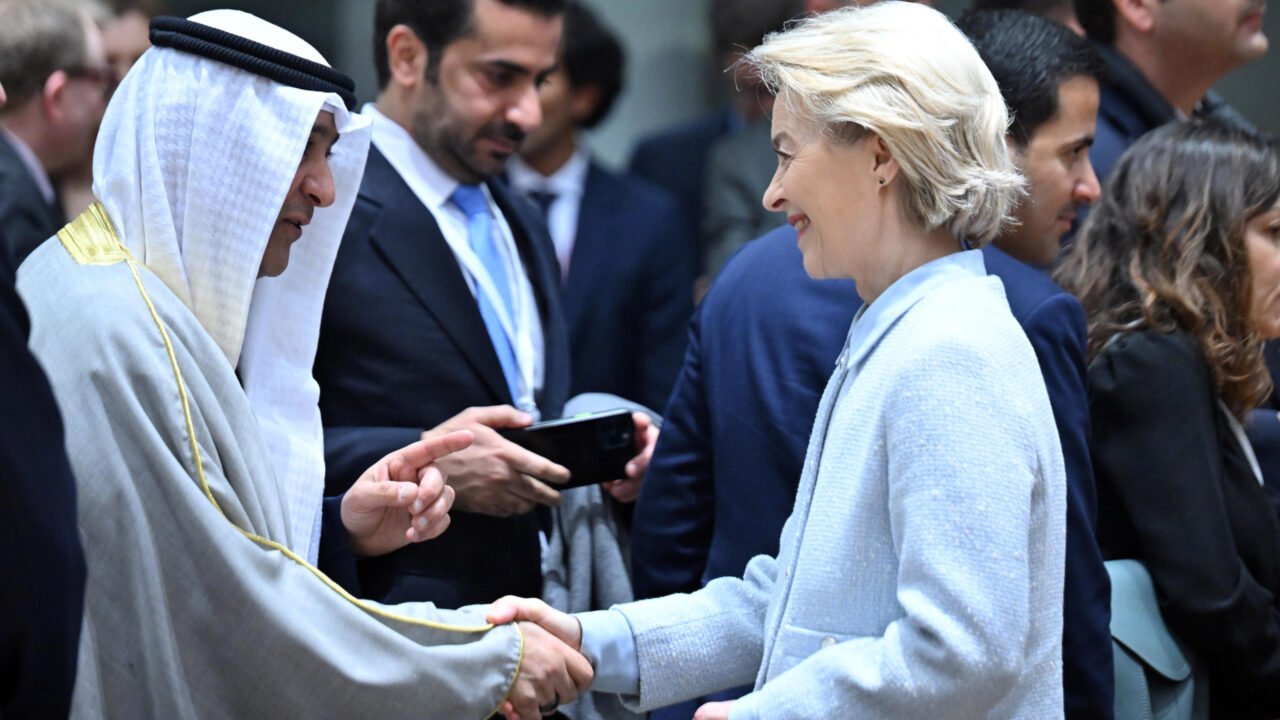
Unlike China and Russia, or even America, the EU, member states and European countries have already shown political alignment with Gulf states and a willingness to back that alignment with security support. In an extraordinary EU-GCC ministerial meeting in March 2026, the EU was quick to affirm solidarity with Gulf states and endorse their positions, priorities and policies. The EU raised the possibility of using its maritime missions to prop up deterrence in the Strait of Hormuz once hostilities have ended. Italy and France have deployed air-defence assets, and Britain has sent Typhoon fighter jets to strengthen coverage across the Gulf. Europeans have also facilitated cooperation between Gulf states and Ukraine: Kyiv has provided battle-tested systems and expert teams designed to counter Iranian drones, which Russia has been firing at them for years.
Europe now needs to position itself as a durable and credible pillar within a “US plus” security framework. This is the best option in a region where multipolarity has failed; yet America, while indispensable, is no longer sufficient on its own and could claim the degradation of Iran’s nuclear threat is sufficient reason to pivot away. Europeans should transform existing naval missions into a permanent, well-resourced maritime security compact covering both the Strait of Hormuz and the Bab al-Mandab, which provides access to the Red Sea. European capabilities must extend from escort and monitoring to encompass minesweeping, air and missile defence support, and the protection of critical infrastructure (including ports, coastal energy export terminals, offshore oil and gas fields, and undersea cables).
Europeans and their partners should embed such a compact within a broader diplomatic framework that prioritises securing freedom of navigation through structured engagement with Iran. The compact should also link maritime security arrangements to a permanent ceasefire and, where possible, to broader political understandings that reduce incentives for disruption.
At the same time, Europeans should address regional vulnerability to chokepoints by co-investing in bypassing Hormuz, including expanded connectivity infrastructure from the Gulf to the Red Sea and the eastern Mediterranean. They should also encourage the expansion of Ukraine-Gulf cooperation towards a Euro-Ukraine-Gulf defence innovation alliance. This would focus on developing new and existing technology and capabilities specifically designed to counter drones, including with “soft kill” electronic and cyber warfare, which could hugely benefit European defence as well.
Finally, Europeans must further intensify their political dialogue with the monarchies. The war will push Gulf states increasingly to focus inwards: rebuilding what was destroyed; propping up their geoeconomic and development plans; and restoring their image as stable, open global nodes. Europeans should expect them to be less active in supporting regional stabilisation, mediation and reconstruction in Gaza and the Levant. It will therefore be necessary for Europeans and Gulf states to develop a realistic plan to divide the burden and responsibility for containing instability in their shared neighbourhood.
In short, Europeans must help steer the region away from the vortex of violence that sucks in the legitimate security concerns of the Gulf countries, and could trap them and their neighbours in a state of perpetual tensions and instability.