
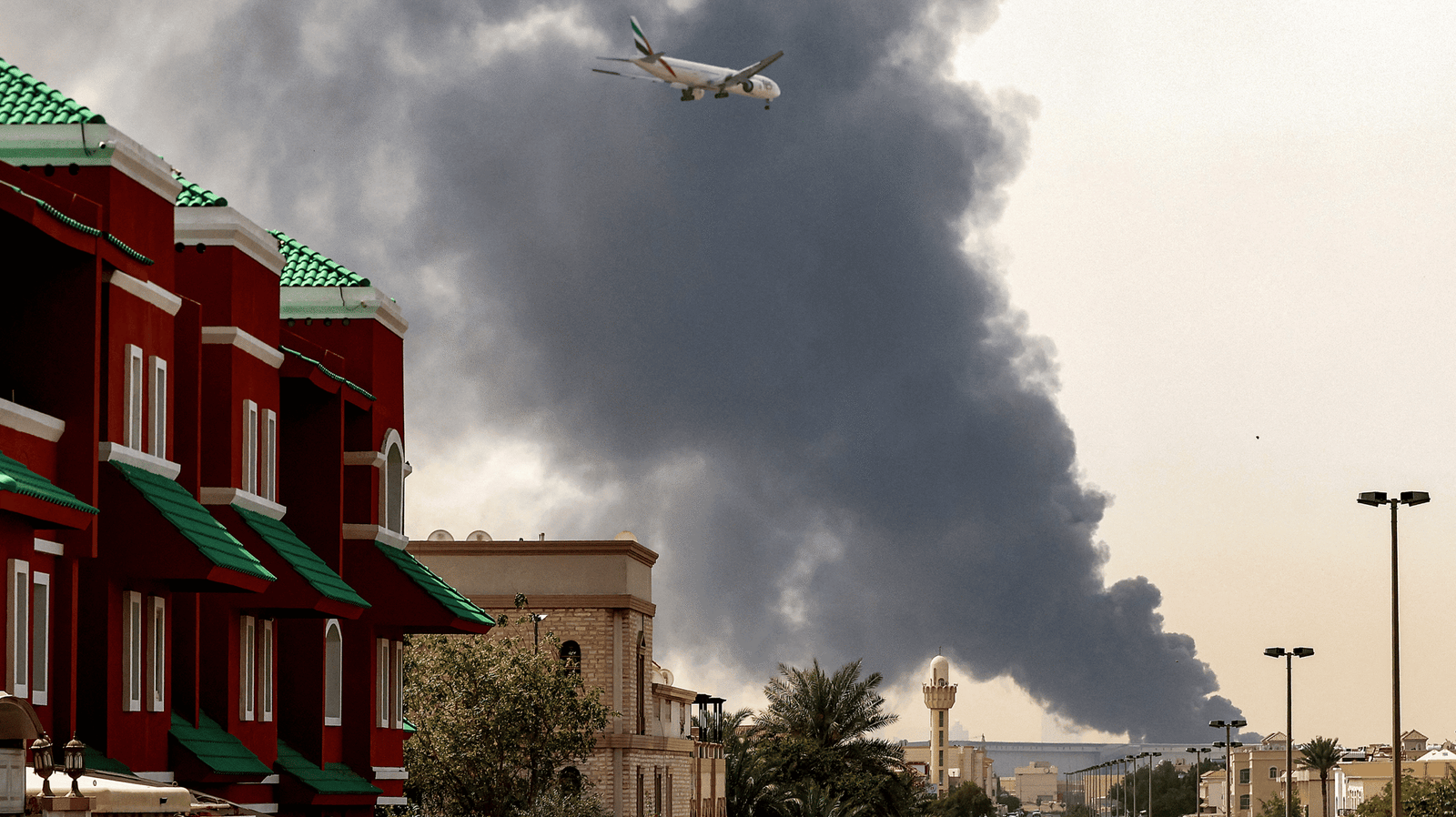
Iran’s strikes on GCC states target energy and civilian hubs, reshaping regional security. Diplomacy failed to deter attacks, undermining trust in US guarantees. Gulf states now prioritize infrastructure defense, seek new alliances, and shift toward collective military capabilities amid widening economic and strategic vulnerability.
Since the US and Israel began their air campaign against Iran, the Islamic Republic has launched wide-ranging drone and missile attacks against all six GCC states. The damage inflicted is intended to put pressure on them, spread the cost of the war and expose the limits of US capabilities and will. Iran’s decision to strike its neighbours will reshape how they define their security and defence priorities.
While only a few of the more than 4,000 Iranian projectiles launched against the Gulf Cooperation Council (GCC) states have hit their intended targets as of 19 March 2026, they have sent shockwaves across global energy, industrial and financial markets. Iran had already targeted energy infrastructure in 2019 and the United States’ military sites in the Gulf in 2025, but its current response is qualitatively and quantitatively different and has firmly crossed red lines that the GCC had hoped would be safeguarded by their diplomacy and ostensible neutrality. Iran has systemically targeted military, energy and other economic sites as part of a strategy of asymmetric warfare that has left no country unaffected. The United Arab Emirates (UAE) and Kuwait have been disproportionately attacked, while Oman and Qatar, Iran’s traditional interlocutors, have also suffered material damage.
From the military domain to the economic
The overall distribution of successful hits across the GCC extends beyond military and dual-use facilities and is significantly weighted towards civilian infrastructure that is central to the global economy. Iran has targeted the region’s energy and transport infrastructure, the pillars of GCC global power; in doing so it is seeking to damage Gulf citizens’, residents’ and investors’ confidence in these states’ ability to provide security to citizens and foreign workers. Despite repeated claims by Iranian officials that civilian areas are not being deliberately targeted, confirmed strikes on airports, ports, tankers, refineries, utilities and industrial and residential areas, especially in Bahrain, Oman, Qatar and the UAE, have widened the consequences of the conflict far beyond the military domain. Iran has justified its actions by deeming any economic infrastructure supporting military action against it (directly or indirectly) a legitimate target. This underscores the scale of the challenge for GCC states’ security: until now, obtaining external security guarantees had been the priority. From now on, the protection of their own critical infrastructure, economic continuity and societal resilience will likely be the foremost goals.
Energy infrastructure has been especially exposed. As Iranian attacks have ramped up, so too have the number of successful hits on energy assets across the GCC. Key Saudi refineries in Ras Tanura and Yanbu have been hit, with the latter potentially jeopardising all possible energy-supply routes out of the Gulf, given its location on the Red Sea provides an alternative to the Strait of Hormuz. Iran has hit Oman’s transport and logistics infrastructure, including ports that function as partial bypass routes. Kuwaiti refineries have also been targeted: the Mina Al Ahmedi refinery came under two waves of attacks on 19 March alone. More than 25 companies operating in the GCC, including national and international energy firms, have applied force majeure. QatarEnergy was the first to invoke the emergency measure after several waves of Iranian strikes on Ras Laffan, one of the world’s largest liquefied natural gas (LNG) facilities. QatarEnergy’s LNG-export capacity has been reduced by 17%; an estimated 3–5 years will be required to restore the facility. As Qatar supplies 20% of the world’s LNG exports, urgent questions will therefore persist over the security of global gas supply beyond this stage of the conflict.
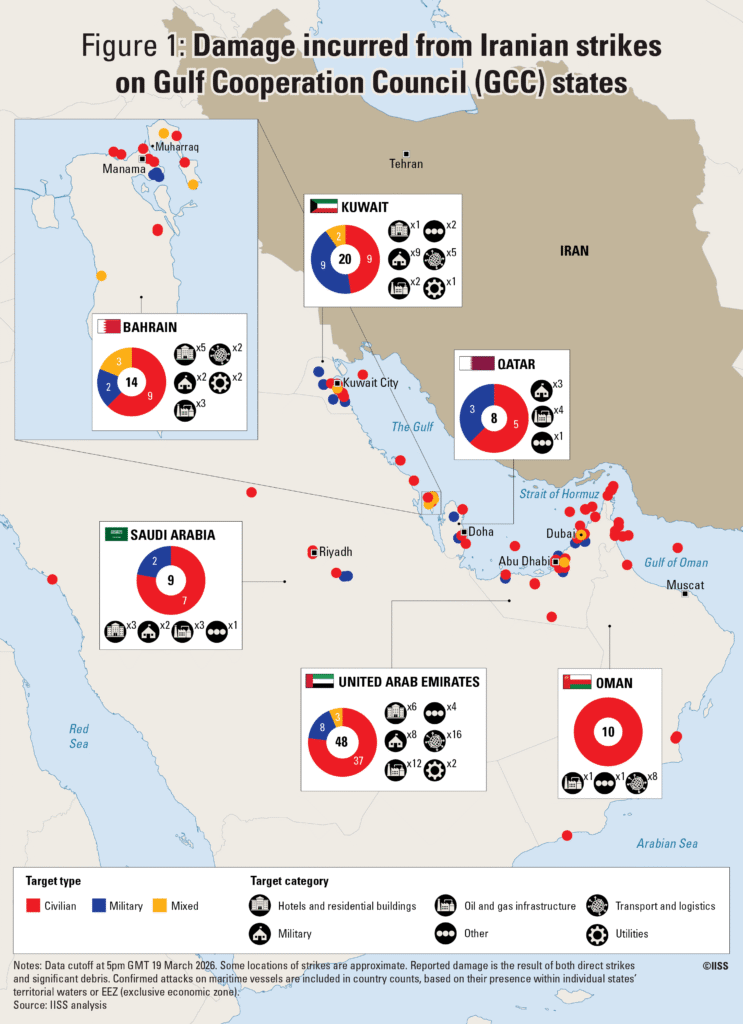
As the Gulf’s premier financial centre as well as a vital international shipping and transit hub, the UAE has been central to Iran’s strategy of pressuring the US by maximising economic impact and disrupting global trade. The UAE has been attacked by more Iranian projectiles than all other GCC states combined and incurred by far the greatest and most varied damage within the group. There have been 48 confirmed hits on significant and strategic sites (see Figure 1), including Dubai’s iconic Burj Al Arab and International Financial Centre, Jebel Ali port, Fujairah’s petrochemical and storage complex, the Ruwais refinery, international airports and Amazon Web Services data centres. The concentration of these high-value targets within a relatively close geographic proximity to Iran has increased the vulnerability of the UAE’s leading economic sectors to conflict. Iran has also sought to legitimise its disproportionate targeting of the UAE by highlighting its close relationship with Israel, with the UAE having made large-scale investments in Israeli arms and technology in recent years.
The limits of diplomatic deterrence
Iran’s attacks on its neighbours offering mediation support show the limits of diplomatic engagement and cover. Oman and Qatar had actively and urgently facilitated US–Iran negotiations in recent months. Yet both have seen their energy and transport infrastructure attacked. Oman has received the lowest attack volumes and reported the least damage. Its foreign minister has framed Iranian retaliation as an ‘inevitable’ byproduct of US–Israel aggression. In contrast, facing substantial economic losses, Qatar has issued severe condemnations against Iran, expelled senior Iranian diplomats and is proving reluctant to conduct mediation. Saudi Arabia and the UAE had also worked to prevent the US-Israeli strikes on Iran and issued statements prior to the war clarifying that their territory would not be used to attack Iran. Iran’s continued attacks have demonstrated its disregard for their good-faith diplomatic efforts and for the long-term repercussions for the respective relationships. The GCC states’ room for manoeuvre has thereby narrowed: in Gulf eyes, diplomacy alone can no longer contain regional spillover and must be reinforced by firmer collective security and stronger conventional capabilities.
GCC reactions to Israel’s targeting of Iran’s South Pars gas field particularly highlighted the limited deterrent value of diplomacy. Oman, Qatar and the UAE publicly warned that such attacks constituted a dangerous escalation and stressed the importance of avoiding strikes on critical energy and civilian infrastructure. Yet, subsequent Iranian attacks on energy-related sites across Qatar, Saudi Arabia and the UAE suggested that such warnings had little restraining effect. This appears to have pushed the GCC states to look beyond diplomatic signalling towards firmer defensive postures. Saudi Foreign Minister Prince Faisal bin Farhan Al Saud captured this shift when he publicly remarked that Saudi Arabia’s and the wider GCC states’ patience was not unlimited, and that they retained ‘very significant capacities and capabilities’ that could be mobilised if required.
Reordering the regional security architecture
GCC defence was long based on the idea that the US security guarantee underpinned regional deterrence; in practice, it has been hollowed out by the war. Relative to other GCC states, Kuwait has incurred the highest proportion of its damage to military sites, including the United States’ strategic Ali Al-Salem air base. The American military presence made Kuwait a top target, yet has been insufficient to protect its territory. In justifying its target selection elsewhere, Iran has accused GCC states of underhandedly facilitating the United States’ military operation, with Bahrain and the UAE being specifically called out by Iranian officials.
Despite GCC states’ relatively high interception rates of Iranian projectiles, Iran’s success in striking high-value assets reveals the limits of their air- and missile-defence architecture. Some GCC officials and analysts, moreover, suspect that the US has prioritised the defence of Israel over the GCC in the early phase of the war. This has prompted the GCC states to reach out to other partners for assistance. The United Kingdom and France have deployed fighter jets in response to shoot down Iranian drones across Bahrain, Qatar and the UAE, and Ukraine has been heavily courted given its cutting-edge drone and counter-drone technologies. Once this phase of the conflict ends, the GCC states will begin reflecting on the right balance between defence, deterrence and broader alliances for their future security.