
Khamenei’s death and expansive Israeli operations catalyze Shiite anxiety across Lebanon, Iraq, and beyond, transforming localized threats into shared identity-based mobilization. The dynamic produces a paradoxical feedback loop wherein military pressure reinforces communal logic sustaining groups like Hezbollah and Iraqi PMF factions. The resulting network may prove more fragmented yet more durable than its predecessor, driven by fear of marginalization.
In the final weeks before his death, Iranian Supreme Leader Ali Khamenei cast the mounting hostility of U.S. President Donald Trump in religious and explicitly Shiite terms. Rejecting calls for capitulation, he invoked the example of Imam Hussein—the third imam, or spiritual leader, of the Shiites—refusing to pledge allegiance to Yazid, the Umayyad ruler widely associated in Shiite memory with tyranny and injustice. Defiance, in this light, was not simply a strategic imperative but a value rooted in history and identity.
That framing did not disappear with Khamenei’s death. Instead, Shiite political figures, clerics, and communities across the region have taken up this rhetoric and symbolism, a measure of their growing disquiet and sense of vulnerability. In Lebanon, the weakening in recent years of the Shiite political and military movement Hezbollah had already altered the country’s sectarian balance. Aggressive Israeli operations in Shiite-populated areas over the past month have only reinforced perceptions that Israel and its ally the United States are bent on subjecting Shiites to collective punishment. In Iraq, repeated U.S. and Israeli strikes on the Popular Mobilization Forces (PMF)—a coalition of armed groups that are at once inside and outside the formal state security forces—have made it harder for factions that had largely avoided entanglement in recent upheavals to stay out of the fray. And beyond the Arab core, reactions to Khamenei’s killing among Shiite populations in places such as Pakistan underscore how the conflict is being interpreted through a broader communal and religious lens.
The war is heightening the salience of Shiite identity across multiple arenas at once and, in doing so, reshaping how political and military actors assess both their interests and their risks. Groups that might otherwise have remained on the sidelines are becoming more likely to get involved in the strife, and those already fighting face growing pressure to escalate.
The consequence is a feedback loop: actions driven by fears of marginalization provoke responses that alarm more and more people, expanding the social base for Shiite mobilization. The “axis of resistance,” Iran’s network of nonstate allies and proxies across the region, has endured numerous setbacks since 2023. But ongoing U.S. and Israeli military actions may lead to its reconstitution, not through the orchestration of Tehran but rather as a result of the altogether more organic impetus of an embattled Shiite identity.
THE MAKING OF SHIITE ANXIETY
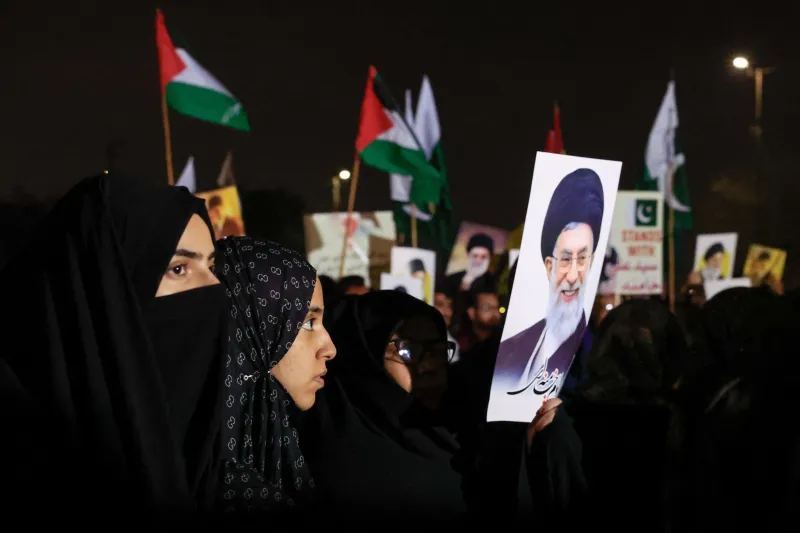
Khamenei’s killing was not simply a political event inside Iran. It reverberated across Shiite communities well beyond the country’s borders, underscoring the extent to which his authority had significance in the wider region. In Pakistan, his death triggered protests among Shiite groups, some of which turned violent, with participants explicitly referring to him as a religious guide. In Bahrain, which has a majority Shiite population even though it is ruled by a Sunni royal family and is home to a key U.S. military base, Shiite protesters clashed with security forces and demonstrators expressed support for the Islamic Republic of Iran. These reactions were not uniform, but they revealed how people across the region interpreted developments in Iran through a sense of shared religious identity and collective fate.
Khamenei’s death also crystallized a perception among Shiites in the region that had been forming for some time. Across several arenas, Shiite actors had already begun to see regional developments as evidence of a disadvantageous shift in the balance of power. The Iran war marked a culmination point in this growing sense of a threat.
In Lebanon, Hezbollah’s position had been under strain since the 2024 war with Israel, weakening a central pillar of the country’s sectarian equilibrium. That only became more pronounced in recent weeks. Israel has ramped up its offensive in Lebanon, including a devastating round of strikes on April 8 that left hundreds dead in areas with large Shiite populations. The New York Times and other publications have also reported that Israeli officials have urged Christians and Druze in southern Lebanon to expel Shiites from their communities. Shiites in Lebanon perceive Israeli pressure as part of a campaign not just against Hezbollah but against the Shiite community more generally.
Meanwhile, the fall of Syrian leader Bashar al-Assad, in 2024, and the emergence of a new political order in Syria raised a different set of concerns in neighboring Iraq. Iraqi Shiites fear that Assad’s replacement, Ahmed al-Shara—a former Sunni jihadi with roots in al-Qaeda in Iraq—could embolden Sunni militant networks and reintroduce a source of cross-border instability, a particularly pressing concern given Iraq’s sectarian history and the still vivid memory of the war against the so-called Islamic State, also known as ISIS, in which Shiite militias played a leading role.
U.S. officials have compounded the alarm by suggesting that a wider reordering of the region is underway. For instance, Shiite commentators in Iran and Iraq noted with concern remarks in September 2025 by Tom Barrack, Washington’s envoy to Syria, who dismissed the very notion of the Middle East as a meaningful political category, stating that “there is no Middle East,” only “tribes and villages.” They saw it as proof of a U.S.-backed effort to reshape the region along sectarian lines, producing a Sunni-dominated arrangement that would sideline Shiite actors.
The historical marginalization of Shiites in many parts of the Middle East gave these perceptions particular force. Across the region, Shiite communities have long occupied politically constrained positions, even where they represent large segments of the population. In Iraq, Shiites grew ascendant only after the toppling of Saddam Hussein, in 2003, but their political preeminence relies on fragile institutional arrangements rooted in sectarian power sharing and on armed groups such as the PMF. In Lebanon, Shiite influence depends on maintaining a delicate balance with Sunnis and Maronite Christians. In Bahrain and other Gulf states, Shiite populations remain politically underrepresented despite their demographic weight.
The war in Iran constitutes just the latest, albeit the most dramatic, instance of what Shiites perceive as a broader campaign against their interests and their representatives. Shiites fear that the gains they have made in recent decades—in Iraq, Lebanon, and elsewhere—could be rolled back. With Khamenei’s death and the bludgeoning Israeli campaign in Lebanon, those anxieties have only become more acute.
RAPID RESPONSE
In places such as Pakistan and Bahrain, Shiite communities largely reacted to the war with protests and symbolic mobilization. More consequential, however, was the behavior of armed and political factions at the core of Shiite power in the region. Their conduct demonstrates the heightened salience of identity—not in rhetoric alone but in decisions to fight even when these groups face significant material constraints.
In Lebanon, Hezbollah’s decision to enter the war in March in support of Iran stands out. Badly weakened and facing sustained Israeli pressure, the group nonetheless sent barrages of rockets into Israel. In response, Israel widened its attacks deep into Shiite-populated areas—even beyond southern Lebanon—contributing to the displacement of more than a million people, the vast majority of them Shiites.These acts blur the distinction between Hezbollah and the population from which it draws support. They also raise the cost of restraint for Hezbollah. The group must keep up the fight against Israel lest it be perceived as having forsaken its mantle as the defender of the Shiite community.
In Iraq, the dynamic is more constrained but no less revealing. From the outset, leading Shiite authorities emphasized caution. In early March, Grand Ayatollah Ali al-Sistani, the most influential Shiite cleric in Iraq, issued a statement warning against escalation and stressing the need to avoid dragging the country into a wider war. Even as his rhetoric hardened in subsequent remarks, he stopped short of calling for jihad or direct mobilization, demonstrating how worried Iraqi Shiite leaders are about the collapse of the country’s delicate political order.
Yet even there, the logic of restraint is coming increasingly under strain. Repeated strikes by the United States and Israel on PMF positions—including attacks on headquarters, logistical facilities, and personnel—have begun to alter the political environment. Attacks by a subset of Iraqi militias, notably those operating under the banner of the so-called Islamic Resistance in Iraq, on U.S. targets have been met with broader strikes that have targeted the PMF as a whole, expanding the scope of confrontation and raising pressure on the Iraqi government and its Shiite constituencies.
The Iraqi government, for its part, has refused to rein in these groups, marking a shift from earlier efforts to contain escalation. The PMF is not simply a collection of militias; it is a central pillar of post-2003 Shiite power in Iraq and, crucially, a part of Iraq’s state armed forces under the prime minister’s authority. Targeting it is tantamount to striking the Iraqi state itself, an act that increases the pressure on Iraqi government forces to mount a direct response against the United States and Israel.
These reactions are more striking when set against earlier phases of Iranian-Israeli confrontation. During the 12-day war in June 2025, Shiite actors in Lebanon and Iraq remained largely on the sidelines. The conflict appeared containable, with limited existential risks to the Shiite-led government in Iran or its allies in the region. The current war is far more expansive, implicating and threatening Shiite actors across the region. That shift helps explain why more Shiite groups have become ensnared in the fighting even as the risks of U.S. and Israeli retaliation have grown.
The result is a dangerous feedback loop. Initial mobilization by more ideologically committed actors—Hezbollah and some Iraqi militias—has prompted escalatory actions by Israel and the United States, including sustained operations in Shiite-populated areas and intensified pressure on institutions associated with Shiite power. Those responses, in turn, are widening the sense of threat among Shiites, making it harder for Shiite political and military actors to exercise restraint.
THE NEW AXIS
No matter the course of the current cease-fire in Iran and the wider war, the growing salience of Shiite identity is likely to shape the trajectory of future regional tensions. In Lebanon, this dynamic may make Hezbollah harder to isolate politically, even as it remains under sustained military pressure. Israeli officials have indicated that operations in southern Lebanon could follow a “Rafah model,” referring to the devastated city in the south of Gaza, raising the prospect of prolonged occupation. Shiites would likely interpret such a scenario as a direct threat to their position and security. That perception is already remaking domestic politics. Earlier tensions between Hezbollah and Amal, another major Shiite political movement in Lebanon, have given way to renewed alignment under pressure. Nabih Berri, the Shiite speaker of parliament and the head of Amal, joined Hezbollah in resisting the Lebanese government’s March 2026 decision to expel Iran’s ambassador from Beirut. Israeli military pressure may degrade Hezbollah’s capabilities, but it also risks reinforcing the communal logic that sustains it.
A similar dynamic could unfold in Iraq, although through different mechanisms. Shiite armed groups in Iraq emerged in response to earlier episodes of perceived threat—first the U.S. invasion and occupation, and later the rise of ISIS. Today, fresh fears of external pressure, stoked by concerns of renewed Sunni extremism and violations of Iraqi sovereignty by the United States and Israel, are reviving earlier narratives of resistance. More groups in Iraq may become willing to exert military and political pressure on the United States to reduce or end its presence in the country, while sectarian and political tensions between Iraqi Shiites, on the one hand, and Sunnis and Kurds, on the other, will deepen.
The broader implication is that the war may reconstitute parts of the Iran-backed “axis of resistance” from below. The key driver would not necessarily be centralized coordination from Tehran but localized fears of marginalization, occupation, and abandonment. Such concerns have historically sustained resistance movements even in the absence of strong state backing.
The result is a paradox. A war intended, in part, to weaken Iran and its regional network may instead strengthen the social and political conditions that sustain it. What emerges is unlikely to resemble the centralized axis of the past. It may be more fragmented, less coordinated, and harder to control, but also more durable, independent of any single state or actor, and rooted in a widening sense of communal fear.