
Trump’s oscillation between peace overtures and threats of infrastructure destruction reveals eroding leverage, while Iran’s regime survival and strait closure demonstrate asymmetric resilience. The Islamabad talks will determine whether coercive diplomacy can extract nuclear concessions or triggers wider escalation with catastrophic economic and political costs
The Iran ceasefire and peace talks this week are hanging by a thread as tensions boil over the strategic waterway that epitomizes Tehran’s new leverage and a conflict that critics warn has escaped President Donald Trump’s control.
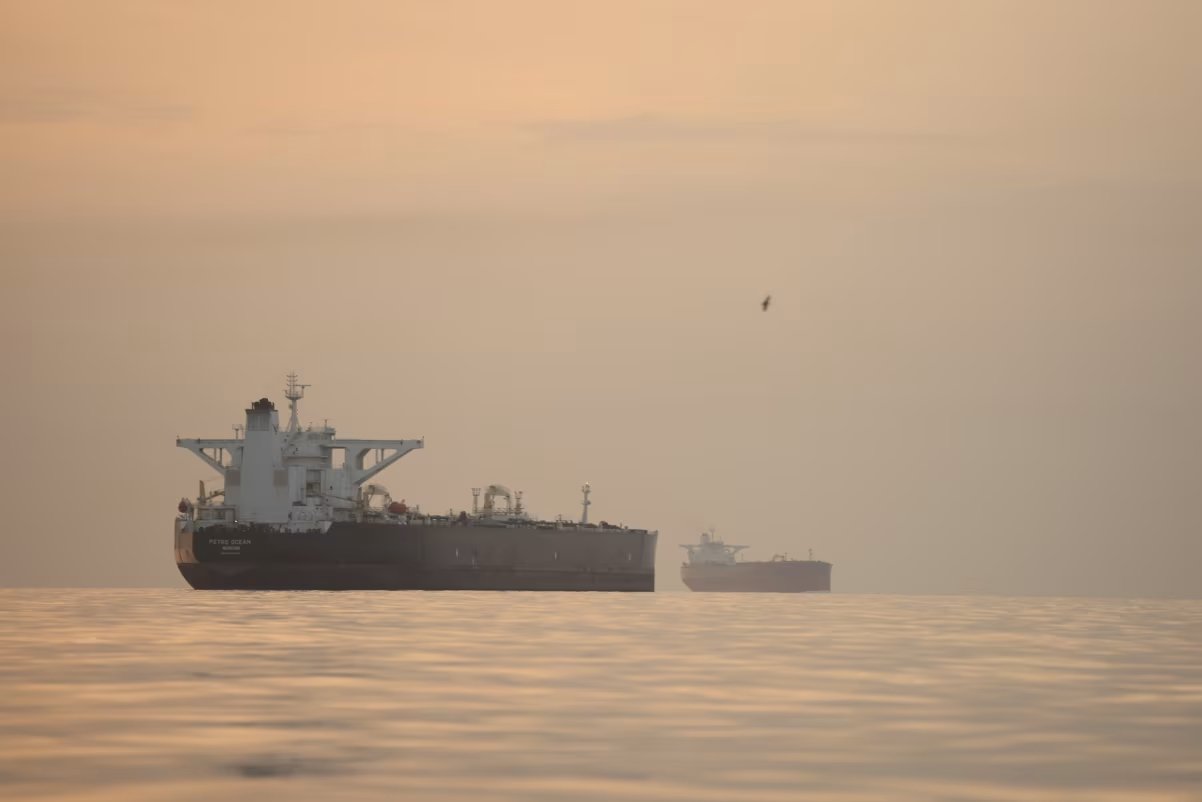
On Friday, Trump said Iran had “agreed to everything,” prompting a stock market rally on hopes the war could soon end. But by Sunday, this looked like another case of overhyping diplomacy, and the president was again threatening to destroy Iran’s bridges and power plants, and Tehran had shut the Strait of Hormuz back down. A mutual lack of trust and fears of a full return to war were on display after the US Navy fired on and seized an Iranian-flagged freighter that tried to bust its blockade of Tehran’s fleet.
The whiplash is typical of Trump’s war leadership, which veers between triumphant predictions of imminent peace and alarming threats of violence. His opponents see chaos and the absence of a plan, while the president’s aides insist he’s masterfully wielding leverage in a way that will force Iran to cave.
But Trump’s fog of war faces its next date with reality as an expected second set of US-Iran talks loom in Pakistan ahead of the scheduled expiration of the ceasefire Tuesday. The next few days may show whether Trump’s now-familiar strategy of intimidation can create diplomatic openings or whether its effectiveness is dwindling. If it fails, Trump may again face a choice of whether to escalate US military involvement to try to find a way out with potentially disastrous results for the global economy and his own sliding popularity.
One of the most confusing characteristics of this war is that it’s all but impossible to judge the sincerity and accuracy of either US or Iranian statements about it.
No one outside Iran can say exactly which leaders are calling the shots after waves of assassinations of regime figures. This makes it hard to assess its diplomatic strategy.
But Trump’s mood in the war — at least as reflected by his social media statements — is constantly shifting. US officials were quoted as saying last week in various reports that Iran was willing to give up supporting proxies such as Hezbollah and Hamas, and to turn over its stocks of highly enriched uranium. This would represent a huge win for the administration. But modern history and Iran’s recent statements and behavior raise questions.
Yet there are compelling reasons, behind the rhetoric and belligerence, for both sides to avoid renewed fighting. Perhaps both are cranking up tensions before possible talks to create diplomatic space.
Trump’s repeated insistence that a deal is in reach hints at waning enthusiasm for a war that has inflicted a heavy economic and political price in a midterm election year. The Wall Street Journal reported Saturday that despite his bravado, Trump harbors serious fears about its consequences and the risks of an escalation.
For Iran’s regime, survival when the war does end would be a victory in itself. The US blockade of Iran’s ports meanwhile threatens to turn a devastated economy into a societal collapse. Weeks of relentless bombing has caused massive devastation that will cost trillions of dollars to rebuild.
‘No More Mr Nice Guy’
The administration is signaling that it believes it can break Tehran’s resistance by cranking up pressure.
On “State of the Union” Sunday, CNN’s Jake Tapper asked Energy Secretary Chris Wright to explain why his boss posted on social media that there’d be “No More Mr Nice Guy” and that he’d bomb every bridge and power plant in Iran if its leaders won’t make a deal the US is offering.
“The president is looking for maximum leverage,” Wright said. He said he was “not worried” because “chatter and noise” in Iran showed a regime that was falling apart and that the end of the war was “not too far away.”
Wright also credited the administration with dealing “fantastically” with the war’s energy shock, which has sent gas prices over $4 a gallon.
US ambassador to the United Nations Mike Waltz on Sunday painted a similar picture of rising stock markets, stable oil prices and fragmentation in Iran’s leadership, saying the country had never been more isolated.
“Iran does not have the cards, and we are confident they will come to the table and finally give up their obsession with having a nuclear weapon,” Waltz said on CBS’ “Face the Nation.”
“We are reducing their capabilities. Their military is in shambles. Their missile program is in shambles. And now, hopefully, diplomatically, they will do it the easy way, rather than the hard way, of finally giving up on this illegal ambition,” Waltz said.
Such expectations put massive pressure on Vice President JD Vance, who has been leading the US diplomacy. CNN reported last week that Trump is quizzing associates about his No. 2’s performance after a first round of talks failed.
Iran, for its part, is contradicting US claims that it’s ready to fold.
Its chief negotiator Mohammad Bagher Ghalibaf told state media that although “progress has been made” in diplomacy, significant gaps remain over the strait and over nuclear issues. He said Iran would not hand over enriched uranium, which the US president calls “nuclear dust.”
Like Trump, Ghalibaf, who serves as speaker of the Iranian Parliament, is addressing domestic audiences inside and outside the government and is staking out the toughest possible position ahead of any talks.
Trump said Sunday that US representatives are traveling to Islamabad for negotiations. Iran has yet to publicly confirm talks will take place.
Like the US, Iran seems to believe it has the upper hand.
But evidence and events in a complex situation do not fully bear out the administration’s claims of a huge success.
US and Israeli air attacks surely caused intense damage to Iran’s forces, military industrial complex, and missile and drone arsenals. But the regime survives. Iran’s people have been unable to rise up and oust their repressors.
The collateral damage for the US has been severe. NATO’s cohesion is in question amid Trump’s fury that member states dodged a war they opposed. Trump threatened — although did not follow through on — a warning that Iranian civilization could die, in one of the most searing statements ever by a US president. And his administration spent last week feuding with Pope Leo XIV and questioning his anti-war theology.
Democrats, conscious of polls that show Trump’s approval rating has plunged over the war — it hit 37% in a new NBC News/SurveyMonkey poll Sunday — are portraying him as stuck in Iran and out of ideas.
“The enriched uranium is still there. We have a more hardline regime there. Khamenei Jr. actually wants to develop nuclear weapons. Does anyone believe that we actually have more leverage over the Strait of Hormuz? We have less. China has more influence in Iran,” Democratic Rep. Ro Khanna told ABC.
The war is now more than a week past the six-week threshold initially suggested by officials as its longest span. Trump has never been under more pressure to end it — and to show it will defang Iran rather than embolden a sworn US foe.