
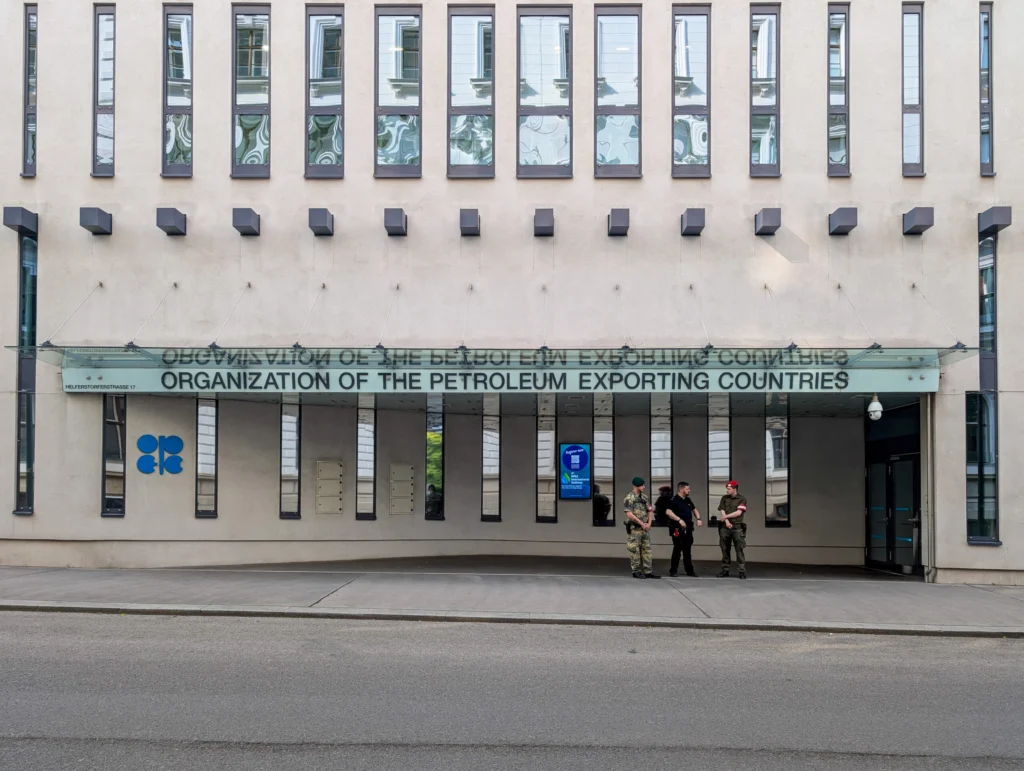
The UAE’s exit from OPEC reflects strategic divergence from Saudi Arabia and Russia, driven by the Iran war and Hormuz closure. Abu Dhabi seeks to maximize energy revenues and leverage spare capacity for bilateral gains, dealing a symbolic and potentially existential blow to the cartel.
The United Arab Emirates (UAE) announced today that it will leave OPEC, the coalition of major oil-producing countries, on May 1. The decision comes amid a global energy crisis resulting from the Iran war and the effective closure of the Strait of Hormuz, as well as increasing tensions between the UAE and Saudi Arabia, OPEC’s most influential member. What is the UAE’s strategic calculus for its OPEC exit? And how will this affect energy markets and the global oil supply? Our experts have spent the day drilling for answers, which they provide below.
The reasons for leaving
An Emirati official told Will today that the move had been “a long time coming,” and Will tells us that leaving OPEC had “been discussed behind closed doors for several years.”
From the UAE’s perspective, Will writes, its “national interests have diverged and are expected to increasingly conflict with the other members of both OPEC and the wider OPEC+ group, which notably includes Russa.”
Given the size of the UAE’s sovereign wealth fund, Will explains, its economy is “more significantly tied to global economic growth than to the global price of oil.”
Leaving OPEC frees up the UAE to exceed the cartel’s production caps. Aside from possibly causing a small reduction in global oil prices, Will notes that more production could also help the UAE improve ties with oil-importing partners such as China. And, he adds, given the economic damage caused by the Iran war, “the prospect of maximizing energy revenues now is undoubtedly attractive.” The geopolitical implications
The announcement also comes “in the context of the growing rivalry between the UAE and Saudi Arabia,” says Will, which “burst into the open” in December after Saudi-led airstrikes on the UAE-backed Southern Transitional Council in Yemen.
Moreover, the Iran war has “changed everything,” says Will, who notes that the UAE has been targeted by Iran (an OPEC member state) more than any other country, not to mention the economic pain caused by the effective closure of the Strait of Hormuz. “It is easy to understand why policymakers in the UAE are no longer interested in being a part of this organization,” Will writes.
What’s more, OPEC+ member Russia has “proven to be a steadfast partner for Iran” during the conflict, says Will, “raising the obvious question in Abu Dhabi why they would want to cooperate with OPEC+ to Moscow’s benefit.”
The market impacts
The UAE’s decision to leave OPEC marks a “symbolic political blow to the organization’s perceived influence,” says Landon, “but it’s unlikely to meaningfully shift the market.”
That’s because, as Landon argues, OPEC has been “been largely ineffective for some time.”
OPEC’s “ability to shape markets depends on access to spare capacity—production that can be brought online quickly to buffer against oil supply shocks,” Landon tells us. But this spare capacity is mostly concentrated in the UAE, Saudi Arabia, and Kuwait, and Landon points out that the nine other member countries “possess little to none.”
Given the UAE’s spare capacity, the move will likely strengthen the UAE-US relationship, Landon predicts, “particularly in relation to managing the strategic petroleum reserve.”
And this could even strengthen US-Saudi ties, Will tells us, “as Riyadh will hold an even greater burden for stabilizing global oil prices.”
The future of OPEC
Now that the UAE won’t be beholden to OPEC production quotas, says Landon, “nothing inhibits the country from leveraging its spare capacity in pursuit of its own strategic interests”—at least, after the Strait of Hormuz reopens.
The same will not be true for OPEC, says Landon, as the cartel “will face growing limitations to exercising meaningful market influence as that capacity concentrates in Saudi Arabia and Kuwait alone.”
While OPEC has lost members before, notes Will, the UAE is a much larger producer than other countries that have left, and “its absence may, over time, pose an existential risk to the cartel’s sustainability.”