

A strategic evaluation of the US-Israel Defense Technology Cooperation Initiative within the FY2027 NDAA. The assessment details the risks of bypassing standard DoD procurement oversight via an unprecedented executive agent structure that integrates supply chains.
The United States–Israel Defense Technology Cooperation Initiative shifts bilateral defense relations into a highly integrated, non-traditional structural paradigm. This defense technology cooperation bypasses standard departmental protocols, leveraging a uniquely empowered executive agent to merge industrial pipelines across critical warfare domains. By embedding this mechanism into security frameworks, the initiative compromises institutional oversight while legally anchoring domestic procurement pipelines to international defense sectors without a formal treaty architecture.
Defense Technology Cooperation Recalibrates Strategic Oversight
The “United States–Israel Defense Technology Cooperation Initiative” in the House–drafted National Defense Authorization Act for Fiscal Year 2027, or FY2027 NDAA, seeks to accelerate the US–Israel defense technology partnership, including technology sharing, coproduction of weapons systems, and bilateral research and development across multiple domains of warfare, including biotechnology, autonomous systems, artificial intelligence, cyberwarfare, and more.
Notably, the cooperation initiative (previously known as Section 224 and subsequently Section 219) would direct the secretary of defense to designate an executive agent, or EA, to expand integration of the US and Israeli defense industrial sectors.
The EA authority makes this provision significantly different from existing defense tech cooperation agreements with other allied nations. EA authority takes precedence over the authority of the other Department of Defense, or DoD, component heads per DoD Directive 5101.01, meaning that the EA would be able to overrule determinations by other DoD agencies such as the Defense Technology Security Administration, or DTSA, which manages risks from the international transfer of defense technology and critical information.
The dangers of this structure go beyond the bias introduced by the EA structure into defense procurement processes. The measure risks tethering the US military to its Israeli counterpart technologically and making it difficult to uproot should conditions change.
Analysts have also raised concern that the initiative may make US military aid to Israel more opaque by transforming assistance into cooperation, thereby sheltering the security relationship from regular congressional votes and oversight.
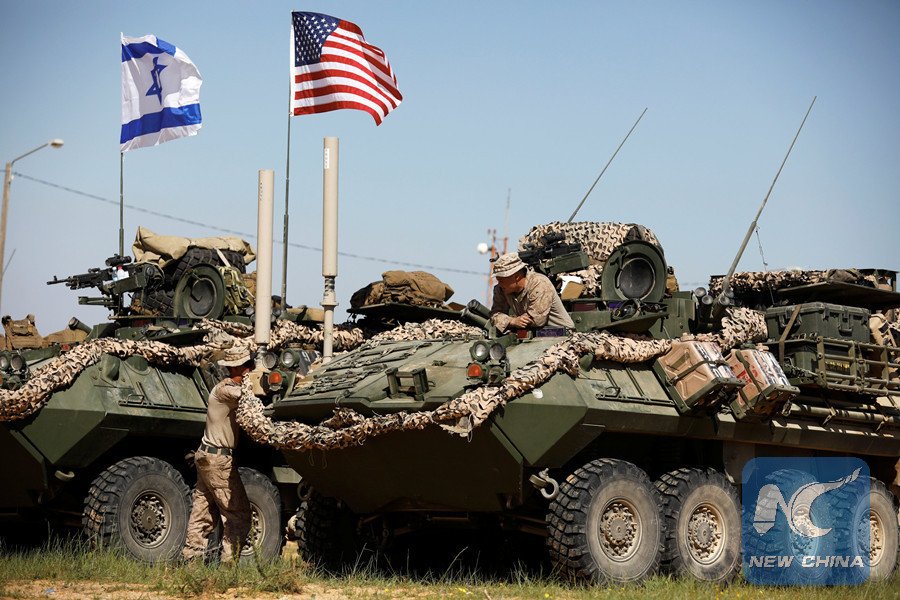
Existing Avenues For Defense Technology Cooperation
Proponents of the initiative argue that the provision will ultimately save American lives and benefit the US military by giving the US access to Israeli defense technology and coproduction arrangements. Israel’s defense technology does have demonstrable military value in specific domains, including systems to counter unmanned aircraft systems, or UAS; active protection systems; and missile defense.
That is not in dispute. The question is whether the institutional mechanism that the cooperation initiative would create is necessary to access that value, and the answer is no. Through existing authorities under 22 U.S.C. § 2767(j)(1), 10 U.S.C. § 2350a, and standard Foreign Military Sales, or FMS, and Direct Commercial Sales, or DCS, the United States can already obtain the Israeli defense technology that it needs.
The United States has procured Israeli technology under existing law for decades. Iron Dome, the Trophy Active Protection System for Abrams tanks, and Barak missile systems were all acquired under existing statutory authority, which is extensive:
Cooperative research and development, or R&D, with Israel is authorized under 22 U.S.C. § 2767(j)(1), which extends the president’s cooperative project agreement authority to friendly foreign countries that are not members of the North Atlantic Treaty Organization, or NATO. Missile defense codevelopment programs, including Arrow and David’s Sling, are funded through annual NDAA missile defense appropriations and Foreign Military Financing, with cooperative project agreements providing the legal framework for the R&D and coproduction arrangements. Anti–UAS cooperative programs have been specifically authorized through NDAA provisions incorporating the authorities of § 2767(j)(1). The United States can do more of this today without the formal cooperation initiative.
Joint ventures, licensing, and coproduction with Israeli industry are permissible under existing FMS and DCS authorities — the Arms Export Control Act, or AECA, broadly — and various other Transaction Authority provisions.
Procurement of Israeli–origin defense articles and services by DoD is currently authorized for most categories. The relevant limit is 10 U.S.C. § 4864, which restricts DoD procurement of certain defense items to sources within the National Technology and Industrial Base, or NTIB. This is the one area where a statutory barrier exists, but it is narrowly targeted at specific item categories, not a general bar on procuring Israeli defense goods.
Integration of foreign-origin technologies into US programs already occurs under current acquisition regulations. Program managers routinely incorporate allied components.
Joint training exercises and information-sharing with Israel are fully authorized under existing bilateral agreements, the 22 U.S.C. Chapter 93 framework, and general secretary of defense authorities. The US–Israel Operations Technology Working Group already exists; the initiative simply directs the EA to coordinate with it.
Biotechnology and artificial intelligence cooperation, while the domains are broad, are not barred under current law for Israel. The limitations here are policy and classification-level restrictions (e.g., DTSA technology control lists and category controls in the context of the International Traffic in Arms Regulations, or ITAR), not statutory prohibitions.

Mandating Integration Through Defense Technology Cooperation
So, if the initiative is not giving the United States access to new technologies or adding authorities, what is the point? The real impact of the provision is structural, with the creation of an executive agent role and a focus on integrating Israeli technologies and companies into US supply chains. The cooperation initiative tasks the EA with “synchronizing cooperative efforts between the United States and Israel, to expand and accelerate bilateral defense technology research development, testing, evaluation, integration, and industrial cooperation …”
The provision would bias internal DoD processes toward US–Israel integration.
The EA designation has specific legal meaning under DoD Directive 5101.01. A DoD EA is the head of a DoD component to whom the secretary of defense or the deputy secretary of defense has assigned specific responsibilities, functions, and authorities to provide defined levels of support for operational missions or administrative or other designated activities that involve two or more DoD components. Most importantly, within the scope of assigned responsibilities and functions, the DoD EA’s authority takes precedence over the authority of other DoD component officials performing related responsibilities and functions.
International cooperative programs are supposed to operate through identified, accountable institutional channels like the Defense Security Cooperation Agency, or DSCA; the DTSA; the Directorate of Defense Trade Controls, or DDTC; and the under secretary of defense for policy, among others.
The initiative would create an EA just for Israeli cooperative programs and open the door for this agent, who would be required to expand integration and cooperation and to put their thumb on the scale for integration wherever there is institutional pushback from concerned DoD offices. The EA would have the authority to supersede DoD recommendations in favor of faster and more expansive integration with prospective Israeli partners. While State Department channels — like the DDTC — would still operate independently of the EA, and programs are required to comply with existing laws, the EA would have significant influence on determinations that are made.
The EA would not be a simple coordinator. They would have precedence authority over nearly the entire DoD bureaucracy on issues relating to US–Israel defense tech cooperation — including the DTSA and program offices — specifically for the US–Israel relationship. No comparable bilateral relationship with any other partner country has this structure.

Defense Technology Cooperation Reshapes Alliance Standards
The United States has many comparable bilateral agreements with countries like the United Kingdom, Japan, Australia, and with NATO. However, there are significant differences in the approach the initiative takes.
No other relationship has an “executive agent” with precedence and authority advocating for integration within the Department of Defense. No bilateral defense cooperation with the United Kingdom, NATO, Japan, or Australia has a dedicated DoD EA whose authority takes precedence over other DoD components and whose job it is to promote the participation of one particular country in a broad array of sensitive US programs. The standard architecture assigns the under secretary of defense for policy as the principal staff assistant for all security cooperation, with the DSCA as the implementing arm.
The initiative creates a parallel institutional lane for one country only, through the EA.
Entrenchment in the supply chain is a goal. Unlike other arrangements, this initiative explicitly contemplates industrial cooperation that would embed Israeli technology within the US defense supply chain, meaning US policymakers would face large costs and time delays should it ever be determined that this arrangement is no longer aligned with US interests.
Shifting From Aid To Defense Technology Cooperation Deeply
This initiative as part of the proposed FY 2027 NDAA should not be viewed in a vacuum. It is part of a larger effort, supported by Israeli Prime Minister Benjamin Netanyahu, to shift the United States’ relationship with Israel from one of America granting aid to Israel’s deeper integration into the US defense sector.
In addition to the cooperation initiative, complementary efforts toward this end have appeared in multiple legislative initiatives, which go beyond defense industrial cooperation to deeper intelligence integration:
The FY2026 NDAA directed the under secretary of defense for acquisition and sustainment to convene the “US–Israel Defense Industrial Base Working Group” to study “the potential for defense industrial base integration between the United States and Israel, including the possibility of inclusion into the national technology and industrial base …”
Section 622 of a draft Senate intelligence authorization bill would require the president to “[e]xpand and enhance intelligence sharing with the Government of Israel” and put significant limitations on the president’s power to limit that intelligence sharing.
House Resolution 1339, introduced by Representative Marlin Stutzman, Republican of Indiana, encourages the signing of a new memorandum of understanding with Israel in order to develop “a framework of joint defense codevelopment, coproduction, and mutual investment.” Even the title of the resolution notes that this plan is “Prime Minister Benjamin Netanyahu’s Initiative.”
Taken in context, the initiative is part of a larger effort to move Israel from the category of major aid recipient and security partner into something closer to — and even beyond — the structural position occupied only by the so-called Five Eyes countries (Australia, Canada, New Zealand, the United Kingdom, and the United States). However, the upgraded US–Israel relationship would be without a treaty, without the normal deliberative process that attended UK and Australian National Technology Industrial Base inclusion, and without the public debate that such a far-reaching goal would likely provoke.
At a moment when the trajectory of the US–Israel relationship is unclear, Israeli actions are historically unpopular with the American public, and US–Israel interests diverge on major issues like the Iran War, it would be imprudent to embark on the kind of defense integration that, until now, was reserved for treaty allies. Once the United States’ and Israel’s military defense tech sectors are heavily integrated, unwinding the relationship would be difficult and costly.
Türkiye’s expulsion from the F–35 supply chain is a good example of the costs associated with unwinding integration efforts. When Türkiye was removed in 2019 after purchasing a Russian surface-to-air missile system, it was producing around 1000 parts in the F–35 global supply chain. Türkiye’s removal from the program led to an enormous increase in the late delivery of parts and ultimately resulted in a marked increase in delinquent deliveries of F–35s.
The move immediately cost more than a half-billion dollars and will ultimately cost taxpayers tens of billions, on top of pushing the already delayed program even further behind schedule.
US policymakers — and the Israeli government — are rightly sensing that a large segment of the American electorate is losing patience with the direct aid of $3.3 billion per year to Israel and would favor a reassessment of the bilateral relationship. Both Congress and the Executive Branch must ensure that the pace and depth of US–Israeli defense cooperation reflect these changes.
In the interim, the statutory authorizations for cooperative programs essential to US security, and where Israel brings a unique and indispensable advantage, remain fully adequate. But policymakers in both branches of the US government must carefully consider — and publicly debate — the supply chain and data risks (as well as the opportunities for inappropriate bias) in procurement processes where US–Israel interests diverge. Providing Israeli defense tech companies their own promoter in the Pentagon is a poor start, and Congress would therefore be wise to remove this cooperation initiative from the NDAA.