
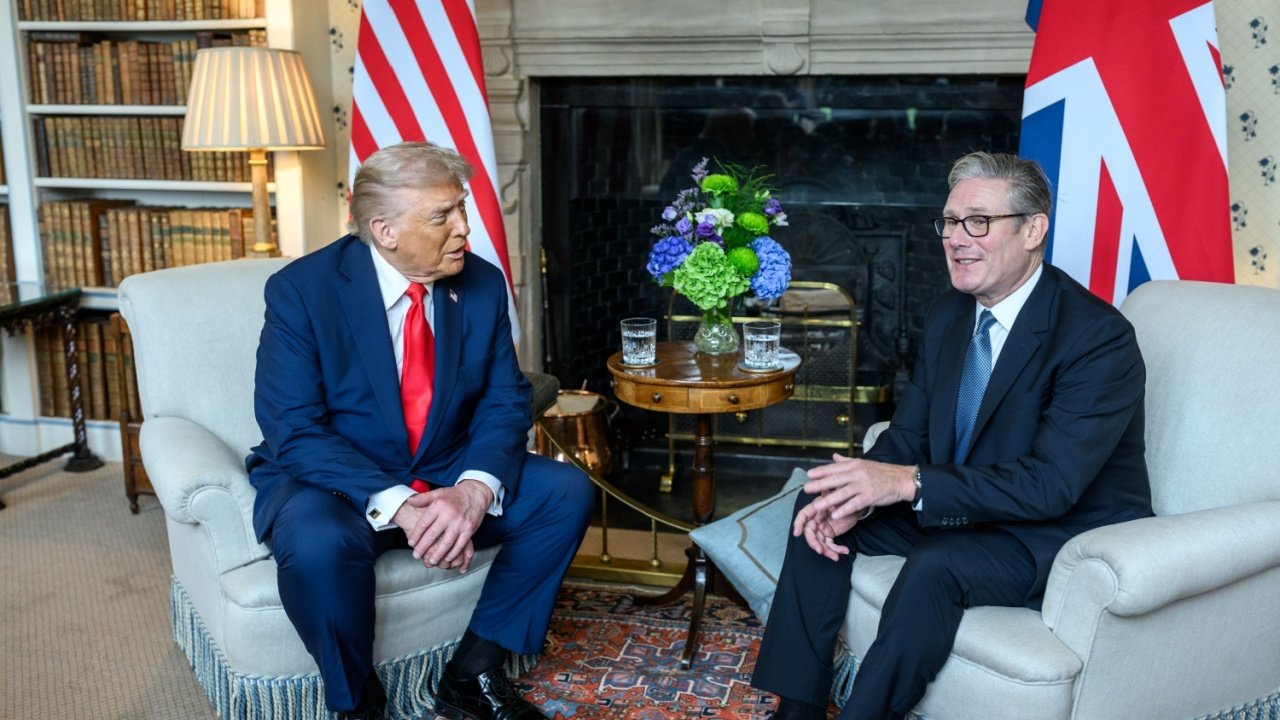
The Special Relationship is currently navigating one of its most turbulent eras in modern history. While King Charles III recently reaffirmed the bond before Congress, the Special Relationship faces internal sabotage from the UK Left and external pressure from the Trump administration. Understanding the Special Relationship requires looking past the pageantry to the deep-seated policy rifts regarding the Iran War. Today, the Special Relationship stands uniquely stressed by irreconcilable domestic interests.
The Historical Weight of the Special Relationship
Anglo-American relations are not only threatened by Donald Trump but also by the UK Left. As part of the celebration of America’s semiquincentennial, last week King Charles III delivered a jovial speech to Congress, in which he quoted many of America’s statesmen. After a citation of the famously anglophilic John F. Kennedy, the king declared to rapturous applause that the United Kingdom’s and the United States’ relationship is “more important today than it has ever been.”
The king’s speech to a joint session of Congress is the first by a British monarch since 1991. The state visit is a sign of goodwill and an expression by the United Kingdom of a certain overall satisfaction with the historic special relationship, solidified in both world wars by shared struggle. Contrary to common assumption, this alliance has not always been easy on either side. As the Iran war continues, this famous partnership between the former colony and motherland stands not simply forgotten, but instead uniquely stressed.
Cold War Fractures in the Special Relationship
In 1987, during a much less splendid diplomatic trip, the leader of the opposition and the Labour Party, Neil Kinnock, visited President Ronald Reagan’s White House. After their meeting had concluded, Press Secretary Marlin Fitzwater said that the Labour Party’s wish to denuclearize “would have a strong effect on NATO, on East-West relations, and would undercut our negotiating position in Geneva.”
One may wonder why Kinnock came to Washington to only bleed further on a pre-existing sore spot, or for what reason an avowed socialist would desire to associate with one of the most conservative administrations in decades. Certainly, Britain’s political elites do find something “special” in the “special relationship.” Enough political capital has been spent on it in the last 80 years. However, the stated interests and domestic politics of the United States and Britain become increasingly irreconcilable.
Labour Governments and the Special Relationship
The American relationship has been important and long-standing, but it has also imposed extreme political weight upon succeeding UK governments, particularly Labour ones. The United Kingdom’s support for the Korean War weakened the already shaky government of Prime Minister Clement Attlee.
Prime Minister Harold Wilson and President Lyndon Johnson clashed over the former’s refusal to join the Vietnam War. Prime Minister Tony Blair’s involvement in Iraq eventually undermined confidence in his leadership of the Labour Party. America aside, the Middle East has also been a treacherous region for Britain. Both Margaret Thatcher and David Cameron faced immense controversy over their actions in Libya, and the latter lost a vote in parliament on intervention in Syria, an unprecedented event.
These incidents, though, were minor compared to the 1973 Oil Embargo and the 1956 Suez Crisis, which helped bring down two prime ministers and led to economic slowdowns.
Starmer’s Defiance of the Special Relationship
With such a controversial history in the Middle East, Starmer’s hesitancy to involve the United Kingdom in America’s military campaign is inherently measured, even in the face of the Iranian drone strike on the UK military base on Cyprus in March. The prime minister’s foreign policy team is not a council of doves. In fact, Starmer’s national security advisor, Jonathan Powell, was Tony Blair’s chief of staff throughout the entirety of his premiership. While hard-nosed men occupy the positions of defense minister and national security advisor, the domestic front now belongs to the Left.
The beginning of this turn by Starmer was first signaled by a budget that comprehensively increased taxes. Whether it was the threat of a leadership challenge from Manchester’s mayor, Andy Burnham, or the Green Party’s victory in the Gorton and Denton by-election, the soft and hard left are both in a position to outflank the prime minister. The Iran War has forced Starmer to take a clear stand. He refused to join Donald Trump on his world-important military endeavor, although he authorized America to use two of its bases for defensive purposes.
European Realignment and the Special Relationship
Starmer announced, “This is not our war. We will not be drawn into the conflict: it is not in our national interest.” What is in Britain’s national interest, according to Starmer, requires “closer partnership with our allies in Europe.” He even took the moment to push his Energy Secretary, Ed Miliband’s controversial green energy agenda, calling it “the only way we get your bill off the roller coaster that is controlled by Putin and the Iranian regime.”
During the ceasefire, the prime minister spent his time visiting the Gulf states to “support and sustain support this ceasefire,” only to return home to President Trump’s threats to cancel a trade deal and withering parliamentary questions about his appointment of Peter Mandelson (a close associate of Jeffrey Epstein) as US ambassador. Whatever the headlines, Starmer’s future—if he has one—lies on the Left. The Labour Party’s most dangerous rival is the left-populist Green Party. Any future leader of the Labour Party will have less and less political interest in moving to the center, and certainly less interest in tacking toward President Trump.
The Uncertain Future of the Special Relationship
Historically, the UK Left has found reasons to work with the United States and Republican presidents, whether in NATO or counterterrorism. While the king praised the “special relationship,” he made sure to highlight Britain’s stated interests, from support for Ukraine to environmental protection. But the rationales will only carry weight if the United States is invested in them as well, and this can no longer be taken for granted.
What unfolds over the next few months may carry little long-term significance, and certainly no treaties are bound to be broken. However, if one political half of Britain sees no interest in collaboration or deference to the Americans, the future of this “special,” seemingly “permanent relationship” may begin to change.